


Listen: the breakdown
Market briefing: Flux shipped FluxOS v8.23.0 on Nov 6 with chain-tracked node moves and enforced CPU limits. BTC sat near $64,663, flat, with nothing in the tape to tie to the release.
- FluxOS v8.23.0 shipped Nov 6 with chain-tracked node moves and block-height IP holds
- CPU limits on components are now enforced, not merely requested
- BTC traded near $64,663, essentially flat, with no reaction to the release
FluxOS v8.23.0 landed on Nov 6 with chain-tracked node moves and enforced CPU limits, yet BTC barely moved near $64,663. So is this an infrastructure story or a price one?
Flux shipped FluxOS v8.23.0 on November 6. The decentralized cloud network pushed the node-software update out to operators across its infrastructure. For once, the changelog is the whole story, not a chart.
The headline change is how the network tracks node movement. Node moves now read from the chain's own record. IP-change holds get judged by block height, not a loose timer. Operators gain a cleaner, tamper-resistant way to confirm where a node lives and when it actually moved.
Then come the resource rules. CPU limits on components are now enforced, not merely requested. That distinction carries weight. A requested limit is a polite suggestion. An enforced limit is a wall. App volumes also receive more direct handling under the new build.
None of this moved the market, and we will not pretend otherwise. BTC sat near $64,663 as the release landed, up a rounding error on the day. No volatility spike. No sentiment surge. No flows to trace back to a node update.
That honesty matters more than a forced narrative. Infrastructure releases rarely trade. They compound quietly, improving reliability for the people who run the network, long before any price chart ever notices or cares.
So treat this as plumbing, upgraded. Useful plumbing, done well, but plumbing. The people who need these changes already know exactly why they matter.
Why enforced limits beat polite requests
The real shift here is enforcement, and enforcement changes behaviour. A requested CPU limit relies on good faith. One greedy component can then starve its neighbours on the same node. An enforced limit removes that failure mode outright. For a shared, decentralized compute network, noisy-neighbour risk is a daily reliability problem, not a theoretical one.
Chain-tracked node moves address a different weakness: trust. When the chain's own record shows where a node sits, operators stop arguing over self-reported state. Block-height-gated IP holds add the same rigour to timing. Height is harder to fake than a clock.
Now the honest part. This is not a macro event. There is no rate decision, no ETF flow, no supply shock hiding in a node changelog. The transmission chain from this update to BTC liquidity is effectively empty, and we see no evidence to invent one.
What it does touch is utility. A network that runs more predictably is easier to build on and cheaper to trust. That value accrues slowly, through retention and uptime, not through a single green candle.
Structurally, that is the point worth holding. Markets price catalysts. Networks are built on releases like this one. The two timelines rarely overlap on the same day, and today they clearly did not.
Why the tape ignored this release entirely
Start with the obvious: there was no cascade to report. BTC traded near $64,663 as the update shipped, up roughly a tenth of a percent on the day. The one-hour move was a shrug. Nothing in the gathered evidence ties a node release to that flat tape.
So the usual chain does not fire here. Normally a driver hits macro, macro hits liquidity, and liquidity rolls down from BTC into ETH and then the longer tail of alts. This story never enters that pipeline. It is a technical release inside one network's own infrastructure.
ETH showed no mechanism to respond either. There is no cross-asset read, no rotation, no liquidity being freed or trapped by a FluxOS changelog. Pretending otherwise would be the kind of narrative that gets written and then quietly deleted.
The broader altcoin complex is equally untouched by this specific event. Alts move on liquidity conditions and risk appetite set far above a single node update. Those conditions did not change on November 6 because of this release.
That is the neutral read, stated plainly. No inflow, no outflow, no distribution, no accumulation signal hangs on this news by itself. The market simply had bigger things on its mind. An infrastructure upgrade that improves reliability is good for the people running nodes. It is not, on its own facts, a trading event.
What adoption, not candles, would confirm
Watch the network, not the ticker, for whatever this release is worth. The confirmation here is operational, not price-based. Does node reliability improve under enforced CPU limits? Do fewer components misbehave on shared hardware? Those are the metrics that tell you the update did its job.
Node operator behaviour is the first signal. Chain-tracked moves and block-height IP holds only matter if operators lean on them. Smoother enforcement should reduce disputes and support retention over weeks, not hours. That is slow evidence, and slow evidence is the honest kind.
Deployment activity is the second thread worth following. The wider toolchain already lets users deploy apps straight from a repository, auto-detect the framework, and push updates across nearby nodes. A more predictable runtime underneath that flow makes building on it less painful. Usage, not announcements, confirms it.
Now the invalidation, which here means something simple. If you came looking for a trade, there is nothing to invalidate, because there was never a setup. No level broke. No divergence formed. No positioning shifted on this news.
So the thing to watch is whether the market ever gives this story a reason to matter. Today it did not. Infrastructure that works tends to disappear from the conversation, which is usually the highest compliment a release like this can earn.
Why this release means nothing for BTC levels
The ParadiseTeam view on this one is short, because the facts are. A node-software update does not touch the levels that actually matter right now, and we will not dress it up as though it does.
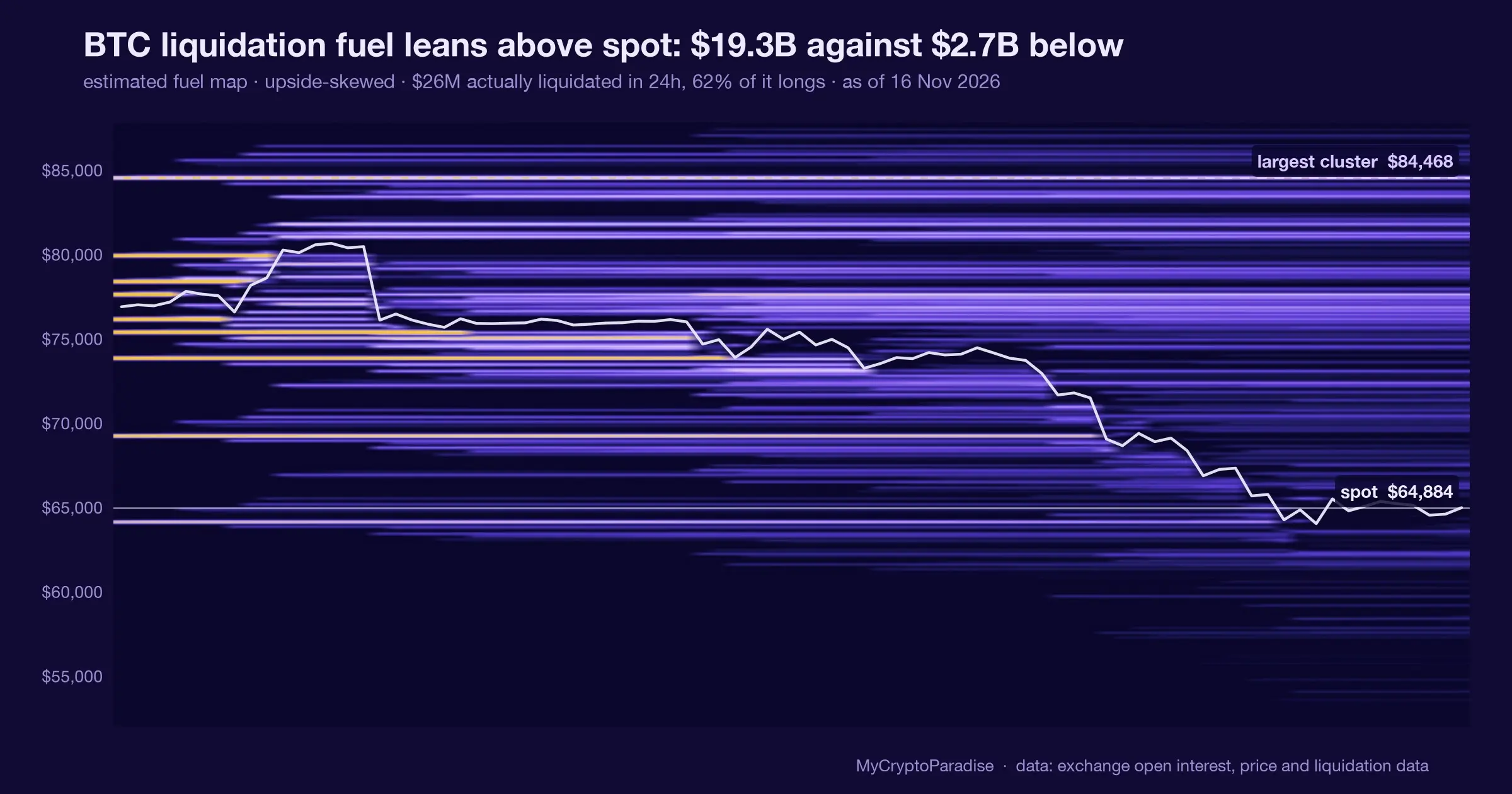
Here is the backdrop we hold. BTC was trading near $64,663 as the release landed, sitting right on the $64,000 support we flagged as the next zone after $69,000 gave way with no reaction. The weekly trend stays heavy. Below us sits the $55,000 to $44,000 exchange-of-hands zone, a target we have carried for a long time.
Nothing in FluxOS v8.23.0 changes any of those numbers. This release does not add bids at $64,000 or remove sellers below it. It is simply the wrong kind of event to move that map.
What we keep watching is unchanged by it. Funding still reads crowded-long into a falling price, which we find telling. Whales slowed their aggressive selling near support, an early hint of slow re-accumulation, not yet a confirmed bottom. The current drop still looks liquidation-driven, retail catching the knife rather than smart money distributing.
So the discipline stays the same. We want funding to reset toward zero or negative, and we want price to confirm inside that $44K to $64K band. Until then, an infrastructure release is just that. Good for node operators. Irrelevant to the trade.
The read behind this: we framed this story through our own market analysis, Bitcoin Crash to $44K or Bounce First?
Track it live: our live crypto funding rates and the Crypto Fear and Greed Index both update in real time, so you can watch this shift for yourself.
Related coverage
For exact entries, targets, and stop losses with full risk management, that is what ParadiseFamilyVIP is for. New to reading these moves? Start with our crypto trading strategies guide.
ParadiseTeam is monitoring the market situation closely, and we are taking these developments into consideration while building our trading tactics inside ParadiseFamilyVIP.
Crypto trading involves substantial risk. Prices are volatile and you can lose money. This article is educational and is not financial advice. Past performance does not guarantee future results.
Will enforced CPU limits meaningfully improve Flux node reliability?
How 1 Paradiser is calling it
The first call is still open
Free account, no password. Members just sign in.












Join the discussion
No comments yet. Members, share how you are reading this.