


Listen: the breakdown
Unconfirmed: This is an early, unverified report that has not been confirmed and may not be accurate. We are tracking it and will update or correct it as facts emerge.
Market briefing: A prediction market has reportedly won a path to list S&P 500 perpetual futures in the US, borrowing crypto's own instrument. BTC sat near $86,011 as of the print, with no measurable reaction either way.
- Kalshi reportedly cleared to list S&P 500 perpetual futures, the instrument crypto pioneered
- The platform already holds a CFTC Designated Contract Market license, the same status legacy exchanges use
- No independent corroboration of the approval yet; BTC and ETH stayed flat, signalling no real-money reaction
A prediction market has reportedly won a path to run S&P 500 perpetual futures, the exact instrument crypto invented. So why are BTC and ETH barely moving on it?
A prediction market has reportedly cleared a regulatory path to launch S&P 500 perpetual futures in the United States. The approval, attributed to the Commodity Futures Trading Commission (CFTC), would put Kalshi into direct competition with established derivatives exchanges. For a platform best known for event contracts, index perpetuals are a sizeable step up the ladder.
The irony writes itself. A perpetual future is the product crypto invented and perfected, and now traditional finance wants to run it on stocks, under crypto's own name.
This is not a company arriving from nowhere. Kalshi already holds a CFTC Designated Contract Market (DCM) license, the same regulatory status that legacy derivatives exchanges operate under. So the structure for listing a futures product is already in place. What would change is the asset wrapped inside it.
The timing matters more than the headline. The CFTC has separately sent draft prediction-market rules to the White House for review, rules that would broaden the definition of a swap to pull event contracts under tighter oversight. Regulators are tidying the rulebook and widening the product set at the same time.
There is a crypto-native echo here too. Back in August, a perpetuals-focused crypto platform formally asked US regulators to create a legitimate path for equity perpetuals to trade onshore.
One caveat we will not bury: the specific approval claim is not independently confirmed in what we can verify. Treat it as plausible, not settled.
Regulatory convergence pulls perpetuals onshore
The real story is convergence, not a crypto liquidity event. US regulators are steering the perpetual-futures wrapper toward mainstream, regulated status. That slowly legitimizes an instrument that spent years labelled as offshore and risky.
Traditional finance borrowing crypto's design is a quiet validation of the category. Perpetual futures have no expiry and track spot through a funding mechanism. When a CFTC-licensed platform lists them on the S&P 500, the structure stops being exotic and starts being plumbing.
The parallel threads make the trend clearer. On one side, draft rules would widen what counts as a swap and tighten how event contracts are overseen. On the other, a crypto-native platform is lobbying for equity perpetuals to trade onshore. Both point the same way: regulated perpetuals as an accepted product class.
This is structural, not a catalyst. It is the backdrop shifting, not the tide turning.
For crypto traders, the second-order read is what counts. If US rails for perpetuals keep opening, the long-term case for regulated crypto derivatives strengthens alongside them. More regulated capacity can mean deeper liquidity and narrower spreads over time.
But none of that is today's trade. There is no funding shift, no flow swing, no transmission into BTC or ETH visible in current prices. This is a signpost about where regulated derivatives are heading, worth filing, not a reason to reposition this afternoon.
Flat tape says crypto shrugged it off
The cleanest signal here is the one in the price: almost nothing. BTC traded near $86,011, up about 0.9 percent on the day, while ETH held around $2,718, up roughly 0.6 percent. That is noise, not a reaction.
Start with BTC, the market's liquidity anchor. A regulated index-futures listing on a prediction market changes no part of Bitcoin's supply, demand, or funding. There is no new buyer and no forced seller, so the tape barely twitched.
ETH tells the same story. Ethereum often amplifies BTC moves when a derivatives narrative catches, yet here there is no move to amplify. A near-flat ETH confirms traders are not pricing this as a flow event.
Alts are even further from the impact. Smaller tokens live on BTC and ETH liquidity. With the majors still, there is no cascade to pass down the risk curve.
So who benefits and who is trapped? On this news, essentially no one on either side. There is no evidence of distribution into strength and none of fresh accumulation on fear. Real money is simply not reacting.
That absence is the point. When a loud headline lands and liquidity does not move, the market is telling you the story sits in the structural file, not the trading file. The legitimization is genuine and slow. The price impact today is close to zero, and pretending otherwise would be the real mistake.
Confirmation of the approval comes first
The first thing to watch is whether the approval is real as stated. Our verified facts do not independently corroborate it, so confirmation from an official channel is the gate everything else sits behind.
If confirmed, the next marker is product, not price. Watch for an actual listing date, contract specs, and the funding mechanism Kalshi applies to an index perpetual. Specs turn a headline into a tradable instrument.
The broader rulebook is the second thread. The draft prediction-market rules under White House review would reshape how event contracts and swap-like products are supervised. That outcome matters more to this platform's long-term path than any single launch.
Watch the crypto-native angle too. If regulators open a formal lane for equity perpetuals onshore, the push from the crypto side for the same treatment gains weight. Parallel approvals would confirm a trend, not a one-off.
What would invalidate the significance? Simple: the approval failing to materialize, or arriving so hedged that the product never reaches real volume. A press line without a live contract is a forecast, and forecasts in this industry are confident far more often than they are correct.
For BTC and ETH specifically, the confirmation that matters is liquidity. If funding, open interest (OI, the total of open derivative positions), or spot flows ever shift because of this, that is the moment it stops being a filing-cabinet story. Until then, it stays background.
A category signal, not a crypto catalyst
The ParadiseTeam files this under category legitimization, not a reason to move size. With BTC near $86,011 as of the print, nothing in this headline changes the levels that actually matter for crypto this week.
Those levels sit elsewhere. Support stands around $82,000, where moving-average and Fibonacci confluence line up. Resistance runs through the $88,000 to $90,000 band. This news touches none of them, because it is an off-crypto index product.
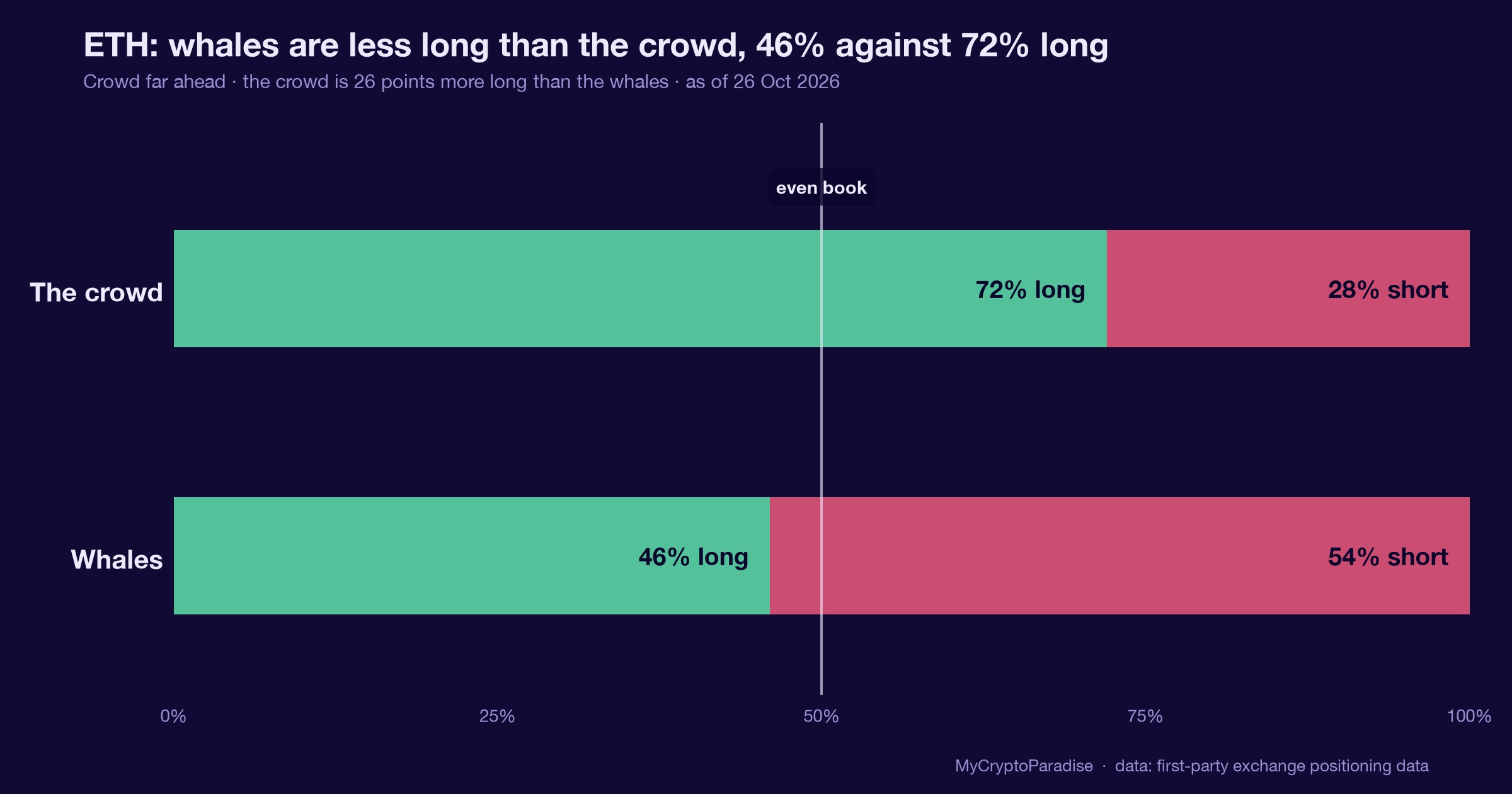
Our standing read is unchanged by it. Whales have been net sellers, roughly 65 percent against 35 percent buying, yet that selling is being absorbed at support while retail stays fearful. That tension, not a prediction-market listing, is what sets up a possible short-term bounce.
Keep the caution intact. A bounce into $88,000 to $90,000 is where we expect sellers to lean, and a rejection there keeps the macro risk pointed lower toward the $55,000 to $44,000 zone. So how should a trader hold this story? As information, not instruction. It tells you regulated perpetuals are maturing, which is structurally constructive for the derivatives category over quarters, not hours.
The discipline is to not manufacture a catalyst from a flat tape. When price refuses to react, respect the refusal. The ParadiseTeam keeps watching volume and cumulative volume delta (CVD, net buy versus sell pressure) at resistance for the real signal, and leaves this one in the structural file where it belongs.
The read behind this: we framed this story through our own market analysis, Can Bitcoin Bounce From Support?
Track it live: our live crypto funding rates and the Crypto Fear and Greed Index both update in real time, so you can watch this shift for yourself.
Related coverage
For exact entries, targets, and stop losses with full risk management, that is what ParadiseFamilyVIP is for. New to reading these moves? Start with our crypto trading strategies guide.
ParadiseTeam is monitoring the market situation closely, and we are taking these developments into consideration while building our trading tactics inside ParadiseFamilyVIP.
Crypto trading involves substantial risk. Prices are volatile and you can lose money. This article is educational and is not financial advice. Past performance does not guarantee future results.
Will regulated equity perpetuals pull real volume away from crypto exchanges?
How 29 Paradisers are calling it
The first call is still open
Free account, no password. Members just sign in.
Follow this topic: Crypto regulation news









Join the discussion 8
definitely curious to see how the liquidity develops here, given how much volatility fed my family for years, it's always good to see new venues open up for it! 📈
a perp structure on indices? this just reminds me of those "synthetic" trades in 2021 that had no liquidity to close if you were on the wrong side. 🤣 Always reconcile your exit strategy first!
I'm a bit confused, sorry if this is obvious, but does this mean those futures are like... backed by actual S&P shares? Or is it more like those synthetic ones Chinedu mentioned? 🙏
so is this a cash-settled thing or do they have physical delivery for spx futures
Yeah, I was wondering the same. Cash-settled has to be the play here, anything else would just be a logistical nightmare for indices 😬.
this is interesting, seeing the perp structure move beyond crypto is actually something I've been hoping for, opens up a lot of basis opportunities if liquidity develops.
The expansion of perp structures to traditional indices is a logical next step, though the market reaction for BTC/ETH seems muted. I confess a certain quiet satisfaction seeing this kind of data evolve.
I see it differently, Jonas. A novel product expanding beyond a liquid core isn't always "logical" when you consider the existing derivatives and the potential for fragmentation of interest.