


Listen: the breakdown
Developing story update (September 25, 2026, 11:21 UTC):
Update: BTC has now briefly pushed back above the $85K production-cost level, a line it spent roughly 280 days beneath. Based on our sources, reclaiming that level tends to ease pressure on miners, which slightly firms the case that the $85K zone is an economic floor and not just a psychological one.
The macro backdrop got heavier at the same time: long-term Treasury yields have jumped above 5%. Higher yields typically weigh on risk assets and help explain why BTC keeps getting turned back at the $87K resistance. For the PERPS+ ‘Get Paid to Hold’ trade this is the exact grind-not-sprint regime the setup was built for: if BTC holds above $85K without clearing the cap, you likely keep the perp gains plus the premium; a stall or slip is where the upfront premium can offset part of the funding or loss.
What to watch now: Whether BTC can hold above the $85K production-cost level while Treasury yields stay above 5%.
Developing story update (September 25, 2026, 10:59 UTC):
Update: US spot Bitcoin ETFs pulled in roughly $324.6 million of net inflows last Friday, based on our sources. That is fresh demand landing while price keeps stalling in the same $85k to $87k band, so the buying is being absorbed rather than pushing a clean breakout.
For the trade in this piece, that context leans supportive of the cap-and-collect structure: steady inflows argue against an imminent collapse, while the repeated rejection at $87k argues against another vertical sprint. Grinding higher into the cap is exactly the path where you keep the perp gains plus the premium. A rip clean through $87k remains the scenario where the capped upside costs you, and liquidation risk still applies.
What to watch now: Whether continued ETF inflows can finally push a daily close above $87k, or get absorbed at resistance again.
Developing story update (September 25, 2026, 09:55 UTC):
Since we published, BTC has stayed capped below $85,000 but dipped deeper, sweeping a low near $82,870 before reclaiming the $83,500 to $84,000 support band. The structure is unchanged: rejection at $87,000, no sustained break of the production-cost level, and price still probing for support rather than trending.
Two new inputs matter for the trade. Treasury yields have pushed above 5%, a macro headwind that tends to pressure risk assets and raises the odds this stays corrective rather than igniting a fresh sprint. At the same time, U.S. spot Bitcoin ETFs logged roughly $324.6 million of net inflows last Friday, so institutional demand has not disappeared even as price stalls.
For the PERPS+ view this reinforces the original read. If BTC keeps grinding sideways to modestly higher under the cap, the collected premium can cushion funding and offset part of a stall or drawdown. A clean reclaim of $85,500 remains the level that would question the corrective case. (Liquidation risk remains.)
What to watch now: Whether BTC can reclaim $85,500 against rising yields, or slips back toward the $82,870 sweep low.
Developing story update (September 25, 2026, 08:51 UTC):
Update: the backdrop has shifted slightly against BTC. Soaring U.S. long-term yields are pressuring sentiment across risk assets, which helps explain why price keeps stalling near the $85k production-cost line rather than breaking out. BTC is holding around $84.3k, still capped under the $87k level that has rejected it twice in a week.
On the demand side, U.S. spot Bitcoin ETFs took in roughly $324.6 million of net inflows last Friday, and the wider crypto market has shown early signs of recovery. That is a real bid, but so far it has not been enough to force a clean close back above $85,500, the level that separates a corrective bounce from a genuine trend turn.
For the PERPS+ trade this changes little: as long as BTC grinds inside the range without ripping past your cap, collecting premium upfront while staying long still improves the trade-off. The risk to watch is the same as before, a sharp move above the cap where you give up the extra upside, plus liquidation risk on the perp.
What to watch now: A daily close back above $85,500 (trend turn) versus rejection there with yields still climbing (deeper corrective leg).
Developing story update (September 25, 2026, 07:48 UTC):
Update: The picture around $85,000 has not changed. $BTC was still turned back near $87,000, still trades below the $85,000 production-cost line, and sits near $83.9k as we write. That keeps the PERPS+ logic intact: if price grinds without clearing the cap, you keep the perp move plus the premium; if it stalls, the premium can cushion part of the funding or loss.
The one new data point worth flagging, based on our sources, is that U.S. spot Bitcoin ETF net inflows ran near $324.6 million on the most recent Friday. That is supportive demand, but on its own it has not been enough to force a clean break through $87,000, which is why we still lean toward more upside probability without another sprint rather than an imminent breakout.
What to watch now: Whether continued ETF inflows finally push $BTC through the $87,000 rejection zone, or price keeps failing there and drifts back under $85,000.
Developing story update (September 25, 2026, 07:04 UTC):
Update: The slip below $85k now has a clearer macro driver behind it. Soaring U.S. long-term yields have knocked sentiment across risk assets, and those yields remain elevated, which historically is not a supportive backdrop for BTC. That context matters for the PERPS+ trade: if yields keep the lid on, a grind rather than a sprint becomes more probable, which is exactly the regime where collecting premium upfront and staying long can work in your favour.
On the demand side, U.S. spot BTC ETF net inflows came back to roughly $324.6 million last Friday, based on our sources. Steady institutional bid into a yield-pressured tape can slow the downside without necessarily fuelling a fresh breakout, again favouring a capped-upside, premium-collecting structure over a naked long. (Liquidation risk remains.)
What to watch now: Whether U.S. long-term yields ease off; a pullback there would give BTC room to retest $87k, while persistently high yields likely keep it capped.
Developing story update (September 25, 2026, 05:38 UTC):
Update: The demand side is still there under the surface. U.S. spot Bitcoin ETF net inflows returned to roughly $324.6 million last Friday, based on our sources, which tells you institutional buyers kept adding into the dip rather than stepping away.
On the chart, $87,000 has now rejected price for the second time in a week, and $84,000 is being tested as support. That keeps the range intact and reinforces the setup: no clean breakout yet, so the cap on a capped-upside ‘Get Paid to Hold’ entry is unlikely to be threatened while $87k holds as resistance. If $84k gives way, funding and premium math matter more, not less.
What to watch now: Whether $84,000 support holds or $87,000 finally breaks; and if ETF inflows keep building through the week.
Developing story update (September 25, 2026, 04:55 UTC):
Update: the picture around that $85,000 line has more weight than a single test suggests. Based on our sources, Bitcoin has now spent roughly 280 days below the $85,000 production-cost level and has only briefly reclaimed it during this run. That makes the current push back above and the fast slip under it a meaningful battle over a cost floor, not just another round number.
The macro backdrop has also tightened. High U.S. long-term yields are creating a less friendly environment for risk assets, which adds pressure on top of the technical rejection at $87,000. For the PERPS+ trade this cuts both ways: a heavier tape raises the odds the price stalls or dips, where the upfront premium can offset part of the funding or loss, while a clean reclaim of the production-cost level would be the scenario where staying long plus the premium pays. (Liquidation risk remains.)
What to watch now: Whether BTC can hold above the $85,000 production-cost level or slips back under it as yields stay high.
Developing story update (September 25, 2026, 03:31 UTC):
Update: the pressure on Bitcoin now has a clear macro driver behind it. Rising U.S. yields are weighing on sentiment across risk assets, and that headwind is a large part of why the rally keeps stalling rather than any single crypto-specific catalyst.
For the trade, the picture is unchanged but firmer: BTC briefly poked above $85,000 and could not hold it, and it currently sits below $85,500 while retesting $84,000 as support. The $87,000 rejection stands, so the cap on ‘Get Paid to Hold’ is likely to keep sitting above spot rather than getting run through. If yields stay elevated, a grind or slip is the higher-probability path, which favours the premium-plus-perp side of the trade over betting on another sprint.
What to watch now: Watch U.S. yields and whether BTC can reclaim and hold $85,500; failure keeps $84,000 support in play.
Developing story update (September 25, 2026, 02:49 UTC):
Update: US spot Bitcoin ETFs took in roughly $324.6 million net last Friday, so fresh institutional demand is still arriving. Even so, price has not been able to hold above $85k and sits near $84.3k, with $87k rejected again inside the same week.
For the trade, that mix matters. Inflows landing while price still fails at resistance is the kind of tape where a plain long stays exposed to chop, while the PERPS+ premium keeps paying you to hold through the grind. High long-term yields remain a background drag on risk appetite, so a slow, capped move stays the more probable path than a clean sprint. (Liquidation risk remains.)
What to watch now: Whether continued ETF inflows can finally push a daily close back above $85k, or keep getting absorbed as exit liquidity.
Developing story update (September 25, 2026, 01:47 UTC):
Update: The $87,000 area has now rejected Bitcoin for the second time in a week, after a local high of $87,397 on Monday, September 21. Price has since slipped back under $85,000, which keeps the double-rejection ceiling firmly in play for anyone still holding the long side of this trade.
Flows have not confirmed the breakout. U.S. spot Bitcoin ETFs took in roughly $324.6 million last Friday, yet that demand was not enough to hold gains above $85,000. When inflows arrive and price still fails at resistance, it more often points to supply being distributed into strength than to a clean continuation higher.
For traders running the PERPS+ ‘Get Paid to Hold’ structure, this matters at the cap. With $85,000 now acting as a production-cost pivot (based on our sources, Bitcoin sat below it for 280 days before this move) and $87,000 capping the upside, a range grind between those levels is the scenario where collecting premium tends to earn its keep. A decisive reclaim of $87,000 is what would reopen the case for real upside beyond the cap.
What to watch now: Whether BTC can reclaim and hold above $87,000 on a third attempt, or loses $85,000 as support.
Market briefing: Bitcoin trades near $84,600 after fading from $86,000, and yield-bearing 'get paid to hold' perps are drawing bulls right under resistance. We read the appetite as distribution into retail greed, not a fresh upside signal.
- 'Get paid to hold' perps let bulls collect premium, but the downside on the long stays fully intact.
- BTC near $84,600 sits pinned under $88,000 resistance while sentiment reads extreme greed.
- We treat heavy retail appetite for these products as smart money distribution, favoring caution over new longs.
'Get paid to hold' Bitcoin perps are being pitched to bulls right as BTC stalls near $84,600 under resistance. Reward for patience, or a quiet exit sign?
A new twist on perpetual futures is spreading fast. Products branded 'get paid to hold' now let long-term Bitcoin bulls collect premium while they sit in a position. The pitch from Aevo's PERPS+ is neat. You still believe BTC has upside, just not another sprint, so you earn yield instead of leaving a plain long flat.
The timing is the interesting part. BTC ran from roughly $81,000 to past $86,000, then slipped back below $85,000. It trades near $84,600 now, barely moved on the day. So the price is calm, but the marketing is loud. That gap matters.
When a product exists to pay people for holding, demand to hold is usually already crowded. Retail wants to stay long without the whiplash of chasing green candles. A yield sweetener makes that patience feel productive, and it keeps people in the trade a little longer than they otherwise would.
We read this through one lens. Smart money is distributing into persistent retail greed, and 'get paid to hold' is a symptom of that greed, not a cure for it. A product that pays you to keep believing is rarely launched near a bottom.
None of this is a confirmed same-day catalyst. The 24-hour move is under half a percent. This is our interpretation of the tape, not a single event we can point to.
The structural takeaway is simple. Yield on a long does not remove the downside. It just changes how the entry feels while the risk stays exactly where it was.
Why yield sweeteners cluster near tops
The mechanism here is emotional, not mechanical. 'Get paid to hold' does not change Bitcoin's supply or demand. It changes how a crowded long feels, and that is enough to keep retail positioned exactly where smart money needs them.
Think about who benefits from more people holding longs. Anyone who wants to sell size needs buyers on the other side. Persistent, confident retail demand is that liquidity, and a product that rewards patience deepens the pool of willing holders.
Our macro lens stays bearish. We expect a real correction and a capitulation phase before a durable bull market can form. Price is grinding higher on a weekly view while smart money quietly hands inventory to an eager crowd.
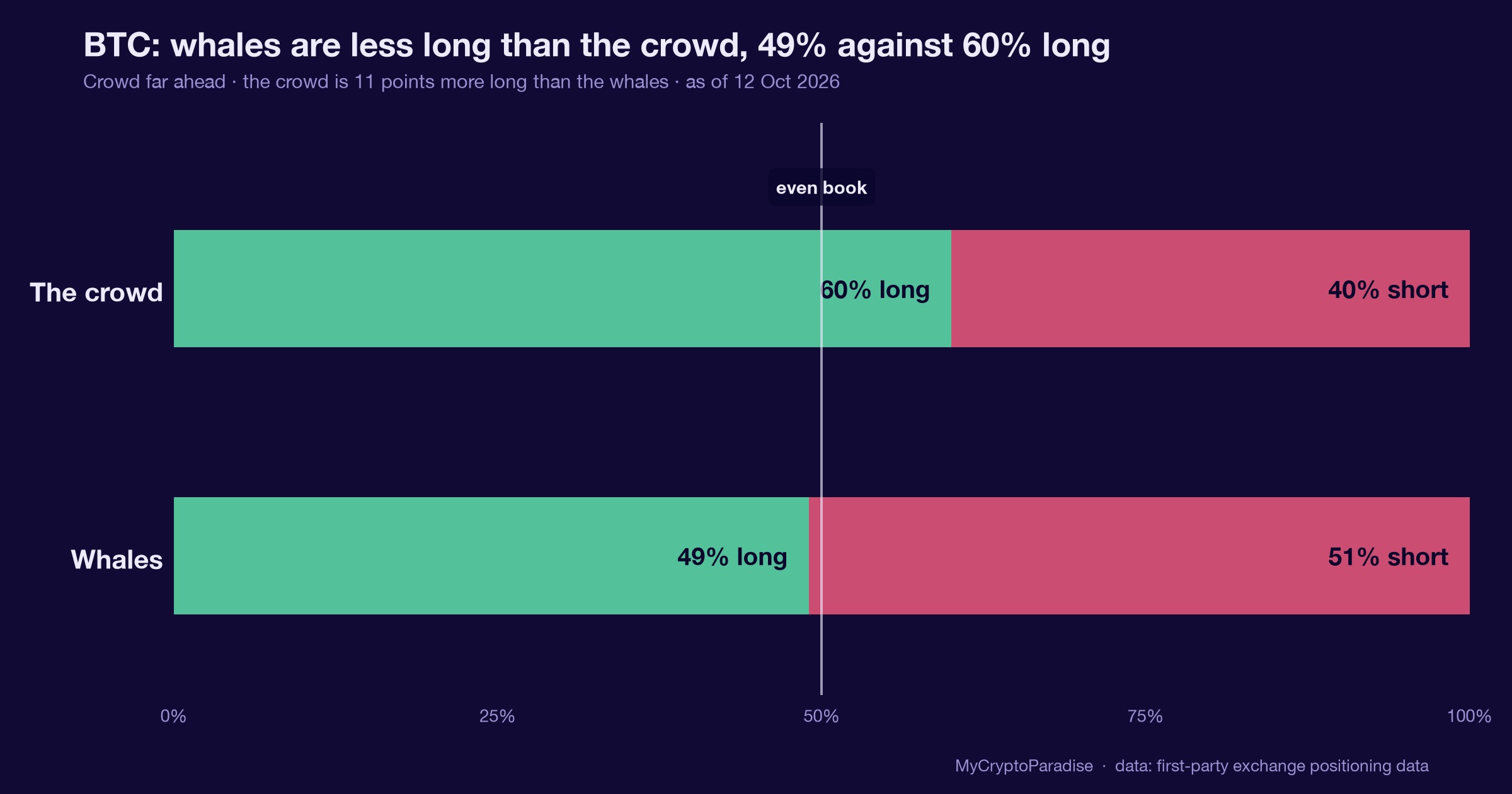
That divergence is the whole story. Sentiment sits in extreme greed, positioning is heavily long, and everyone has a reason to stay in. History says that is when the exit gets narrow.
The 'paid to hold' framing also softens risk perception. A premium arriving each day feels like progress. It quietly reframes a leveraged directional bet as an income stream, which is a very old trick in a very new wrapper.
For traders, the point is not that the product is bad. It is that widespread appetite for it tells you the crowd is leaning one way. When the crowd leans hard near resistance, the tape usually punishes the last ones in.
Where thin liquidity sits under 88K
Start with Bitcoin, because everything downstream keys off it. BTC sits near $84,600, just under the $88,000 resistance we care about. Open interest, or OI, the total value of live futures contracts, tends to build as these hold-and-earn products draw fresh longs.
Rising OI into resistance is not strength. It is fuel. It marks where stops sit and where a flush can cascade.
If BTC rejects $88,000, the first leg lower hunts the longs stacked just beneath price. Leverage that felt safe while collecting premium becomes forced selling once liquidation prices are tagged. Yield does not stop a margin call.
Ethereum usually amplifies the move. ETH carries more speculative leverage per dollar than BTC, so a Bitcoin slip tends to hit ETH harder on the way down. When BTC sneezes, ETH has a habit of catching the heavier cold.
Alts sit at the end of the whip. They rally last and bleed first. A modest BTC drop can erase weeks of altcoin gains in a session, because their liquidity is thin and their holders are the most emotional.
The chain is clean. Crowded 'paid to hold' longs, into resistance, with stops beneath, hand smart money the exact liquidity it needs to distribute. If that pressure resolves down, BTC leads, ETH exaggerates, and alts take the deepest cut before any real reaccumulation begins.
The 88K line that settles the read
One level decides the near-term read: $88,000. A clean reclaim and hold above it puts real upside probability back on the table. Until that happens, the grind under resistance favors the distributors.
Watch how price behaves on the approach. A push to $88,000 on falling volume and a bearish divergence would tell us buyers are exhausted, not dominant. That is distribution, not breakout.
Above $88,000, the next resistance sits at $99,000. Reclaiming both would force us to respect more upside than our base case allows. We hold views loosely and let price referee.
To the downside, $67,000 is the liquidation zone we track. Losing the current range and accepting below it would open the path toward our deeper capitulation band. Structure, not headlines, confirms that shift.
Our defined exchange-of-hands zone remains $44,000 to $55,000. That is where we expect real fear and where smart money likely reaccumulates aggressively. It is not a call for a straight line there, only the area our weekly work points to.
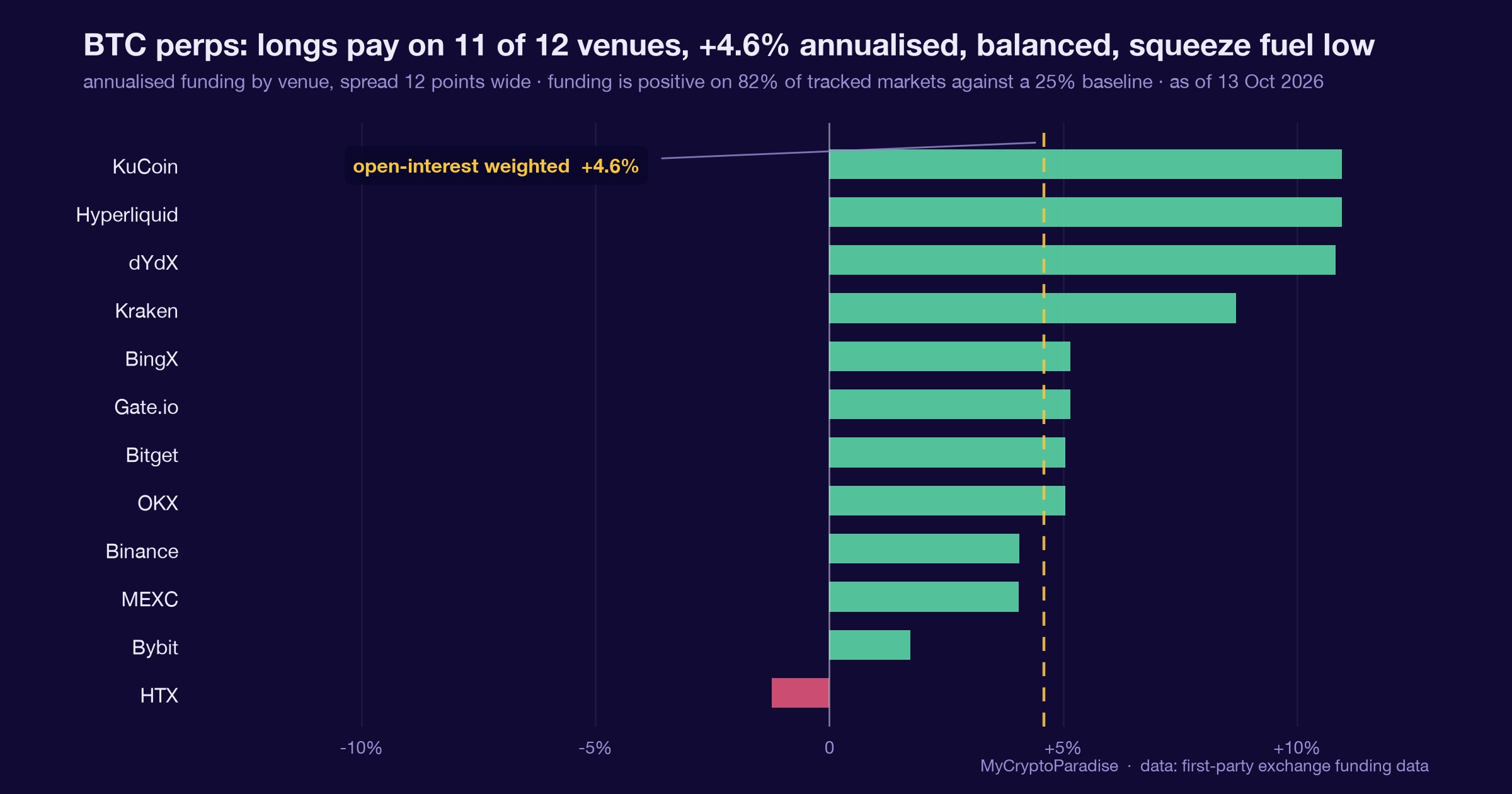
Funding and OI are the tells. If funding stays hot and OI keeps climbing while price stalls, the crowd is getting more committed as risk rises. That combination usually precedes a shakeout.
So the map is simple. Reclaim $88,000 to argue upside. Reject it with tired momentum, and the distribution read strengthens.
Reading persistent greed under 88K
The ParadiseTeam reads this product wave as a greed signal, not a green light. Bitcoin near $84,600, pinned under $88,000, with a crowd eager to be paid for staying long, fits our distribution thesis cleanly.
If you already hold longs from lower, this is a moment to protect them, not press them. Consider moving your SL, or stop-loss, the price where you exit to cap a loss, up toward breakeven or into profit. Taking partial TP, or take-profit, the level where you bank gains, near resistance is reasonable risk management.
We are not opening fresh aggressive longs here. Chasing into $88,000 while the crowd piles in offers poor risk-to-reward, or R:R, the ratio of what you risk against what you aim to gain. The upside room is thin, the downside room is not.
A yield tag on a long does not improve that math. It just makes a bad entry feel comfortable, which is precisely the problem.
The higher-probability opportunity, in our read, is patience. We want confirmation, either a rejection at $88,000 with weakening momentum, or a clean reclaim that changes the picture entirely.
If price rejects and structure breaks, the crowd that got paid to hold becomes the fuel for the move down. That is when the distribution thesis pays, and when discipline beats conviction. None of this is a promise, only where the probabilities lean.
The read behind this: we framed this story through our own market analysis, Can Bitcoin Reach a New High at $169K?
Track it live: our live crypto funding rates and the Crypto Fear and Greed Index both update in real time, so you can watch this shift for yourself.
Related coverage
For exact entries, targets, and stop losses with full risk management, that is what ParadiseFamilyVIP is for. New to reading these moves? Start with our crypto trading strategies guide.
ParadiseTeam is monitoring the market situation closely, and we are taking these developments into consideration while building our trading tactics inside ParadiseFamilyVIP.
Crypto trading involves substantial risk. Prices are volatile and you can lose money. This article is educational and is not financial advice. Past performance does not guarantee future results.
Does BTC reclaim $88,000 before it revisits $67,000?
This is how 18 Paradisers are calling it. Tap your call.
No calls on this one yet. Tap yours to be the first.
Free account, no password. Members just sign in.
Follow this topic: Crypto regulation news






Join the discussion 8
that "get paid to hold" thing 🤔 I wonder if its just big wallets trying to bait people in before a dump 🐳📉 it never feels quite right to me.
man, the "get paid to hold" thing always gets me chopped up. 😂 feels like a trap for us speed demons, right?! just too tempting to sit there.
I monitor funding rates for sustained anomalies across multiple exchanges. Persistent negative funding often precedes volatility, which is where the risk of being exit liquidity grows.
yeah I track funding too but also perpetual futures open interest, its another good sign of leveraged positions building up. 📈
yeah the "get paid to hold" narrative certainly pops up, its fascinating to track the actual basis and what that implies for perp-versus-spot on different venues. brings me back to 2019 when i first started diving in.
i look at the funding rate history for a while not just right now, shows you who holds the bag when it flips bad.
i always cross-check these "get paid to hold" claims by looking at open interest and funding rates on-chain. its a good way to see whats actually happening.
hahaha "get paid to hold" 🤣 sure, reminds me of some stablecoins I bought once... I'm a bit more careful with that kind of bait now! 🎣📉