

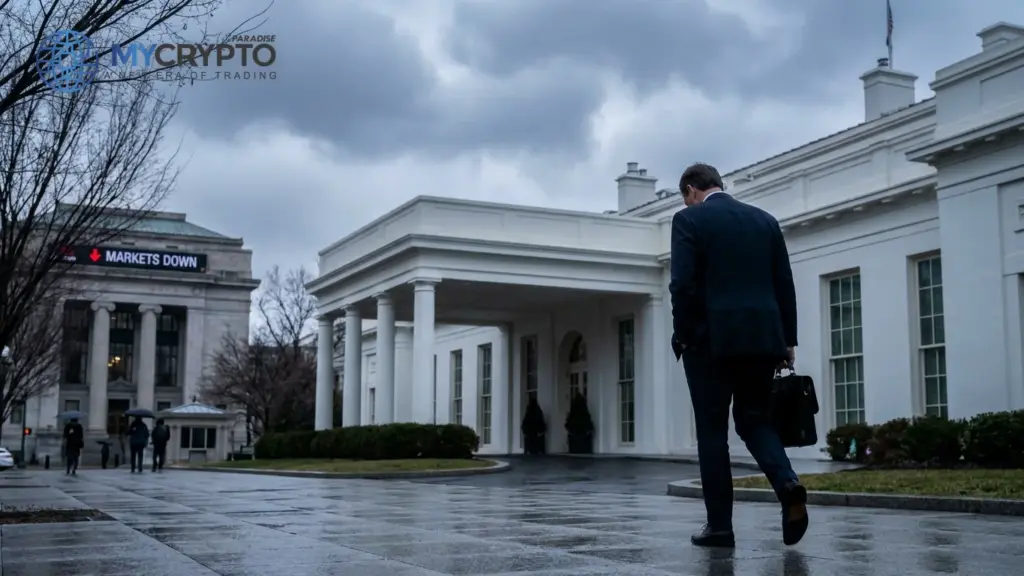
Listen: the breakdown
Developing story update (September 24, 2026, 05:04 UTC):
Update: while the CLARITY Act stays stalled, the Treasury is now drafting the implementation rules for the stablecoin provisions under the separate GENIUS Act. That means the near-term regulatory framework for stablecoins is likely to come through GENIUS rulemaking rather than through CLARITY, which officials still expect will not pass this year.
For traders this points to a slower, more fragmented path to clarity. The market impact probably lands on the specific timing and wording of those Treasury rules, particularly anything touching deposit-like yield, rather than on the CLARITY fight itself. Prices are little changed since we first covered this, with BTC near 84,026 and ETH near 2,681, both down roughly 3 percent on the day.
What to watch now: Timing and content of the Treasury's GENIUS Act stablecoin implementation rules, especially any yield or deposit-like provisions.
Developing story update (September 24, 2026, 03:40 UTC):
Update: a second official, Treasury’s Luke Pettit, has now added his voice to the White House adviser’s assessment, saying the CLARITY Act has little chance of passing this year. Two officials aligning on the same timeline narrows the odds of a near-term legislative fix for traders watching for a catalyst.
Officials also signalled that the SEC and CFTC are expected to keep advancing digital-asset oversight under their existing mandates rather than waiting on new law. In practice that likely shifts the near-term regulatory driver from Congress to the agencies, so watch agency rulemaking and enforcement posture over the coming weeks rather than a Senate vote.
What to watch now: SEC and CFTC actions under current mandates, since near-term regulatory movement is more likely there than in the stalled Senate bill.
Developing story update (September 24, 2026, 03:18 UTC):
The White House crypto adviser has now gone further, saying the CLARITY Act is unlikely to pass this year. That shifts the read from a single stalled vote to a probable write-off for the whole session, which pushes any comprehensive market-structure clarity into next year.
Based on our sources, banking groups framed their objection around stablecoins competing directly for customer deposits and, by extension, threatening bank lending capacity. That is a broader argument than a single provision, and it signals the resistance is structural rather than about one clause.
What to watch now: Whether the administration pivots to the GENIUS Act stablecoin rules as the near-term path while CLARITY slips to next year.
Market briefing: The White House is pinning the CLARITY Act's failure on big banks fearing stablecoins will drain their deposits. Bitcoin sits near $84,299, down 2.5 percent, as regulatory clarity slips into next year.
- The White House blames big banks for killing the CLARITY Act over stablecoin deposit fears.
- The bill is now unlikely to pass this year, leaving the SEC, CFTC and Treasury to lead.
- BTC trades near $84,299, down 2.5 percent, while retail stays heavily long into resistance.
The White House says big banks torched the CLARITY Act to protect their deposits. So who really wins when crypto's rulebook stalls again this year?
The White House has put a name to the CLARITY Act's failure: big banks. Its crypto adviser described the opposition as a wildfire started by larger banks that spread to community banks. The stated fear is simple. Stablecoins could pull deposits out of the traditional banking system.
That framing matters more than the politics behind it. It confirms that established finance sees stablecoins as a direct competitive threat, not a passing experiment. When your deposit base is the product, a rival that pays or moves money faster is not welcome.
Section 404 of the bill would have blocked covered digital-asset providers from paying U.S. customers passive, deposit-like yield. Even that guardrail was not enough to win the banks over. The bill is now unlikely to pass this year.
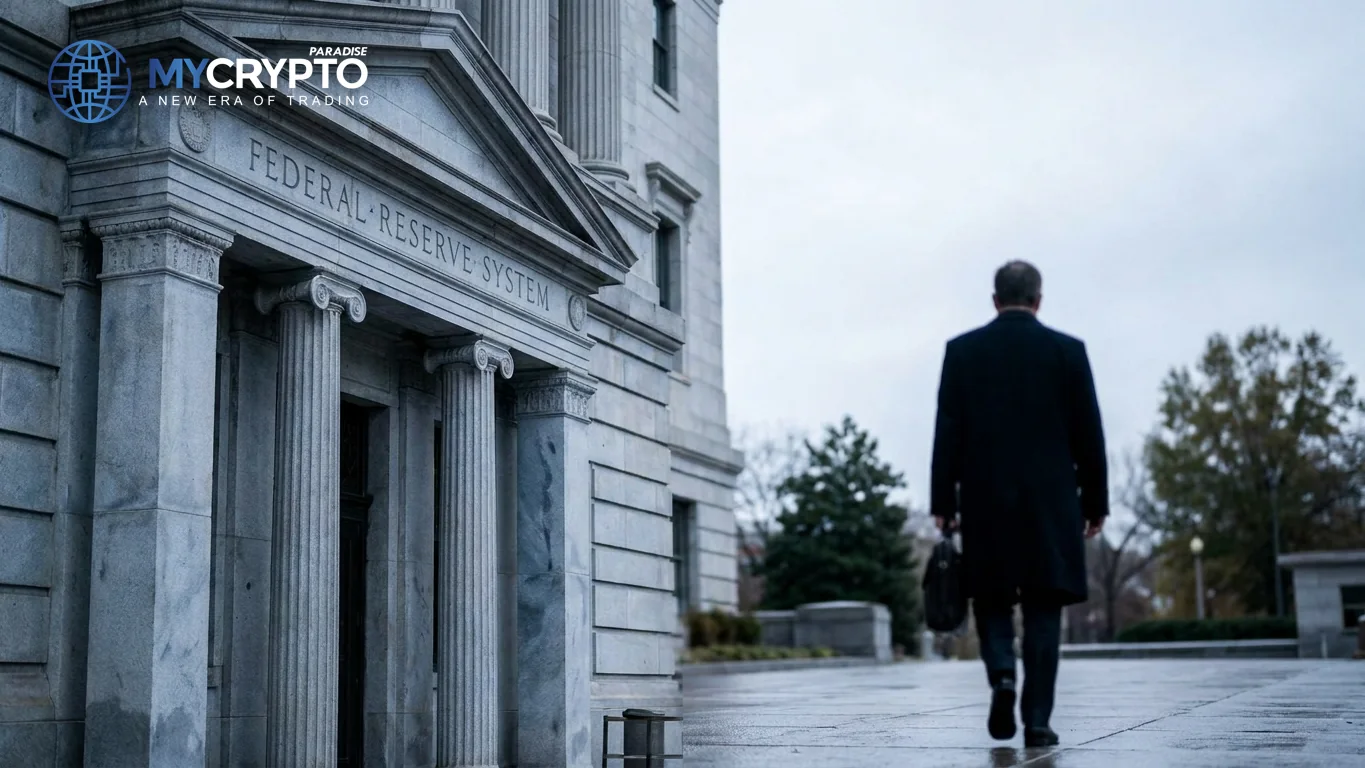
So the vacuum stays. The SEC and CFTC are expected to keep grinding forward under their existing mandates, while the Treasury drafts stablecoin implementation rules under the separate GENIUS Act framework. Clarity arrives in pieces, through agencies, not through one clean law.
For traders, the headline reads bearish on the surface: gridlock, lobbying, and a stalled bill. But price barely flinched on the news itself. There is no single confirmed same-day catalyst here, and we will be honest about that. This is context, not a trigger.
What it does is thicken the fog. And fog is exactly the environment where the patient side of the market prefers to operate, quietly, while everyone else argues about legislation.
Why banks fear the stablecoin deposit drain
The transmission mechanism here runs through bank balance sheets, not crypto order books. Banks lend against deposits. If stablecoins peel off even a slice of that base, funding costs rise and lending margins compress. That is the real objection dressed up as prudence.
A yield-bearing, dollar-pegged instrument competes directly with a checking account. That is why Section 404 tried to ban passive, deposit-like interest in the first place, and why banks still fought the wider bill. They read the direction of travel clearly.
The macro effect is continued U.S. regulatory gridlock. Comprehensive rules keep slipping, and the market is left reading agency actions one at a time. Uncertainty like this rarely produces a clean sell-off. Instead it caps conviction.
Capped conviction is the point. When traders cannot price a clear regulatory path, they hesitate to add serious risk, and thin conviction keeps liquidity shallow above. Shallow liquidity is easier for larger participants to work against.
There is a quiet irony worth noting. The same institutions that spent years dismissing crypto as irrelevant are now lobbying hard against it because it is relevant enough to threaten their deposits. That is not the behaviour of people who think it is a fad. So the structural read is straightforward. Regulatory friction persists, stablecoins remain a contested growth story, and the near-term market has one less bullish catalyst to lean on this year.
How the gridlock feeds the liquidity picture
Start with the tape. Bitcoin was trading near $84,299 as of the latest read, down about 2.5 percent on the day, with ETH near $2,683 and off a similar amount. The reaction to the news itself was muted, which tells you it was not the driver.
That matters. When a plausibly bearish political headline lands and price does not break, it usually means positioning, not news, is steering the market. The story adds weight to an existing lean rather than starting a new one.
The liquidity chain runs top down. BTC sets the tone, ETH follows, and alts amplify in both directions. With a fresh bullish catalyst removed for this year, BTC loses one reason to squeeze higher, and that filters straight into the weaker links.
Alts are the most exposed. They rely on risk appetite and available capital flowing down the stack. A market missing regulatory clarity and running on retail greed is a fragile base for the speculative end of the curve.
Stablecoins sit in the middle of it all. Their growth story stays intact under the GENIUS Act rules Treasury is drafting, but the deposit-drain fight signals ongoing friction between crypto rails and the banks. That tension is now openly acknowledged at the top.
Net effect: no forced cascade today, but a market with thinner upside fuel, crowded long positioning, and shallow liquidity above price. That combination tends to resolve lower before it resolves higher.
What confirms or invalidates the bearish lean
The first thing to watch is whether this stays a talking point or becomes a policy pivot. If the SEC, CFTC and Treasury visibly accelerate their own rulemaking, the failed bill matters less. Piecemeal clarity can still be clarity.
Watch the Treasury's stablecoin implementation work most closely. Those rules will shape whether stablecoins keep pressuring bank deposits or get boxed in. That is the real battleground now, not the dead bill.
On price, the level that decides the near-term story is $88,000. A clean reclaim and hold above it would tell us the crowd's optimism has real fuel behind it. Until that happens, rallies deserve suspicion.
Below, the structure is where confirmation of weakness lives. Losing recent support opens air toward the $67,000 liquidation zone, where stacked leverage sits. That is where a fear-driven flush would find its stops.
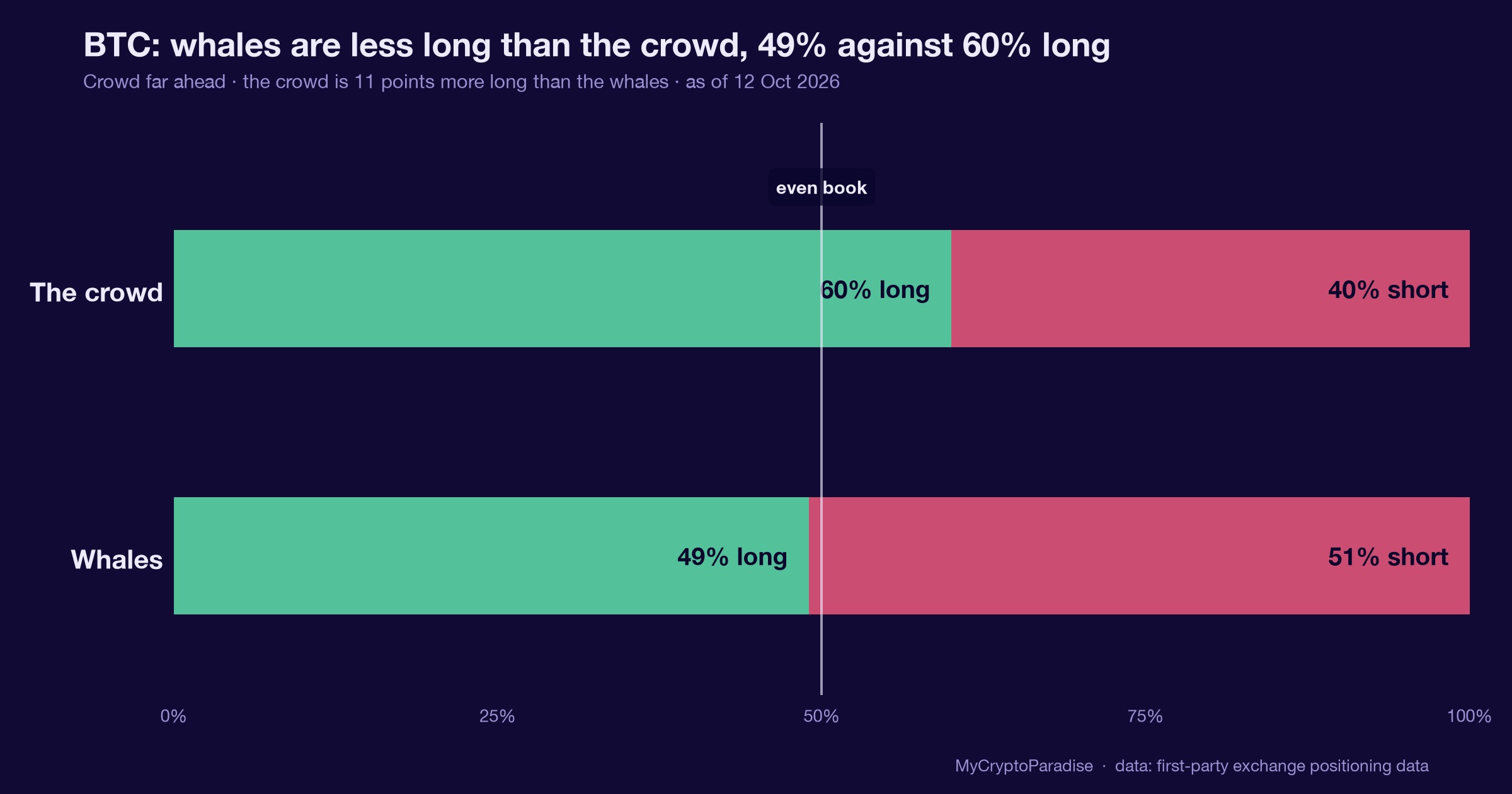
Sentiment is the tell in between. Retail remains in extreme greed and heavily long, which is precisely the posture that provides exit liquidity. If that greed persists while price stalls under resistance, the distribution read strengthens.
The honest invalidation is simple. If BTC reclaims $88,000 with strong follow-through and holds, and breadth improves across alts, our cautious stance is wrong and the market is stronger than the positioning suggested. We would respect that signal rather than fight it. Everything else favours patience over chasing.
Reading this stall through smart money positioning
The ParadiseTeam reads this event through one lens: a stalled bill removes a catalyst without changing the structural picture, and the structural picture still favours caution near $84,299. Price sits under the $88,000 resistance, which remains the gate for any upside probability.
Think about who is on each side. Retail is heavily long into extreme greed, and news like this rarely shakes them. That crowded positioning is exactly the exit liquidity that a distributing larger player wants to sell into.
The stops tell the story. Long stops now sit clustered below recent support, thinning down toward the $67,000 liquidation zone. That pool of forced sells is a magnet, not a coincidence, and it is why we treat downside as the path of least resistance for now.
On levels, $88,000 is the line. Reclaim and hold it and the upside case earns a hearing toward $99,000. Fail there and the $44,000 to $55,000 capitulation zone becomes the area where patient capital would look to reaccumulate aggressively.
On management, the ParadiseTeam would protect open longs, not chase. Moving your SL (stop-loss) to breakeven and banking partial TP (take-profit) beats adding risk into resistance. R:R (risk-to-reward) simply does not favour fresh aggressive longs here.
This is analysis, not a signal. The read is probabilistic: distribution into greed, thin upside fuel, and a market that likely needs a flush before a durable low. Patience is the position.
The read behind this: we framed this story through our own market analysis, Can Bitcoin Reach a New High at $169K?
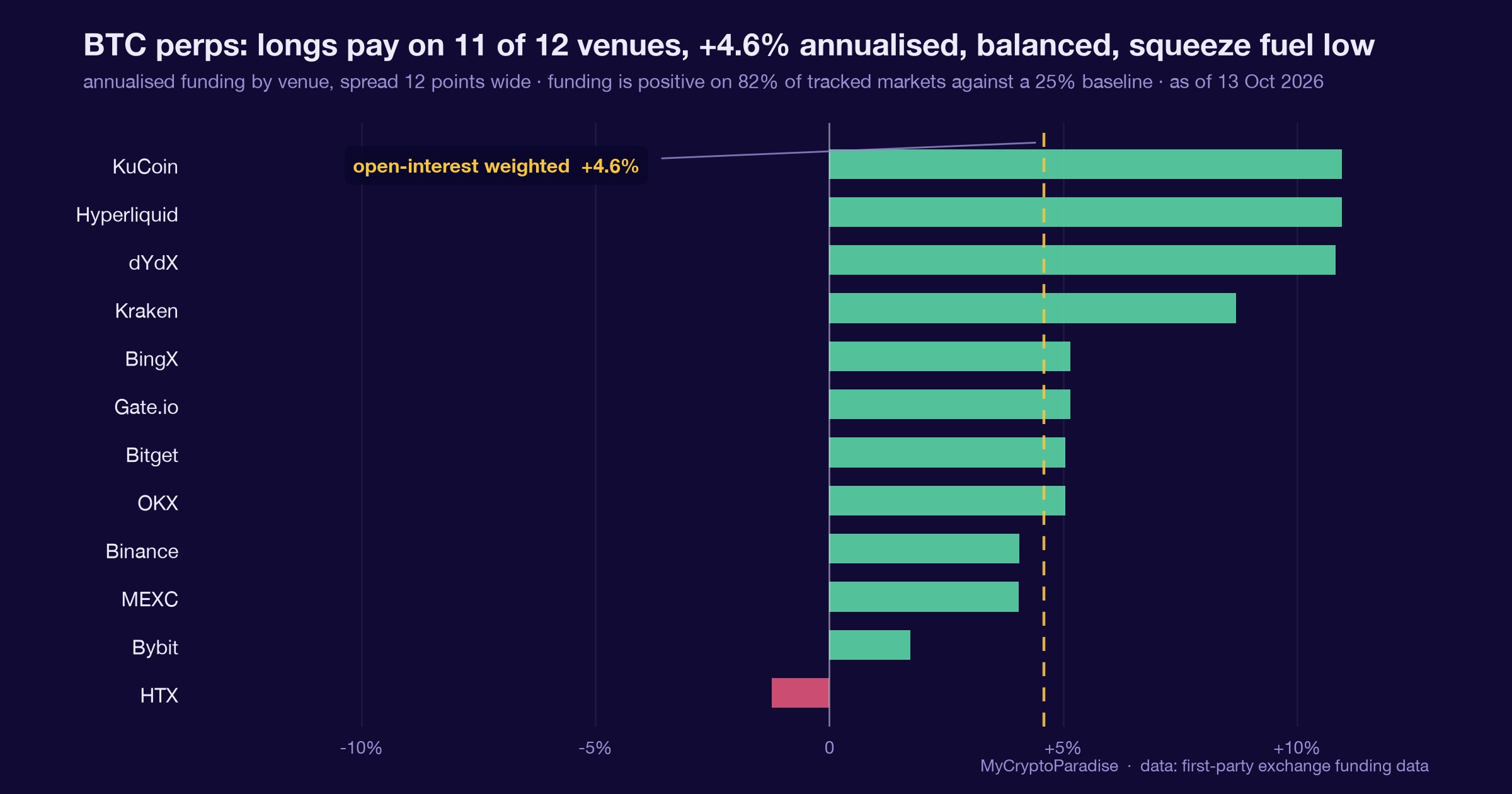
Track it live: our Crypto Fear and Greed Index and the live crypto funding rates both update in real time, so you can watch this shift for yourself.
Related coverage
For exact entries, targets, and stop losses with full risk management, that is what ParadiseFamilyVIP is for. New to reading these moves? Start with our crypto trading strategies guide.
ParadiseTeam is monitoring the market situation closely, and we are taking these developments into consideration while building our trading tactics inside ParadiseFamilyVIP.
Crypto trading involves substantial risk. Prices are volatile and you can lose money. This article is educational and is not financial advice. Past performance does not guarantee future results.
With the CLARITY Act stalled, where does BTC head next from $84K?
This is how 28 Paradisers are calling it. Tap your call.
No calls on this one yet. Tap yours to be the first.
Free account, no password. Members just sign in.
Follow this topic: Crypto regulation news









Join the discussion 25
The "deposit fears" argument feels a bit thin here. It seems more about protecting existing fee structures than genuine systemic risk, frankly.
Jonas, it also makes you wonder about the speed of transactions, no? Moving stablecoins is very fast... compared to banks.
i just hope they dont get everyone so confused that real people get caught out again, like when i first started and that instagram person got me 😬
Clarity Act collapse and the banks... 🙄 I mean, ok but also, when *isn't* it big banks 🏦 getting in the way?! Just feels like an excuse sometimes, no? 🤷♂️
Man... blaming banks kinda feels like when I blame my internet provider for my own slow downloads, even though I'm the one always forgetting to clear my cache 🤦♂️. Just feels... familiar. 😅
noah its not really like that. big banks are too big to fail so they get different rules.
this reminds me of those "bank charges" we used to get for international wires that never reconciled to anything 🤔 you just debited the expense.
so with all this talk about banks and laws what's the one level that matters for bitcoin right now
always remember how quick things can change, like when they said the old currency was worthless overnight. makes you think about having your own keys.
it does make you wonder about the risk if it all switches again, like when we changed to the euro.
blaming big banks when the *spirit* of the law is missing from the start is just... really something, isnt it?! 😡 we've seen this movie before.
Exactly! But it's not just the banks, is it? The *spirit* of some of these laws seems to miss the user completely. 🤔
Blaming banks for this bill failing is a bit rich. The real issue is nobody can agree on how to regulate something that can vaporize your capital overnight.
Honestly, the whole blame game reminds me of 2021 when everyone was panicking about regulation. Is anyone actually surprised by this? 🤷♀️ Four-hour noise is not a signal.
It's always fees, isn't it? 🤦♀️ I just want my brother to get his money without half of it vanishing into thin air! 💸 So annoying. 🙄
Totally! 💯 The fees are crazy, like what's the point of sending money if so much gets eaten up? Makes you wonder how many other people are having that problem... 😒
yeah, watching the big boys squirm over stablecoin rules is almost as fun as getting chopped up on a 1m chart, almost! 😂 you see it too?
It's always someone else's fault when the old system struggles. They forget that for many, stability and protection are not luxuries but basic structural requirements.
It's so true what Rahul said, 👆 banks really don't like giving up those fees 💸 my family used to pay so much to send money home! 🥺 It’s sad to see.
i'm not sure its that simple, olivia. banks just adapt, they dont really *give up* fees, just find new ways to charge for "value added" services.
That is a very fair point about fees, Olivia. It definitely highlights one of the key problems crypto aims to solve for so many people.
Olivia, it is true that remittances have been such an extractive force, a kind of hidden tax on families for decades. Perhaps this friction being removed will lead to a new equilibrium.
I really worry about this type of news because I'm so new, and sometimes I think maybe I should just keep my savings in my old account? przepraszam.
The resistance from established institutions is predictable. It simply reinforces my habit of placing stops based on their anticipated reactions to price action, rather than just chart patterns.
Anticipated reactions" to price action, Marco?? 🙄 mate, it's not some grand strategy from the banks, it's just them protecting their own backs, same as always. They always protect their own first 🤬.