

Listen: the breakdown
Developing story update (September 24, 2026, 12:48 UTC):
Update: alongside the Centrifuge integration, Venus Core is now running negative borrow APYs on USDT and USDC, reaching as low as -23.4%. In practice this means borrowers of those stablecoins are being paid to borrow rather than charged, for as long as the incentive holds.
Based on our sources this program is scheduled to run until October 14. Traders can potentially pair a paid-to-borrow stablecoin position with the real-world yield now available through the Liquidity Hub, but the negative rate is promotional and can normalize once the window closes, so size positions with that expiry in mind.
What to watch now: Whether the -23.4% stablecoin borrow incentive is extended, cut, or lapses at the October 14 deadline.
Developing story update (September 24, 2026, 10:38 UTC):
An added incentive is now live alongside the Centrifuge integration: Venus Core is running negative borrow rates on USDT and USDC, with APYs reaching as low as -23.4%. In practice a negative borrow rate means borrowers are being paid to take on the position rather than paying interest, which sharply lowers the cost of building leverage on those stablecoins.
Based on our sources this promotion runs through October 14. For traders it stacks with the Liquidity Hub yield story: supplied capital can earn the real-world fund yield while the same collateral unlocks cheaper, temporarily subsidised borrowing power. Treat the window as short-lived and size positions with the usual liquidation risk in mind, since the negative rate is a time-boxed incentive and not a permanent condition.
What to watch now: Whether the -23.4% negative borrow incentive on USDT/USDC is extended or expires at the October 14 cutoff.
Developing story update (September 24, 2026, 09:33 UTC):
Update: On top of the Centrifuge integration, Venus Core is now running negative borrow APYs on USDT and USDC, reaching as low as -23.4%. In practice that means borrowers of those stablecoins are currently being paid to borrow rather than paying interest, an incentive scheduled to run until October 14.
For traders this stacks with the Liquidity Hub setup: the same supplied capital can earn real-world yield through the JTRSY and JAAA funds while borrowing power on Venus Core is temporarily subsidised. As always with time-limited incentive rates, terms can change, so confirm the live rate and end date in-app before sizing any position.
What to watch now: Whether the -23.4% negative stablecoin borrow rate holds through October 14 or is cut early as utilisation shifts.
Market briefing: Venus Protocol has plugged Centrifuge real-world assets into its Liquidity Hub on BNB Chain, adding tokenized Treasury yield to DeFi. BNB sat near $768 and Bitcoin traded around $83,466, down 2.7 percent, as of 08:57 UTC. Our read stays cautious.
- Venus integrated Centrifuge assets into its Liquidity Hub on BNB Chain, adding two Janus Henderson funds
- JTRSY brings tokenized U.S. Treasury yield on-chain, deepening the TradFi to DeFi bridge
- Venus Core is running negative borrow rates near minus 23.4 percent on USDT and USDC through October 14
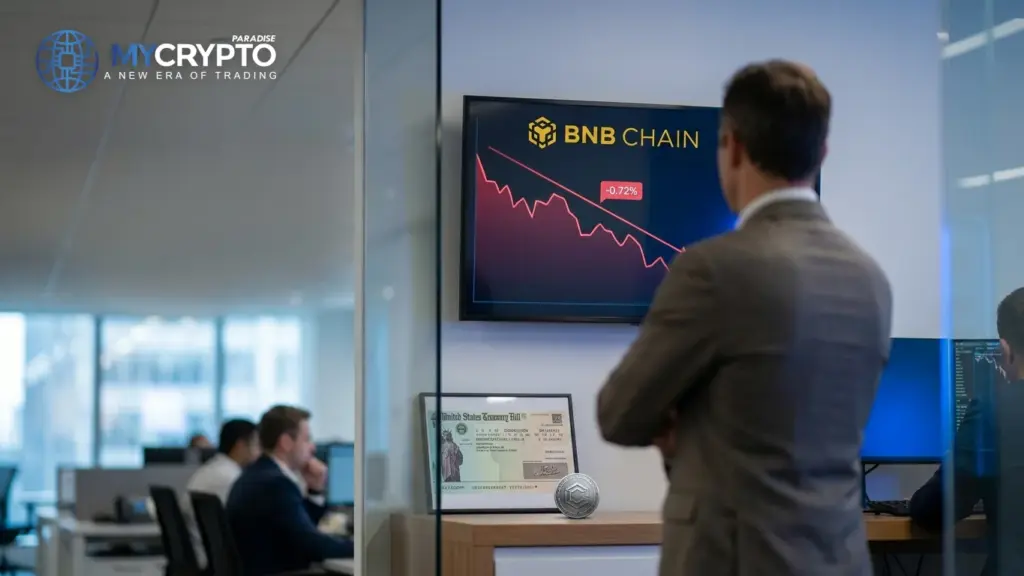
The Venus Centrifuge RWA integration just brought tokenized U.S. Treasury yield onto BNB Chain. But does new institutional plumbing change a market where smart money is already selling?
Venus Protocol has integrated Centrifuge assets into its Liquidity Hub on BNB Chain. The move makes two Janus Henderson funds accessible inside the Venus ecosystem for the first time.
One of them, JTRSY, offers tokenized U.S. Treasury yield. That matters because it drops a familiar, low-risk cash instrument straight into a DeFi lending market. Traders can now borrow against, or lend alongside, an asset that behaves like a government bill rather than a volatile token.
Centrifuge is the plumbing underneath. It tokenizes real-world assets, converts them into non-fungible tokens, and funds them through Tinlake, the first DApp built on the Centrifuge chain to reach liquidity on Ethereum. Its CFG token carries its own bridge to Ethereum, so the rails already crossed chains before this listing.
The timing is the interesting part. Venus Core recently launched negative borrow rates on USDT and USDC, reaching minus 23.4 percent, effectively paying users to borrow through October 14. So on one screen you have conservative Treasury yield, and on the next you have subsidised leverage. Prudence and adrenaline, sold from the same counter.
That combination tells you who the audience is right now. This is a real structural step in bridging traditional finance with DeFi, and we report it as one. But BNB traded near $768, down about 2.2 percent on the day, while Bitcoin sat around $83,466. The market shrugged. New institutional plumbing arrived, and price did not celebrate.
Where TradFi yield meets DeFi leverage
The real transmission mechanism here is yield, not price. JTRSY carries tokenized U.S. Treasury income, so it imports a slice of the traditional risk-free rate directly into an on-chain lending market. That changes the collateral mix on BNB Chain. A protocol that mostly held volatile tokens can now anchor part of its liquidity to an asset backed by government paper. In theory, that makes the system sturdier and widens the pool of institutions willing to touch DeFi.
But mechanisms cut both ways. Pair stable Treasury yield with borrow rates near minus 23.4 percent, and the incentive is not to sit in Treasuries. The incentive is to borrow cheaply and lever up elsewhere. Safe yield becomes the on-ramp for unsafe positioning.
This is the honest tension. RWA integration genuinely expands DeFi's addressable market and utility. We are not disputing the structural progress; it is real and it is happening.
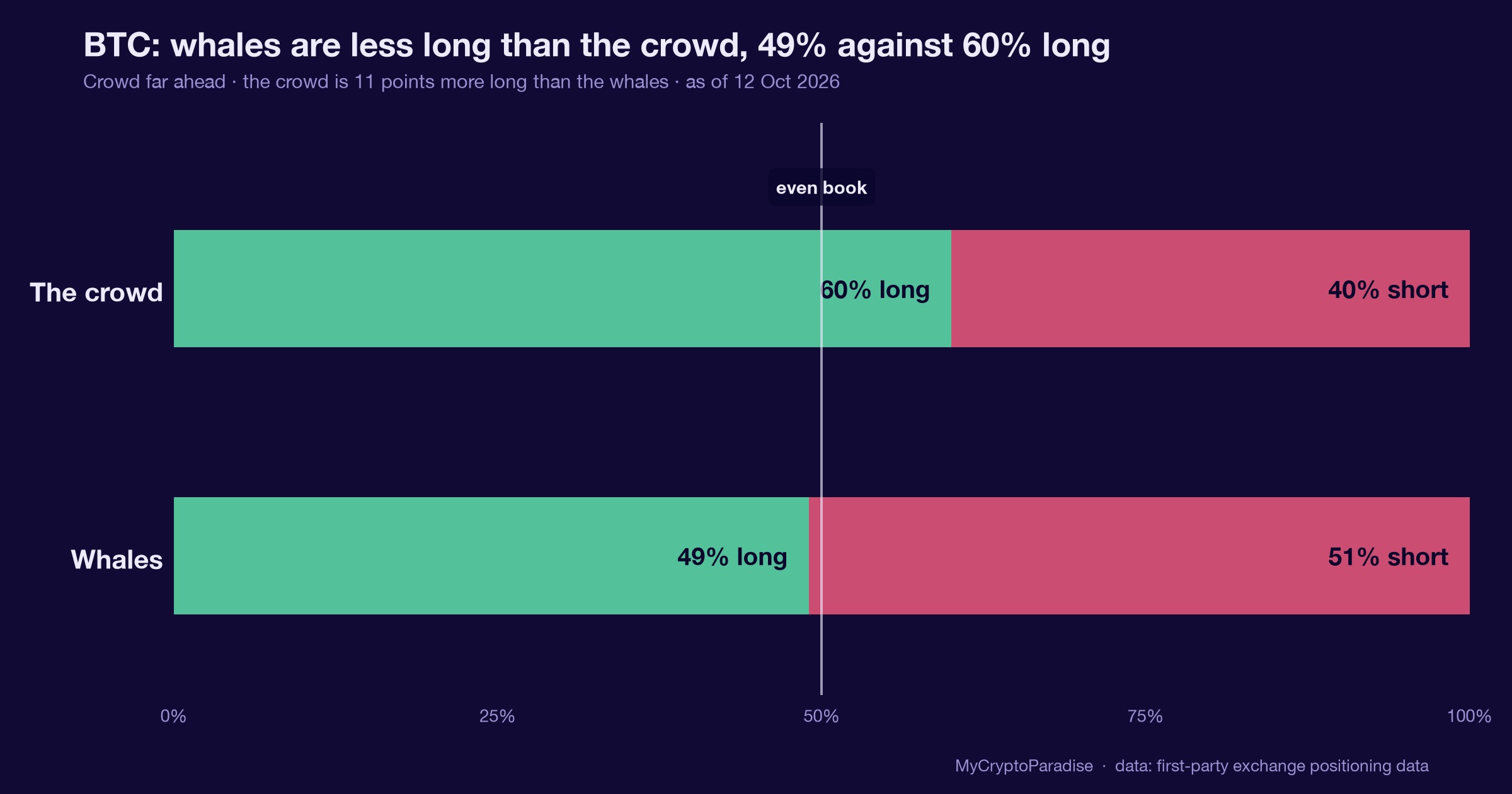
Where we separate fact from read: the story that this single integration lifts BTC, ETH, or alts is our interpretation of a mood, not a confirmed catalyst. There is no single same-day driver moving the tape. What the news does reliably is feed a narrative of institutional adoption into a crowd that is already convinced. And a convinced crowd, historically, is the one providing the liquidity for everyone else to sell into.
Liquidity flows through BNB before Bitcoin
Follow the liquidity, and it starts on BNB Chain, not with Bitcoin. This integration deepens borrowing and lending capacity inside Venus, so the first-order effect is concentrated in the BNB ecosystem itself.
Yet BNB did not respond with conviction. It traded near $768.76, down about 2.2 percent over 24 hours, roughly flat on the hour. A genuinely bullish structural catalyst usually leaves a mark on the asset closest to it. This one did not.
That muted reaction is the tell. When adoption news lands and the native token still bleeds, the bid is not there. Retail reads the headline as confirmation of the bull case, while price quietly disagrees.
From BNB, the cascade to Bitcoin and Ethereum is even thinner. Tokenized Treasury yield on one BNB Chain protocol does not move BTC's macro liquidity. Bitcoin sat near $83,466, down 2.7 percent on the day, tracking its own weight rather than this news.
Alts sit at the fragile end of that chain. They rally hardest on adoption narratives and fall hardest when the leverage that funded the rally unwinds. Negative borrow rates encourage exactly that leverage.
So the impact picture is asymmetric. The upside case rests on a story. The downside case rests on crowded longs, subsidised borrowing, and a market where the strongest hands are lightening up while the tape drifts lower.
Signals that separate adoption from distribution
The cleanest confirmation would be BNB and Bitcoin turning the news into a bid. Watch whether BNB reclaims strength above $768 with rising volume, or whether every bounce fades. Conviction shows up as follow-through, not a single green candle.
On Bitcoin, the level that matters is $88,000. That is current resistance on the weekly view. A decisive reclaim there would force us to give the bulls real probability, because it would mean price is absorbing supply rather than rolling over.
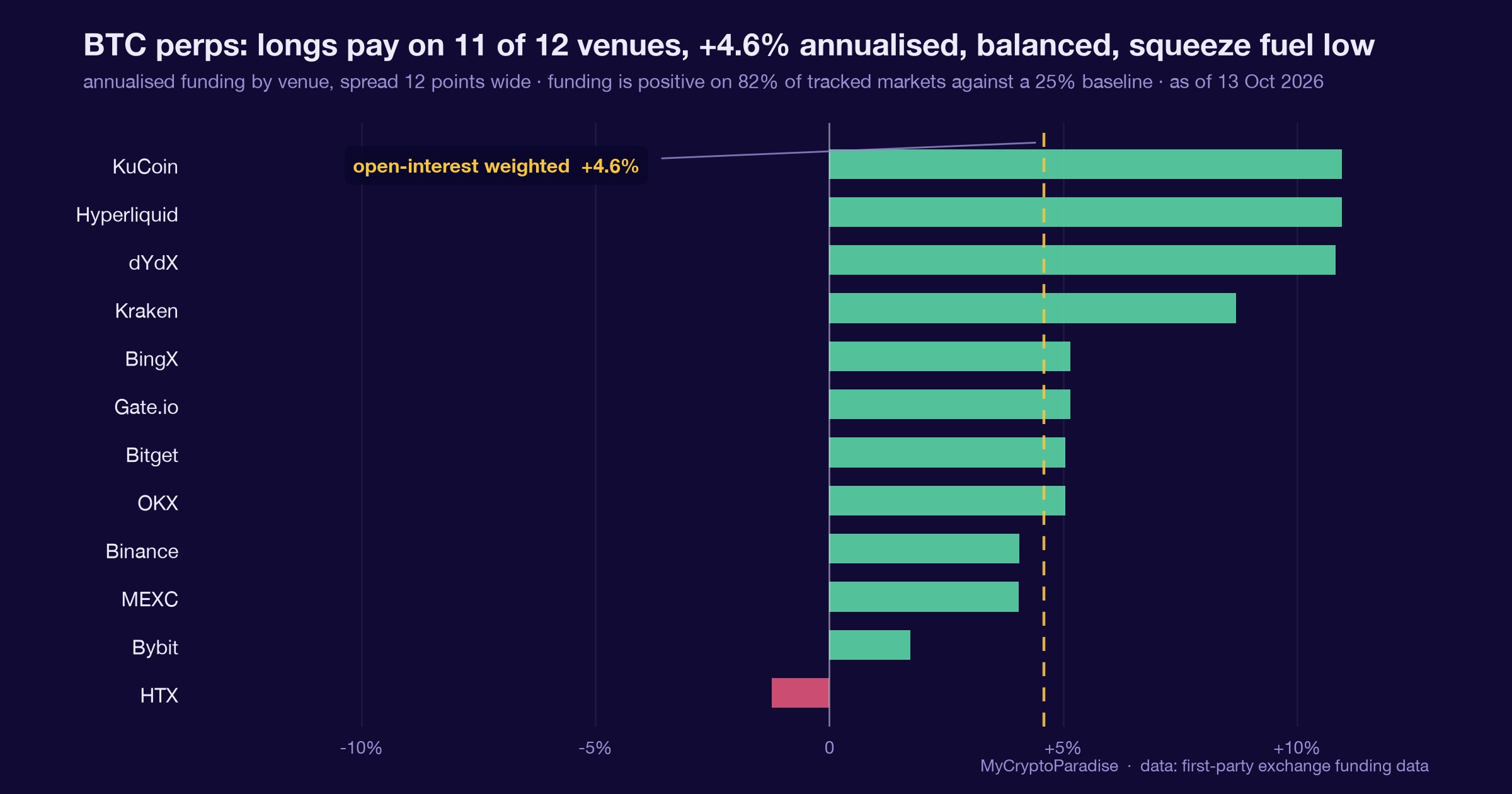
Until that happens, we watch for the opposite. Bitcoin was near $83,466, already below $88,000. A rejection that keeps it capped, paired with rising open interest (OI, the total value of outstanding leveraged contracts), signals crowded longs building into weakness. That is fuel for a flush.
The $67,000 area sits below as a liquidation zone. If price loses momentum here, that pocket becomes the magnet where over-leveraged longs get cleared. Negative borrow rates on Venus only add to the pile of leverage that can unwind fast.
Invalidations for the cautious view are specific. A weekly close back above $88,000, funding staying calm, and OI cooling instead of climbing would all argue the distribution read is wrong.
What we do not want to see is the crowd treating RWA headlines as a reason to add aggressive longs into resistance. That behaviour, historically, precedes the exact correction it ignores.
Why this yield lands in a distribution phase
The ParadiseTeam frames this integration through a single question: who is providing liquidity to whom. Our macro lens is bearish, and we read the current tape as smart money distributing into retail's extreme greed before a deeper reset.
Against that backdrop, an adoption headline is not a buy signal. It is exit liquidity dressed as progress. Tokenized Treasury yield on BNB Chain is a legitimate step, but it lands while Bitcoin trades near $83,466, below the $88,000 resistance that has to reclaim before upside earns real probability.
Until $88,000 flips to support, we treat rallies as opportunities for stronger hands to sell, not for retail to chase. Above it sits $99,000 as the next ceiling. Neither is in play while price grinds under resistance on a bearish weekly structure.
Below, the map is what guides our caution. The $67,000 zone is where leveraged longs get liquidated, and the $44,000 to $55,000 region is the exchange-of-hands area where we would expect capitulation and genuine re-accumulation. So our positioning read is defensive. Existing longs deserve protective stops moved toward breakeven, and profit-taking is reasonable into strength. Fresh aggressive longs into resistance, funded by subsidised borrow rates, are the crowded trade we would avoid.
High-probability shorts need price-action confirmation, not a headline. This integration changes DeFi's plumbing. It does not, in our read, change the distribution phase.
The read behind this: we framed this story through our own market analysis, Can Bitcoin Reach a New High at $169K?
Track it live: our live crypto funding rates and the crypto liquidation heatmap both update in real time, so you can watch this shift for yourself.
Related coverage
For exact entries, targets, and stop losses with full risk management, that is what ParadiseFamilyVIP is for. New to reading these moves? Start with our crypto trading strategies guide.
ParadiseTeam is monitoring the market situation closely, and we are taking these developments into consideration while building our trading tactics inside ParadiseFamilyVIP.
Crypto trading involves substantial risk. Prices are volatile and you can lose money. This article is educational and is not financial advice. Past performance does not guarantee future results.
Does Venus adding tokenized Treasuries change Bitcoin's near-term direction?
This is how 14 Paradisers are calling it. Tap your call.
No calls on this one yet. Tap yours to be the first.
Free account, no password. Members just sign in.










Join the discussion 4
It's always a little scary when new options open up and everyone rushes in right away 😅 I usually wait to see how things settle before I even think about it.
so this means we can finally get real yield without leaving chain right or is there still an offramp step
Finally, real world assets coming to BNB Chain. I always check for a few cycles of volume stability before diving into these new integrations.. lessons learned from past yield farms.
Volume stability is good but liquidity is what reprices everything when opinions shift. That's my only concern here.