

Listen: the breakdown
Developing story update (September 25, 2026, 20:23 UTC):
The enforcement side of the Turkish fund liquidation has widened. Beyond the brokerage chairman already in custody, our sources indicate 17 further individuals have now been jailed and assets have been seized as part of the crackdown.
For traders, the read is unchanged at the macro level: BTC near $84k and ETH near $2,690 are still moving less than half a percent on the day, so this remains a regional stress event rather than a broad crypto catalyst. The story worth tracking is localized: whether the widening seizures push more Turkish Lira exposure toward onchain stablecoin rails like wiTRY-USDM as a domestic hedge.
What to watch now: Whether further arrests or asset freezes accelerate Turkish Lira flows into onchain stablecoins rather than moving major crypto prices.
Developing story update (September 25, 2026, 19:41 UTC):
Update: the scope of the Turkish liquidation is now clearer. Based on our sources, 131 investment funds have been liquidated, well beyond the headline $18 billion figure, and alleged Ponzi-style schemes are reported to have wiped roughly $30 billion off the Turkish stock market in just two days.
For traders, this widens the pool of domestic capital looking for a safe exit. A shock of that size to local savings and equities is the classic backdrop for stress bids into hard assets and dollar-pegged onchain instruments. Global BTC and ETH prices remain flat so far, so any effect is still localized rather than a broad market driver.
What to watch now: Watch for TRY outflows into stablecoins and dollar-pegged onchain assets as the forced fund sales run over the coming months.
Developing story update (September 25, 2026, 19:20 UTC):
Update: the Turkish investigation has widened. Beyond the arrest of the chairman of the brokerage at the center of the scandal, based on our sources 17 additional individuals have now been jailed and assets have been seized as the probe continues.
Regulators also signaled that the liquidation of the funds’ holdings, previously set at up to six months, may now be completed earlier. For traders the read is unchanged so far: this remains a regional traditional finance stressor with no evidence yet of TRY capital rotating into BTC or ETH, both of which continue to trade essentially flat.
What to watch now: Watch for signs of forced-selling timelines shortening and any first evidence of TRY flows moving onchain into stablecoins or BTC.
Developing story update (September 25, 2026, 18:18 UTC):
Update: the Turkish fund crackdown has widened. Beyond the brokerage chairman already detained, authorities have now jailed 17 additional individuals and seized assets tied to the fund turmoil, signalling this is being treated as a broad enforcement action rather than an isolated case.
The knock-on damage is larger than first reported. Based on our sources, alleged Ponzi-like schemes linked to the crisis wiped roughly $30 billion from the local stock market in just two days, on top of the roughly $18 billion in liquidated funds. That is a far bigger local capital shock than the initial figure suggested.
For traders, majors remain unmoved: Bitcoin is near $83,974 and Ethereum near $2,694, both broadly flat on the day. The onchain TRY story is still the place to watch for any capital that seeks a crypto exit, since no global safe-haven bid has appeared yet.
What to watch now: Whether the widening arrests and $30B equity wipeout push more Turkish capital toward onchain TRY rails, since majors are still not reacting.
Developing story update (September 25, 2026, 17:16 UTC):
The clampdown has widened. Beyond the brokerage chairman already detained, 17 more individuals have now been jailed and assets have been seized as Turkish authorities press the fund investigation. This points to a deeper, more aggressive enforcement phase rather than a contained one-off action.
The damage is also spilling well past the funds themselves. Based on our sources, the alleged Ponzi-like schemes tied to this crisis reportedly erased around $30 billion from the Turkish stock market in just two days, a shock far larger than the roughly $18 billion in liquidated funds first reported.
For traders the read is unchanged so far onchain: BTC and ETH remain essentially flat with no clear capital-flight signal into crypto yet. The setup to watch is whether escalating domestic losses and a widening probe eventually push Turkish capital toward decentralized assets, which would likely show up first in stablecoin and TRY-pair flows rather than in headline BTC price.
What to watch now: Watch for TRY stablecoin and onchain TRY-pair flows as the arrest count and stock-market losses climb.
Developing story update (September 25, 2026, 16:15 UTC):
The scope of the Turkish fund crisis has widened. The liquidation now covers over 100 investment funds, and based on our sources the episode is being tied to alleged Ponzi-like schemes reportedly connected to roughly $30 billion wiped from the local stock market in two days. That is a far larger blast radius than the fund pool alone.
The six-month window regulators set to sell the funds’ holdings may close earlier. For traders, that shortens the runway on any forced-selling overhang and keeps the onchain TRY story worth watching as local capital looks for exits. Crypto majors have not repriced on this: probabilities favour it staying a regional signal rather than a global catalyst unless the contagion widens.
What to watch now: Whether the alleged Ponzi links and $30B equity hit trigger local capital flight into onchain TRY and crypto majors.
Developing story update (September 25, 2026, 15:54 UTC):
The Turkish crackdown tied to the roughly $18B fund liquidation has widened. Beyond the earlier arrest of the chairman of Tera Yatirim Menkul Degerler AS, 17 more individuals have now been jailed and assets seized as part of the probe, based on our sources.
For traders the read is unchanged in scale: the roughly 450,000 affected investors and the six-month window to unwind holdings keep this a regional story rather than a global catalyst. BTC and ETH are drifting modestly lower with no signal of a direct reaction. The point of interest remains whether displaced Turkish capital rotates toward crypto as a hedge over time, not an immediate flow.
What to watch now: Whether the widening arrests trigger any measurable Turkish capital rotation into crypto or stablecoins.
Developing story update (September 25, 2026, 15:33 UTC):
The picture is now larger than the fund liquidation itself. Based on our sources, the same alleged Ponzi-like schemes are tied to roughly $30 billion being wiped from the Turkish stock market in just two days, on top of the reported $18 billion in funds ordered into liquidation. That reframes this as a broad confidence shock across Turkish equities, not an isolated fund failure.
For traders the read is unchanged at the global level: BTC and ETH are barely moving, so this stays a regional story rather than a market-wide catalyst. The angle worth watching is domestic, where a shock of this size can push affected Turkish retail capital toward alternative stores of value, including crypto, over the coming weeks.
What to watch now: Watch for Turkish retail capital rotating toward crypto and stablecoins as equity confidence stays shaken.
Market briefing: Turkey is liquidating around $18 billion in investment funds, hitting nearly half a million investors. BTC sat near $83,875, down 0.3 percent, barely reacting to a crisis unfolding far from the global tape.
- Turkish authorities ordered over 100 investment funds worth about $18 billion into liquidation last week.
- Roughly 450,000 to half a million investors are affected, with arrests and seized assets amid alleged Ponzi-like schemes.
- Global crypto barely moved, yet a failing local system historically pushes trapped capital toward alternative assets.
Turkey ordered an $18 billion fund liquidation last week, trapping half a million investors. When a domestic financial system fails this loudly, where does frightened money actually run?
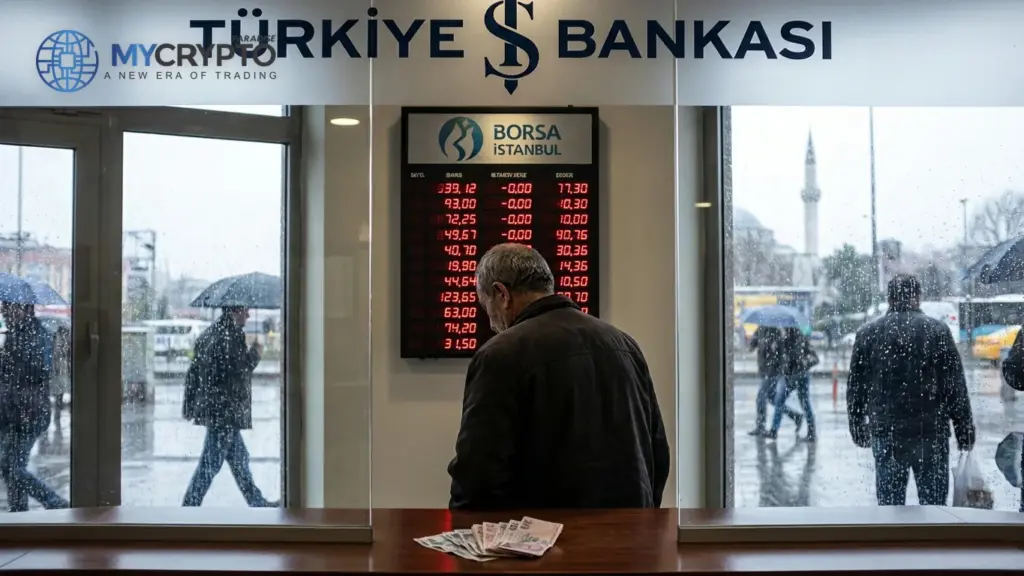
Turkey ordered more than 100 investment funds into liquidation last week. Together they were worth around $18 billion. Nearly half a million investors are now caught inside the unwind. The regulator has allowed up to six months to complete it, though it may finish sooner.
Underneath sit allegations of Ponzi-like schemes. The chairman of one brokerage, Tera Yatirim Menkul Degerler AS, was arrested. Seventeen more individuals have been jailed, and assets have been seized as the turmoil spreads.
This is a domestic crisis, not a crypto one. Global prices barely flinched. BTC traded near $83,875 as the news landed, and ETH held above $2,690. The tape treated a foreign scandal the way it treats most foreign scandals: with a shrug.
But the second-order effect is where traders should look. When a traditional system fails this publicly, confidence in the local currency and the institutions around it erodes fast. Turkey has lived this movie before, and its citizens learned the lesson early.
Money that no longer trusts a broker or a fund looks for somewhere else to sit. Some of it moves to hard assets. Some moves onchain, into stablecoins and into BTC and ETH, as a way to step outside a system that just froze nearly half a million accounts. That is the real signal here. Not a global price catalyst, but a familiar pattern: a broken local system quietly manufacturing new crypto demand while the headlines focus on the arrests.
How a $18 billion collapse erodes lira trust
The transmission mechanism runs through confidence, not price. An $18 billion liquidation tells nearly half a million people that regulated, mainstream vehicles can be frozen overnight. That lesson does not stay contained to the funds involved.
Confidence is the real currency of any financial system. When it breaks, people stop asking which fund is safe and start asking whether the system itself is. Turkey's savers have watched their lira lose purchasing power for years, so this scandal lands on already-thin trust.
That is the backdrop where capital flight becomes rational, not panicked. Money leaves what it cannot trust. Historically it moves into hard assets, foreign currency, and increasingly into crypto that no regulator can freeze with a single order.
Crypto's pitch in this exact scenario is simple: self-custody and a supply nobody can quietly liquidate. For a Turkish saver watching accounts get seized, a stablecoin or BTC held in a personal wallet answers a real fear.
The scale matters too. This is not a niche fund blowup. Half a million affected investors is a population large enough to shift local onchain demand in a measurable way over the coming months.
None of this moves the global order book today. But adoption rarely arrives as a single green candle. It arrives as a slow, local decision by many people to stop trusting one system and start using another. This crisis is exactly that kind of nudge.
Where trapped Turkish capital could flow next
Start with the honest part: the global impact today is close to zero. BTC held near $83,875, down about 0.3 percent, and ETH was actually green near $2,692. A domestic Turkish liquidation does not move a market this size on its own.
So the effect is local and gradual, not a headline pump. Any real flow shows up first in stablecoins. Frightened capital rarely jumps straight into a volatile asset; it parks in dollar-pegged tokens as a first exit from the lira.
From there, some of that parked capital rotates into BTC as the reserve asset of choice. Bitcoin is the name a nervous newcomer already knows. It tends to absorb the first wave of conviction buying in any flight-to-safety story.
ETH and larger alts sit next in the queue. They usually catch flow only after BTC leads and confidence returns, which means their turn, if it comes, arrives later and smaller in a story like this.
The read favours the bulls on the facts, but keep the size in proportion. This is localized demand feeding into a global range that other, larger forces still control. A six-month liquidation window means any inflow drips in, it does not flood.
For traders, the practical takeaway is patience. Watch for a persistent bid rather than a spike. Real adoption-driven demand shows up as a floor that quietly firms, not as a candle you can trade on the day the arrests hit the wires.
Onchain lira flows worth tracking
The confirmation of this thesis lives onchain, not in the price of BTC. Watch lira-linked stablecoin activity and local exchange volumes over the coming weeks. A steady climb there is the tell that trapped capital is genuinely moving.
Premiums are a second confirmation. If Turkish exchanges start trading BTC and stablecoins at a persistent markup to global prices, that is real domestic demand outrunning local supply. It is a footprint that is hard to fake.
The six-month liquidation window is the clock to keep. As accounts are returned or written down over that period, freed-up capital has to go somewhere. Watch whether it recycles into local markets or leaks steadily into crypto.
Invalidation is just as important, and traders should respect it. If onchain lira flows stay flat and local premiums do not appear, then the flight-to-crypto story simply did not happen this time. Fear does not always convert into buying.
There is also the honest caveat from our own briefing. No single confirmed same-day catalyst ties this liquidation to a crypto move. The adoption angle is an interpretation of a plausible pattern, not a proven cause, and we treat it that way.
So the level to watch is behaviour, not price. Confirmation is rising local demand with a persistent premium. Invalidation is silence in the same data. Until one of those prints clearly, this remains a slow-burn adoption story rather than a trade to chase.
Reading local demand against a global range
The ParadiseTeam frames this as a local demand story pressing against a global structure that has not yet resolved. BTC traded near $83,875 as the news broke. That price is set by professionals, not by Turkish retail seeking an exit.
Our standing read still expects a deeper flush before a durable macro bull run. Bitcoin needs to reclaim $88,000 to open the door higher; failure there keeps $66,000 in play as a liquidation trigger. The professional capitulation zone remains $55,000 to $44,000.
So we hold two truths at once. A Turkish crisis can seed genuine, lasting local demand while the global tape still travels lower first. Adoption inflows are a floor over months, not a shield against a weekly flush.
This is where smart money and retail diverge. Institutions are currently playing against each other, patiently waiting for lower prices to draw retail back. A steady stream of frightened Turkish buyers is exactly the kind of durable, price-insensitive demand professionals are happy to sell into and later re-accumulate under.
The practical stance is to separate the timeframes. Treat rising onchain Turkish demand as a bullish structural drip, consistent with this story's verdict. Treat the daily chart as unresolved and still exposed to a move toward $66,000.
Bull confirmation for us is $88,000 reclaimed on the global chart, not a local premium alone. Until then, the ParadiseTeam reads this as slow accumulation fuel building beneath a market that may still need its flush.
The read behind this: we framed this story through our own market analysis, Bitcoin at Resistance: Is $66K Next?
Track it live: our crypto liquidation heatmap and the Crypto Fear and Greed Index both update in real time, so you can watch this shift for yourself.
Related coverage
For exact entries, targets, and stop losses with full risk management, that is what ParadiseFamilyVIP is for. New to reading these moves? Start with our crypto trading strategies guide.
ParadiseTeam is monitoring the market situation closely, and we are taking these developments into consideration while building our trading tactics inside ParadiseFamilyVIP.
Crypto trading involves substantial risk. Prices are volatile and you can lose money. This article is educational and is not financial advice. Past performance does not guarantee future results.
Will Turkey's fund collapse drive a lasting rise in local crypto demand?
This is how 19 Paradisers are calling it. Tap your call.
No calls on this one yet. Tap yours to be the first.
Free account, no password. Members just sign in.




Join the discussion 23
man, it’s always just a waiting game to see where that capital actually lands, right? 💸 could be a nice little tailwind for us though. what do you guys think?!
Just makes you think about all those times I put money in savings... wish I knew about crypto back then, eh? 🤔 Seems like a safer bet... 😬
I'm sorry, I just don't see how this adds "new liquidity" without also adding *new* risk, like Sandra said. Risk should be a bigger part of this discussion, shouldn't it?!
Yes, Marta! And the *kind* of risk is important too 🤔, like contagion if this is connected to other things.
My buddy lost his shirt on futures... This kind of thing... it always pushes people somewhere.
Will that capital inflow even be enough to move the needle, or just a drop in the Aegean Sea for crypto?
This is exactly what makes me so cross... pushing people who have already lost so much into *more* risk... it’s not right. 😠
I'm not so sure about the "quietly push capital" part. How much of that $18 billion would even consider crypto, let alone actually flow in?
It's not about what they *consider* now, but what they will accept when options narrow.. liquidity will find its way.
The question is not if the capital inflow is enough, but what risk factors accompany the new liquidity. Monitor for the exit plan.
Quietly push capital" - hmm 🤔, for half a million folks who just lost their shirts? They'll be moving to crypto like an emergency exit 🏃♀️💨, not a secret handshake. Bram, it's more than a drop!
it's not capital inflow that matters here, it's that these people are once again left holding the bag. that's the risk factor. 🙄
It seems to me capital inflow is precisely what matters here, as it may shift the basis and thus the overall funding dynamic.
watching these regional shifts feels like seeing a new component load into the market's UI. a complex data flow, but the pattern recognition is key, not the noise. 🧐
chloe, that capital needs a safe harbor. local systems like this just push people to protect their purchasing power elsewhere.. it's not about trust in the system, it's about not losing what you have.
Diego, exactly! The flight for "safe harbor" _is_ a data point, part of the system's new state. Ignoring that interaction pattern won't make the underlying logic disappear. It's a fundamental change in how users interface with their capital!! 😠
nah, i dont see it pushing much cash here ➡️. its more about trust in the system, and what system is that 🤔? ppl stay local first.
I wonder how many of these people were using stablecoins to avoid their money losing value... that's why I started, to protect my tutoring earnings.
that's a solid debit entry, Samuel. protecting capital is key, but also the quick settlement for cross-border payments was a huge credit for me. 🏦
hmm, for me it was never about protecting existing earnings 🤔, more like trying to make some new ones super fast 🚀. but i guess that can come after 😅.
i think its more about how they could get their money out not just keeping value
borrowed money here means they just moving pain from one system to the next. that dont solve anything for folks who trusted a system with everything.
Exactly! It's always about where that money *goes* after the rug, no? 🤔💸 I always watch these capital flight narratives to see what new liquidity finds us. ➡️📈