


Listen: the breakdown
Market briefing: Singapore's MAS has warned the public off crypto trading after the $6.3 billion Binance hack, calling the asset class unsuitable even through licensed firms. BTC held near $75,803 as the market treated the old warning as largely priced in.
- MAS says crypto trading is unsuitable for the general public after the Binance hack
- Safeguards cannot fully prevent losses even at licensed firms, the regulator said
- BNB barely moved at $694.19, signaling the market treated the warning as old news
Singapore's regulator just told the public to stay away from crypto after a record Binance hack. But BNB barely moved. So is this warning a real threat, or old news dressed up?
Singapore's financial regulator has told the public what it has told them before: crypto trading is not suitable for ordinary people. The statement came on November 5, in direct response to the roughly $6.3 billion stolen from Binance in a recent hack.
The Monetary Authority of Singapore went further than a general caution. It said that even when consumers use licensed firms, safeguards cannot fully prevent losses from crypto assets. That is an unusually blunt admission from a regulator that has spent years building a licensing regime.
None of this is new risk. It is an old warning, repeated in the shadow of a record theft.
What makes the week heavier is the company the warning keeps. Law enforcement has attributed the Binance theft to a North Korean cyber group, with the stolen assets converted primarily into ETH. Blockchain analysts say those funds are now moving through Chinese money-laundering networks.
Then came a second blow. The same analytics firm tracking the laundering suffered its own breach, exposing names, usernames, password hashes and live authentication tokens for all of its users. The firewall, it turns out, had a leak of its own.
US regulators have quietly contacted multiple commercial banks, checking for vulnerabilities before crypto cyber risk spills into traditional finance. The concern is contagion through security, not through price. And yet the market barely blinked. BNB traded at $694.19, up a quarter of a percent on the day and down a fraction on the hour. For a sector supposedly under a regulatory cloud, the tape looked remarkably calm.
Old warning, record hack, flat tape
A regulator telling the public to stay away from an asset class is not a price event. It is a participation event. The transmission runs slowly: less retail onboarding, thinner new demand, a higher bar for the next wave of adoption.
Singapore matters here out of proportion to its size. It is a hub that other jurisdictions watch and copy. When MAS hardens its tone, the message travels.
But read the mechanism honestly. There is no single confirmed catalyst moving price today. The warning restates a long-standing stance rather than introducing new rules, so its market effect is interpretive, not mechanical.
The real transmission is through confidence, not liquidity. A $6.3 billion theft, a second breach at the firm meant to police it, and a state actor laundering the proceeds all point at the same soft spot: exchange custody and security. That is a trust problem, and trust problems compound quietly.
US outreach to commercial banks sharpens the point. The worry is not that crypto falls. The worry is that a crypto hack becomes a banking problem. That framing pulls traditional-finance risk managers into the conversation, and they rarely arrive as buyers.
For traders, the chain is simple. Tighter scrutiny plus repeated security failures raises the cost of custody and the friction of participation. Neither shows up in a single candle. Both show up in the slope of adoption, which is where the next cycle's demand is supposed to come from.
Confidence overhang, not a liquidity shock
On its own facts, this is a drag, not a dump. The warning does not force selling. It raises the ambient cost of being in the sector, and that leans bearish over days to weeks rather than hours.
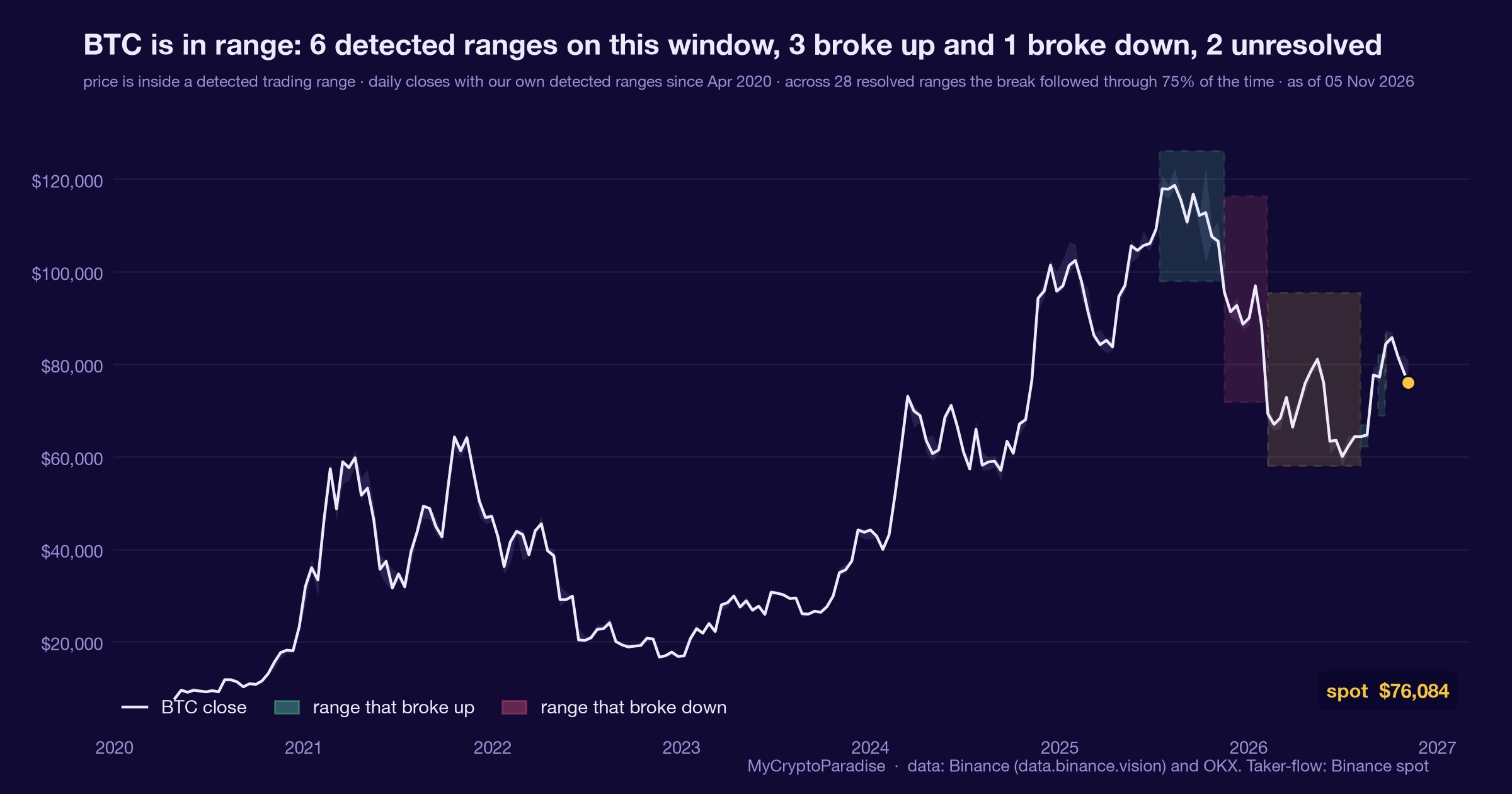
Start with BTC. Bitcoin was trading near $75,803 as of 04:49 UTC, a fraction above its key support at $76,000. A regulatory confidence overhang does not help a market already testing that floor. It removes a layer of marginal retail demand just as the level matters most.
ETH carries a sharper tail. The stolen funds were converted primarily into ETH, which means a large pool of tainted supply now sits in hostile hands. As launderers cycle it through networks, exchanges may freeze or flag addresses, adding friction to ETH liquidity specifically. That is an asset-level overhang the warning indirectly spotlights.
BNB sits closest to the fire and barely moved. At $694.19, down a quarter percent on the hour, the token at the center of the hacked exchange shrugged. That tells you the market has priced the headline as old news, not fresh danger.
Alts feel this last and worst if confidence erodes. In a risk-off drift, lower-liquidity tokens bleed first, because the marginal retail buyer the regulator just warned off is exactly who holds them. So the cascade here is slow and psychological. No forced liquidation chain, just a steady tax on sentiment: custody risk, laundering headlines and a regulator saying the quiet part out loud.
Where the stolen ETH goes next
The live wire is security, not macro. Watch the stolen funds first. If more exchanges or vendors report breaches in the coming days, the confidence overhang deepens and the bearish read strengthens.
Watch the ETH addresses tied to the laundering. Fresh freezes or exchange flags would confirm the tainted-supply friction. A clean, quiet movement of funds through Chinese networks, with no new victims, would suggest the damage is contained and the story fades.
On price, the confirmation is simple and brutal. A clean daily close below $76,000, with rising volume, tells you the marginal buyer stepped back and the regulatory chill is biting. That opens the path toward the $70,000 to $71,000 liquidation pocket below.
Invalidation runs the other way. If BTC reclaims $76,000 and holds it on a retest with fading sell volume, the news has been absorbed and the warning was noise. BNB holding flat near $694 already hints at that absorption.
Also watch the banking angle. If US outreach to commercial banks escalates into formal guidance or restrictions, that is a genuine new catalyst, and it would read bearish for the whole sector. Silence there means the contagion fear stays theoretical.
Finally, watch whether other regulators echo Singapore. One hub repeating an old line is noise. A chorus of regulators within the same week is a trend, and trends in scrutiny tend to compress valuations before they compress anything else.
Reading a shrug near $76K support
The ParadiseTeam reads this headline as background noise against a louder structural tug-of-war. The regulator's warning shifts sentiment at the edges. It does not move the levels that matter.
BTC was near $75,803 as of 04:49 UTC, sitting right on the $76,000 support that defines the current fight. That line is the invalidation level for the near-term bulls, and a confidence overhang is exactly the kind of story that tempts retail to sell into it.
But watch who is on the other side. Whales have been net buyers into this dip, absorbing sell pressure while the Fear and Greed index sits near 20. Regulatory fear headlines like this one tend to manufacture the panic that smart money quietly buys. The ParadiseTeam sees this warning as more fuel for that retail fear, not evidence of a new down-leg on its own.
If $76,000 holds, a short-covering squeeze toward the $81,700 to $82,500 cluster stays on the table, where roughly 2.2 billion in short liquidations sit as a magnet. That upside would be relief, not a trend change.
The dominant daily and weekly picture stays bearish toward $44,000 until proven otherwise. So the ParadiseTeam treats any squeeze as a move to fade, and any break of $76,000 on rising volume as confirmation of the bigger bearish thesis. News like this nudges fear. The levels decide the direction.
The read behind this: we framed this story through our own market analysis, Bitcoin Squeeze to $82K or Crash to $44K?
Track it live: our Crypto Fear and Greed Index and the live crypto funding rates both update in real time, so you can watch this shift for yourself.
Related coverage
For exact entries, targets, and stop losses with full risk management, that is what ParadiseFamilyVIP is for. New to reading these moves? Start with our crypto trading strategies guide.
ParadiseTeam is monitoring the market situation closely, and we are taking these developments into consideration while building our trading tactics inside ParadiseFamilyVIP.
Crypto trading involves substantial risk. Prices are volatile and you can lose money. This article is educational and is not financial advice. Past performance does not guarantee future results.
Is security risk now a bigger threat than macro to crypto?
How 1 Paradiser is calling it
The first call is still open
Free account, no password. Members just sign in.
Follow this topic: Crypto regulation news









Join the discussion
No comments yet. Members, share how you are reading this.