

In short
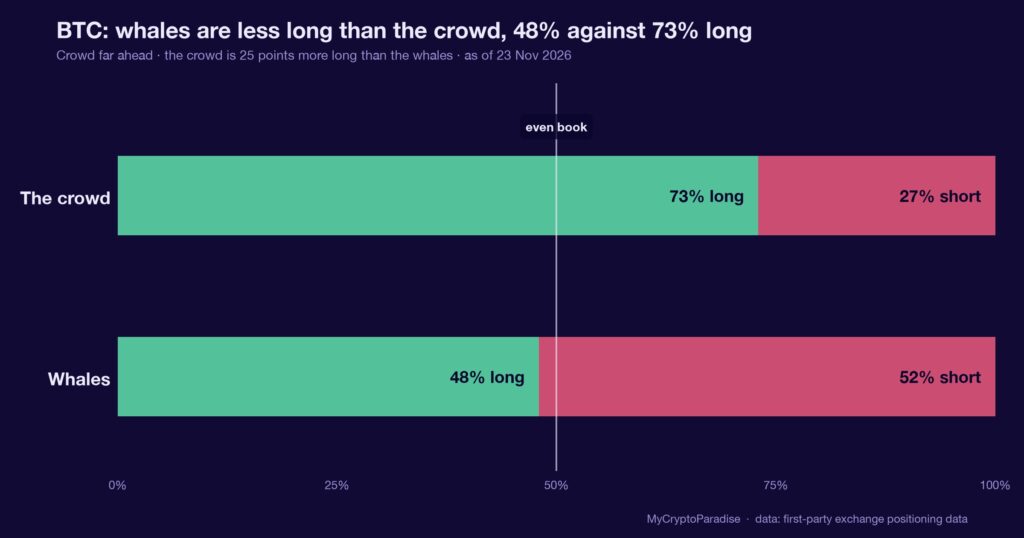
The Whale Index is our composite read on big-wallet behaviour: it blends spot flow, positioning, price lean and liquidation skew into one 0 to 100 score. On 23 November 2026, with BTC near $61,237, the Insider feed said whales were buying support at their cost basis. Our own tape agrees on the narrow point: whale spot flow netted plus $264.64 million over 24 hours. Yet the full index reads 44, sell-side, sitting in only the 30th percentile of its month. We called this a divergence, not a reversal, and explicitly not a bottom. The reason is positioning: the crowd is 73 percent long against the whales’ 48 percent, a gap that has run 33 days. This piece shows you how to read whale flow against positioning yourself, and where the read breaks.
Key facts
- Whale long share on BTC
- 48%
- Crowd long share on BTC
- 73%
- Crowd minus whales, long share
- +25 points
- Positioning read
- Crowd far ahead
- What would prove this read wrong
- The Whale Index reclaiming 50 of 100 as the crowd-versus-whale gap compresses toward single digits, or the Coinbase premium turning decisively US-led, ends the defensive read.
- Reading taken
- 23 November 2026
- Source
- Our MCP Insights tools, from our own MCP Insights first-party data
One large buy is not a market stance
A whale buying spot tells you that one large wallet wanted coins at one price. It does not tell you how that same cohort sits in leverage, or whether the wider crowd is already piled onto the same side of the trade.
That is why a single flow number can mislead. Spot accumulation, perpetual positioning, the price lean on native venues and the balance of forced liquidations are four different questions, and they do not always answer the same way.
Price can hold a cost-basis zone for honest reasons or fragile ones. The difference is not in the buying itself but in everything stacked around it: who else is already positioned, and at what leverage.
A metric that reports only the buying it can see, and none of the leverage behind it, is a headline, not a position.
The tape agrees, the index does not
Per our MCP Insights whale tape, BTC spot flow netted plus $264.64 million in the 24 hours into 23 November 2026: $685.87 million bought against $421.23 million sold across 91 tracked orders, lean accumulation. On the narrow claim, the Insider feed is right.
The composite disagrees. Our Whale Index reads 44 on its 0 to 100 scale, sell-side, in the 30th percentile of the last 30 days.
Flow leans positive at plus 0.239, but positioning leans minus 0.303, the price lean on native venues is minus 0.039, and the liquidation skew sits at minus 1. Three of four inputs pull down.
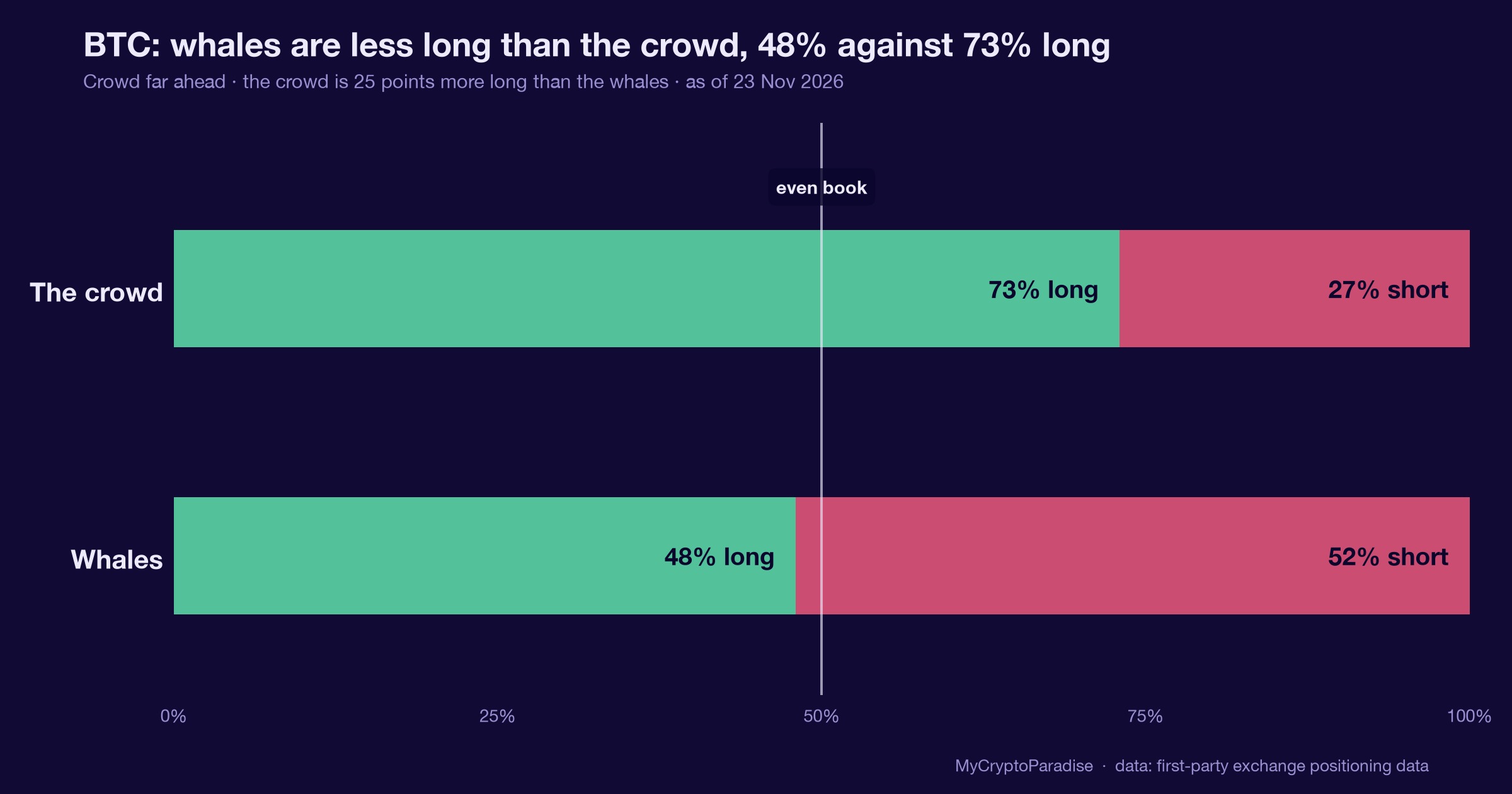
Positioning carries the weight. Our own exchange grid has the crowd 73 percent long against whales at 48 percent, a 25-point gap that has run 33 days, with funding at 5.84 percent annualised and longs paying.
A reading that quotes only the buying is marketing. The three inputs that disagree are what size the risk.
What is different here
The ParadiseTeam does not repeat the Insider headline and move on; it reads the same event against its own tape first. Where the feed saw whales buying support, our composite index and positioning grid found three of four inputs leaning the other way, so we weighted the claim rather than echoing it.
Crowded longs are the near-term risk
The obvious misreading is to take whale spot buying as a green light. Support that whales defend is real, but it sits underneath a market where the crowd is already 73 percent long and paying to hold that bet.
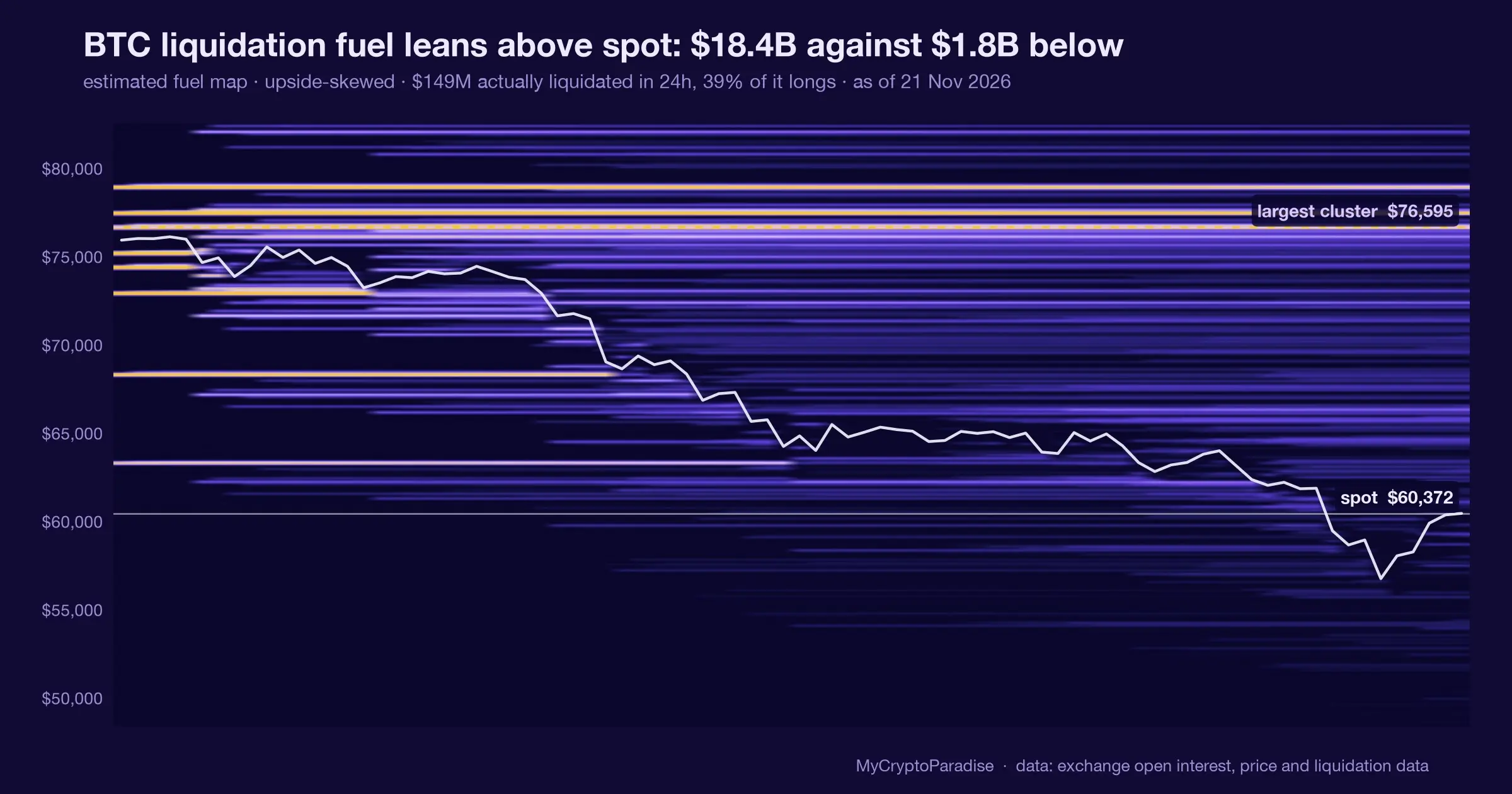
Crowded, leveraged longs are fuel. When price stalls, the cheapest liquidity to take is the stops of the majority, and right now the majority is long. The liquidation skew at minus 1 says the forced flow that exists leans long, not short.
This whale read is one indicator among several. It sits alongside funding, positioning and the premium tape, and today it is the input that disagrees with the bullish headline.
Support below and crowded longs above is not a contradiction. It is a range, and the leverage decides which edge breaks first.
US venues have not led the bid
If real demand were turning, the Coinbase premium would show it. Per our MCP Insights spot premium, US venues led the BTC price in just 1 of 22 graded sessions since 22 October, and the current session runs at minus $5 a coin. The premium sits at minus 0.0066 percent.
So the spot buying is there, but it is not US-led, and it is not broad. One cohort buying its own cost basis is a floor, not a trend, until the premium and the positioning gap move with it.
Breadth is the missing ingredient. One cohort defending a number it bought at is support you can measure, but it is narrow by definition, and narrow floors are the ones that give way when the leveraged majority is forced to sell into them.
A floor is a place to lean from, not a reason to chase. The bid that matters is the one the whole tape joins.
Where this read goes wrong
The read breaks in two clean ways. If the Whale Index climbs back through 50 and the crowd-versus-whale gap compresses toward single digits, the positioning risk drains and the spot buying becomes the dominant story.
It also breaks on funding. Longs paying 5.84 percent annualised is a mild lean, not an extreme; if funding flips to shorts paying, the crowd is no longer the crowded side and the squeeze risk inverts.
The honest version of a divergence names both exits. A read that cannot be wrong was never a reading.
Reading whale flow against positioning yourself, step by step
- Start with the raw spot tape: check the 24-hour whale net flow and whether it leans accumulation or distribution.
- Do not stop at flow; pull the composite whale score and see which timeframes read buy versus sell.
- Read positioning next: compare the crowd long share against the whale long share, and note the size of the gap.
- Check who pays: a positive funding rate with longs paying tells you the crowded side is leveraged and exposed.
- Confirm with the premium tape: see whether US venues are leading the bid or merely following an offshore move.
The step people skip is the funding check: flow and price feel like the whole story, but the rate quietly tells you which side is paying to stay wrong.
Every number above is checkable against the live data. Start with the live crypto funding rates, then cross-read the MCP Insights hub and the Crypto Fear and Greed Index.
Act and invalidate
| Scenario | What confirms it | What kills it |
|---|---|---|
| Range holds, longs bleed | Funding stays positive, index below 50 | Whale Index reclaims 50 |
| Support gives way | Liquidation skew stays long, net flow flips | Crowd long share drops toward 48 percent |
| Real bid confirms | US premium turns leader, gap compresses | Premium stays offshore, crowd stays 73 percent long |
Posture: Defensive while the crowd sits 73 percent long into whale support: a floor to lean from, not a breakout to chase. No trade is a valid read here.
Frequently asked questions
Did whales actually buy Bitcoin on 23 November?
Yes, on the narrow point. Our 24-hour whale tape netted plus $264.64 million in BTC spot, with $685.87 million bought against $421.23 million sold across 91 orders. The accumulation lean is real; the dispute is whether it outweighs crowded positioning.
What is the Whale Index measuring here?
It is a 0 to 100 composite that blends spot flow, perpetual positioning, native-venue price lean and liquidation skew. On 23 November it read 44, sell-side, because three of those four inputs leaned down even as spot flow leaned up.
Why does crowded long positioning matter?
Leveraged longs are the liquidity a stalling market reaches for. With the crowd 73 percent long against whales at 48 percent and funding positive, the majority is paying to hold the exposed side, which raises the odds of a downside flush over an upside break.
Is this a reason to buy the dip?
It is one input, not a trigger. Whale support is a floor to lean from, but the positioning gap and an offshore-led premium argue against chasing. The highest-probability posture for most remains patience until the tape agrees with itself.
What would flip this read bullish?
Two things together. The Whale Index reclaiming 50 as the crowd-versus-whale gap compresses toward single digits, and the Coinbase premium turning US-led. Until those move, spot buying alone is a floor, not a trend, however genuine it is.
Crypto trading involves substantial risk and is not suitable for everyone. Nothing here is financial advice; it is education only. Never risk more than you can afford to lose.
The private Extras feed, where the whale flow tape, the composite Whale Index and the crowd-versus-whale positioning gap update intraday, is part of PRO Paradiser, the intelligence layer behind the ParadiseFamilyVIP strategies.










Join the discussion
No comments yet. Members, share how you are reading this.