

In short: A liquidity sweep is a fast push past an obvious high or low that triggers resting orders, then reverses. The close decides: wick beyond, then back inside on that candle or the next, is a sweep, not a breakout. A sweep shows where resting stops were taken; read it with the next swing break before acting on it.
Your own stop-loss can become the fuel for the move that stops you out. That is the uncomfortable lesson hiding inside a liquidity sweep.
Traders also call the same event a liquidity grab or a stop hunt. This MCP University FREE lesson shows what gets swept and where a stop sits beyond its reach.
What liquidity means on a chart
Liquidity means orders waiting to be filled. Pools of resting orders sit just beyond obvious swing highs and swing lows that stand out at a glance. A swing high is a peak that rises above the candles on both sides; a swing low is the mirror.
Why there? A long position gains when price rises, a short one when price falls. A stop-loss order is an automatic exit that becomes a market order at a set price, so longs rest theirs under the recent low. A market order fills at once at the best available price.
Traders who are short do the mirror: their stop sits just above the recent high. Both pools are predictable, so one fast push past the level can reach many stops at once.
Leverage lets a trader control a large position with a small amount of capital. Leveraged futures, contracts that track an asset’s price, add a second pool. A forced liquidation closes a leveraged position when the account is under-margined and a margin call goes unmet. A margin call is a demand to add funds when margin runs too low.
These liquidation levels also stack beyond obvious highs and lows. So a visible level is not just a line: it is a shelf of resting orders.
When price reaches that shelf, the orders become market orders and add fuel to the move. This is the core of smart money concepts (SMC), a way of reading charts around resting liquidity.
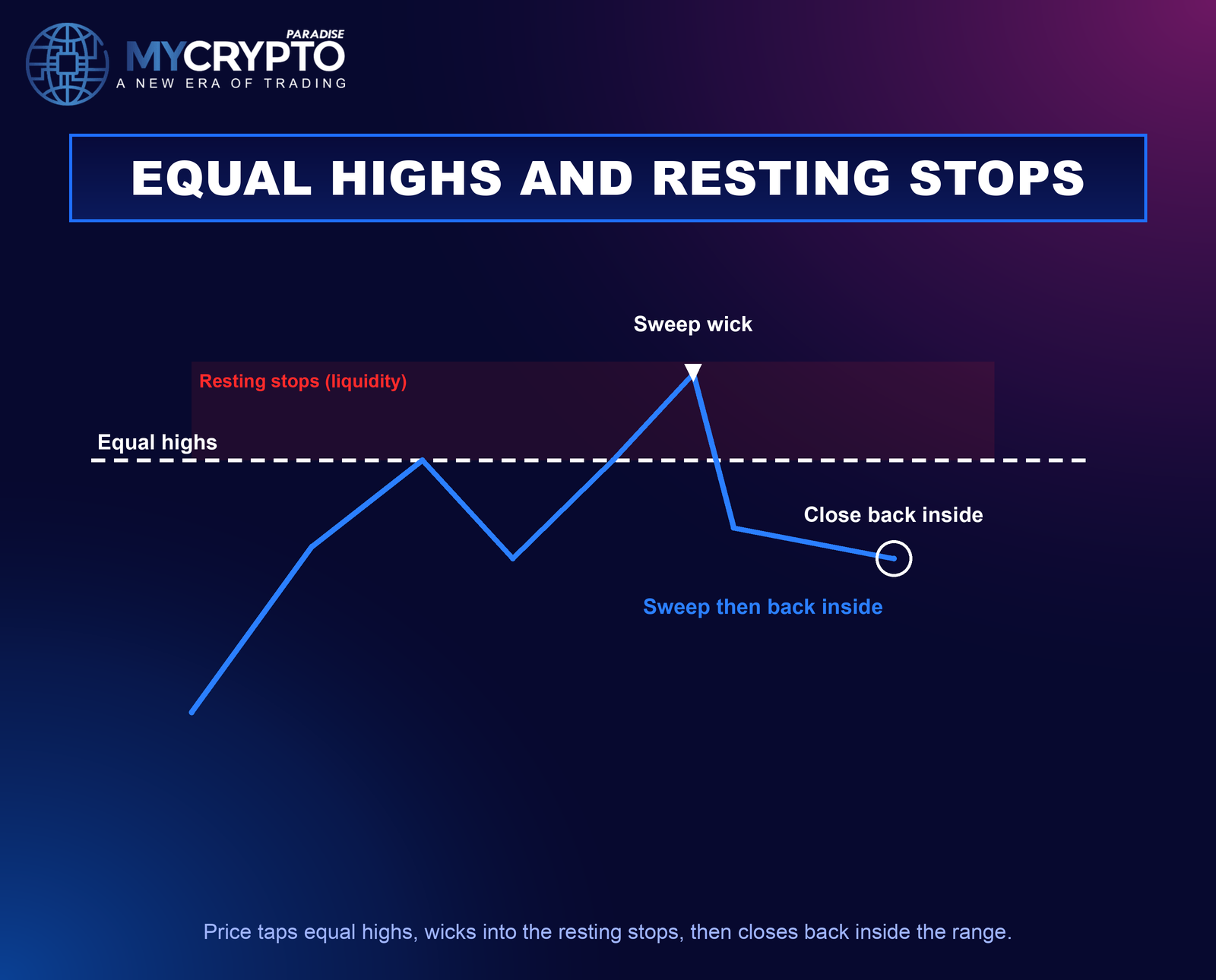
Equal highs are two or more tops at about the same price: an obvious shelf where stops gather.
Sweep versus breakout: the close decides
A breakout is when price closes beyond a level and holds, starting a new leg. A sweep looks the same for a moment, then fails.
The difference is the close. A wick is the thin line on a candle that marks the high or low reached. A range is the band price traded in before the push. In a sweep, price wicks past the level, triggers the orders, then closes back inside the old range, on that candle or the next.
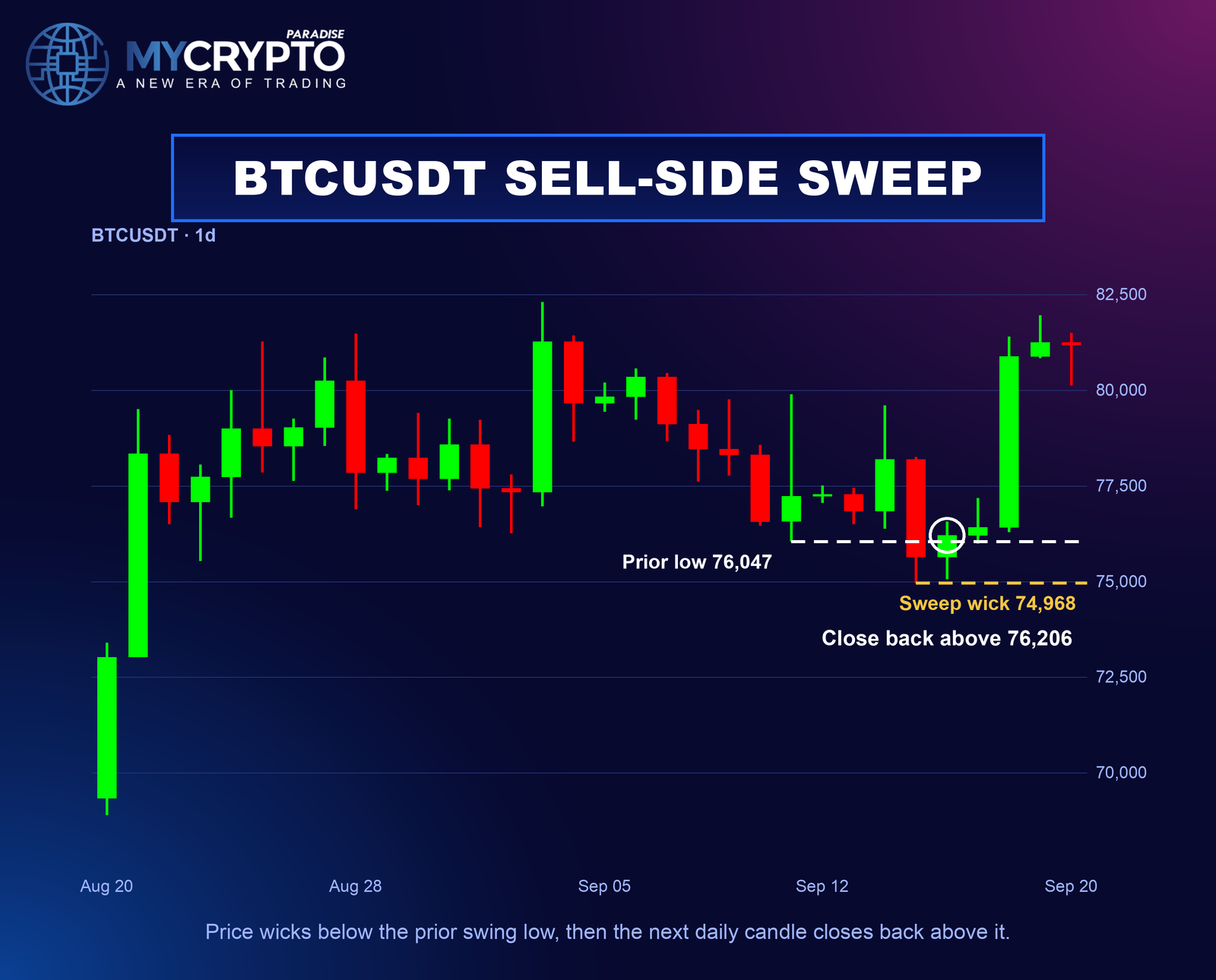
Take a sell-side sweep, a push below a low. On 2026-09-15 the BTCUSDT (Bitcoin priced in the USDT stablecoin) daily candle dipped to 74,968, below the 2026-09-11 swing low at 76,047.
It closed that day at 75,644, still below the level. The next day, 2026-09-16, it closed back above at 76,206, so the sweep took one extra candle to close inside. A daily candle can split the push and the recovery across two closes.
The mirror is a buy-side sweep, a push above a high. On 2026-08-28 price spiked to 81,479, just above the 2026-08-25 high at 81,273, then closed far lower at 77,846.
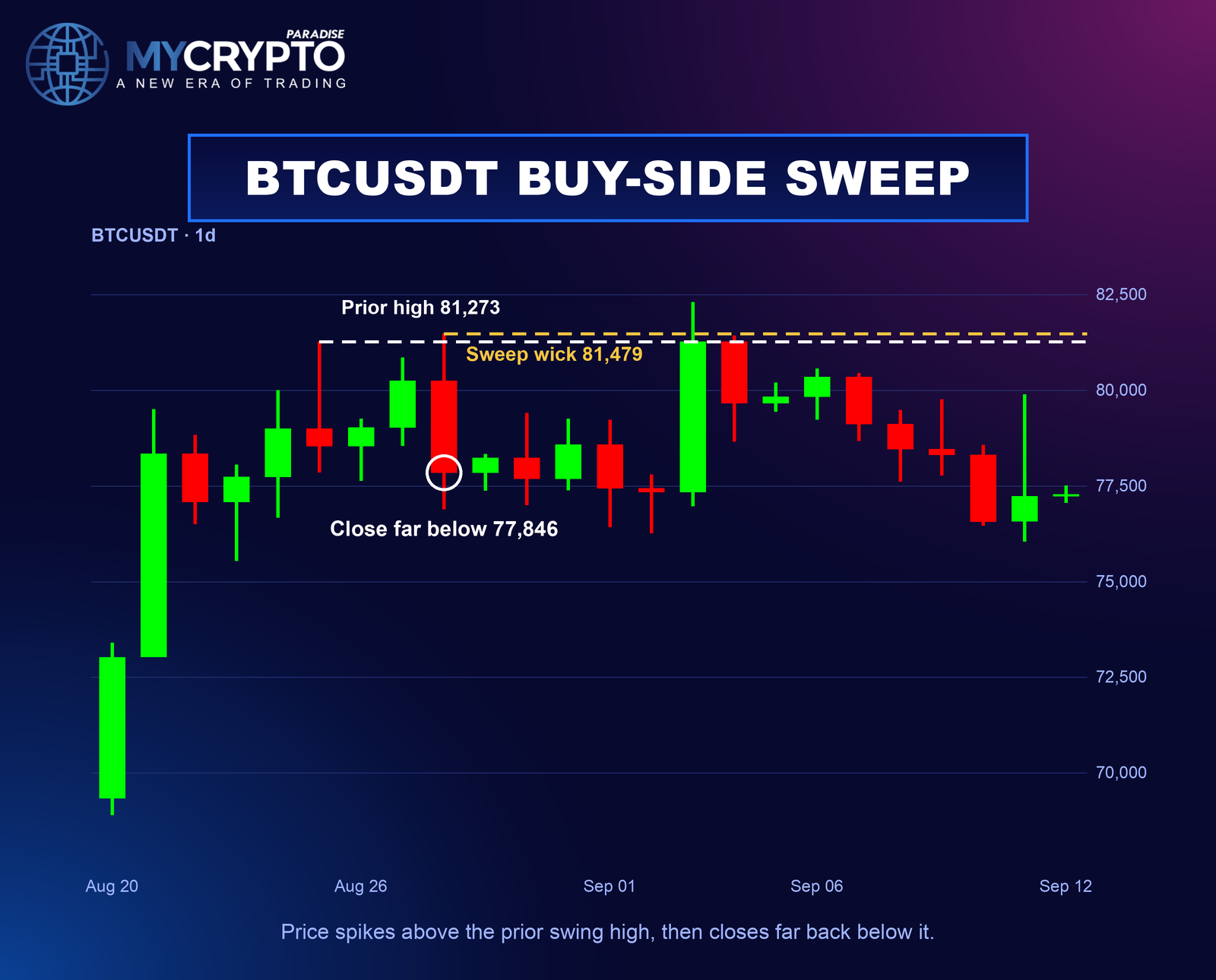
A simple rule: wick beyond and close back inside, on that candle or the next, is a sweep. Close beyond and build from there is a breakout. Waiting for the close means you never act on the wick alone.
Leverage, 24/7 trading and chained liquidations
Three features of crypto markets can put more resting orders beyond the obvious levels.
First, leverage is high and easy to reach. So a small move can force many leveraged exits at once.
Second, crypto trades around the clock. No closing bell means a thin session can let a push travel further on less volume.
Third, liquidations can chain. When price hits a cluster, forced exits push it further, which triggers the next cluster: a liquidation cascade.
A cascade can stretch a sweep far past the level, and price may or may not snap back. Reading a liquidation map before a futures trade shows where those clusters may sit.
The same force explains why cascades shape position sizing: a wider real-world wick demands a smaller position.
Sweep plus change of character: the reversal sequence
After a sweep, look for a change of character (CHoCH).
A change of character is when price breaks a recent swing in the opposite direction after the sweep. It shows the short-term structure has changed direction.
Keep a CHoCH apart from a break of structure (BOS), which extends the current trend instead. The gap between BOS and CHoCH is worth studying.
The reversal sequence reads in three steps:
- Price sweeps the obvious level.
- Price reverses off it.
- Price closes beyond the last swing the other way.
A lower high is a swing high below the one before it. On the BTCUSDT four-hour (4H) chart, the candle that opened at 20:00 Coordinated Universal Time (UTC) on 2026-09-14 set a lower high of 79,600. It then swept the lows to 74,968 on 2026-09-15.
The 4H candle that opened at 12:00 UTC on 2026-09-18 closed at 80,726, back above that lower high. That close above the prior lower high is the change of character.
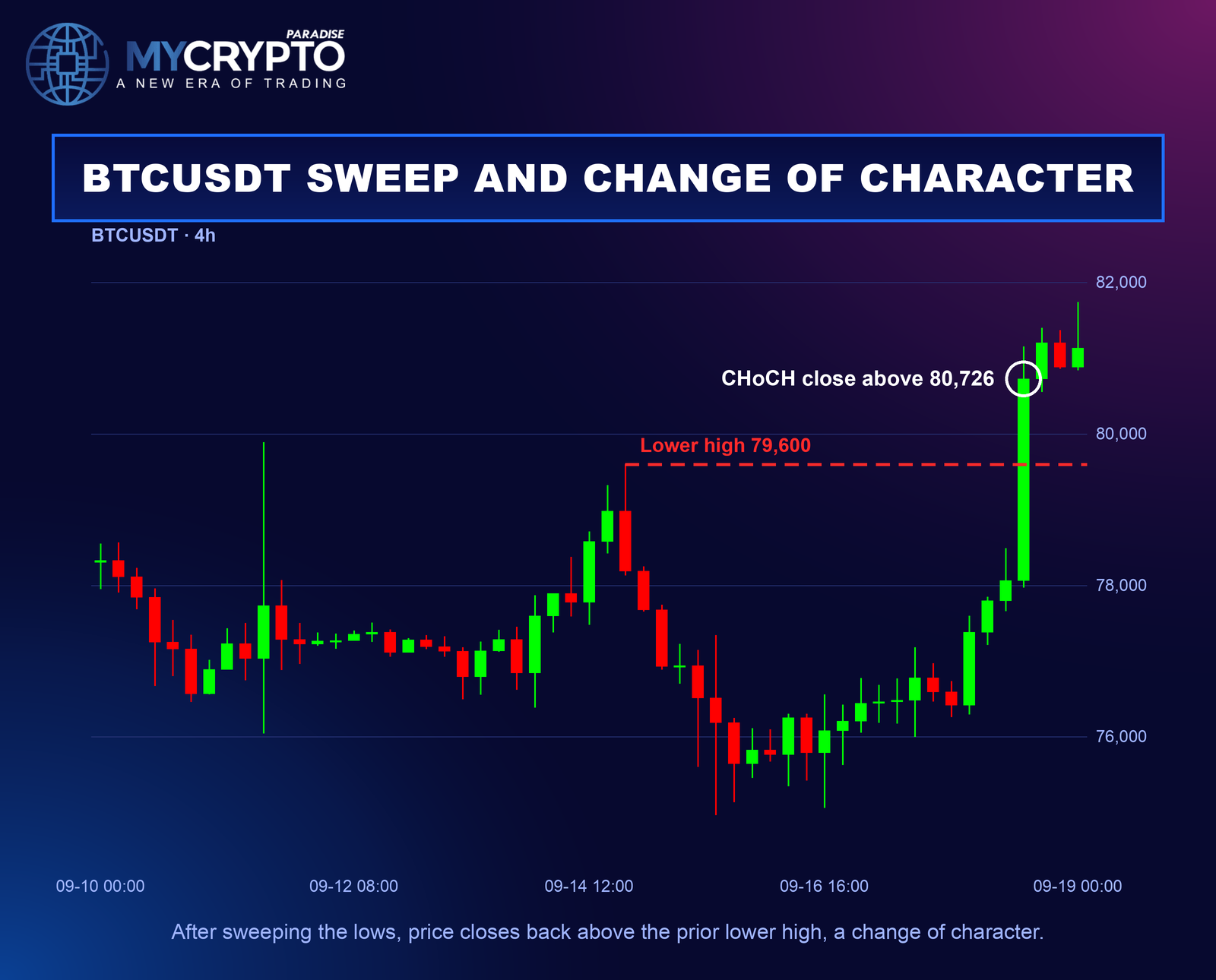
Here the turn showed only on 2026-09-18, three days after the sweep.
Spring and upthrust: the Wyckoff names for a sweep in a range
The Wyckoff method has older names for this event, and they still fit crypto. The wick and the close read the same way; Wyckoff adds where in the range it happens.
A spring is a sell-side sweep near the bottom of a range. Price dips below support, a floor where buying has held before, traps sellers, then recovers inside. In the Wyckoff schematic, a map of how a range develops, it comes late in accumulation, where buyers absorb supply before a rise.
An upthrust is the opposite: a buy-side sweep near the top of a range. Price pokes above resistance, a ceiling where selling has held before, traps buyers, then falls back inside. It comes in distribution, the range where sellers unload before a fall.
To study the pattern in depth, read Wyckoff Spring and Upthrust on reading failed breakouts.
Common mistakes
The first mistake is entering on the wick. You see the level break, buy or sell in the breakout direction, and a reversal can stop you out before the candle closes.
The second is parking your stop at the exact level. The prior high or low is where resting orders gather, so a wick reaches a stop parked there easily.
The third is treating a sweep as a promise. Wait for the CHoCH close before treating the sweep as a turn, because a swept level can still break for real.
Practice this
Give the level room. Set your stop beyond where a normal sweep would reach, so a quick wick does not take you out before your idea plays out.
Then size the position so the wider stop still fits your risk. Risk a small, fixed share of the account per trade, so a run of losing trades leaves the account able to keep trading. Let the stop distance set the size, so the amount at risk stays the same however wide the stop is.
You cannot see resting orders on a bare price chart. Three tools help picture the liquidity before price arrives.
Order books show large resting orders, whale trackers flag outsized flows, and a liquidation heatmap shades where leveraged exits may cluster.
A position size calculator does the sizing math. Use these tools as context, not as a signal on their own. They show where orders rest, but resting orders can be pulled or never trigger a turn.
To put this into practice, work through a recent sweep on your own chart:
- Mark the obvious swing high and swing low.
- Wait for a wick past it, then watch the close.
- Note whether price closes back inside or holds beyond.
- Check for a close beyond the opposite swing, the CHoCH.
- Plan a stop with room beyond the level.
Order Book Walls, Crypto Whale Alerts and the liquidation heatmap can add context to a read like this.
FAQs
Is a liquidity sweep the same as a stop hunt?
Yes. Stop hunt and liquidity grab name the same event: a push past an obvious high or low that triggers resting orders, then reverses. The intent behind it does not change the chart behaviour you read. Whatever the name, the close back inside is what marks it.
Is liquidity good in trading?
It depends on the sense. For filling orders, yes: a liquid market lets you buy or sell with little price impact. In a sweep, liquidity means something narrower: the stops and liquidation levels resting beyond a high or low. A fast push can set those off in seconds.
What is a liquidity trap in trading?
It is a move that lures entries toward a false break, then reverses against them. A sweep is one version: price trips the orders beyond an obvious level, then snaps back inside and traps the chasers. The chasers are the traders who entered on the break before the candle closed.
Does a sweep guarantee a reversal?
No. A sweep only shows where resting stops were taken, so it never promises the turn by itself. Price can wick a level and simply keep going. A close beyond the opposite swing, the change of character, is the next thing to check.
This class is part of the free education library from MyCryptoParadise, a professional crypto signals and trading education service operating since 2016.
Risk disclaimer: Crypto trading involves substantial risk of loss. This class is education only, not financial advice. Never trade with money you cannot afford to lose. Past results do not guarantee future results.
How this class was made: AI-assisted writing from our own research brief, checked against our data and editorial rules by our review system. Every chart is drawn by code, the market charts from real price data.






Join the discussion
No comments yet. Members, share how you are reading this.