

Listen: the breakdown
Developing story update (September 03, 2026, 01:10 UTC):
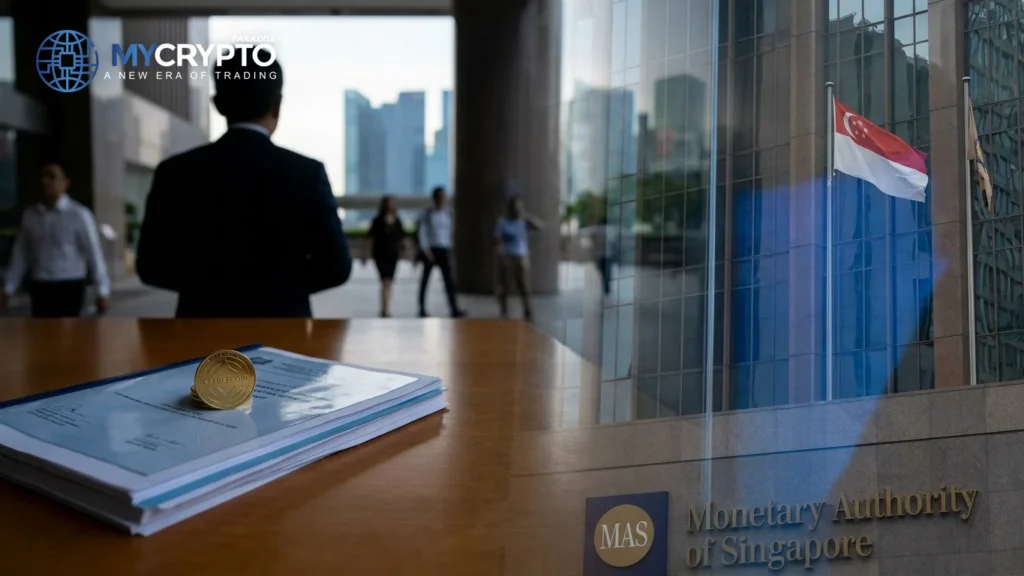
Singapore proposes BANNING stablecoin issuers from paying yield to holders. The Monetary Authority of Singapore wants 100% reserve backing at all times, segregated custody, stress testing, an. Singapore proposes BANNING stablecoin issuers from paying yield to holders. The Monetary Authority of Singapore wants 100% reserve backing at all times, segregated custody, stress testing, and mandatory wind-down plans. Only licensed issuers can call their tokens "MAS-regulated stablecoins." The US GENIUS Act, the EU's MiCA, Hong Kong, and Japan already enforce similar rules.
FIVE of the
Developing story: This story is still unfolding. We are tracking it and will update this article as more details are confirmed.
Market briefing: Singapore's central bank has proposed a strict stablecoin license demanding full reserves and no holder interest. Bitcoin was trading near 78,967 dollars as the news landed, up about 1.2 percent on the day, barely reacting.
- MAS proposes a dedicated stablecoin license requiring 100% reserves and no interest for holders.
- Issuers keep the reserve income, a business line worth billions, while users lose the yield.
- Regulation is a slow structural tailwind, not the same-day catalyst that moves BTC or ETH.
Source: Monetary Authority of Singapore
Singapore just proposed a stablecoin license demanding full reserves and zero holder interest, tightening the rules as global frameworks mature. So who really gains from this shift?
The Monetary Authority of Singapore has proposed amendments to its Payment Services Act. The move would create a dedicated license for stablecoin issuers. It targets single-currency stablecoins issued in Singapore, pegged to the Singapore dollar or a G10 currency. This is not a vague suggestion. It is a framework taking real shape.
Two conditions define it. Issuers must hold 100% reserve assets behind every coin. Holders earn no interest on what they own. That second rule matters more than it first appears, because it quietly settles who keeps the money.
Stablecoin reserves are not idle. They sit in short-term instruments that earn yield, and at scale that income runs into billions of dollars a year, an estimated 3.5 billion for the largest issuers. Under this proposal, that income stays with the issuer. The holder gets stability and nothing else.
Singapore is not acting alone. The European Union, United States, United Kingdom, and Hong Kong are all maturing their own stablecoin rules. The direction is consistent. Regulators want reserve-backed digital money that behaves, not speculative yield instruments that surprise.
Markets shrugged. Bitcoin was trading near 78,967 dollars as the proposal circulated, up roughly 1.2 percent on the day. Ethereum sat near 2,474 dollars. Neither moved on the headline, which tells you something. Structural regulation rarely arrives with a price tag attached, however important it proves later.
The reserve rule reshaping issuer economics
Follow the income, and this proposal gets clearer. A stablecoin is a claim on cash the issuer holds. Those reserves earn interest. The 100% reserve rule guarantees the backing is real, which protects users from a collapse. But the no-interest rule decides who pockets the yield, and the answer is the issuer, not you.
That design choice is deliberate. Regulators want stablecoins to act like money, not like a savings product. A coin that pays interest starts to compete with bank deposits and money-market funds, and that invites systemic questions no central bank enjoys. Strip the yield, and the coin becomes a clean payment rail instead.
The transmission runs through the business model. Regulated issuers get legitimacy and predictable revenue. Unregulated or offshore rivals keep offering yield to attract users, at least until their own regulators catch up. So the moat widens for compliant players and narrows for speculative ones.
For the wider market, the effect is slow, not sudden. More trusted stablecoins mean deeper, more reliable liquidity underneath crypto over time. That is genuinely useful. It just does not fire on the day of an announcement.
There is a quiet irony here. The safest version of digital dollars is also the least exciting one for holders chasing return. Stability and yield rarely share a seat. Singapore has chosen stability, and that choice tells you where serious regulation is heading everywhere.
Where liquidity actually flows from here
Start with what did not happen. Bitcoin held near 78,967 dollars and barely twitched. That is the honest signal. A regulatory proposal in one jurisdiction is not a liquidity event, and the tape agrees.
The real mechanism is longer term. Stronger stablecoin rules deepen the base layer of crypto liquidity. Most trading pairs settle in stablecoins, so their credibility feeds directly into how smoothly BTC and ETH trade. Cleaner rails eventually mean steadier flows. But eventually is doing a lot of work in that sentence.
Bitcoin sets the tone as always. With BTC drifting up 1.2 percent on thin conviction, there is no fresh capital charging in on this news. Ethereum near 2,474 dollars looks the same, up 1.6 percent, tracking rather than leading.
Ethereum does carry one live thread worth naming. BitMine added 53,501 ETH over the past week, lifting its stack to 5,901,112 ETH, roughly 4.9 percent of supply. That is structural accumulation, and it matters more to ETH than any stablecoin headline does today.
Altcoins sit at the far end of the chain. They need Bitcoin strength and abundant liquidity to run, and neither is decisively present. Regulation that favors compliant stablecoins may, over quarters, support a healthier alt environment. In the short run, alts stay hostage to BTC's direction and to whether this 1.2 percent bid is real demand or just retail chasing a quiet green candle.
Levels that decide the next Bitcoin leg
The first thing to watch is not a level. It is whether other regulators echo Singapore. The EU, US, UK, and Hong Kong are all mid-cycle on stablecoin rules, so a coordinated tightening would confirm this as a structural trend rather than a local headline. That is the slow signal, and it points to legitimacy over quarters.
On price, the question is simple. Is the 1.2 percent bid in Bitcoin backed by real demand, or is it retail buying a calm day? Confirmation looks like BTC holding above the round 78,000 dollar area and building volume as it presses toward 80,000. That would suggest buyers are absorbing supply, not just poking at it.
Invalidation is just as clear. A slide back through 78,000 on rising volume would tell you this uptick was thin, and that sellers still control the structure. In that case, the regulatory news changes nothing about the tape.
Watch Ethereum's accumulation story too. If large holders keep adding ETH the way BitMine has, that quiet bid can matter more than any headline. Continued buying is a tell.
Above all, resist reading regulation as a trade trigger. It rarely is. The market that ignores a headline today often only prices it in months later. Track the trend, size for the actual tape, and let confirmation, not the news cycle, decide your bias.
What no-yield stablecoins mean for crypto liquidity
The ParadiseTeam reads this as a structural story wearing a news headline, and the two should not be confused. Bitcoin near 78,967 dollars moved 1.2 percent and shrugged, which is exactly how price behaves when a story is important but not urgent. Do not trade the calendar entry as if it were a catalyst.
Liquidity is the real thread here. Stricter, fully reserved stablecoins eventually make the plumbing of crypto more trustworthy, and better plumbing supports cleaner moves in BTC and ETH. That is a tailwind measured in quarters, not candles. Position for it with patience, not leverage.
On the tape, the ParadiseTeam stays balanced. The 78,000 dollar round number is the line that matters near current price. Holding above it with real volume keeps the door open toward 80,000. Losing it on strength argues the bid was retail and premature.
Watch who is actually buying. The ETH accumulation from large holders, now near 4.9 percent of supply in one stack, is a stronger signal than any regulatory print. Smart money accumulates quietly on structure. Retail reacts loudly to headlines.
Our stance is risk-first and honest. This is not a same-day bull trigger, and it is not a reason to sell. It is confirmation that the ecosystem is maturing while the market still waits for a decisive move. Trade the level, respect the round number, and let volume, not the news, set your bias.
Track it live: our live crypto funding rates tracks this in real time, so you can watch it play out for yourself.
Related coverage
For exact entries, targets, and stop losses with full risk management, that is what ParadiseFamilyVIP is for. New to reading these moves? Start with our crypto trading strategies guide.
ParadiseTeam is monitoring the market situation closely, and we are taking these developments into consideration while building our trading tactics inside ParadiseFamilyVIP.
Crypto trading involves substantial risk. Prices are volatile and you can lose money. This article is educational and is not financial advice. Past performance does not guarantee future results.
Does strict stablecoin regulation help crypto over the next year?
This is how 19 Paradisers are calling it. Tap your call.
No calls on this one yet. Tap yours to be the first.
Free account, no password. Members just sign in.
Follow this topic: Stablecoin news









Join the discussion 24
man, 100% reserves… 🥵 I just remember those UST days, getting chopped up holding that bag, lol. anyone else?! 🤦♂️
oh wow benny, so real 🥺 it was a lifesaver for my family too, getting money home was always such a headache before stablecoins! 🙏 big ups to MAS for this clarity ✨
wonder if the no interest rule is to deter whales from holding large amounts and influencing the market, but then what about liquidity?
This is awesome, 🤩 for my family in Da Nang it was always a headache sending money home! 🇻🇳 That 100% reserve idea 💯 makes holding so much safer. ⬆️
this reserve part is good for me too i keep my spending cash there its useful for when i move it later
yeah tommy, this is great for smaller amounts too, knowing its there and not in a risky defi protocol is a relief.
this focus on reserves is encouraging... it makes holding my tuition earnings safer between semesters. a clear framework like this could help many.
MAS focusing on the reserve side is smart... I wish we had this clarity earlier, it would've helped my family when getting money was impossible.
The framing of this as "liquidity" misses the crucial point - this is a demand-side question. Restricting interest to holders only reinforces that capital will go elsewhere.
I see this more as an attempt to introduce clarity for users, Isabella. Full reserves are fundamental for any unit of account.
Clarity is not the same as utility, Ben. Full reserves for stablecoins, while ostensibly sound, are a structural disincentive to adoption when competing alternatives offer yield. Capital will simply migrate.
mas focus on reserves does mean less liquidity on the exchange side its an interesting tradeoff but one that makes sense for longer term stability in my view
i always worry about the money being there when you need it you know especially with all the things you hear about on instagram 😬
Grace, the security of the underlying assets is one element. Another is how readily those assets can be accessed or converted during peak demand.
Totally agree, Grace! It's why I started looking into this whole space after some transfers went nowhere for a while 😅. The certainty is such a relief.
The focus on "liquidity" here still feels disconnected from actual on-chain flow. The distinction between reserve backing and active market supply is a relevant gap.
that 100% reserve makes the stablecoin behave like the bank account I use for hedging it holds value better through the seasons
It's really encouraging to see this focus on stability. After that first payment arrived so quickly, this whole world just clicked for me ✨. Makes me feel a bit less nervous, actually!
hey yuki, i get what you're saying about stability but i think the interest thing could actually help liquidity. more people might use em if they earned a little. 🤔
it really did click different, huh? 🤯 it's good to hear it made a difference for you too, yuki. that kinda reassurance is everything! 💖
it just reinforces my practice of not holding anything in a stablecoin if i cant see its audited reserves and have a clear exit path.
I get your point Katya, but for me, I think if the audits are clear, that’s enough. 🤔 I’m still figuring out exit paths anyway… hard to find good info.
i get that for sure - but its a double check for *them* to see how much they can actually move without crashing the system too 🤔
i see it different. audits are snapshots, not continuous. liquidity dictates your exit, not whats on a balance sheet.. 🌊