

Listen: the breakdown
Market briefing: A single unrevoked approval let a phisher drain a trader twice, roughly 219,000 SYN in total. No price impact, yet a sharp reminder of long-tail risk. Bitcoin held near 78,242 dollars as we published.
- One malicious approval signed 922 days ago enabled two separate drains from the same wallet
- Losses reached roughly 97,000 SYN, then another 122,000 SYN, because the allowance was never revoked
- No direct BTC or ETH impact, but the case underlines vigilance while retail optimism runs ahead of structure
An unrevoked token approval sat dormant for 922 days, then drained the same trader twice. So what does a two-year-old signature still let a phisher take?
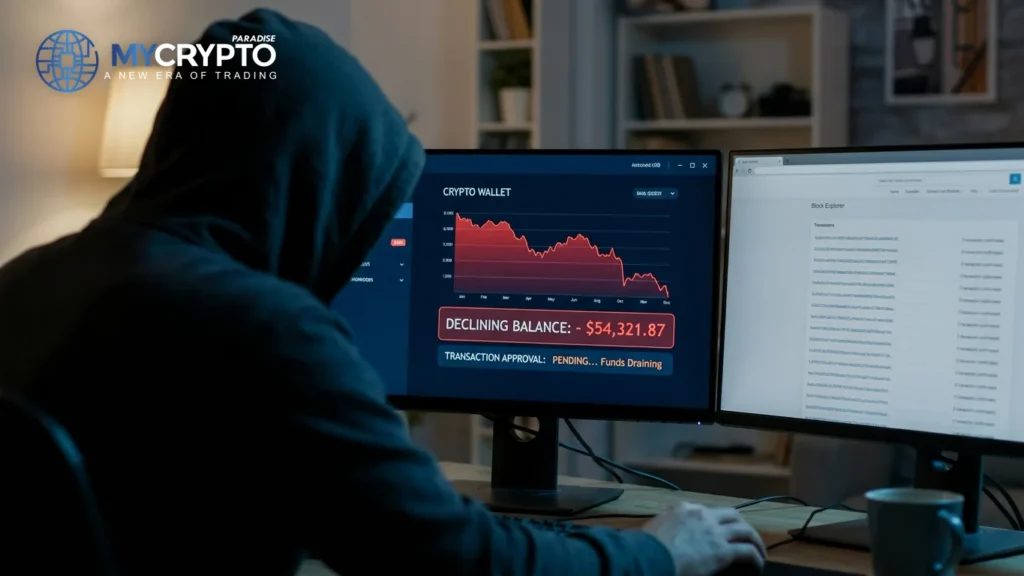
A crypto trader signed one malicious approval and paid for it 922 days later. That single Permit signature handed a phisher standing access to their tokens. The wallet was drained of roughly 97,000 SYN in the first hit.
Then came the part that stings. The victim never revoked the allowance. So the door stayed open, quietly, for the better part of three years.
The phisher simply walked back through it. A second drain pulled another 122,000 SYN, worth about 122,000 dollars, from the same address, 0x686618aBb3730079601a5abEAD6eC24549c5Ce34. Two withdrawals, one wallet, and one signature at the root of both.
We report this as a confirmed on-chain event, not a market mover. Bitcoin traded near 78,242 dollars as we published, up around half a percent on the day, indifferent to one trader's loss. Ethereum sat near 2,457 dollars, slightly firmer.
What makes this matter is the mechanism, not the size. A Permit signature grants a spender ongoing permission to move a token. It does not expire on its own. Unless the owner actively revokes it, that permission outlives the moment of panic, the price cycle, and often the memory of the mistake.
So the loss here was not a fresh hack. It was an old wound reopened. The attacker did nothing clever the second time. They checked whether the allowance still existed, found it did, and took the rest. In a market obsessed with the next catalyst, this is a reminder that some risks just wait.
Why one signature keeps paying attackers
This case matters because it exposes how token approvals actually work, and most traders never look. A Permit signature is a standing authorization. It lets a named spender move your tokens whenever they choose, up to the approved amount, for as long as the allowance lives.
That design is normal and useful. Every decentralized exchange interaction relies on it. The problem is that the permission does not know the difference between a legitimate protocol and a phishing contract wearing the same interface.
Here is the transmission mechanism that traders miss. You sign once, believing it is a one-time action. The blockchain records it as a persistent right. The attacker now holds a key that stays valid until you consciously turn it off. Time does not close it.
So the 922-day gap is the real story. The first drain was the warning. The unrevoked allowance was the open liability sitting on-chain, visible to anyone who checked. The second drain was simply the attacker collecting the balance that had rebuilt.
This is why on-chain hygiene is not a footnote. Revoking stale approvals is the equivalent of changing the locks after you lose a key. Skip it, and every future deposit into that wallet is exposed to a decision you made years earlier and forgot.
The broader lesson ties to the market itself. Long-tail risks do not announce themselves. They accumulate quietly, then surface at the worst possible moment, usually when the holder assumes the danger has passed.
No price ripple, but the risk lesson lands
The direct market impact of this drain is close to zero, and we will not pretend otherwise. Two hundred thousand SYN leaving one wallet does not move Bitcoin, Ethereum, or the broader alt complex. There is no liquidity cascade to trace here.
BTC held near 78,242 dollars as we published, a shade positive on the day and slightly negative over the last hour. ETH sat near 2,457 dollars, up about 1.7 percent. Neither reacted, because neither had reason to.
So the honest framing is this. This is a risk-awareness event, not a supply or flow event. It changes nothing in order books and everything in how a careful trader thinks about their own exposure.
Where it does connect to the wider tape is sentiment texture. Markets that feel comfortable are exactly when overlooked risks bite. A trader who signed a bad approval in a calmer period got drained again in a period of renewed optimism, without lifting a finger.
That pattern rhymes with the broader setup we are watching. Retail confidence tends to run ahead of structure. Attention flows to green candles and new-high narratives, not to the boring maintenance that protects capital.
So the market impact worth naming is behavioral. When participants feel safe, they revoke less, verify less, and assume more. The attacker in this case profited precisely from that gap between perceived safety and actual on-chain exposure.
Stale approvals and the safety of feeling safe
The first thing to watch is your own approval list, not a price level. If you have interacted with any protocol you no longer trust, or signed anything you did not fully read, treat that allowance as live until you prove otherwise on-chain.
Confirmation that this remains an isolated event looks simple. No cluster of similar drains against the same token, no coordinated campaign, and no protocol-level compromise. On current facts, this is one victim and one persistent allowance, nothing systemic.
Invalidation of that calm read would be a wave of copycat drains hitting wallets that share the same forgotten-approval pattern. That would signal an attacker sweeping old signatures at scale, which turns a single case into a trend worth pricing into sentiment.
For the broader market, the level that matters is behavioral, not technical. Watch whether comfort keeps rising while basic security discipline slips. That divergence is the tell.
We are honest that no single confirmed catalyst is driving today's tape. The cautious macro read is our interpretation, not an established cause. So do not treat this drain as a market signal. Treat it as a maintenance prompt.
The practical watch item is boring and that is the point. Revoke unused allowances. Verify every signature request. Assume a permission granted once stays granted until you cancel it. In this environment, the quiet housekeeping protects more capital than the next trade idea.
What this drain says about a comfortable market
The ParadiseTeam sees this drain less as a headline and more as a mirror of current positioning. With BTC near 78,242 dollars and holding a small daily gain, the tape feels constructive, and that comfort is exactly the condition in which overlooked risk compounds.
Our read on the broader market stays cautious. We think smart money is still braced for more downside and genuine institutional capitulation before a durable bottom prints. Present strength looks more like a potential trap than a confirmed structural shift, with echoes of 2022.
This story fits that frame cleanly. A trader felt safe enough to forget a stale approval, and the risk sat patiently until it paid the attacker again. That is the retail-comfort mechanism in miniature.
So who benefits and who gets trapped here. The attacker is the patient party, doing nothing but waiting on an open allowance. The victim is the optimistic one, assuming the danger passed. That asymmetry mirrors how we see smart money and retail across the tape right now.
We are not converting a phishing case into a price call, and we will not pretend it moves BTC. Our directional read is neutral on this event specifically. It changes no levels and no flows.
What it reinforces is discipline. In a market where retail narratives already call for new highs, the edge is not just where you buy. It is refusing to let a forgotten signature undo the position you were right about.
Track it live: our Crypto Fear and Greed Index and the live crypto funding rates both update in real time, so you can watch this shift for yourself.
Related coverage
For exact entries, targets, and stop losses with full risk management, that is what ParadiseFamilyVIP is for. New to reading these moves? Start with our crypto trading strategies guide.
ParadiseTeam is monitoring the market situation closely, and we are taking these developments into consideration while building our trading tactics inside ParadiseFamilyVIP.
Crypto trading involves substantial risk. Prices are volatile and you can lose money. This article is educational and is not financial advice. Past performance does not guarantee future results.
Do you regularly check and revoke old token approvals on your wallet?
This is how 22 Paradisers are calling it. Tap your call.
No calls on this one yet. Tap yours to be the first.
Free account, no password. Members just sign in.






Join the discussion 3
so its still about the stop loss hey what's the one level that matters
Sorry, but I don't think it's just about the stop loss here. I mean, with approvals like this, it feels like it's more about security, doesn't it?
219k SYN drained? 😱 Oh man, I always check my approvals like a madman now after my last rugpull 😵💫 - lesson learned!! 🔥