

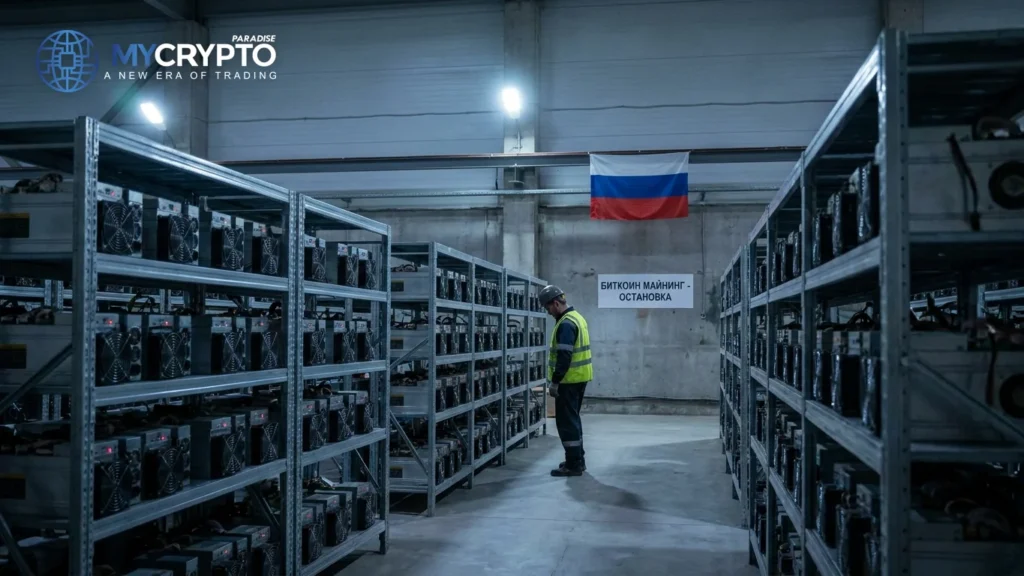
Developing story update (August 01, 2026, 20:18 UTC):
Additional context has surfaced on Russia’s regional mining ban. Based on our sources, the August 15 start date is not the original one: the measure was pushed back from an initial effective date of July 1, 2026. That delay signals the rules were softened or slowed before taking force, which traders may read as a less aggressive stance than the headline suggests.
Price action confirms the muted read. Bitcoin is holding near $62,500, effectively flat on the hour and down under one percent on the day, so the market continues to treat this as a future dated, regionally scoped headwind rather than an immediate catalyst. As long as price defends the invalidation zone, the structure favoring a push toward higher targets stays intact.
What to watch now: Whether the August 15 date slips again or expands beyond Moscow and Kursk regions.
Listen: the breakdown
Market briefing: Russia is banning Bitcoin mining across Moscow and nearby regions from August 15 through 2032, and yet BTC only slipped to about 62,536, down 1.1 percent. A country holding 17 percent of global hashrate is closing a door, and the tape barely noticed.
- Russia bans mining in Moscow, Moscow Oblast and 8 Kursk districts from Aug 15, 2026 through 2032.
- Power grid strain is the cited reason, in a country holding 17 percent of global BTC hashrate.
- BTC held near $62,536, down 1.1 percent, signalling the market treated the ban as noise, not shock.
Russia's mining ban just closed Moscow to miners through 2032, in a nation holding 17 percent of Bitcoin's hashrate. So why did BTC barely flinch?
Russia has confirmed a mining ban across Moscow, Moscow Oblast, and eight districts of Kursk Oblast. It takes effect on August 15, 2026, and stays in force through December 31, 2032. The stated reason is power grid concerns.
We covered the expansion of this ban earlier today. What is new now is the market's answer to it, and that answer is more revealing than the decree itself.
Russia holds an estimated 17 percent of global Bitcoin hashrate. On paper, a multi-year ban across its most power-hungry regions reads like a genuine shock to the network's production base. A headline built for fear. Yet BTC was trading near $62,536 as of the print, down just 1.1 percent on the day and only 0.2 percent on the hour. A seventeen-percent hashrate contributor closes its capital region to miners, and the tape shrugs.
That gap between the press release and the price is the story. The ban is real and the timeline is long, but mining is mobile. Rigs do not respect borders; they follow cheap power. A ban in one grid tends to relocate hashrate rather than delete it, and difficulty adjustments absorb the rest over time.
So the structural change is slow, partial, and priced against a market already looking past it. The fear is loud. The mechanism is quiet. And the distance between the two is exactly where retail tends to make its worst decisions.
Why a hashrate hit barely dents price
Bitcoin's price and its hashrate are linked, but loosely and with a lag. A mining ban changes where coins are produced, not how many. Issuance follows the protocol schedule, and difficulty re-targets roughly every two weeks to keep block times stable. So a regional ban trims capacity, then the network quietly rebalances.
That is the transmission mechanism here. Russia's 17 percent share sounds decisive, but the ban is geographic, not national, and phased over years to 2032. Miners in affected regions have time and incentive to move hardware to friendlier grids. Displaced hashrate rarely disappears; it migrates.
The macro read matters more than the mining map. This is a regulatory headwind, not a liquidity event. It does not drain dollars from the system, force sellers, or freeze exchanges. It reshuffles production geography on a multi-year clock.
There is a second-order angle worth naming. Grid-driven bans reflect states protecting infrastructure, not banning Bitcoin ownership or trade. That is a narrower attack surface than a market-wide crackdown, and markets tend to distinguish between the two.
So the honest framing is this: real news, modest transmission. The event edits the hashrate distribution slowly while leaving demand, custody, and settlement untouched. That is why a decree big enough to headline moved price less than a normal Tuesday. Structurally, it is a redistribution story dressed as a disruption story.
How the muted reaction ripples through the tape
Start with BTC, because Bitcoin is where a mining story should hit hardest. It did not. Price held near $62,536 with a 1.1 percent daily drift and a 0.2 percent hourly move. That is background noise, not a repricing.
When the asset most exposed to a hashrate ban barely reacts, the signal cascades quickly. ETH and the broader altcoin complex have almost no direct link to Russian mining capacity, so any move there would be pure sympathy, not substance. With BTC steady, that sympathy pressure stayed minimal.
Liquidity is the tell. A genuine shock shows up as a spike in liquidations, a lurch in funding, and a visible flush of leverage. None of that arrived. The order book absorbed the headline and moved on, which is what an already-discounted event looks like in real time.
That calm is not the same as strength. It simply means the ban did not become a liquidity trigger. Price is still doing whatever the dominant flows were already doing, and this decree did not redirect them.
For traders, the practical read is that this is not a catalyst to chase in either direction. Selling the news assumes a hashrate crisis the tape refuses to confirm. Buying the dip assumes a dip that never really formed. The event edited sentiment more than structure, and structure is what actually moves size.
What confirms the shrug, what breaks it
The first thing to watch is not price, it is participation. If BTC keeps grinding in its recent range with quiet funding and no liquidation spikes, the market has confirmed its verdict: this ban is noise, and any fear was retail-driven.
Invalidation would look different. A sharp drop through key support on rising volume, paired with a jump in liquidations, would suggest the ban became a genuine trigger rather than a discounted one. Watch whether sellers can hold a breakdown or whether it gets bought back within hours.
On the mining side, the slower confirmation is difficulty and hashrate data over coming weeks. If hashrate dips then recovers as rigs relocate, that validates the migration thesis and neuters the bearish case entirely. A sustained, non-recovering drop would be the rarer, more serious signal.
Sentiment is the trap to monitor. If crypto fear deepens on this story while price holds, that divergence usually favors accumulation, not capitulation. Fear without follow-through in price is often smart money letting retail do the worrying.
Finally, watch for policy contagion. This is currently one country protecting its grid. If it stays that way, the event decays into background regulation. If other major mining jurisdictions echo it, the read changes and the hashrate story earns real weight. Until then, treat the ban as confirmed fact and muted driver.
What the ban means for BTC's key levels
The ParadiseTeam reads this as a low-signal event landing in a high-stakes zone. BTC was near $62,536 at the print, and that number sits almost exactly on the line that decides the near-term structure.
Our working map has smart money reaccumulating around $61,000, with $62,500 acting as the critical invalidation for the current bullish structure. The mining ban does not move those levels. It just adds emotional pressure right where the market was already deciding.
That is the useful part. A scary headline arriving at a pivotal level is where retail hands get shaken. If fear over Russian hashrate pushes weak holders to sell into the $61,000 to $62,500 band, that supply tends to get absorbed by patient buyers rather than chased lower.
So the mechanism to hold in mind: bearish narrative, minor real impact, price parked on the fence. Losing $62,500 with conviction would put the bullish case on the back foot and open room toward the reaccumulation zone. Reclaiming and holding above it keeps the path toward the $79,000 redistribution target intact.
The ParadiseTeam is treating this ban as context, not a catalyst. It changes the emotional weather around these levels without changing the levels themselves. Probabilities, not promises: the edge here is patience while retail reacts to a decree the tape has already discounted.
Track it live: our Crypto Fear and Greed Index and the crypto liquidation heatmap both update in real time, so you can watch this shift for yourself.
Related coverage
For exact entries, targets, and stop losses with full risk management, that is what ParadiseFamilyVIP is for. New to reading these moves? Start with our crypto trading strategies guide.
ParadiseTeam is monitoring the market situation closely, and we are taking these developments into consideration while building our trading tactics inside ParadiseFamilyVIP.
Crypto trading involves substantial risk. Prices are volatile and you can lose money. This article is educational and is not financial advice. Past performance does not guarantee future results.
Does Russia's mining ban change BTC's path over the next few weeks?
This is how the Paradisers are calling it. Tap your call.
No calls on this one yet. Tap yours to be the first.
Free account, no password. Members just sign in.









Join the discussion
No comments yet. Members, share how you are reading this.