

Listen: the breakdown
Developing story: This story is still unfolding. We are tracking it and will update this article as more details are confirmed.
Market briefing: Ravencoin has fallen to a record low as mining pools that hold most of its hash rate quietly build a competing chain, raising the risk of a multi-day reorganization. Bitcoin sat near $63,716 as of the print, barely moving, so the damage looks contained to one altcoin rather than the wider market.
- Ravencoin prints a record low as a network exploit threatens transaction finality
- Mining pools holding most of the hash rate are building a rival chain, risking a three-day reorg
- BTC held near $63,716 with almost no reaction, so contagion looks limited for now
Ravencoin just hit a record low as pools controlling most of its hash rate build a rival chain. When miners can rewrite three days of history, is any small chain safe?
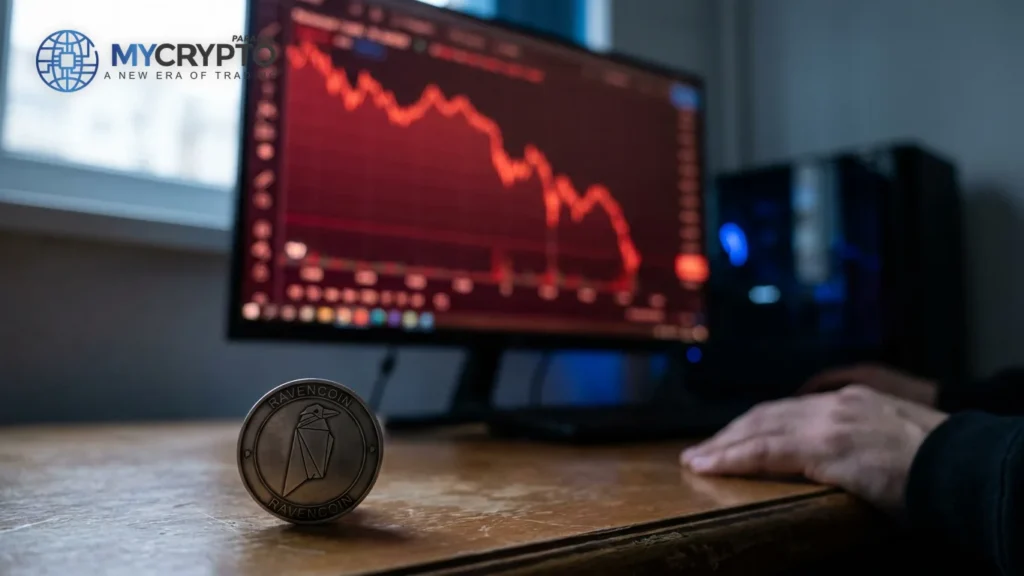
Ravencoin has fallen to a record low. The trigger is not a headline hack but something quieter and, in some ways, worse: mining pools that control most of the network's hash rate are building a competing chain.
That matters because of a threat called a reorg, short for reorganization. In a reorg, a longer competing chain replaces the one users thought was final, and transactions that looked settled can simply vanish. Here the risk stretches to roughly three days of history. For anyone who moved coins in that window, finality is now a hope rather than a fact.
This is the crypto version of finding out the referee owns shares in the other team. The security model of a small proof-of-work chain rests on no single group holding the majority of mining power. When a handful of pools quietly cross that line, the chain still runs, but its guarantees weaken to a promise of good behaviour.
The market response tells its own story. Ravencoin sold off hard, yet Bitcoin sat near $63,716, down just 0.3 percent on the day, and Ethereum near $1,881.61 was actually green. Traders are treating this as an isolated coin-specific problem, not a systemic one.
Structurally, that split is the whole point. A record low plus a credible reorg threat is exactly the kind of fear that empties out small holders. The question is who ends up holding the coins once the panic clears, and whether the broad market even notices.
Why a majority hash rate breaks trust
The reason this reaches beyond one ticker is trust, and trust is the only real asset a small chain owns. Proof-of-work security assumes mining power stays spread out, so no single group can rewrite the ledger. Once pools hold most of the hash rate, that assumption quietly dies, and every user is now trusting people not to do what they clearly can.
A three-day reorg window is the practical shape of that failure. Deposits, swaps, and payments confirmed inside that window can be reversed if the rival chain wins. Exchanges tend to respond by freezing or extending confirmations, which strands liquidity and deepens the fear at exactly the wrong moment.
The macro transmission here is narrow, and that is the honest read. This is not a Bitcoin base-layer event. There is no single confirmed same-day catalyst moving the whole market, so we frame the broad tape as interpretation, not cause. Bitcoin near $63,716 barely flinched, which tells us capital is not fleeing crypto, it is avoiding one damaged network.
Still, the episode is a reminder that priced into every small-cap altcoin is a security discount most holders forget in a bull run. When the discount suddenly gets repriced, it repriced fast. Smart money reads these events as a stress test of which chains actually deserve their valuations, and which were coasting on the assumption that this time the incentives would behave.
How the shock stays boxed inside one coin
Start with the liquidity picture, because that is where the fear becomes visible. Ravencoin's record low is a self-reinforcing drain: holders rush to move coins off the risky chain, thin order books swallow the selling, and the price gaps lower with each wave. A reorg threat does not need to execute to do damage; the mere possibility freezes confidence.
Now trace the chain outward, which is where it stops. Bitcoin, the market's anchor, sat near $63,716 and moved 0.3 percent, well inside normal noise. Ethereum near $1,881.61 was slightly higher on the day. If this were read as systemic contagion, BTC would be leading lower and dragging everything with it. It is not.
Alts usually follow Bitcoin's broader trend far more than they follow one another's accidents. That is the key structural point. A single chain's governance failure rarely sets the tone for the whole complex, so most alts should keep taking their cue from BTC rather than from Ravencoin's distress.
The practical impact is concentrated risk. Capital parked in Ravencoin faces a genuine binary outcome around the competing chain. Capital in BTC and ETH faces the same macro backdrop it faced yesterday.
Our read is that this event drains liquidity from one pocket while leaving the main arteries open. That is precisely how a coin-specific shock is supposed to behave, and, for once, the market is behaving.
What confirms or defuses the reorg risk
The first thing to watch is whether the competing chain actually overtakes the main one. That is the difference between a scare and an event. If a longer rival chain surfaces and a multi-day reorg lands, expect exchanges to halt deposits and withdrawals, and treat any recent Ravencoin transfer as unsettled until the network stabilizes.
Watch the hash rate distribution next. A credible fix looks like mining power dispersing back below a majority, or pools publicly stepping back. If concentration instead climbs, the threat is escalating, not resolving, and the record low is unlikely to be the last one.
Watch exchange behaviour as a real-time confidence gauge. Rising confirmation requirements or paused trading signal that professional risk teams take the reorg seriously. Normal deposit flow returning is the clearest all-clear you will get.
On the broad market, the invalidation of the contained thesis is simple. Keep an eye on Bitcoin around $63,716. As long as BTC holds its range and ignores the Ravencoin story, the isolation read stays intact. A sudden BTC breakdown alongside this news would force a rethink, though nothing in the current tape points that way.
Finally, watch the narrative itself. Small-chain security failures often spark broad think-pieces about whether other minor proof-of-work coins share the risk. That chatter can pressure similar low-hash-rate names even when their own networks are fine, so contagion here is more likely to travel through sentiment than through code.
What this print signals about liquidity and positioning
The ParadiseTeam reads this through positioning, not panic. Our working bias remains a cautious lean toward an interim push before a larger reset, and this Ravencoin shock does almost nothing to that structure, because it lives in one isolated chain rather than in Bitcoin's liquidity.
Apply our levels to the event. We see reaccumulation around $61,000 and treat $44,000 as the deeper zone where patient buyers want size. BTC near $63,716 sitting still through an altcoin security scare fits that map: no forced selling in the majors, no contagion bid for safety, just noise on the edge of the market.
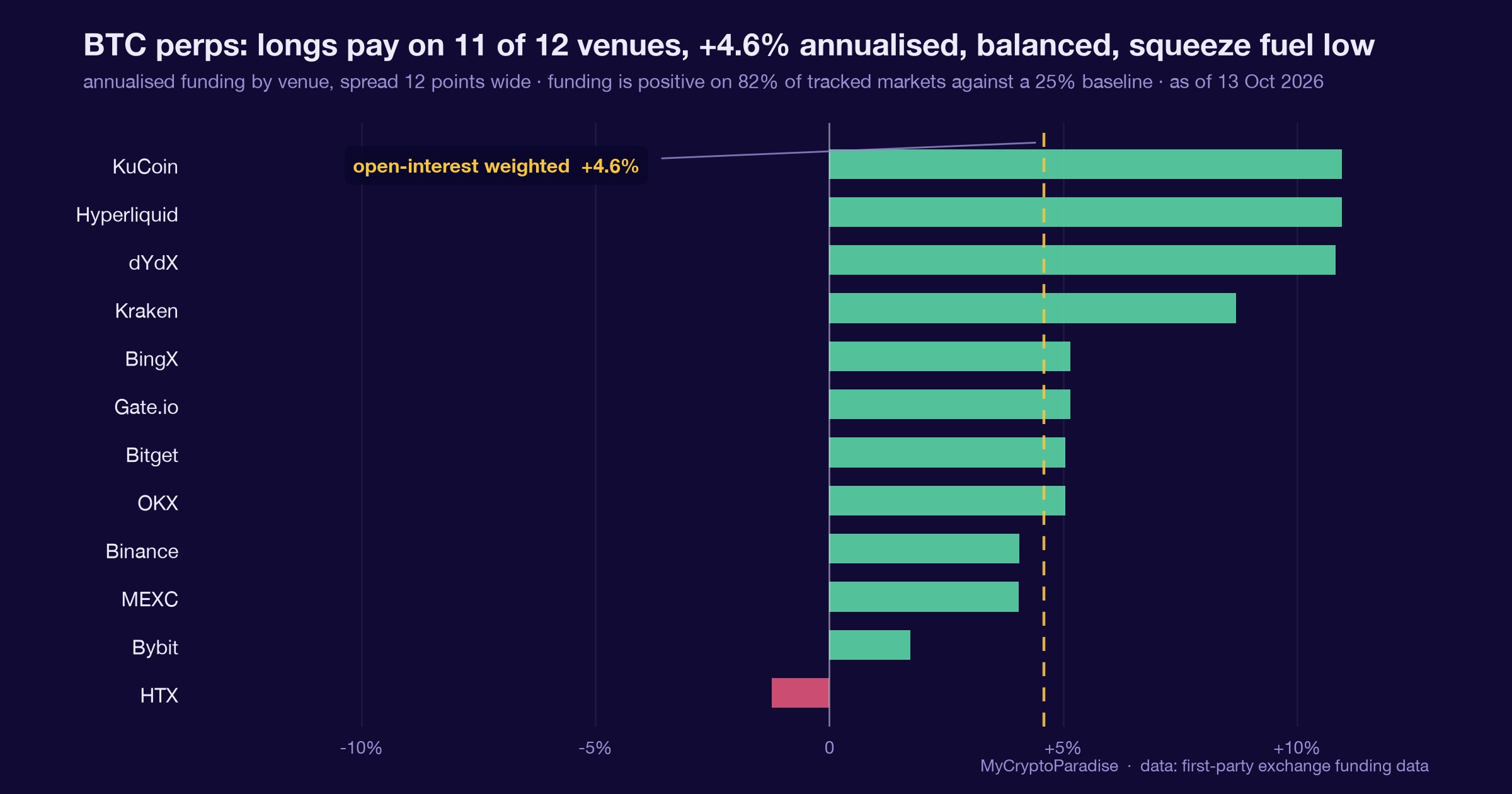
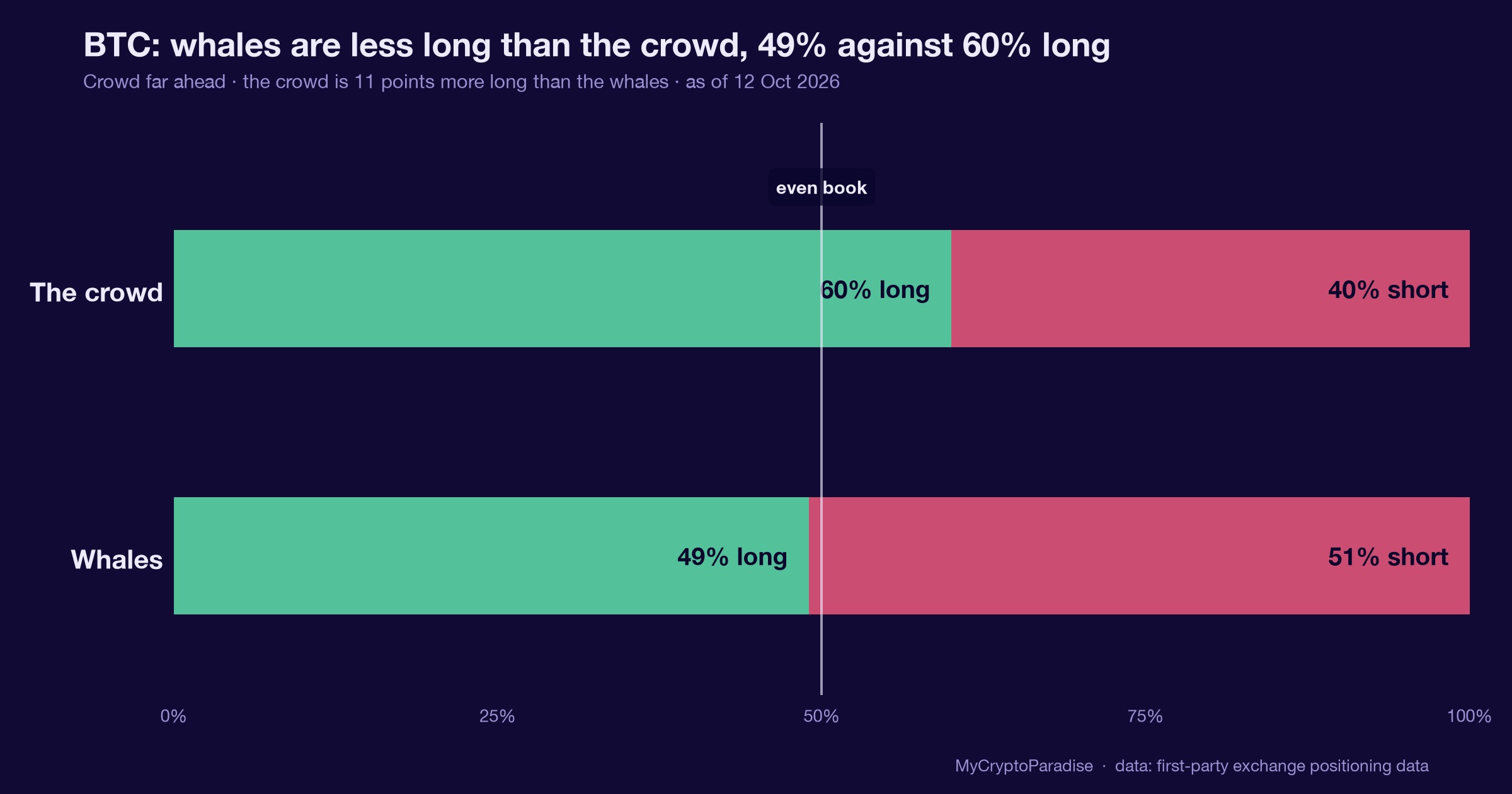
Meanwhile the crowd stays leaning long. Funding is positive and sentiment sits near the greedier end, which historically raises the odds of a squeeze that flushes crowded longs before any cleaner move higher toward the $69,000 to $79,000 region we are watching. Ravencoin is not the cause of that setup; it is a sideshow while the real tension builds in BTC positioning.
So who benefits here? On Ravencoin itself, the record-low fear hands cheap coins to whoever is willing to underwrite the reorg risk, which is a specialist's game, not a place to be a hero.
On the broad market, nothing about this event changes where the stops sit or who is trapped. That is the discipline: let one damaged chain be one damaged chain, and keep your attention on Bitcoin's structure, where the money that matters is actually positioned.
Track it live: our Crypto Fear and Greed Index and the live crypto funding rates both update in real time, so you can watch this shift for yourself.
Related coverage
For exact entries, targets, and stop losses with full risk management, that is what ParadiseFamilyVIP is for. New to reading these moves? Start with our crypto trading strategies guide.
ParadiseTeam is monitoring the market situation closely, and we are taking these developments into consideration while building our trading tactics inside ParadiseFamilyVIP.
Crypto trading involves substantial risk. Prices are volatile and you can lose money. This article is educational and is not financial advice. Past performance does not guarantee future results.
Does the Ravencoin reorg threat spread fear to other small proof of work coins?
This is how the Paradisers are calling it. Tap your call.
No calls on this one yet. Tap yours to be the first.
Free account, no password. Members just sign in.







Join the discussion
No comments yet. Members, share how you are reading this.