


Listen: the breakdown
Market briefing: Quack AI rolled out Trust Receipts, an on-chain way to prove an AI agent paid exactly what a user authorized. It is a quiet plumbing fix, not a price catalyst, with BTC near $83,564 as of 12:08 UTC.
- Trust Receipts give a verifiable record that an AI agent followed the user's payment mandate.
- Verification runs on-chain through a standalone package that never calls the issuer's own API.
- The problem is real: fake AI-generated receipts have already been used to claim a store refund.
Trust Receipts let an AI agent prove it paid exactly what you authorized, settled on-chain. But if the agent already sent the funds, why verify the receipt at all?
Quack AI has shipped Trust Receipts, a way to prove an AI agent paid exactly what a user told it to pay. The design is simple. Each paid response carries a verification receipt with links and a deterministic memo ID, and the check happens on-chain.
The launch docs demo it with one line: send a small USDT amount to a named recipient on BNB, then verify the receipt. Read as a human, the second half looks pointless. The agent already sent the money. So why ask it to confirm its own homework?
Because the money moving is not the same as the mandate being honored. An agent can pay the wrong person, the wrong amount, or at the wrong time, and still hand you a clean-looking confirmation. Trust Receipts separate what the agent claims from what actually settled.
The verification runs through a standalone package that does not call the issuing entity's API. That detail matters. It means the proof lives on-chain, not inside the same system that could have made the error in the first place.
The timing is not accidental. AI agents are starting to move real funds on behalf of real people, and the payments industry now has to answer three hard questions. Did the user actually authorize this? Was the authority delegated correctly? And did the payment match its stated purpose? Trust Receipts are one early attempt to answer all three in a form anyone can check.
The trust gap in agent-driven payments
The deeper story is not a product. It is a gap that automated finance has quietly opened. When a human pays, intent and action sit in the same place. When an agent pays, they split apart, and the receipt becomes the only bridge between what you wanted and what happened.
That bridge is exactly where fraud creeps in. The brief notes a real case: an AI-generated receipt was used to pull a refund from a store that never owed one. If a fake receipt can fool a human clerk, it can fool an automated workflow far faster and at far greater scale.
So the payments industry now needs to verify three things it used to take for granted. Intent, meaning the user truly asked for this. Delegated authority, meaning the agent was allowed to act. And context, meaning the payment matched its purpose and amount.
On-chain verification answers these without trusting the agent's own word. The memo ID is deterministic, so the same mandate always produces the same fingerprint. The check runs independently of the issuer, so a compromised agent cannot forge its own clean record.
This is why the development reads as infrastructure, not hype. It does not promise a price move. It tackles a practical problem that would otherwise cap how far people trust agents with money. Solving boring trust problems is usually how a technology earns its next wave of adoption, long after the louder narratives have moved on.
A utility story, not a price shock
Let us be honest about the scale. This is a utility upgrade for a narrow corner of crypto, not a liquidity event. BTC was trading near $83,564 as of 12:08 UTC, up a modest 0.4 percent, and nothing about an agent-payment verification tool changes that chart today.
The demo settles on BNB, which sat at $742.93, up roughly 0.6 percent on the day. That is quiet movement that owes nothing to this news. A single verification package does not generate the transaction volume that would meaningfully lift a network token.
The transmission chain here is slow by design. More verifiable agent payments build more trust, more trust supports more adoption, and only over time does that adoption translate into real on-chain settlement demand. Any benefit to BNB, LINK at $12.97, or broader infrastructure tokens is a multi-quarter story, not a same-day one.
That is why the honest read is neutral. The first-order effect is positive for the legitimacy of on-chain payments, but the scope is too small to ripple into BTC, then ETH, then alts the way a regulatory shift or an ETF flow would.
For traders, the practical takeaway is to file this under narrative, not catalyst. It strengthens the case that crypto rails can carry serious automated finance. It does not hand you a price move to position around. Confusing an interesting idea for a tradeable event is a reliable way to overpay for a story.
Proof points that turn a demo real
The thing to track is whether Trust Receipts move from a clever demo to something builders actually adopt. A standalone verification package is only as valuable as the number of agent workflows that choose to plug it in.
Confirmation would look concrete. Other agent frameworks or payment layers integrating a similar on-chain receipt standard. Rising settlement volume tied to verified agent payments. Any sign that a recognized standard is forming around intent, delegated authority, and context, rather than a dozen incompatible versions.
Invalidation would be just as clear. If agent payments keep settling without independent verification, or if integrations stall at the proof-of-concept stage, this stays a nice idea that the market never priced because the market never needed to.
Watch the fraud side too. The real test of any verification layer is whether it holds up once bad actors have an incentive to beat it. A receipt scheme is only trustworthy until someone profits from forging it, and then we learn how robust the design truly was.
For the wider market, the signal is adoption breadth, not token price. If agentic finance keeps expanding, verification infrastructure like this becomes necessary plumbing, and that is a slow structural tailwind for the chains that host it. For now, treat it as a trend to monitor. Nothing here forces a position, and pretending otherwise would be exactly the kind of story-chasing that empties accounts.
What agent payments mean for network demand
BTC sat near $83,564 as of 12:08 UTC, and the ParadiseTeam does not see this story touching that level in either direction. Agent-payment verification is a structural trend, not a trigger for the price action we are currently tracking.
Our standing read on Bitcoin is short-term bullish continuation, built on whale support around the defended $82,000 region and the $82,300 zone where significant long interest opened. That read rests on structure and liquidity, not on an AI receipts tool, and it would be dishonest to pretend this news reinforces it.
What this story does inform is how we think about network tokens over a longer horizon. If verifiable agent payments scale, chains that settle them gain genuine utility demand. That is a reason to respect infrastructure tokens structurally, but it is not a reason to buy one today on a single package release.
The ParadiseTeam stays disciplined here. Above current price, $84,000 marks the previous high and $84,500 sits as a defined objective, with $90,000 the major resistance where we see meaningful rejection odds. Below, $82,000 remains the line that must hold. None of those levels shift because of Trust Receipts.
The edge in a story like this is restraint. Retail tends to translate every interesting headline into a trade. Smart money files most of them as context and waits for the chart to actually offer something. This one is context.
The read behind this: we framed this story through our own market analysis, Bitcoin at $82K: Can Bulls Defend It?
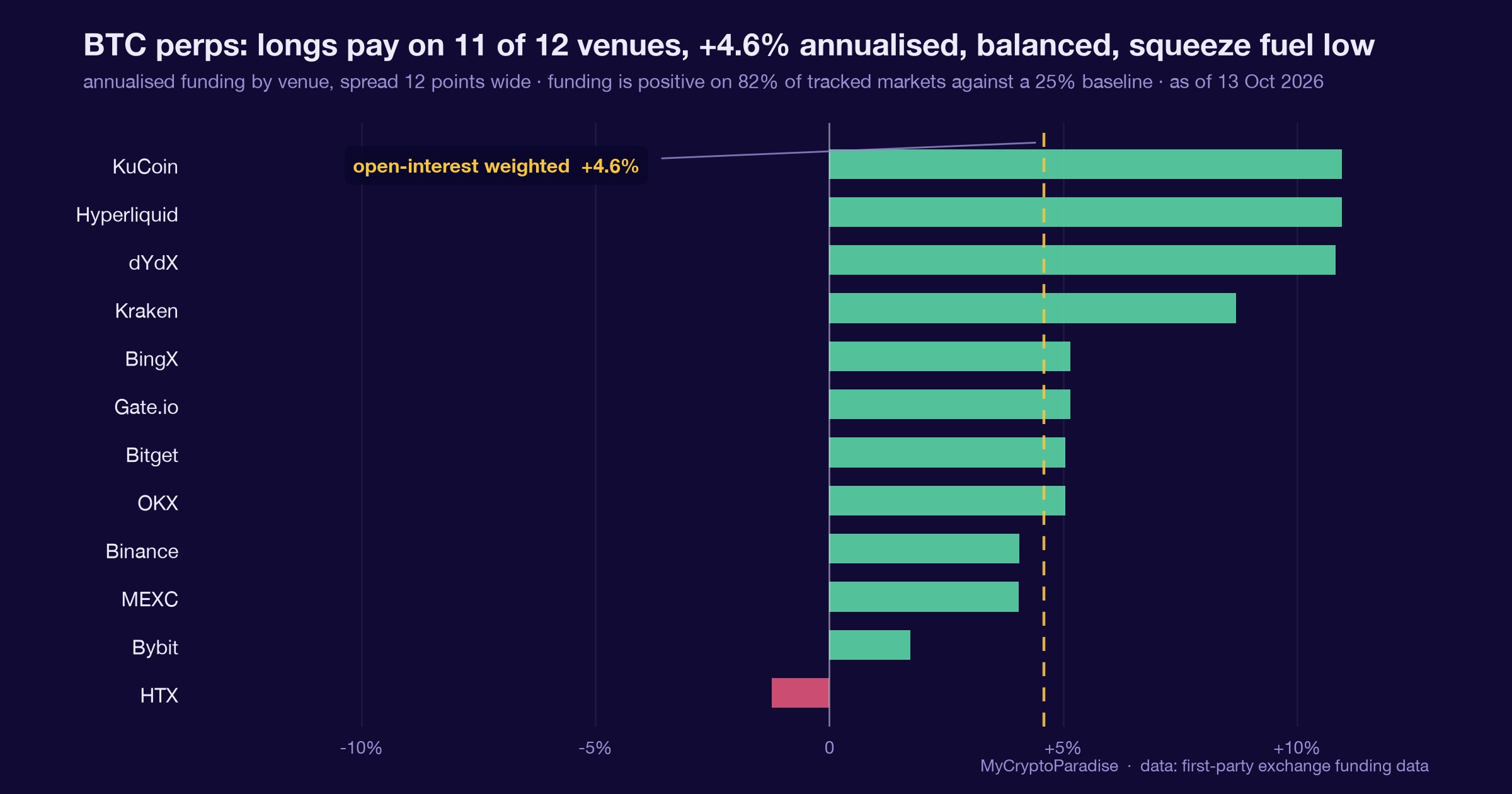
Track it live: our live crypto funding rates tracks this in real time, so you can watch it play out for yourself.
Related coverage
For exact entries, targets, and stop losses with full risk management, that is what ParadiseFamilyVIP is for. New to reading these moves? Start with our crypto trading strategies guide.
ParadiseTeam is monitoring the market situation closely, and we are taking these developments into consideration while building our trading tactics inside ParadiseFamilyVIP.
Crypto trading involves substantial risk. Prices are volatile and you can lose money. This article is educational and is not financial advice. Past performance does not guarantee future results.
Will on-chain receipts become standard for AI agent payments within a year?
This is how 1 Paradiser is calling it. Tap your call.
No calls on this one yet. Tap yours to be the first.
Free account, no password. Members just sign in.







Join the discussion
No comments yet. Members, share how you are reading this.