


Listen: the breakdown
Market briefing: BitMEX faces a £20 million UK lawsuit over crypto derivatives it allegedly offered without FCA authorization. Bitcoin barely reacted, trading near $83,321, with the market treating this as an isolated legal dispute rather than a fresh crackdown.
- A former UK trader is suing BitMEX for £20 million, seeking the return of 324.8 BTC lost between 2018 and 2022.
- The claim argues the derivatives contracts were void under UK law because BitMEX operated without FCA authorization.
- BTC held near $83,321 with no meaningful reaction, signaling the market sees isolated legal risk, not systemic danger.
Source: UK legislation (FSMA 2000)
A former trader wants his bitcoin back. The BitMEX UK lawsuit now puts £20 million and 324.8 BTC in front of a London judge. Does one old case threaten every offshore exchange?
BitMEX is back in a courtroom, and this time the fight is in London. A former investor, British software engineer Lewis Barber, has filed a claim in the UK High Court seeking £20 million in damages. He wants the return of 324.8 bitcoin he says he lost trading on the exchange between 2018 and 2022.
The legal argument is narrow but sharp. Barber claims BitMEX offered crypto derivatives to UK users without authorization from the Financial Conduct Authority (FCA). Under the UK Financial Services and Markets Act 2000, he argues, those contracts should be treated as void. Void contracts, in theory, entitle an investor to recover what they cost him.
That is the whole case in one sentence: if the product was never legal to sell here, the trades never truly counted.
BitMEX, operated by HDR Global Trading Limited, built much of its early reputation on high-leverage perpetual contracts. For years, offshore structure was treated as a feature rather than a liability. Regulators in several jurisdictions have since taken a rather different view.
The claim reaches back to 2018, which tells you how slowly these disputes mature. By the time the paperwork lands, the market has usually moved on through three cycles. Bitcoin was trading near $83,321 as the filing surfaced, and it barely registered the news.
Regulatory risk returns to derivatives platforms
The driver here is regulatory risk, not price. A single lawsuit does not drain liquidity. But it reprices a specific kind of risk: the cost of having operated in a grey zone, measured years after the fact.
The transmission runs through confidence, not capital. When a court in a major financial centre entertains the idea that unauthorized derivatives contracts are void, every offshore platform takes note. That precedent, if it holds, hands a template to other users who lost money on unregistered products.
This matters more for platforms than for coins. BTC and ETH do not care which exchange hosted a trade in 2019. The asset is indifferent. The intermediary is exposed.
For traders, the lesson is structural. Compliance is slowly becoming a moat. The exchanges that embraced authorization early now look conservative and dull, which in this industry is usually a compliment. The ones that leaned on offshore ambiguity carry a long tail of legal liability that can surface at any time.
None of this moves the market today. All of it shapes where serious capital eventually feels safe parking size.
Liquidity shrugs off an isolated case
Start with the obvious: BTC did not flinch. Price sat near $83,321, roughly flat on the day, while the headline circulated. That calm is itself the data point.
A genuine systemic threat shows up in the tape within minutes. Funding flips, open interest (OI, the total value of open derivatives contracts) spikes, and liquidations cascade. None of that happened here. The market read this as an isolated legacy dispute, not a fresh regulatory wave.
In the bearish framing, this is a slow drip rather than a shock. Regulatory liability on derivatives platforms adds a small, persistent discount to risk appetite. It does not trigger a sell-off; it quietly caps enthusiasm at the margins.
The cascade logic still matters if this ever spreads. BTC is the liquidity anchor. If regulatory fear broadened into active exchange restrictions, BTC would wobble first, ETH would follow with a wider swing, and alts would take the deepest cut because they live on the thinnest order books. Today none of that is in motion.
So the honest read is limited impact now, latent risk later.
When a single case becomes a trend
The question is whether this stays one case or becomes a pattern. One former trader recovering bitcoin is a footnote. A dozen filings citing the same statute is a trend, and trends move capital.
Watch for copycat claims. If other UK users file under the same void-contract argument, the legal theory gains weight and other offshore platforms face real exposure. That would confirm this is a category risk, not a one-off.
Watch the exchanges, not the charts. Any sign of a platform restricting UK users, ring-fencing liabilities, or quietly settling tells you the industry takes the threat seriously. Business-as-usual tells you the opposite.
The invalidation is simpler. If the claim settles quietly, gets dismissed, or draws no imitators, the story closes with no market footprint. Given how BTC absorbed the headline, that remains the base case.
On price, the thing to watch has nothing to do with BitMEX. It is whether BTC holds its footing near $82,000. Regulatory noise only bites when it meets a market already looking for an excuse to sell. Right now, that market is not looking.
Muted tape near the whale support
The ParadiseTeam treats this lawsuit as background risk, not a trigger. It changes nothing structural on the chart with BTC near $83,321. The levels that mattered before this headline still matter, unchanged by it.
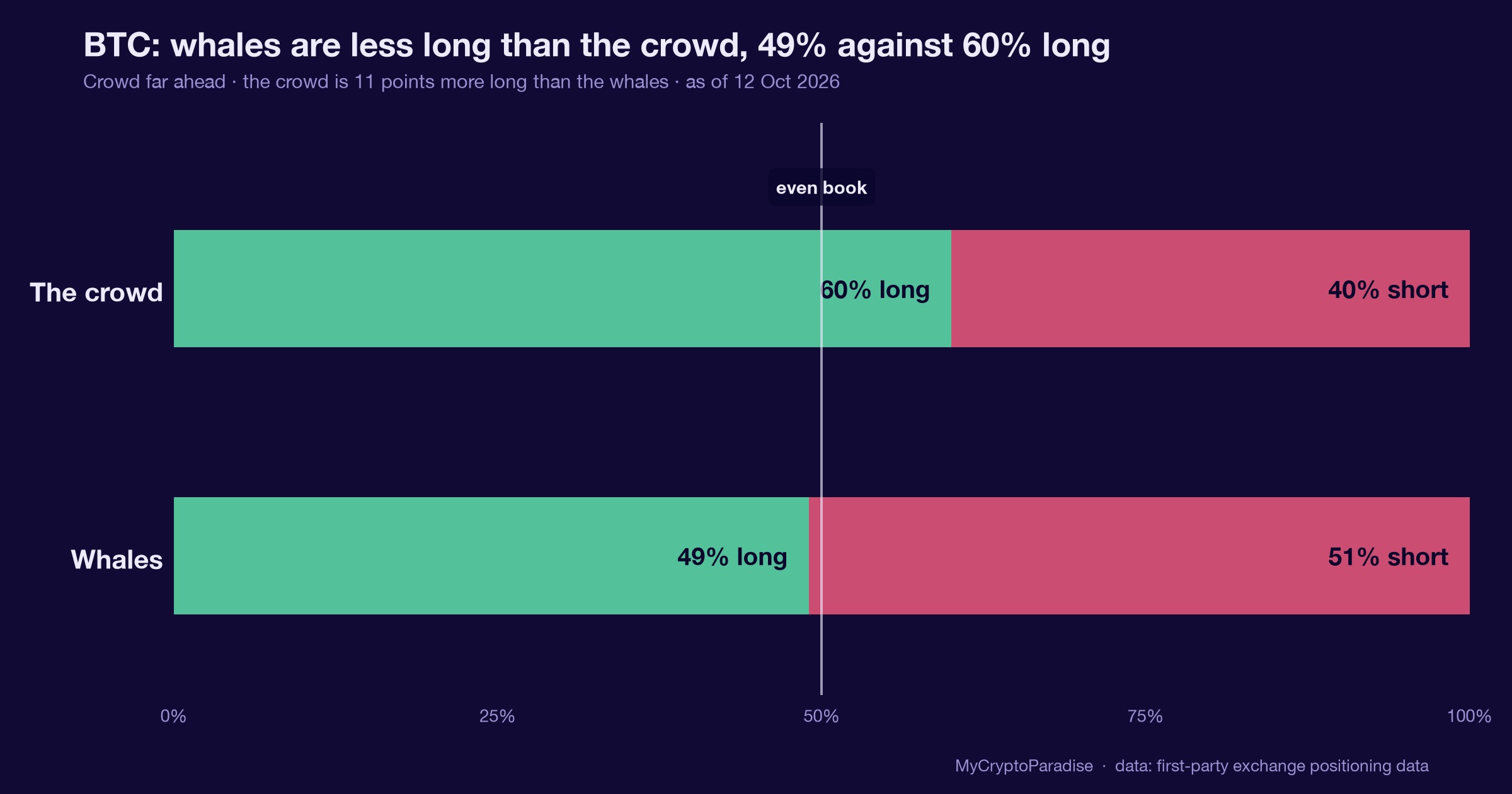
$82,000 is the line that counts. Whales defended it on the V-shaped recovery, and a $37M long opened near $82,300 turned prior resistance into support. As long as that floor holds, a legacy legal dispute is noise, not signal.
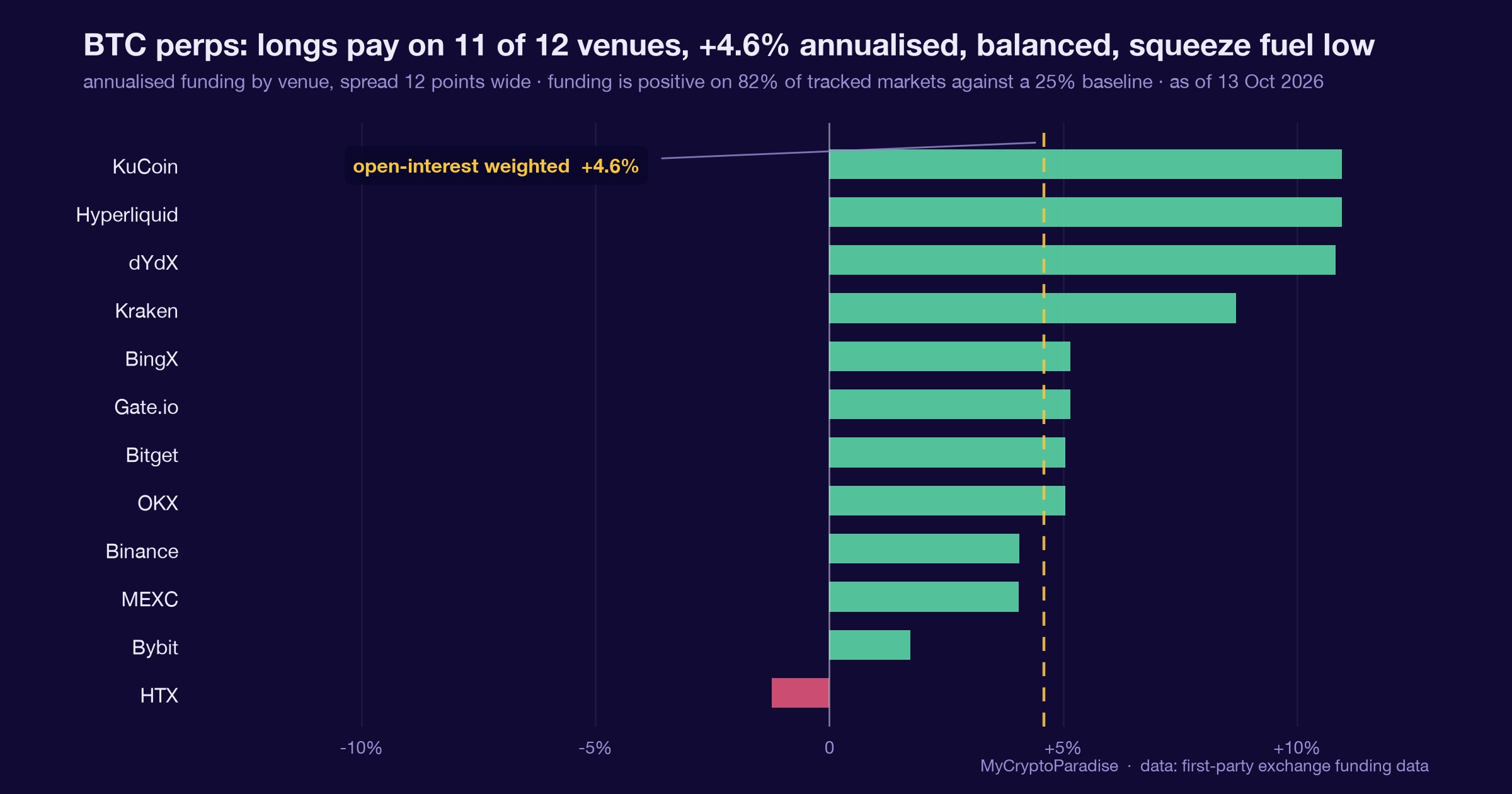
Open interest sits near all-time lows and funding rates rest at a 90-day baseline. That combination means little leverage and little crowd froth. A regulatory headline hitting a lightly positioned market struggles to force liquidations, which is exactly why the tape stayed flat.
The ParadiseTeam's standing caution lives higher up. $90,000 is major resistance, where we see roughly a 60% chance of rejection. Strength into that zone can meet selling, and that is where distribution risk, not a lawsuit, would do the real damage. So the read is consistent: respect $82,000 as the pivot, note $84,000 above as the next test, and treat this filing as one more reason compliant structure tends to win over a full cycle.
The read behind this: we framed this story through our own market analysis, Bitcoin at $82K: Can Bulls Defend It?
Track it live: our live crypto funding rates and the crypto liquidation heatmap both update in real time, so you can watch this shift for yourself.
Related coverage
For exact entries, targets, and stop losses with full risk management, that is what ParadiseFamilyVIP is for. New to reading these moves? Start with our crypto trading strategies guide.
ParadiseTeam is monitoring the market situation closely, and we are taking these developments into consideration while building our trading tactics inside ParadiseFamilyVIP.
Crypto trading involves substantial risk. Prices are volatile and you can lose money. This article is educational and is not financial advice. Past performance does not guarantee future results.
Do more UK lawsuits hit offshore crypto exchanges from here?
This is how 1 Paradiser is calling it. Tap your call.
No calls on this one yet. Tap yours to be the first.
Free account, no password. Members just sign in.
Follow this topic: Crypto regulation news








Join the discussion
No comments yet. Members, share how you are reading this.