

Listen: the breakdown
Market briefing: Two Layer-1 networks stumbled at once. Ontology halted block production over a security concern, while Injective bled $4.8 million to a suspected exploit. Bitcoin sat near $78,162 as the market shrugged, but the risk signal is louder than the price.
- Ontology paused mainnet block production on August 31 over a potential security concern, freezing transactions.
- Injective was hit by a suspected exploit that cost roughly $4.8 million.
- Crypto hacks are up 67% and August losses reached $136 million, keeping risk appetite thin.
Two Layer-1 chains broke on the same day, and one lost $4.8 million to a suspected exploit. So is this an isolated glitch, or a warning the market keeps ignoring?
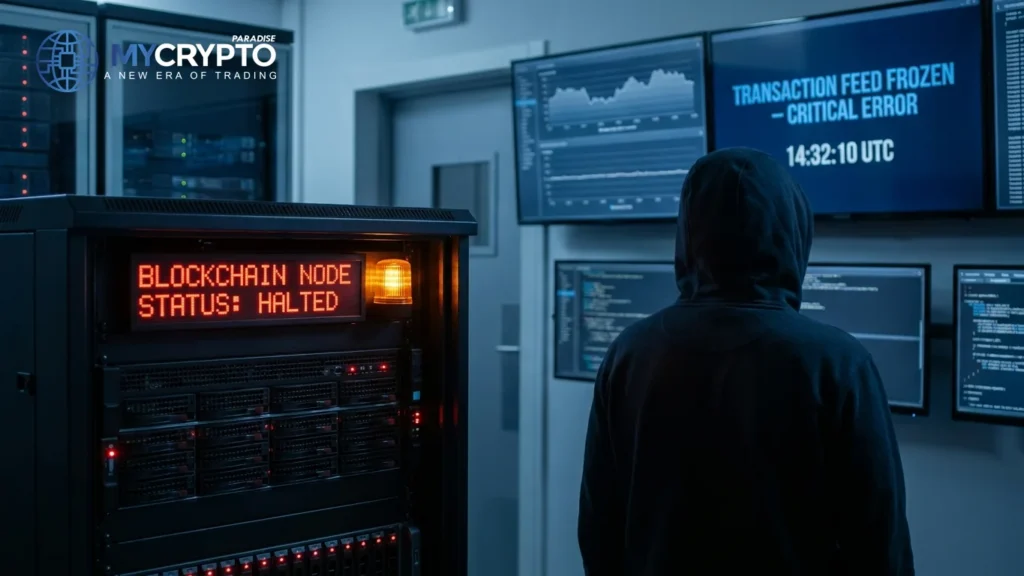
Two Layer-1 blockchains ran into trouble on the same day. Ontology, an identity-focused public chain, paused block production on its mainnet on August 31. The team cited a potential security concern, and while it was halted, transactions simply could not process. A chain that stops confirming blocks is not a chain doing its job.
At roughly the same moment, Injective was hit by what looks like an exploit. The loss came in around $4.8 million. Two separate networks, one bad day, and a market that barely blinked.
The timing matters more than either incident alone. Crypto hacks have climbed 67%, and August losses across the space reached $136 million. That is not a rounding error, and it is not a story about one buggy contract.
Bitcoin held near $78,162 while all of this unfolded, up a fraction on the day. The affected assets took the hit, not the majors. That is normal for chain-specific events, but it does not make the signal harmless.
We read this as another entry in a long ledger of Layer-1 fragility. The pitch decks promise unstoppable, decentralized infrastructure. The incident logs keep suggesting the infrastructure is younger and more breakable than the marketing admits. For traders, the useful takeaway is not panic. It is a reminder that risk is stacking quietly while retail focuses on the next green candle.
Rising hack losses reshape risk appetite
The transmission here runs through perception, not through Bitcoin's supply or macro rates. When two Layer-1 networks fail on one day, the market re-prices how safe the broader altcoin stack really is. That re-pricing is the mechanism, and it moves capital before it moves headlines.
Start with the hard numbers. Hacks are up 67%, and August alone drained $136 million from the space. Each fresh incident nudges the perceived cost of holding smaller, less battle-tested chains higher. Capital does not need a crash to react. It just needs a reason to demand a bigger discount for risk.
That is exactly what a halt and an exploit deliver. Ontology stopping block production says the base layer itself can freeze. Injective losing $4.8 million says even active, liquid ecosystems leak. Both feed the same conclusion: the L1 tier still carries structural fragility that spreadsheets rarely price in.
In a cautious market, that conclusion compounds. Our read is that smart money already expects further downside and wants to see institutional capitulation before committing size. Incidents like these validate the patience. They give the cautious camp evidence, and they give the optimistic retail camp something to explain away.
So the macro effect is subtle but real. Nothing about Bitcoin's fundamentals changed on August 31. What changed is the risk premium attached to everything riskier than Bitcoin, and that premium is the quiet tax that shapes the next leg.
Where the flight from risk lands next
Liquidity flows toward safety when confidence cracks, and this is a confidence event. The immediate pressure sits on the affected names. Ontology and Injective wear the direct damage, and any token tied to a chain now labeled fragile inherits a discount.
Bitcoin is the reference point, and it barely moved. Near $78,162 and slightly green, BTC absorbed the news without stress. That is the tell. Chain-specific failures rarely dent the majors directly, because the majors are where nervous capital hides.
Ethereum sits one rung down and usually tracks BTC in these moments. If risk-off deepens, ETH tends to hold better than smaller L1s but worse than Bitcoin. It is the middle of the flight-to-safety ladder, and today that ladder is what matters.
The real weight lands on alts. Reduced appetite for Layer-1s with security question marks pulls liquidity out of the long tail first. Thin order books make that exit sharper, so a modest sell instinct can produce an outsized move in a smaller token.
BNB, worth noting, sat calm at $687.51, up a fraction on the day, showing the majors of the alt world stayed insulated. The pain concentrates where liquidity is thinnest, not where it is deepest.
Our read is straightforward. This is not a market-wide liquidation trigger. It is a selective drain that punishes the weakest links and quietly rewards patience in the strongest, which is precisely how a cautious tape is supposed to behave.
The restart, the refund, and the flows
The first concrete marker is Ontology's restart. A clean resumption of block production, with a clear explanation of the security concern, would contain the damage and read as a competent response. A prolonged halt or a vague postmortem would do the opposite and keep confidence suppressed.
Injective's handling of the roughly $4.8 million loss is the second marker. Watch for whether the exploit path is identified, whether funds are recovered or reimbursed, and whether the affected code is patched publicly. Transparency here is what separates a survivable incident from a lingering trust wound.
Broader flows are the third thing to track. If capital rotates out of smaller L1 tokens and parks in BTC and the larger alts, that confirms the flight-to-safety read. If instead the affected names bounce quickly on dip buying, retail is treating the news as noise, which is its own signal.
Bitcoin's behavior around $78,162 is the anchor. As long as BTC holds steady, this stays a contained alt story. A sudden BTC breakdown alongside these headlines would suggest the risk-off mood is generalizing, and that would change the whole frame.
Invalidations are simple. A swift, credible fix on both chains plus stable or rising alt liquidity would tell us the market correctly filed this as isolated. Continued outflows, more incidents, or a wave of copycat exploits would confirm the fragility thesis and justify staying defensive.
What these breaks say about market timing
The ParadiseTeam reads these incidents as confirmation of a cautious stance, not a trigger to chase anything. Bitcoin near $78,162 looks calm, but our bias remains defensive on the medium timeframe, and today's events fit that thesis rather than challenge it.
Here is the core point. We have been watching for institutional capitulation before a durable bottom, and the indicators we track have not printed it yet. Rising hacks, a 67% jump, and $136 million in August losses are the kind of background stress that tends to appear near the end of a grind, not the start of a clean rally.
So we treat current strength with suspicion. When retail stays optimistic while base-layer chains halt and exploits multiply, that gap between mood and risk is usually where smart money waits. The patient side of the book does not need to catch the exact low. It needs to avoid being the liquidity that impatient buyers exit into.
For positioning, that means respecting BTC as the safety anchor and treating fragile L1 alts as guilty until proven robust. The affected names carry a discount now for a reason.
Risk note: this is analysis, not a signal, and outcomes are probabilities, not certainties. Size positions so a wrong read costs little. The edge here is patience, and patience only works when it survives being wrong.
Track it live: our Crypto Fear and Greed Index and the live crypto funding rates both update in real time, so you can watch this shift for yourself.
Related coverage
For exact entries, targets, and stop losses with full risk management, that is what ParadiseFamilyVIP is for. New to reading these moves? Start with our crypto trading strategies guide.
ParadiseTeam is monitoring the market situation closely, and we are taking these developments into consideration while building our trading tactics inside ParadiseFamilyVIP.
Crypto trading involves substantial risk. Prices are volatile and you can lose money. This article is educational and is not financial advice. Past performance does not guarantee future results.
After these L1 failures, where does risk-off pressure show up first?
This is how 18 Paradisers are calling it. Tap your call.
No calls on this one yet. Tap yours to be the first.
Free account, no password. Members just sign in.









Join the discussion 4
Another reminder to verify every wallet update, even from sources you trust. I saw a colleague lose coins that way. Good data for what to log, and where.
another reminder that liquidity remains an illusion for many of these chains, just a question of *when* the asymmetry reveals itself. my alerts are set.
This is what worries me too... especially with smaller altcoins, it feels like there's no real market if you need to exit quickly. 😔
yeah it's a scary thought! and if its a small coin, it can be hard to even find enough buyers to exit if you need to 😬