

Listen: the breakdown
Update on this developing report (September 01, 2026, 14:59 UTC):
The fallout is now spreading past crude itself. US diesel crack spreads have breached the $100-a-barrel threshold, a sign the strain is hitting refined fuels directly and hardening the inflation impulse traders were already pricing.
Risk assets are feeling it. The S&P 500 has slipped to its lowest level since August 4th, and European gas prices have jumped to a six-month peak. Bitcoin and Ethereum have both drifted slightly negative on the 24-hour view, consistent with a market absorbing a macro headwind rather than shrugging it off.
What to watch now: Whether diesel and gas strength keeps forcing rate-cut expectations lower and pressures crypto liquidity further.
Update on this developing report (September 01, 2026, 14:37 UTC):
The oil shock is now spreading across broader markets. Since we first reported the tanker strikes, stock index futures have turned lower and government bond yields have spiked higher while crude holds above 92 dollars per barrel, based on our sources. This is the classic risk-off, higher-rates combination that tends to weigh on speculative assets.
Crypto remains the notable outlier for now. Bitcoin and Ethereum are still trading roughly flat over 24 hours, showing little immediate reaction to the equity and bond moves. In our read this muted response is not strength, it is the market waiting: a sustained yield spike would likely pressure risk assets, and premature optimism into that setup is exactly the kind of trap that catches retail.
What to watch now: Watch whether rising bond yields and falling equity futures start dragging crypto lower, or if BTC keeps holding flat.
Update on this developing report (September 01, 2026, 13:53 UTC):
Update: the oil driven inflation scare is now spilling into the broader market. Stock futures have turned lower and government bond yields have spiked higher, a sign that traders are repricing for a longer stretch of elevated rates rather than treating this as a one day energy blip.
For crypto the setup stays fragile. Bitcoin and Ethereum are holding roughly flat while yields climb, and rising yields have historically been a headwind for risk assets. Any short term stability here is more likely a pause than a base, so treat strength with caution rather than chasing it.
What to watch now: Whether bond yields keep climbing and drag risk assets, or ease if the Strait of Hormuz situation stabilizes.
Update on this developing report (September 01, 2026, 13:31 UTC):
Update: the pressure is broadening beyond crude. Oil has now risen for a second straight day, and the stress is spilling into the wider energy complex. European gas prices have climbed to a six-month peak, and US diesel crack spreads have pushed past the $100 a barrel mark, a sign that refined-product supply fears are intensifying alongside the crude move.
For traders this widens the inflation channel. It is no longer only about the Brent headline; higher diesel and gas costs feed directly into freight, industry and consumer prices, which probably keeps central banks cautious for longer. Crypto is still barely reacting, with Bitcoin near $77,769 and Ethereum near $2,440, both modestly lower on the day, consistent with a market that is absorbing macro risk rather than pricing relief.
What to watch now: Whether diesel and European gas keep climbing, which would deepen the inflation read and pressure risk assets like crypto.
Update on this developing report (September 01, 2026, 13:09 UTC):
Update: the situation around the Strait of Hormuz has escalated beyond the tanker strikes. Based on our sources, the U.S. and Iran have now exchanged fire directly for the first time in over a month, adding a state-level military dimension to what began as a shipping incident.
For traders the notable tell is the lack of follow-through in prices. Brent is holding around the same $92 level and both BTC and ETH are flat to slightly lower, so markets are not yet pricing a wider conflict. That muted reaction is the thing to watch: a calm tape into escalating headlines can compress and then move sharply if the exchange of fire broadens.
What to watch now: Whether the U.S. and Iran exchange of fire broadens, and if oil breaks decisively above $92 to force a delayed crypto reaction.
Update on this developing report (September 01, 2026, 12:23 UTC):
Update: fresh readings show the initial Brent crude reaction was far sharper than the roughly 3 percent move we first reported. Early trading saw prices spike by 10 to 13 percent before settling back toward the 92 dollar area, a signal that the market briefly priced a much wider supply shock through the Strait of Hormuz.
For traders this widens the near term inflation tail. A double digit intraday oil spike, even one that fades, raises the odds of stickier headline inflation and keeps the case for a cautious, patient stance on crypto intact. We continue to read any minor crypto stability here as retail resilience rather than a confirmed bottom, with the deeper liquidity impact still to play out.
What to watch now: Whether Brent holds the 90 dollar area or the 10-13% intraday spike fully unwinds as tanker traffic normalizes.
Update on this developing report (September 01, 2026, 12:01 UTC):
Fresh shipping data now quantifies the disruption behind the price move. Visible commodity vessel transits through the Strait of Hormuz have dropped to about five per day, well below the recent 10-day average of roughly 14, based on our sources. This confirms that traffic through the chokepoint that normally carries around 20% of the world’s oil and LNG is contracting in real terms, not just on sentiment.
More telling for traders: none of the five vessels still moving through the strait were liquid tankers. That points to crude and product flows being the most exposed leg of the disruption, which is consistent with Brent holding above $92 rather than fading. If tanker transits stay suppressed, the supply-side pressure supporting oil, and the associated inflation read, could persist rather than resolve quickly.
What to watch now: Watch whether daily Hormuz tanker transits recover toward the 14-vessel average or stay suppressed, which would prolong the oil and inflation pressure.
Update on this developing report (September 01, 2026, 11:40 UTC):
The move is no longer just a Brent story. WTI crude, the US benchmark, has now pushed above $85 per barrel, up roughly 2.8% on the day, confirming that both main crude contracts are up more than 2% together. When both benchmarks lift in tandem rather than one leading, it points to a broad supply-risk repricing tied to the Strait of Hormuz rather than an isolated spread move.
For traders this widens the inflation channel that has been weighing on risk appetite. Bitcoin and Ethereum remain muted, with BTC near $78,049 and ETH near $2,459 and both close to flat on the day, so crypto is still not treating this as a flight-to-safety trigger. Based on our sources the near-term risk skews toward tighter liquidity if crude holds these gains rather than a fast crypto bid.
What to watch now: Whether both crude benchmarks hold above their breakout levels or fade as tanker traffic normalizes.
Update on this developing report (September 01, 2026, 10:35 UTC):
Fresh shipping data puts a concrete number on the disruption already reported. Vessel transits through the Strait of Hormuz slowed to about five per day on Monday, well under the roughly 14 per day ten-day average, and none of those transits were liquid tankers. That points to a real, not just headline, tightening of physical oil flow through the chokepoint.
For traders, this is the supply side confirming the price move rather than contradicting it. Both Brent and WTI held gains of more than 2%, extending the prior session. With crypto still trading flat to slightly negative, the inflation-hedge narrative is not showing up in Bitcoin yet, which keeps the macro risk skewed to further pressure on risk assets rather than a clean bid.
What to watch now: Watch whether liquid tanker transits stay near zero, which would signal sustained supply disruption rather than a one-day pause.
Developing story: This story is still unfolding. We are tracking it and will update this article as more details are confirmed.
Market briefing: Brent crude has pushed above 92 dollars after two tankers were struck in the Strait of Hormuz, reigniting inflation fears. Bitcoin sits near 77,950 dollars, down under one percent, barely reacting so far.
- Brent crude traded above $92 a barrel after two tankers were struck in the Strait of Hormuz.
- Roughly 20% of the world's oil and LNG normally moves through that strait, and vessel traffic has thinned.
- BTC held near $77,950 and ETH near $2,451, a muted reaction that we read as complacency, not strength.
Oil surged past $92 a barrel after tanker strikes in the Strait of Hormuz revived inflation fears. So why is Bitcoin barely moving?
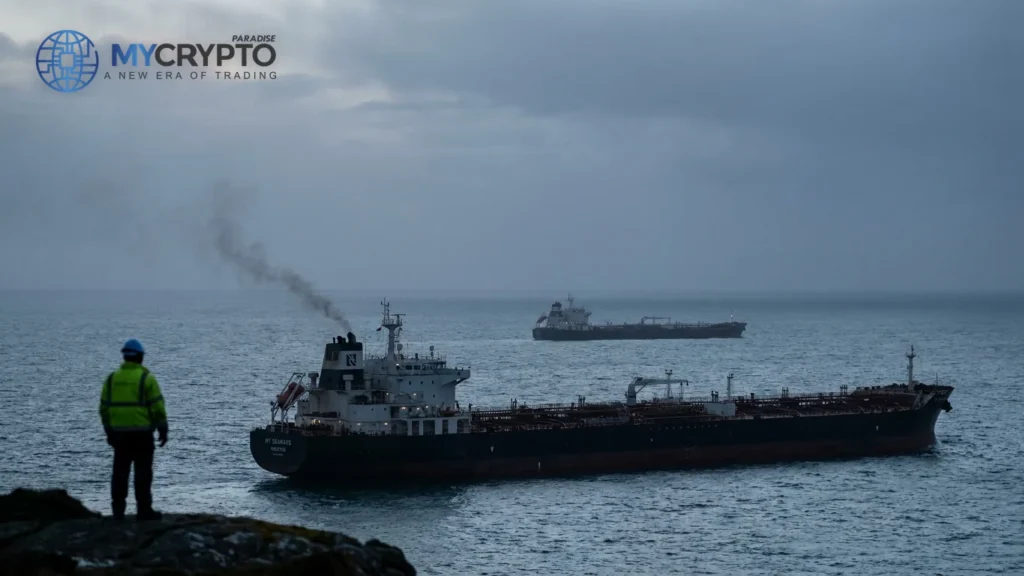
Brent crude oil pushed above $92 a barrel early Tuesday after two oil tankers were struck in the Strait of Hormuz. That single chokepoint normally carries roughly 20% of the world's oil and LNG. When shipping there is threatened, energy prices move fast, and they did.
In early trading, Brent jumped by 10 to 13% as traders scrambled to price the disruption. The move followed a run higher over recent sessions, with Brent rising 3.2% to $90.91 on Monday. Both Brent and WTI had already climbed more than 2% after earlier strikes.
The physical picture backs the fear. On Monday, visible commodity vessels crossing the strait fell to about five per day, well below the 10-day average near 14. Fewer ships means tighter supply, and tighter supply means higher prices.
Markets are now pricing another wave of inflation. Energy sits upstream of almost everything: transport, manufacturing, and the weekly shop. When oil jumps, that cost eventually lands on the consumer.
Crypto, so far, has shrugged. Bitcoin trades near $77,950, down under 1% on the day. Ethereum is flat near $2,451. It is the sort of calm that looks reassuring right up until it isn't.
Energy costs feed straight into inflation fears
The transmission runs through cost, not sentiment. Oil is the base input for freight, factories, and food. When Brent gains 10% in a morning, that pressure works its way into prices over the following months. Central banks read those prints, and they do not enjoy surprises.
That is the real risk for crypto here. Policymakers are already wrestling with sticky inflation. A fresh energy shock hands them a reason to stay hawkish, or to tighten further. Hawkish policy drains liquidity, and risk assets breathe liquidity.
We want to be honest about causation. There is no single confirmed same-day catalyst pulling crypto lower. This oil shock is not a direct crypto event. We frame it as a macro headwind, an interpretation of the pressure building around risk assets, not a proven cause of any Bitcoin move.
Still, the chain is coherent. Geopolitical conflict disrupts oil supply. The supply shock lifts prices. Higher prices revive inflation fears. Inflation fears invite tighter policy. Tighter policy squeezes the liquidity that has been supporting speculative markets all year.
The muted crypto reaction tells its own story. Either the market has not priced these implications yet, or it is treating oil as somebody else's problem. Both readings favour caution over comfort.
Crude climbs while Bitcoin holds its ground
Start with the dog that did not bark. Oil ripped higher, inflation fears returned, and Bitcoin moved less than 1%. In our experience, a flat tape into a genuine macro shock is rarely resilience. It is often positioning that has not been tested yet.
Bitcoin sets the tone for the complex. If a broader risk-off mood takes hold, BTC usually leads the move, and it leads in both directions. A calm hourly chart, down 0.9% on the hour, keeps leverage comfortable and stops parked in predictable places.
Ethereum sits slightly green near $2,451, up 0.2%. That mild outperformance is thin evidence of demand. In a liquidity squeeze, ETH tends to track BTC lower, not decouple higher.
Alts are the tail of this whip. They are the most liquidity-sensitive assets on the board. If oil-driven inflation forces even a modest tightening, the smaller caps feel it first and hardest, because that is where the marginal, borrowed money lives.
Here is the mechanism we care about. Retail reads the flat price and relaxes. Smart money reads the macro and holds capital back. That gap between comfort and caution is exactly where late longs get trapped when the tape finally reacts.
The Hormuz shipping data worth tracking
Watch the strait itself first. Vessel traffic near five per day, against a 10-day average near 14, is the cleanest live gauge of stress. If crossings recover, the oil spike may fade, and the inflation scare fades with it.
Brent is the second tell. A hold above $92, or a push higher, keeps inflation on the front page and pressure on central banks. A sharp reversal back under recent levels would ease the macro headwind quickly, and that would be the more constructive path for risk.
For Bitcoin, we would treat a decisive break of local support on rising volume as confirmation that the macro is finally biting. A slow grind lower on thin volume says the same thing, just quieter.
Invalidation of the bearish read is simple and specific. If oil calms, vessel traffic normalises, and BTC reclaims and holds the levels it is defending, the shock passes as noise. That would tell us the market was right to shrug.
One caveat keeps us balanced. This is a developing geopolitical situation, and details are still emerging. Headlines can reverse a tape in minutes. We size for that uncertainty rather than pretending we can predict the next tanker report.
Reading the calm near the 78K zone
The ParadiseTeam reading starts with the current price. Bitcoin near $77,950, barely down, sitting just under the $79K area, is not the picture of a market pricing an inflation shock. It is the picture of one that has not yet decided to.
Apply the oil story to that level. A genuine risk-off wave would test the support beneath current price, and that is where late longs cluster their stops. Bearish macro news arriving while retail stays optimistic is the setup that most often precedes distribution, not accumulation.
So who benefits. Smart money benefits from patience here. It does not need to chase a flat tape. It can wait for the institutional capitulation that usually marks a real bottom, using macro shocks like this one as further justification to hold liquidity back.
Retail sits on the other side. The calm reading of a 1% down day encourages adding into a market that has a fresh macro headwind and no confirmed local catalyst to support it.
Our bias into this event is cautious. We treat the muted reaction as unfinished business, not a green light. We want to see the strait, oil, and BTC support all confirm together before assuming the worst has passed. Probabilities, not promises, and right now the probabilities favour patience over conviction longs.
Track it live: our Crypto Fear and Greed Index and the live crypto funding rates both update in real time, so you can watch this shift for yourself.
Related coverage
For exact entries, targets, and stop losses with full risk management, that is what ParadiseFamilyVIP is for. New to reading these moves? Start with our crypto trading strategies guide.
ParadiseTeam is monitoring the market situation closely, and we are taking these developments into consideration while building our trading tactics inside ParadiseFamilyVIP.
Crypto trading involves substantial risk. Prices are volatile and you can lose money. This article is educational and is not financial advice. Past performance does not guarantee future results.
Where does BTC head next as the oil-led inflation scare builds?
This is how 17 Paradisers are calling it. Tap your call.
No calls on this one yet. Tap yours to be the first.
Free account, no password. Members just sign in.







Join the discussion 12
i’m still trying to work out the wider connections from these kinds of things you know, like how oil suddenly makes my bitcoin feel a bit wobbly 🤯 is that a silly way to think about it lol
so, its just a reminder to always have that macro check box on the pre-trade checklist, yes.
i dont think btc staying steady is a sign its decoupling. it just means the people holding it arent worried about the news right now.
But "not worried" can simply reflect the present liquidity picture, Tommy. What about the positioning of those who might be?
lol my dad is the same with the oil prices! 😅 I guess I am learning to care more now, with my small bags. 📉 Not much choise! 🔥
Same here with the oil price... it's all part of the big machine, always affecting the smaller gears. You really see it when you're on the water.
ha, exactly carlos! when the stakes get real, even the most detached among us start tracking those obscure economic indicators, isnt it? ⛽️
This reminds me of when my uncle would panic over crude oil prices, convinced it dictated everything. I still find myself looking for what truly changes the core thesis in these situations.
It's hard to explain this to my friends sometimes, they just don't get why I would care about oil prices when I'm just drawing at my desk! 😅
Oil prices always matter. The cost of drawing at your desk still needs to get there.
They keep trying to link this to BTC but the correlation just isn't there, is it? It's like trying to connect a button's colour to its function. 🤷♀️
The inflation concern is a retest of earlier narratives. Curious if anyone is anticipating a new support level in the next CPI release.