

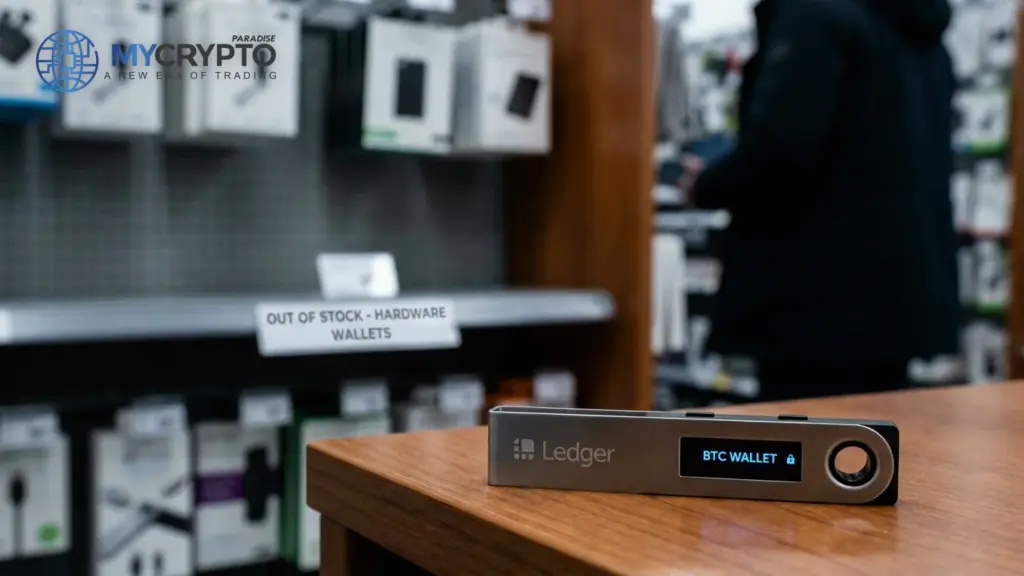
Market briefing: Ledger confirmed a hidden implant that read recovery phrases and sent them out over an LTE cellular link, and a major German retailer halted Ledger sales. BTC was near $83,246 as the market shrugged.
- Ledger's Donjon team found hardware implants in wallets sold by reseller CryptoBilis.
- The implant read the 24-word recovery phrase on screen and sent it over LTE via an eSIM.
- MediaMarkt Saturn halted Ledger sales in Germany after one suspected implant, with no reported losses there.
Source: Ledger
A Ledger implant quietly read recovery phrases and shipped them out over an LTE link. So is this a supply chain scare or a crack in self-custody itself?
Ledger's security research team, Donjon, has now explained how a hidden hardware implant stole recovery phrases from its wallets. The affected devices were sold through one reseller, CryptoBilis, and the method was patient and clinical.
During setup, the implant read the 24-word recovery phrase straight off the device screen. A small microcontroller inside the enclosure decoded those words. Then it sent them out over LTE cellular networks using an embedded SIM. No cable, no app, no obvious trace.
The detail that matters: Ledger says the implant did not touch the Secure Element, the operating system, transactions or signatures. In plain terms, the core wallet still worked. Someone had simply hidden a second, uninvited machine inside the box. This is day five of a running story. First drain reports surfaced on October 9, Ledger confirmed the implant on October 10, and the full breakdown landed on October 13.
Europe then felt the chill. MediaMarkt Saturn stopped selling Ledger devices in Germany after a single customer reported a suspected implant. No fund losses were reported in that German case, and there is no sign Ledger's own infrastructure was compromised.
So the panic and the facts point in slightly different directions. The attack was real and sophisticated, but it rode in on a third-party sales channel, not on a flaw in Ledger's chips. For an industry that sells trust in a sealed box, a retailer quietly pulling that box off the shelf still stings.
Supply chain trust is the real casualty
Self-custody rests on one quiet assumption: the device in your hand is the device the maker shipped. This implant attacks that assumption directly, which is why it travels further than the actual losses.
The transmission mechanism here is confidence, not liquidity. A hardware wallet is sold as the safe end of crypto, the answer to exchange hacks and custodial failures. When the threat moves from software to the physical box itself, the fear becomes harder to reason away. Retail users cannot audit a sealed enclosure.
That fear concentrates on a specific weak point, the purchase channel. Every confirmed problem traced back to one reseller, CryptoBilis, not to official distribution. The lesson is narrow but important: where you buy the device now matters as much as which device you buy.
A major retailer halting sales amplifies this, even with no reported losses in Germany. A precautionary pull by a large electronics chain reads to the public as an admission of risk, whether or not that is fair.
The broader backdrop is the old tension in crypto between decentralization and the messy practicalities of keeping keys safe. Incidents like this feed the self-custody doubt that pushes nervous holders back toward custodians. So the significance is reputational and behavioural, not structural. It does not break Bitcoin or Ethereum. It chips at the trust layer underneath the sector, and trust, once dented, is slow and expensive to rebuild.
A contained scare, not a systemic crack
Price barely flinched, and that tells you most of the story. BTC was trading near $83,246 as of the brief, up about 0.7 percent on the day, while ETH sat near $2,506 and LINK near $12.94. A genuine systemic threat does not leave the tape this calm.
That muted reaction is the honest read. The attack is specific to one sales channel, not a flaw in the protocols that price BTC, ETH and alts. There is no liquidity being drained from the market, no forced selling, no broken exchange.
Walk the chain down the risk curve and you see the same picture. BTC absorbs a security headline like this easily, because nothing about its monetary network changed. ETH follows, unbothered at the base layer. Alts, including LINK, drift on their own flows rather than on this news.
Where the real impact lands is demand for specific hardware and specific channels, not spot price. Expect some buyers to favour official storefronts and direct orders over resellers. Expect a short bump in attention for competing wallets.
We will be honest about causation. There is no single confirmed same-day catalyst moving the broad market, so framing today's minor moves as a Ledger reaction would be an interpretation, not a fact.
The story is a trust event for the hardware niche. It is close to noise for market-wide liquidity, and the price action quietly agrees.
Confirmation lines between targeted and systemic
The first thing to watch is scope. So far, every verified loss traces to wallets bought through CryptoBilis, and Ledger has found no similar losses through other channels. That boundary is the whole case.
Confirmation that this stays contained would be simple. No credible reports of implants in devices bought from official storefronts or trusted retailers. No fund losses tied to Ledger's own infrastructure. The German incident staying exactly as it is, a suspected implant with no money gone.
Invalidation would look very different. Verified implants surfacing in devices from mainstream, non-reseller channels would turn a supply chain problem into a distribution problem, and that is a far heavier story.
Watch other large retailers too. MediaMarkt Saturn moved first in Germany. If more chains quietly pull stock, the reputational damage compounds regardless of the technical facts, because shelf space is its own kind of verdict.
Keep an eye on competitor behaviour. A rival wallet loudly marketing tamper-evidence tells you the industry smells an opening, which is itself a signal that the narrative has legs.
Finally, separate the hardware story from the price story cleanly. If BTC moves hard this week, look for the actual driver elsewhere, in flows, liquidations or macro, not in this implant. Tying every candle to the loudest headline is how traders talk themselves into the wrong trade. Let the scope of the breach, not the volume of the panic, set your read.
What the implant means for self-custody flows
The ParadiseTeam treats this as a trust event, not a price event, and the levels confirm it. BTC was near $83,246, pressed right under the previous high at $83,400, with support stacked at $81,500 and $81,000. None of those levels care about a reseller's tampered box.
Our standing read on Bitcoin is constructive into $90,000, with smart money accumulating and absorbing fearful retail selling. This implant story does nothing to that structure. It is self-custody noise sitting beside an unrelated market setup, and conflating the two is the trap.
The smart-money angle here lives off the chart, in behaviour. Panicking holders who overreact to a channel-specific breach, by dumping coins or fleeing to custodians, hand cheaper supply to those who read the facts calmly. Fear that outruns the evidence is exactly the inefficiency we respect.
For positioning, the level that matters is still $83,400. A clean reclaim and hold above the previous high keeps the path toward $90,000 open. Losing $81,500 on real volume would force a rethink, but on today's drivers, not on a hardware headline.
We would add one caution from the lens, not a reversal of the read. Strength into the previous high can still meet selling, so chasing a wick through $83,400 without a hold invites a trap.
Trade the structure, store the keys carefully, and do not let a security scare write your market thesis for you.
The read behind this: we framed this story through our own market analysis, Bitcoin Miner Moves $81M: Is $44K Next?
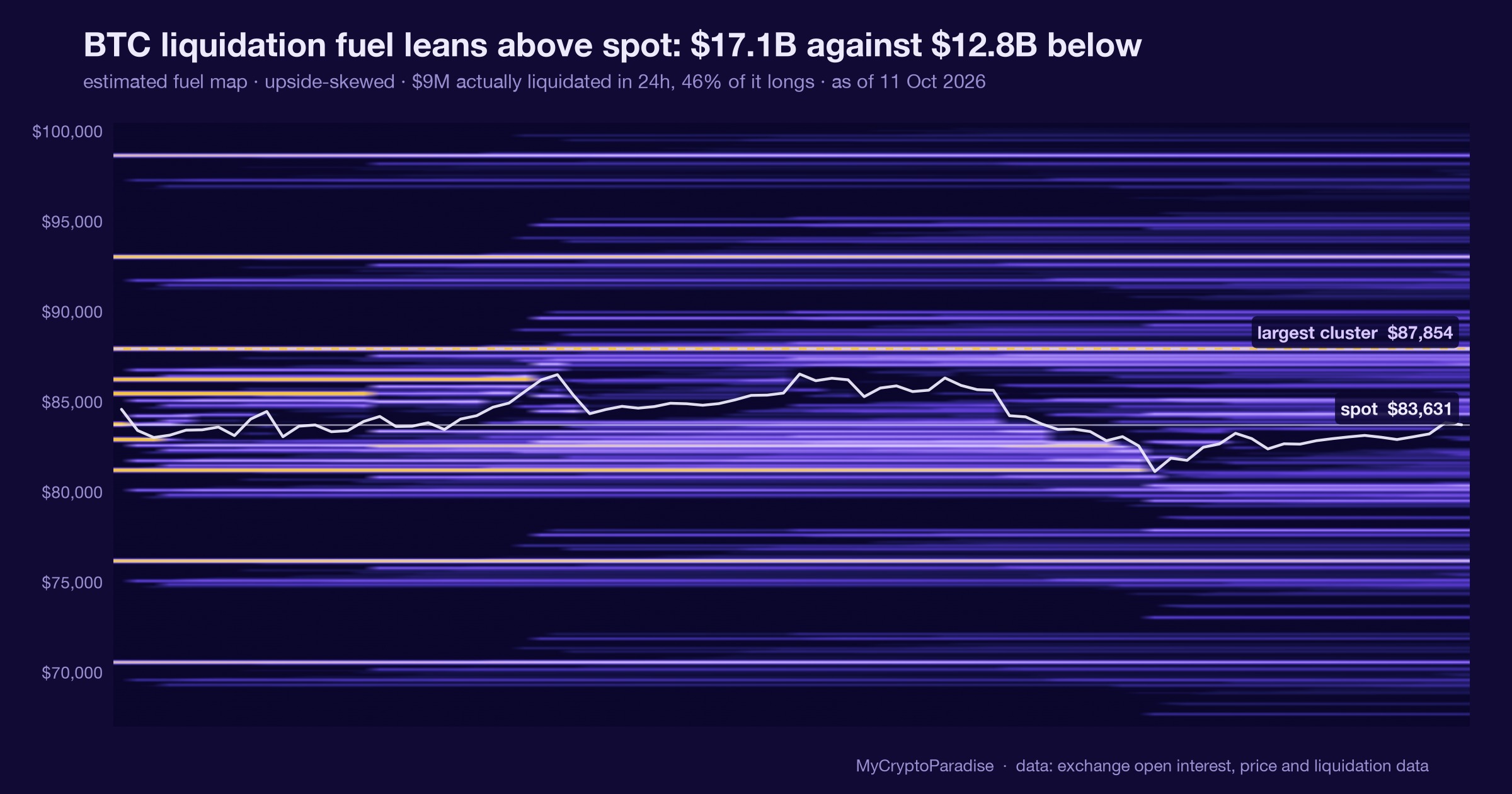
Track it live: our Crypto Fear and Greed Index and the crypto liquidation heatmap both update in real time, so you can watch this shift for yourself.
Related coverage
For exact entries, targets, and stop losses with full risk management, that is what ParadiseFamilyVIP is for. New to reading these moves? Start with our crypto trading strategies guide.
ParadiseTeam is monitoring the market situation closely, and we are taking these developments into consideration while building our trading tactics inside ParadiseFamilyVIP.
Crypto trading involves substantial risk. Prices are volatile and you can lose money. This article is educational and is not financial advice. Past performance does not guarantee future results.
Will this implant scare change how traders buy hardware wallets?
This is how 4 Paradisers are calling it. Tap your call.
No calls on this one yet. Tap yours to be the first.
Free account, no password. Members just sign in.









Join the discussion 1
Wait, so the implant was from the reseller's side?? 🤯 That's a new level of scam, wow. People cant even trust a hardware store now? 🤦♀️💔