

Listen: the breakdown
Market briefing: A counterfeit Ledger site is topping Google Search with over a million monthly visits, built to harvest seed phrases, while roughly $86 million in wallet thefts sits under investigation. BTC held near $82,929 as the news barely moved price.
- A fake Ledger site and app reached the top of Google Search and drew over 1M visits in 30 days.
- The pages exist to trick users into typing their 24-word seed phrase; roughly $86M in thefts is under investigation.
- BTC sat near $82,929, up about 0.5% on the day, showing little direct price reaction.
A fake Ledger phishing site is sitting at the top of Google with over a million visits, quietly harvesting seed phrases. Is retail trust the real casualty here?
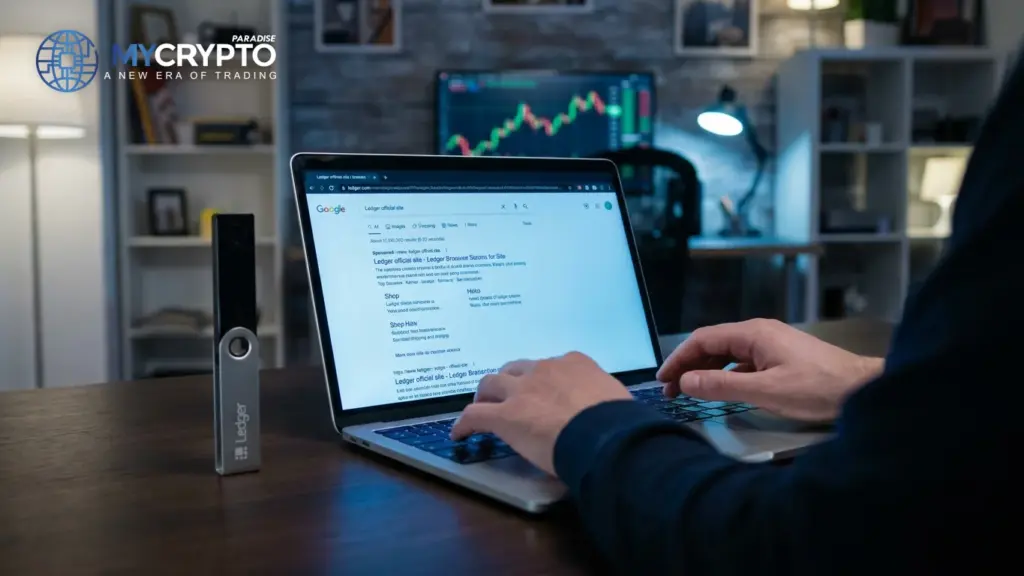
A fraudulent Ledger website and application climbed to the very top of Google Search. Over the past thirty days it pulled in more than one million visits. The pages look official. They are not. Their only job is to coax a user into typing the 24-word seed phrase that controls a hardware wallet.
That single detail is the whole story. A seed phrase is the keys to the vault. Hand it over on a counterfeit page and the funds leave in seconds, with no bank, no chargeback, and no support line to call.
The discovery lands while investigators examine an estimated $86 million in wallet thefts. We treat the two as part of one pattern, not a proven single chain, and we will say so plainly rather than overstate the link. Security researchers have been warning users directly. Earlier, malicious ads impersonating Ledger were already redirecting people to fake wallet pages, so the playbook is familiar.
What changed is the distribution. A scam ranking first on the world's biggest search engine is not a dark-corner trap. It is standing in the front window. New entrants searching an honest query are the ones most exposed.
Bitcoin barely blinked. BTC traded near $82,929 as of the latest read, up roughly half a percent on the day. The price does not price in this incident, which tells you where the damage actually falls: on individual holders, not on the order book.
Why self-custody trust is the real target
The macro lesson here is older than crypto: in a system where you are your own bank, you are also your own fraud department. There is no deposit insurance behind a seed phrase. So the transmission mechanism runs through confidence, not through balance sheets.
When a phishing page ranks first on Google, the cost is paid in trust. Every headline about stolen funds nudges a cautious newcomer back toward the exit. That slows the flow of fresh capital into the asset class, which is the oxygen every bull phase needs.
We separate fact from read carefully. The fact is a prominent fake site with over a million visits and an $86 million theft investigation. The read is that this erodes sentiment at the margin rather than triggering a market-wide shock.
The structural point is who absorbs the hit. These attacks prey on the less vigilant holder, the one who keeps everything in one place and clicks the top result. That is the same cohort our framework calls dump money: late, crowded, and emotionally exposed.
Everyone pretends they would never fall for it, right up until a convincing clone sits at the top of the page they already trusted. That gap between confidence and caution is exactly what scammers monetise. So the event matters less for today's candle and more for the slow drip on retail conviction. Weak hands that lose funds to fraud rarely come back as patient buyers. They come back, if at all, as sellers.
How the fear filters into crypto prices
Read through our bearish lens, the immediate price impact is small but the directional tilt is real. BTC near $82,929 showed no meaningful reaction, because the order book does not clear seed-phrase theft. The liquidity stays where it was.
The effect instead travels through sentiment. Fear is contagious in a market already nervous near support. When retail reads about stolen wallets, risk appetite thins, bids get lazy, and the marginal buyer hesitates. That is a quiet bearish pressure, not a cascade.
BTC is the trust anchor, so it wears this first. If confidence in self-custody wobbles, Bitcoin feels the hesitation before anything else does, simply because it is where new money usually starts.
Ethereum inherits the same unease one step removed. ETH holders run more wallet connections and sign more transactions, so the surface area for phishing is wider. Reduced confidence there tends to show up as softer spot demand rather than a sharp drop.
Alts sit at the fragile end of the chain. They need steady risk appetite and fresh retail inflows to hold bids. A story that scares newcomers off the on-ramp hits the thinnest books hardest, which is why alt liquidity usually dries up first in a trust scare.
None of this is a crash catalyst. It is a weight on the scale. On the facts, it leans bearish: a security shock that chips at retail conviction while smart money, better secured and mostly patient, is barely touched.
What confirms deeper retail capitulation ahead
The first thing to watch is whether the fraud story stays contained or spreads. One ranked phishing site is a warning. A wave of copycats climbing search results, plus a rising theft tally beyond the $86 million figure, would signal a broader trust problem and deeper retail retreat.
Confirmation of the bearish read would be BTC losing its footing near the $82,000 support zone while fear headlines pile up. That combination, weak hands selling into bad news at support, is the capitulation our framework waits for.
Invalidation looks different. If BTC absorbs the noise, holds $82,000, and reclaims $84,000 on steady spot buying, the scare stays cosmetic. Price shrugging off fear at support usually means stronger hands are quietly taking the other side.
Watch the quality of any bounce. A reclaim of $88,000 on genuine volume would say the market has looked past the incident entirely. A limp drift back up on thin volume says nothing has changed and the risk still points lower.
Also watch behaviour, not just price. Rising reports of drained wallets and spiking searches for safe storage are retail fear in real time. That fear is the fuel capitulation runs on.
Above all, verify before you trust. A security story like this is a reminder to confirm every URL and never enter a seed phrase online. The market read is secondary to not becoming the next line in the theft total.
What this scare means for patient capital
The ParadiseTeam reads this as a sentiment event, not a liquidity event. BTC near $82,929 is sitting right on the $82,000 support we are tracking, and a phishing scare does nothing to move that level directly. It works on the holders around it.
Our standing bias stays macro bearish, with rallies treated as distribution rather than breakouts. A story that scares retail fits that frame. Frightened new money does not chase; it sells or sits out, which thins the bids that hold price up.
The mechanism is simple. Fear transfers coins from nervous hands to patient ones. If BTC loses $82,000 and slides while fraud headlines spread, that is the kind of weak-hand selling smart capital waits to absorb, with the deeper reaccumulation zone we watch sitting far lower near $55,000 to $44,000.
For confirmation we want to see spot demand quietly stepping in as price tests support, not panic chasing. Strength that stalls under the $88,000 reclaim level would, by contrast, look like another distribution window.
The practical edge here is not a level. It is hygiene. Smart money rarely loses funds to a seed-phrase page, because it verifies everything and keeps keys offline. Retail that skips that step donates liquidity to the patient side.
So the positioning read is caution, not alarm. Respect $82,000, expect fear to pressure the downside, and treat the scare as one more reason weaker hands may hand over coins before any real bottom forms.
The read behind this: we framed this story through our own market analysis, Bitcoin Crashes to $82K: Reversal Next?
Track it live: our Crypto Fear and Greed Index and the crypto liquidation heatmap both update in real time, so you can watch this shift for yourself.
Related coverage
For exact entries, targets, and stop losses with full risk management, that is what ParadiseFamilyVIP is for. New to reading these moves? Start with our crypto trading strategies guide.
ParadiseTeam is monitoring the market situation closely, and we are taking these developments into consideration while building our trading tactics inside ParadiseFamilyVIP.
Crypto trading involves substantial risk. Prices are volatile and you can lose money. This article is educational and is not financial advice. Past performance does not guarantee future results.
How will crypto users react to the ongoing self-custody security threats?
This is how 1 Paradiser is calling it. Tap your call.
No calls on this one yet. Tap yours to be the first.
Free account, no password. Members just sign in.








Join the discussion
No comments yet. Members, share how you are reading this.