

Listen: the breakdown
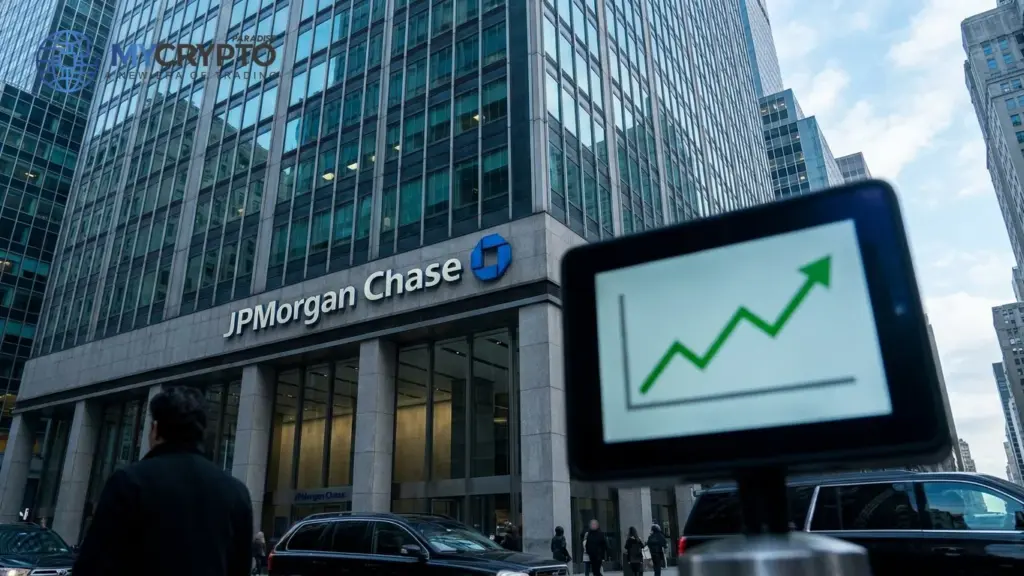
Market briefing: JPMorgan just expanded two tokenized money market funds onto Solana for qualified US investors. BTC traded near $81,688 as of 09:23 UTC, barely moving, while the quiet institutional build continues.
- JPMorgan Asset Management expanded MONY and JLTXX to Solana on October 22
- Qualified US investors reach both funds through the Morgan Money platform
- JLTXX is built to support stablecoin issuers under the GENIUS Act
JPMorgan's tokenized funds just landed on Solana, extending a quiet TradFi push onto public rails. Is this the institutional validation SOL has waited for?
JPMorgan Asset Management has expanded two tokenized money market funds onto the Solana blockchain. The move, announced on October 22, brings MONY and JLTXX to a second public chain after their Ethereum debut.
Qualified US investors can now reach both funds through Morgan Money, the firm's institutional trading and liquidity platform. One fund matters more than its ticker suggests. JLTXX is designed to support stablecoin issuers under the GENIUS Act, tying a regulated money market product directly to the plumbing behind dollar-pegged tokens.
This is not a startup experimenting at the edges. It is one of the largest banks on earth placing core cash-management products onto rails that purists once dismissed as unserious. The same institution that spent years warning about crypto now quietly ships tokenized funds across two chains.
JPMorgan already runs three tokenized products on Ethereum mainnet: JPMD, a USD deposit token also live on Base, plus MONY and JLTXX. Solana now joins that footprint, widening the bank's multi-chain reach rather than replacing Ethereum.
The structural point is simple. Traditional finance is no longer asking whether public blockchains can carry regulated assets. It is choosing which chains to build on, and Solana just made the shortlist.
That choice carries weight. High-throughput settlement and low fees matter when a bank moves institutional liquidity at scale. For Solana, hosting a JPMorgan product is less a marketing win than a technical endorsement, the kind that compounds slowly and rarely reverses.
A bank choosing which chains carry regulated cash
The transmission here runs through credibility, not price. When a major bank deploys regulated money market funds onto a public chain, it signals that chain can carry institutional-grade assets safely. That judgment travels further than any token price.
Tokenized money market funds sit at the boundary between TradFi cash and on-chain settlement. They let qualified investors park dollars in a yield-bearing, regulated wrapper that lives on a blockchain. The GENIUS Act angle sharpens this. JLTXX is built to back stablecoin issuers, which means it plugs directly into the collateral layer of the dollar-token economy.
That matters because stablecoins are the real on-ramp for institutional liquidity. If regulated money funds become their reserve backing, the link between bank balance sheets and crypto rails tightens considerably.
Solana gains the most from this specific choice. The chain now hosts a product from an institution that spent a decade publicly skeptical of the whole space. The irony is not lost on anyone who read the old research notes.
For the broader market, the mechanism is adoption, not speculation. Each regulated product on public rails lowers the perceived risk of the next one. Infrastructure decisions by large allocators tend to compound, because committees rarely reverse a chain they have already vetted. This is how legitimization actually happens. Not in a single headline, but in a slow accumulation of institutional commitments that make the technology harder to dismiss and easier to build on.
Why SOL barely twitched on a serious endorsement
SOL traded near $103.96 and moved only fractionally on the news, up about 0.3 percent over 24 hours. That muted reaction is the tell, not a disappointment.
Fundamental infrastructure news rarely produces a retail pump. There is no airdrop, no listing, no promise of quick gains to chase. Smart money reads an institutional deployment as a long-term thesis; retail reads it as a headline it does not quite understand and scrolls past.
That gap is where positioning forms quietly. A major bank building on Solana adds durable utility and potential liquidity flow, yet the price shows almost nothing today. The value accrues over quarters, through actual usage, not over a single trading session.
BTC and ETH sit broadly supportive rather than directly driven here. BTC hovered near $81,688 and ETH near $2,393.97, both flat on the day. The story strengthens the L1 adoption narrative that lifts all serious chains, but it names Solana specifically.
The liquidity path is the real prize. If JLTXX scales as stablecoin collateral, regulated dollars gain a cleaner route onto public rails. That capital tends to arrive steadily, not in the explosive bursts retail prefers.
So the chain to watch is not today's candle. It is whether assets under management on these tokenized funds grow, and whether other allocators follow JPMorgan onto Solana. Adoption prints slowly. It also prints more reliably than hype, which is precisely why the quiet reaction is the bullish part.
Signposts that separate a real build from a press release
The confirmation to track is usage, not the announcement itself. A tokenized fund on a new chain means little until assets actually flow into it. Watch for growth in the funds' on-chain balances over the coming weeks.
The gap between a glossy press release and a growing balance sheet is where many TradFi crypto projects quietly stall. JPMorgan has the distribution to avoid that fate, but the proof lives in the numbers, not the launch.
The second signal is follow-on. If other large asset managers announce Solana deployments, it confirms the chain has crossed an institutional trust threshold. One bank is a decision; several is a trend.
Stablecoin integration is the sharpest tell. JLTXX was built to back issuers under the GENIUS Act, so watch whether any stablecoin actually adopts it as reserve collateral. Real integration there would turn a product launch into infrastructure.
Invalidation looks different from a price drop. The bearish read is not SOL falling; it is the funds sitting near-empty months from now, a capability announced but unused. That would mark this as optionality rather than commitment.
For the wider tape, keep BTC's structure in view, since macro still sets the mood music for every altcoin. A broad risk-off move would mask Solana's fundamental gain, but it would not erase it.
The honest frame: this is a confirmed, constructive development whose payoff is measured in adoption curves. Judge it by flows, not by the first day's candle.
What JPMorgan's Solana move means for institutional flow
The ParadiseTeam frames this as a fundamental positive for Solana that the chart will not reward overnight. Institutional infrastructure builds value in layers, and the tape reflects it late.
Our standing read on the broader market stays cautious on high timeframes. BTC traded near $81,688 as of 09:23 UTC, holding the $80,000 to $81,000 support zone we mark at the 0.618 retracement. Below that, $79,000 is the line that defines whether bullish structure survives.
That caution matters for how SOL trades this news. A Solana-specific catalyst can still get dragged lower if BTC loses $79,000 and the whole market rolls over. Fundamentals do not override macro structure in the short term; they set the floor for the next cycle, not this week's candle.
We see smart money absorbing retail selling at these BTC support levels, with roughly 56 percent of tracked smart money buying over the past 24 hours. That absorption is the backdrop, not a green light.
On the upside, we still treat $85,300 and $90,000 as resistance where strength can meet selling. A bullish fundamental story does not change where the liquidity sits above price. So the ParadiseTeam reads JPMorgan's Solana deployment as real institutional validation stacking quietly beneath the market, while the near-term direction stays tied to BTC defending its support. Patience favors the fundamental holder here. Momentum traders should respect the levels, because conviction without structure is just hope with a thesis attached.
The read behind this: we framed this story through our own market analysis, Can Bitcoin Still Make a Higher High?
Track it live: our live crypto funding rates and the Crypto Fear and Greed Index both update in real time, so you can watch this shift for yourself.
Related coverage
For exact entries, targets, and stop losses with full risk management, that is what ParadiseFamilyVIP is for. New to reading these moves? Start with our crypto trading strategies guide.
ParadiseTeam is monitoring the market situation closely, and we are taking these developments into consideration while building our trading tactics inside ParadiseFamilyVIP.
Crypto trading involves substantial risk. Prices are volatile and you can lose money. This article is educational and is not financial advice. Past performance does not guarantee future results.
Does JPMorgan building on Solana pull real TradFi liquidity into SOL?
This is how 2 Paradisers are calling it. Tap your call.
No calls on this one yet. Tap yours to be the first.
Free account, no password. Members just sign in.
Follow this topic: Solana news






Join the discussion
No comments yet. Members, share how you are reading this.