

Listen: the breakdown
Developing story update (September 02, 2026, 11:59 UTC):
The strike scope has widened since we published. Beyond Jordan, Kuwait and Bahrain, based on our sources the attacks now also reach the UAE, Saudi Arabia and US military bases across the region, turning a targeted retaliation into a broader multi-country event.
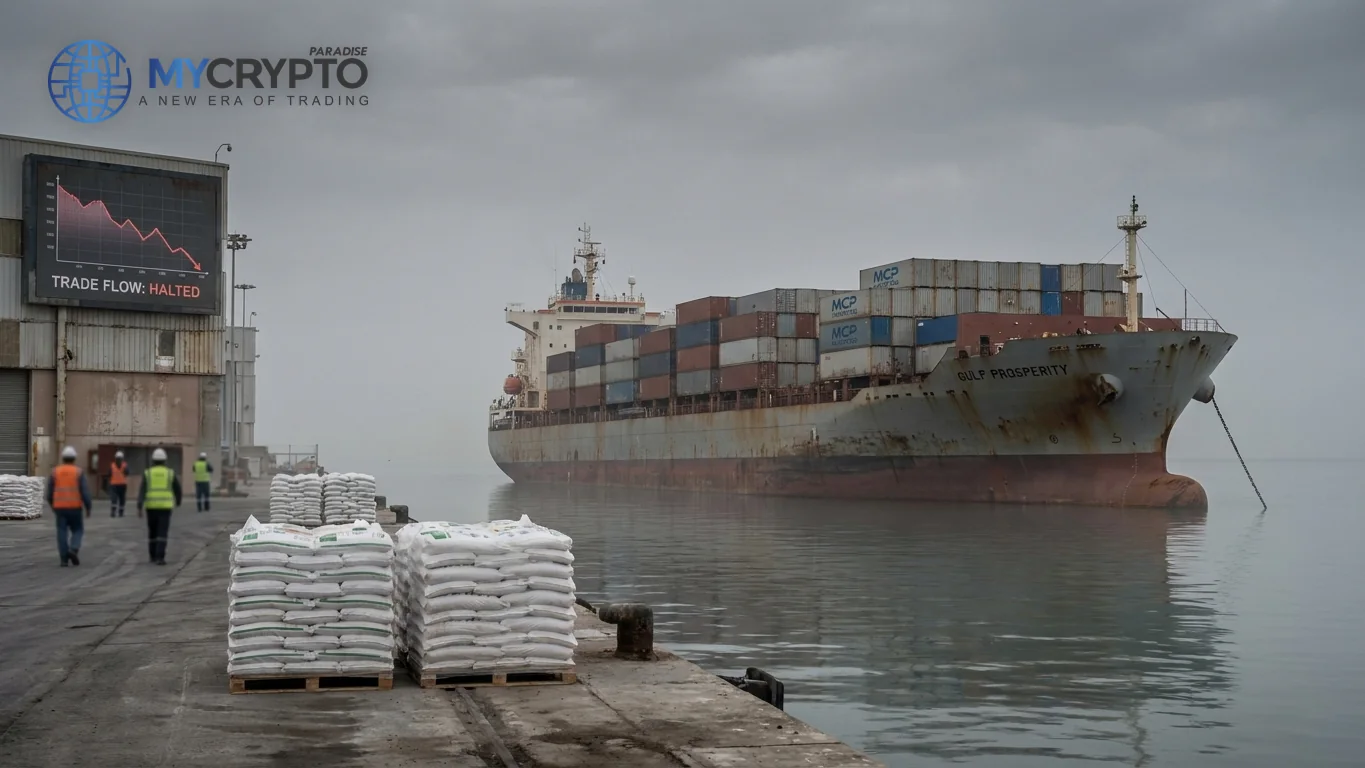
More important for traders: shipping through the Strait of Hormuz is now disrupted. That corridor carries a large share of global seaborne oil, so any sustained interruption raises the odds of an energy price shock feeding a wider risk-off move. Crypto has barely reacted so far, with BTC near $76,678 and still rejected under $79,000, which keeps the distribution read intact.
Watch whether the Hormuz disruption escalates or eases. A prolonged closure would likely pressure risk assets further and could accelerate the move toward lower liquidation clusters rather than trigger a relief bounce.
What to watch now: Whether Strait of Hormuz disruption persists and drags oil and risk assets lower.
Developing story update (September 02, 2026, 09:44 UTC):
The strike wave now has a confirmed impact point outside the earlier general targeting: based on our sources, an Iranian missile reportedly hit Aqaba Airport in Jordan, and Kuwaiti air defenses were actively engaging incoming drones. This moves the story from broad targeting of US interests to a named civilian aviation hub being struck, which raises the odds of a wider escalation and further shipping and airspace disruption around the region.
Crypto has stayed relatively muted through this. Bitcoin is near $76,590, down about 1.7 percent on the day, and Ethereum is near $2,371, down about 3.2 percent, with ETH continuing to underperform. The measured drop rather than a sharp flush is consistent with a distribution read: risk-off pressure is building slowly rather than triggering immediate capitulation, so traders should watch for whether fresh headlines force a faster repricing.
What to watch now: Watch for confirmation of further named strike targets and any airspace or Strait of Hormuz closures that could accelerate a risk-off flush.
Developing story update (September 02, 2026, 08:07 UTC):
The conflict has now spilled into a chokepoint that traders watch closely: shipping through the Strait of Hormuz has been disrupted, according to our sources. This is the first supply-side consequence tied to the strikes, and it widens the story from a purely military exchange to a potential energy and logistics risk.
Crypto itself is barely moving on the news. Bitcoin sits near 77,457 and Ethereum near 2,418, both showing only fractional one-hour declines. That muted reaction likely means the market has already discounted broad instability, so any sharp repricing would probably need a fresh escalation rather than a repeat of the same headlines.
What to watch now: Whether Hormuz disruption feeds through to oil and forces a delayed risk-off move in crypto.
Developing story update (September 02, 2026, 07:21 UTC):
The picture has sharpened since we published. A missile has now struck Jordan’s Aqaba Airport, a specific and confirmed hit on civilian aviation infrastructure that widens the footprint of the strikes beyond the earlier general reports.
Iran’s Revolutionary Guards has now openly claimed responsibility, stating it launched the attacks toward military targets. An official claim of ownership raises the odds of a direct retaliatory cycle rather than a de-escalation, which keeps a risk-off bid in play for hard assets and a lid on crypto.
For traders the price reaction remains muted, with Bitcoin near $77,580 and Ethereum near $2,423, both still down on the day. Flat price into an escalating headline can mean the market has already discounted the conflict, but it also leaves room for a sharper move if the Strait of Hormuz disruption deepens.
What to watch now: Whether the official Revolutionary Guards claim triggers a named counter-response and further Hormuz shipping disruption.
Developing story update (September 02, 2026, 06:35 UTC):
Update: Bahrain has now accused Iran of deliberately targeting civilians in the latest missile and drone waves, a sharper escalation in rhetoric that raises the odds of a wider regional response. For markets this hardens the risk-off backdrop rather than easing it.
The conflict is also now disrupting shipping through the Strait of Hormuz, the key oil transit chokepoint. Any sustained interruption there tends to lift energy prices and inflation expectations, which historically pressures risk assets including crypto. Traders should treat headlines from the Strait as a live catalyst for volatility.
What to watch now: Watch for any confirmed closure or naval incident in the Strait of Hormuz as the next volatility trigger.
Developing story update (September 02, 2026, 05:27 UTC):
Iran has now put an official on the record. A military spokesperson, Ebrahim Zolfaghari, stated that Tehran will no longer exercise restraint regarding Bahrain and Kuwait, framing the strikes as direct retaliation for recent US action. This shifts the situation from a one-off wave toward a stated policy of continued escalation.
For traders, the read is unchanged so far: BTC holds near $77.7k and ETH near $2,420 with no fresh 1-hour reaction, which suggests the market is still not pricing this in. That desensitization can persist until a harder catalyst hits, so probabilities favor caution rather than chasing current strength.
What to watch now: Whether a named threat of no restraint toward Bahrain and Kuwait triggers a broader response and finally forces a risk-off crypto reaction.
Developing story update (September 02, 2026, 03:38 UTC):
The escalation has now spilled into commercial shipping. Based on our sources, vessel traffic through the Strait of Hormuz has been disrupted, which puts a direct energy and supply-chain premium on the conflict rather than a purely political one. That is the channel through which a regional strike can start pricing into global risk assets.
A specific Iranian strike on Jordan’s Aqaba Airport has also been cited as part of the same retaliatory wave, giving the second-wave narrative a concrete new impact point. For traders the setup is unchanged in structure: BTC near 77.5k with a soft 24 hour trend and only a shallow 1 hour bounce, which reads as caution rather than a real risk-off flush. Treat sharp relief rallies on any de-escalation headline as suspect until volume confirms.
What to watch now: Watch Strait of Hormuz shipping and oil headlines; a supply shock there is the real transmission path into crypto risk.
Developing story update (September 02, 2026, 02:53 UTC):
The strikes have widened beyond the earlier reported targets. Bahrain has now been named as a target alongside Jordan and Kuwait, and the latest wave reportedly combines drones with ballistic missiles rather than missiles alone. For traders this signals the conflict is broadening geographically, not de-escalating.
An Iranian military spokesperson stated the country would no longer exercise restraint regarding Bahrain and Kuwait, and the action was framed as open defiance of US President Donald Trump’s warning of a much harder response. This raises the probability of a further round of retaliation and keeps a risk-off tone likely across crypto in the near term.
What to watch now: Watch for any official US or Gulf state military response that could trigger a deeper risk-off flush.
Developing story: This story is still unfolding. We are tracking it and will update this article as more details are confirmed.
Market briefing: Iran has widened its ballistic missile strikes to Kuwait and Jordan in a second wave, hitting US bases, yet Bitcoin only slipped to about 77,192 dollars, down 1.4 percent on the day. The market is nervous, not panicking.
- Iran launched a second wave of ballistic missiles, now also aimed at Kuwait alongside Jordan.
- Jordan intercepted 10 of 13 missiles fired at a US Marine Corps camp on its soil.
- BTC held near 77,192 dollars, down only 1.4 percent, a restrained response to a serious escalation.
Iran missile strikes just widened to Kuwait in a second wave, hitting US bases, yet Bitcoin barely moved near 77,192 dollars. So who is really selling here?
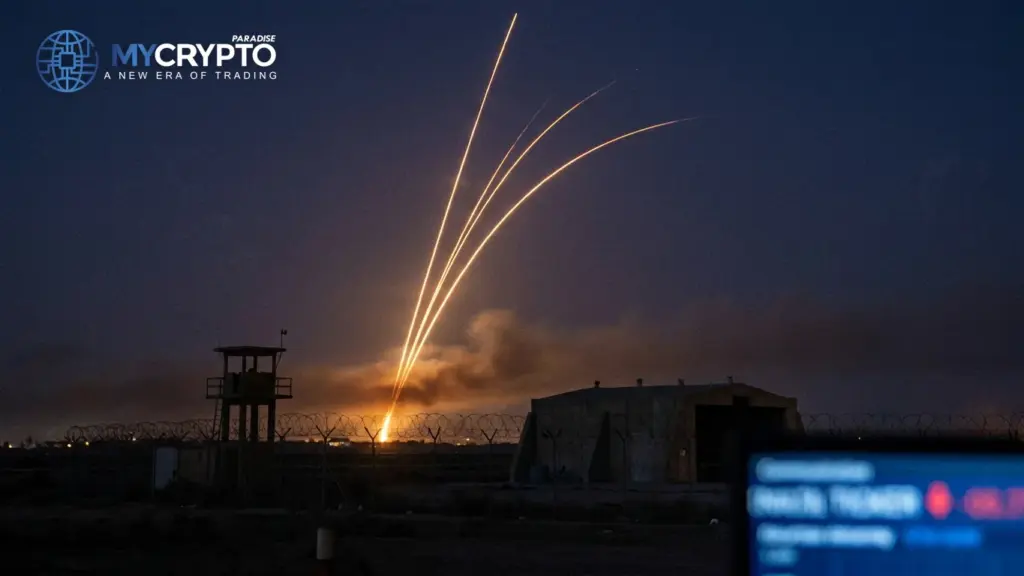
Iran has escalated. A massive new wave of ballistic missiles launched from Kermanshah, Lorestan, Tabriz, Arak, and Yazd, and this time the targets widened to include Kuwait as well as Jordan.
The Iranian armed forces reported a strike on two US bases in the region. Missiles were fired at a US Marine Corps camp in Jordan, and the Jordanian Army said it intercepted 10 of the 13 that came its way. A video and an accompanying statement followed, framed as a response to earlier US strikes.
This is the part that matters for traders: it is a second wave, not a one-off. A single salvo can be dismissed as a signal. A widening campaign that now names a new country reads as intent, and markets price intent differently from noise.
We already covered the first reports of strikes on US bases earlier today, when Bitcoin barely flinched. What is new is the geographic expansion and the confirmed second launch. That is the fresh escalation, and it is why we are back on this story.
And yet the price tape stayed oddly calm. BTC traded near 77,192 dollars, down 1.4 percent over 24 hours and only 0.4 percent in the last hour. ETH sat around 2,405 dollars, down 2.1 percent. For a night of missiles and struck bases, that is a whisper, not a scream. The gap between the headline and the candle is the whole story.
How war risk drains crypto liquidity
Geopolitical escalation works on crypto through liquidity, not through any direct link to a token. When missiles fly and US bases are hit, global capital reaches for safety first and asks questions later.
The transmission runs in a chain. Escalation raises uncertainty. Uncertainty widens the risk premium on everything speculative. Traders trim leverage, market makers pull back quotes, and the pool of ready capital that normally cushions crypto thins out. Thinner liquidity means the same sell order moves price further.
Crypto sits at the far end of that risk curve. It is the most speculative, most liquid, most globally accessible risk asset, so it is where fear gets expressed fastest and at any hour. A stock market can be closed at 3am. Bitcoin never is.
That is why a Middle East strike with no crypto content still pressures BTC and ETH. The mechanism is capital flight and reduced liquidity, not a story about blockchains.
But here is the tension. The actual drop was small. A genuine risk-off cascade usually shows up as a sharp, liquidation-driven flush, not a quiet 1.4 percent drift. Either the market has already discounted a wider conflict, or the selling is being absorbed as fast as it appears. Both readings change how the next headline should be traded, and neither is the panic the framing implies.
BTC leads as alts feel the squeeze
The order of who moves tells you who is doing the moving. In a real flight from risk, BTC falls first and least, ETH follows harder, and altcoins bleed the most as liquidity drains from the bottom of the market upward. So far the tape only half fits. BTC near 77,192 dollars is down 1.4 percent, ETH is down 2.1 percent, and that ETH-over-BTC weakness is the classic risk-off tell. Capital is rotating toward the deepest, most defensible asset, exactly as the model predicts.
What is missing is scale. Down low single digits on a night of struck US bases is not capitulation. It is a controlled step back.
That restraint is itself information. It suggests the leverage flush that usually accompanies war headlines has not yet triggered, which means the fuel for a violent move is still sitting on the books. Open interest that does not clear is a coiled spring, not a resolved risk.
For altcoins the warning is sharper. They have not cracked yet, but they always crack last and hardest. If BTC gives up its footing, the thin liquidity underneath alts is where the real damage would land. The muted print is not a green light. It is the market holding its breath, and held breath eventually resolves in one direction.
Signals that separate panic from a bottom
The next move hinges on whether this stays a headline or becomes a trend, so watch the tape more than the news wires.
Confirmation of real risk-off would be a decisive break below the recent range on rising volume, with liquidations clustering and ETH accelerating its underperformance versus BTC. If a third wave or a widening of targets coincides with a sharp liquidation cascade, the calm was a lag, not a verdict, and the flush is arriving late.
Invalidation looks like the opposite. If BTC holds near current levels while headlines keep escalating, the market is telling you the war premium is already in the price. A stable bid into worsening news is one of the more reliable signs that sellers are exhausted.
Watch three things specifically. First, whether open interest resets lower through liquidation or grinds sideways. Second, whether ETH stops leading the drop, which would signal the risk-off rotation stalling. Third, whether any bounce reclaims the levels lost today or fades at them.
The honest read is that this is developing, not settled. A second wave is confirmed, but the market's verdict is not. The temptation is to trade the emotion of the headline. The discipline is to trade the reaction to it, because in geopolitics the first candle is rarely the last word.
Reading the muted drop through smart money
The ParadiseTeam reads the gap between the headline and the candle as the entire trade here. A widening missile campaign that hits US bases should frighten a fragile market, and near 77,192 dollars it barely did. That muted reaction cuts two ways, and we are honest that this is analysis, not a confirmed cause. It can mean the conflict is already discounted and sellers are spent. It can also mean the real capitulation simply has not printed yet, and the quiet is a lag before the flush.
Our bias stays cautious. We do not see this as the deep institutional capitulation that usually marks a durable bottom, because that event tends to arrive with a violent liquidation, not a gentle 1.4 percent drift. Smart money rarely commits size into an unresolved war headline. It waits for the flush, then buys the fear it created.
Retail tends to do the reverse. Some panic sell the headline at the lows. Others rush a premature buy the dip into an escalation that is still live. Both hand liquidity to patient capital.
So we treat current strength as fragile, not confirmed. We want to see how price behaves on the next escalation before assuming the war premium is fully paid. Probabilities, not certainty: a calm tape into bad news is encouraging, but one quiet candle does not close a conflict.
Track it live: our crypto liquidation heatmap and the Crypto Fear and Greed Index both update in real time, so you can watch this shift for yourself.
Related coverage
For exact entries, targets, and stop losses with full risk management, that is what ParadiseFamilyVIP is for. New to reading these moves? Start with our crypto trading strategies guide.
ParadiseTeam is monitoring the market situation closely, and we are taking these developments into consideration while building our trading tactics inside ParadiseFamilyVIP.
Crypto trading involves substantial risk. Prices are volatile and you can lose money. This article is educational and is not financial advice. Past performance does not guarantee future results.
With Iran escalating, what does Bitcoin do from here over the next week?
This is how 21 Paradisers are calling it. Tap your call.
No calls on this one yet. Tap yours to be the first.
Free account, no password. Members just sign in.






Join the discussion 9
It is surprising to see the market hold today, given the news. This strength reminds me of earlier days, when the protocol's resilience was more often tested.
This resilience reflects a greater understanding of Bitcoin's design principles, akin to how a structure's capacity handles unexpected load cases.
You know, for me, it always comes back to that 2015 summer... the feeling of being locked out of your own wallet. Makes you look at any news like this through a different lens, eh? Steady as she goes...
Yeah, the macro liquidity picture is more telling here than any immediate news... always check global dollar flows when everyone's scrambling over headlines.
I find the market holding like this reminds us that long term building should not be swayed by daily news.
watching the charts after news like this is a proper exercise in risk-reward calculation; so many folk think geopolitical events are a direct debit to the market. 😅📈
yes and having your exit protocol clearly defined, that's the real risk managment.
Correct. The real risk is ignoring how fast capital can reroute when supply chains get choked, especially in the short term.
it’s quite somethng to see how the market reacts so calmly to such big news... makes me wonder what’s really moving things behind the scenes, you know?