

Listen: the breakdown
Market briefing: Iran has retaliated against U.S. bases after a deadly strike on an Iranian wedding, yet crypto barely flinched. BTC sits near $76,976, down about 1.1%, as smart money keeps distributing into retail.
- Iran struck U.S. bases in reply to a wedding raid that killed at least five and injured 68, with children among the casualties.
- Crypto shrugged: BTC near $76,976, down about 1.1%, and ETH softer by roughly 2% on the day.
- We read the shallow dip as ongoing distribution, with a break of $58,000 the trigger that confirms the next leg down.
Iran struck U.S. bases in retaliation for a deadly wedding raid, yet Bitcoin barely dipped near $76,976. Is that calm real strength, or smart money still quietly selling?
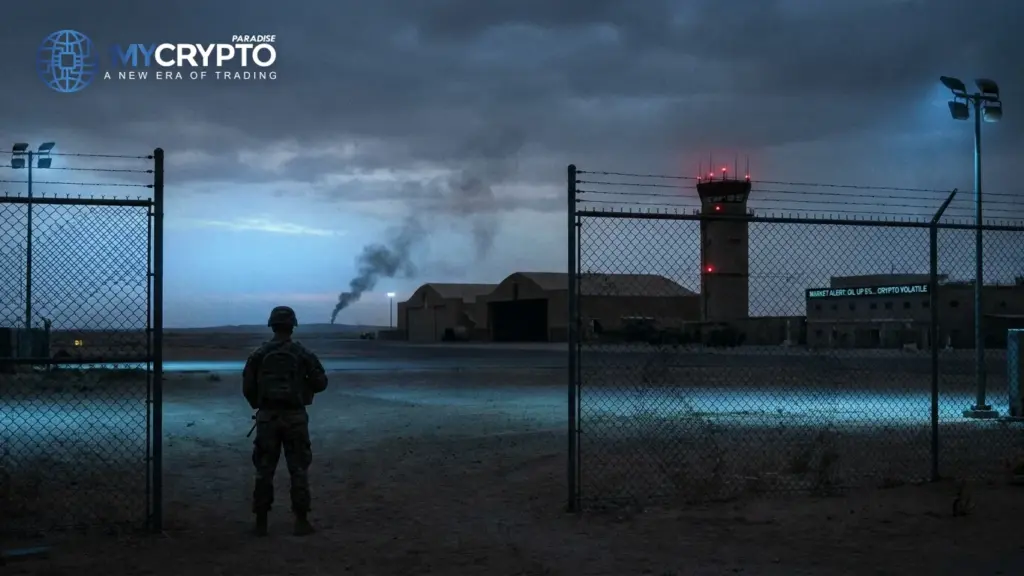
Iran has struck United States bases. The attack answers a U.S. airstrike that hit a wedding in southern Iran days earlier. That raid killed at least five people and injured 68. Children were among the casualties.
The wedding strike landed on a home in Kuhestak, with some accounts placing it in nearby Sirik. Either way, the target was a celebration, not a barracks. Tehran accused Washington directly and promised a response. That response has now arrived.
This is the part of the cycle where each side insists the other started it. The escalation ladder now runs both directions, and neither rung looks temporary.
For traders, the striking detail is how little price moved. BTC sat near $76,976, down about 1.1% on the day. ETH traded around $2,396.94, softer by roughly 2%. War headlines that once jolted markets barely registered.
That calm is the story. Risk-off events usually pull money toward the dollar and away from speculative assets. We see a mild version of that here, not a panic. The dip is orderly, almost polite.
Structurally, this matters because context decides reaction. The same news at a fear extreme sparks capitulation. The same news mid-distribution simply greases an existing slide. Right now we sit in the second case.
So we treat this as fuel, not trigger. Nothing about the retaliation changes our map. It thickens the risk-off air that smart money already uses to sell into eager buyers.
A retaliation loop with no off ramp
Geopolitical shocks move markets through fear, not arithmetic. A strike does not change Bitcoin's supply. It changes how much risk investors will hold overnight.
When two governments trade blows, capital reprices uncertainty. Money rotates toward assets seen as safe: the dollar, short-term government debt, sometimes gold. Crypto, still treated as a risk asset by large allocators, sits on the wrong side of that rotation.
That is the transmission chain. Escalation raises the odds of a wider conflict. Wider conflict threatens oil, shipping, and inflation math. A dollar bid follows. And a stronger dollar quietly pressures every asset priced against it, crypto included.
Here is the nuance that traders miss. The size of the reaction tells you the state of the market, not the size of the news. A 1% dip on genuine escalation is not strength. It is a market with few fresh buyers left to spook.
Think of it as a room already emptying. One more alarm does not cause a stampede when most people have quietly stepped out.
For medium-term positioning, the read is simple. This event does not need to crash prices to matter. It removes reasons to buy while giving sellers cover. That asymmetry favors the downside.
We are honest that no single confirmed catalyst explains the recent weakness. This strike is one input among several. But it fits the direction of travel, and direction is what we trade.
Risk-off drips into thin crypto liquidity
Liquidity, not narrative, decides where price lands next. So trace the cash.
BTC is the market's reserve asset. When risk-off hits, traders defend Bitcoin first and dump the periphery. That is why BTC's 1.1% slip looks mild while ETH already sheds close to 2%.
ETH sits one rung down the risk ladder. It bleeds faster because it carries more leverage and more retail hope. A modest BTC wobble becomes a sharper ETH move, and altcoins amplify that again.
Alts are the tail of the whip. In a risk-off drift they do not need heavy selling to fall. They simply lose bids. Thin order books mean small sells travel far.
Watch open interest, or OI, the total value of live derivative contracts. Rising OI into a falling price means fresh shorts, not longer-term buyers. That is a market leaning down, not catching a knife.
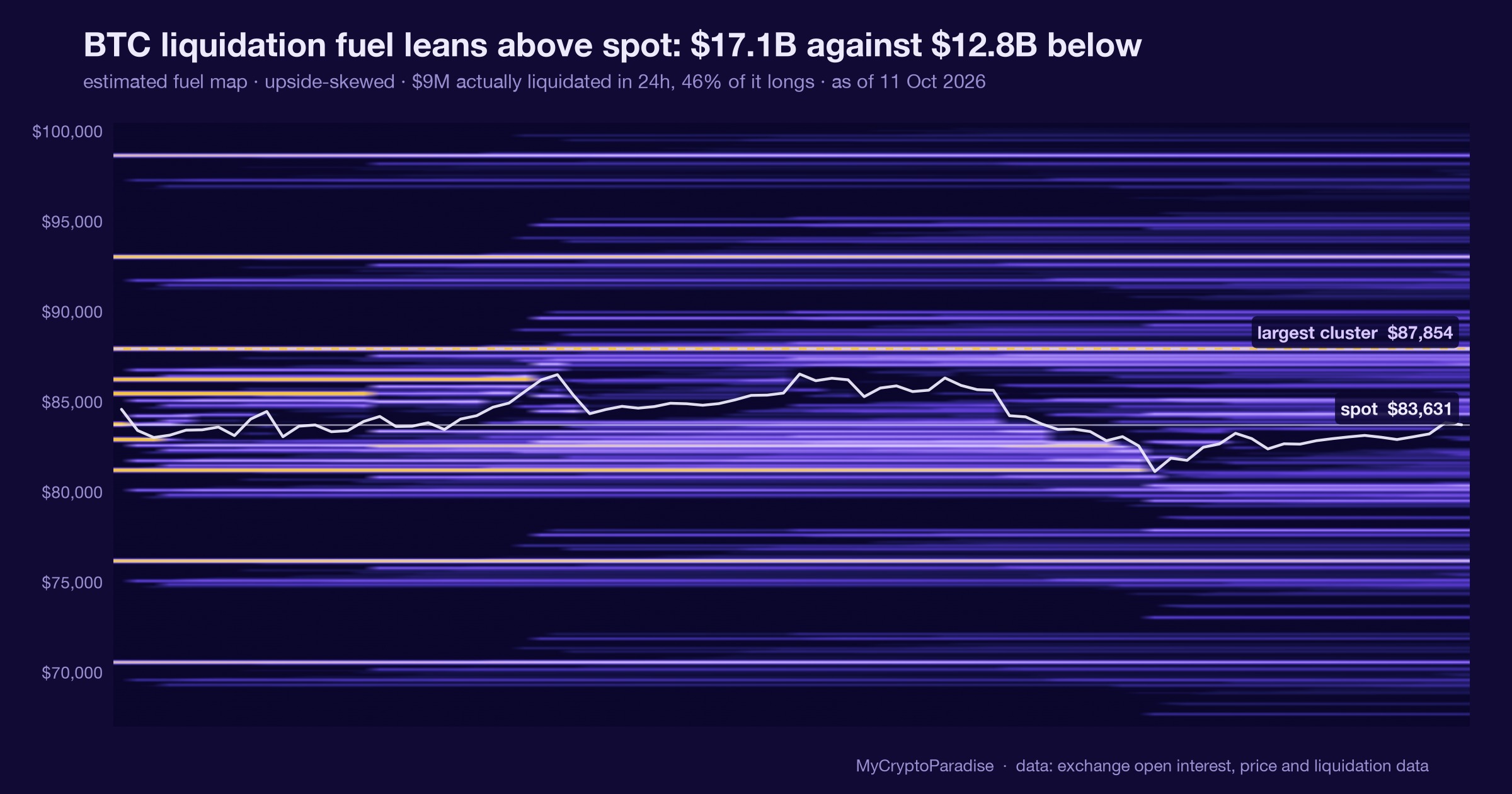
The liquidation map tells the rest. Long positions cluster near $57,000. A push into that zone hands market makers a payday and traps late buyers who called the bottom early.
Here is the uncomfortable part. Retail read the shallow dip as resilience. Smart money reads the same dip as room to keep selling. Both cannot be right.
Our lens says the second group is driving. The war headline does not reverse that flow. It thins liquidity, widens spreads, and lets distribution continue with less resistance from buyers who have run out of conviction.
58K breakdown versus a 79K reclaim
One level decides the near-term story: $58,000. A clean break below it confirms our bearish path toward deeper support. Until then, this is drift, not breakdown.
The upside test is $79,000. That is resistance and the line our lens watches closely. A reclaim and hold above it would force us to rethink the whole bearish map. Price keeps failing there for now.
So the two triggers are clear. Break $58,000 and the flush thesis gains weight. Reclaim $79,000 and the bears lose their footing. Everything between is noise dressed as action.
Watch the weekly candle close too. A bearish engulfing on the weekly would confirm sellers took control at the highs. That carries more weight than any single day's headline.
On the geopolitical side, the question is width. A contained exchange of strikes lets markets exhale. A widening conflict that drags in oil or allies would deepen the risk-off bid and pressure crypto further.
Keep an eye on the dollar. If it keeps climbing, crypto stays heavy regardless of any bounce. A softening dollar would give risk assets breathing room.
Invalidation is honest and specific. We are wrong on the near-term flush if price reclaims $79,000 and holds. We are wrong on the bearish structure if the weekly refuses to confirm downside.
Until one of those prints, we treat rallies as suspect and dips as incomplete. The retaliation adds pressure. It does not change which levels matter.
Distribution rolls on beneath the war headlines
Background pressure, not a fresh signal: that is how the ParadiseTeam frames this strike. Our map was bearish before the missiles flew, and the retaliation simply confirms the mood.
BTC was trading near $76,976 as of the latest read. That sits well below the $79,000 resistance we keep flagging. Price has failed there repeatedly, printing a shooting star on the daily and weekly.
Here is how the news maps onto our levels. Risk-off flow makes a reclaim of $79,000 harder and a break of $58,000 easier. The war headline tilts the odds toward the path we already favored.
Who benefits? Smart money, which is distributing into retail longs. The crowd is buying this dip and calling the bear phase over. That is the exact behavior that tends to precede capitulation, not the end of one.
Where do stops sit? Below $58,000 and stacked near the $57,000 long cluster. Those stops are fuel. Market makers are incentivized to reach for them, and a risk-off tape gives them cover to do it.
Our medium-term reference stays $44,000, where we expect aggressive accumulation once retail finally folds. This strike does not change that number. It just thickens the air on the way down.
Probabilities, not promises. If $79,000 reclaims and holds, we step aside and reassess. Until then, the ParadiseTeam treats bounces as distribution and reads shallow dips as unfinished business, not the bottom.
The read behind this: we framed this story through our own market analysis, Bitcoin Fails at $79K: Who Is Selling?
Track it live: our Crypto Fear and Greed Index and the live crypto funding rates both update in real time, so you can watch this shift for yourself.
Related coverage
For exact entries, targets, and stop losses with full risk management, that is what ParadiseFamilyVIP is for. New to reading these moves? Start with our crypto trading strategies guide.
ParadiseTeam is monitoring the market situation closely, and we are taking these developments into consideration while building our trading tactics inside ParadiseFamilyVIP.
Crypto trading involves substantial risk. Prices are volatile and you can lose money. This article is educational and is not financial advice. Past performance does not guarantee future results.
Does BTC break $58,000 before it reclaims $79,000 from here?
This is how 32 Paradisers are calling it. Tap your call.
No calls on this one yet. Tap yours to be the first.
Free account, no password. Members just sign in.












Join the discussion 25
i was really thinking this would mean a proper dip though, like the bigger ones we've seen before 🤔 guess its not always that straightforward with world news affecting things so directly 🤷♀️
Even during the Indian banking freeze, the initial knee-jerk moves were often faded pretty quickly. Seems like larger capital just waits for a better entry now. 📈
yeah this "smart money distribution" thing always feels like a reach when the market just… shrugs. 😅 Am I the only one who feels that? gets me chopped up.
Yeah, the market seems to shrug off anything these days 🤷♂️. My first thought is always "how bad can this get for my stack?" before anything else.
smart money distribution Ricardo? you want to tell that to everyone who lost everything when the smart money decided to pull their rug
what rug pull?! just trying to not be caught with zero, like I was in 2020. always ask about the downside first. always. 🙄
i usually check the basis premium on those events, often see it dip a little before the perp funding rate adjusts. this time, not so much.
Exactly! So if it wasn't smart money distributing, where did that liquidity come from for the buy side to credit their accounts? 🤔 Hard to square this in my journal.
nah, ppl always think geopolitical events mean easy drops 📉 or pumps 🚀 but its rarely that clean on my 15m chart. always lookin for more context 🤔.
Oh, I see it differently! I thought the initial reaction was actually pretty strong, just recovered super fast?! Sorry, I'm still learning.
Aisha, even if the 15m chart is messy, a big event like this *can* create an edge, no? It's about how you frame the risk, not always about clean trends. 🤔
aisha, i hear you on the 15m... but sometimes the big picture moves the small one, even if its not a perfect drop 📉. those charts can be too clean...
too clean…" 🤔 my charts are clean cus I clean em, George. price action on the 15m tells the story 📖, fundamentals are just the whispers before the storm 🌬️. no need for 'big picture' noise when you see the shifts happening live 📈.
no, an "edge" from this kinda event is often just choppiness 🎢 on my charts. you still need volume and *real* price action to confirm, not just news headlines 📰.
yeah, strong initial reaction is normal but it aint sustainable for my entries 😤. recovery speed just means the big players arent panicking, so no big trend here. 🙄 its always about context. 📊
yeah, it’s like when you spend hours perfecting an interface, thinking it’s bulletproof, then users ignore your flow entirely and find their own way 😅. the market’s always pulling that trick.
A quiet market reaction to geopolitical events often means the prior price action already factored in the risk. I am not seeing enough volume data here to support smart money distribution.
I notice this too! 😳 So often it feels like the big players already know what's coming, eh? 🧐 My tiny orders never move the needle. 😅
yea, makes me wonder sometimes if the actual news is already priced in before it even hits the wires... my charts dont lie.
hi olivia, I dont see it as big players knowing what's coming, more likely the market is just digesting the news without overreacting. bitcoin has a habit of doing that.
So even with all this going on... the chart barely budged 😮. Makes you wonder if a big geo event ever really does cause a deep dip anymore, eh? 🤔
ya it's like we see these big macro things happening, and then nothing 🤷♂️. Used to think it had to mean a drop, every time! 📉 Live and learn, eh? 😂
That's what I always thought too. But then I wonder if it's also about how much of the news is already priced in by the time we even hear it?
smart money distribution" sounds a bit like an excuse when markets dont react how we expect 🤔. here in Dakar, we see real money move for real reasons, not just charts 🌍.
amara, if a narrative fails to move price, it tells you more about the narrative then the market. 🤷♂️