


Listen: the breakdown
Market briefing: BlackRock's IBIT shed $209.5M on November 17, reversing a lone inflow day and driving the sector's outflows while BTC traded near $62,868, down 2.9% on the day.
- IBIT posted $209.5M in net outflows on November 17, the primary driver of $239.9M across US spot bitcoin ETFs
- The redemption erased 97% of a single inflow day that had recovered just 3.3% of a $2.35B outflow streak
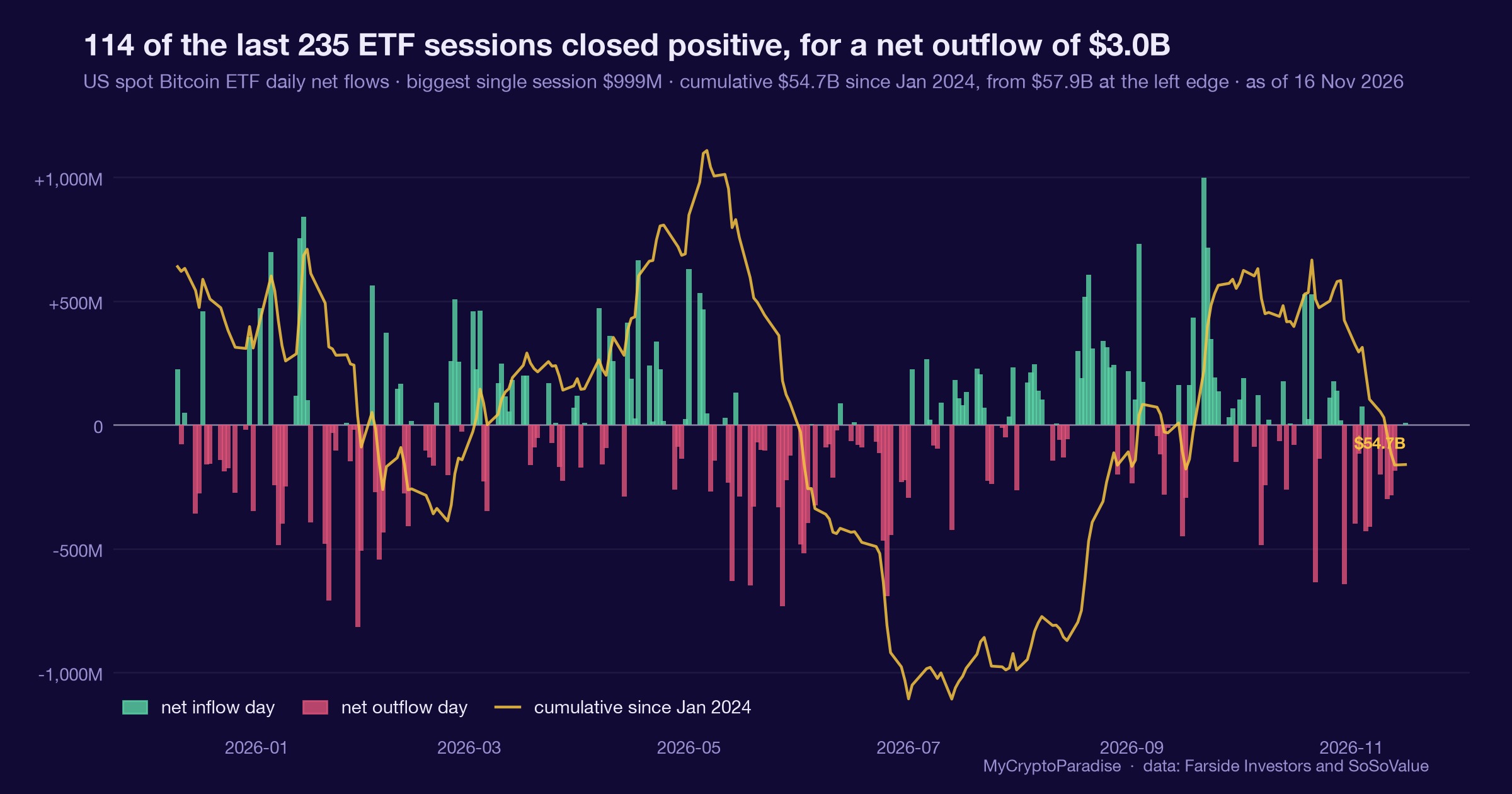
- IBIT alone accounts for roughly 87% of this month's $2.25B in spot bitcoin ETF outflows
BlackRock's IBIT couldn't hold even one day of green before resuming bitcoin ETF outflows. So what do these renewed redemptions tell us about institutional demand right now?
BlackRock's IBIT, the largest US spot bitcoin ETF, resumed outflows on November 17. The fund shed $209.5M in a single session.
That print matters because of what came just before it. IBIT had logged one lonely inflow day, a brief rebound that recovered only 3.3% of a prior $2.35B outflow streak. One session later, the money left again. The rebound lasted about as long as a New Year's resolution.
IBIT drove the whole sector. Total US spot bitcoin ETF outflows reached $239.9M on the day, with BlackRock's fund responsible for the large majority. Grayscale's GBTC added another $17.7M in redemptions, so the selling was not isolated to one issuer.
Zoom out and the concentration is striking. IBIT's November outflows now sit near $2.25B, roughly 87% of every dollar that has left US spot bitcoin ETFs this month. This is not a broad panic across many funds. It is a sustained, single-issuer drawdown in the product that institutions lean on most.
Context keeps it honest. These same ETFs still hold around $54.47B in cumulative net inflows since inception, so the category remains deeply positive over its lifetime. One rough month does not undo two years of accumulation.
Still, the trend reads soft. BTC was trading near $62,868 as of the latest data, down 2.9% on the day while ticking higher on the hour. The flow figure lands after price already moved, confirmation of institutional selling rather than its trigger.
Why one issuer now drives ETF selling
The transmission mechanism here is concentration, not breadth. When a single fund accounts for 87% of monthly outflows, the sector's demand signal effectively becomes one issuer's order flow. IBIT is the dominant pipe between institutional capital and spot bitcoin, so when it drains, primary-market demand for actual coins thins out fast.
Spot ETFs work by creating and redeeming shares against real bitcoin. Net inflows force authorised participants to buy coins; net outflows let them deliver coins back and sell. A $209.5M redemption day therefore removes a slice of steady, price-insensitive institutional bid that the market had grown used to leaning on.
The failed rebound is the tell. A one-day inflow that recovered just 3.3% of a multi-billion-dollar streak, then reversed, suggests the dip buyers who stepped in lacked conviction. Demand is not absent, but it is clearly hesitant.
That hesitation feeds straight into the macro picture. Bitcoin's institutional thesis rests partly on ETFs as a durable, growing bid. A month where the flagship fund bleeds while the rest of the sector barely moves undercuts the story of relentless accumulation.
None of this erases the $54.47B lifetime base. It simply shows the marginal buyer has turned into a marginal seller for now. In markets, the marginal flow sets the price, not the cumulative one, and right now that margin is pointing out the door.
How thinner ETF demand pressures BTC and ETH
Read through our bearish lens, this print pressures the tape from the top down. Reduced net ETF demand means a thinner institutional bid under spot bitcoin, and BTC is the asset that absorbs that first. Price near $62,868, down 2.9% on the day, already reflects some of it.
The mechanism is simple liquidity. Fewer dollars arriving through the ETF pipe means weaker passive buying to absorb sellers. On a down day, that missing bid shows up as faster drops and shallower bounces, exactly the character of recent sessions.
ETH moves in sympathy rather than for its own reason. Ethereum was near $1,777, down 2.3%, tracking BTC's risk tone. When the bitcoin ETF complex looks soft, the whole large-cap crypto bid tends to soften with it, and ETH is the first large-cap to feel BTC's wobble.
Alts sit furthest down the chain. They rely on risk appetite flowing out of BTC and ETH, so a session where even the flagship fund is redeeming leaves little spare liquidity to chase smaller tokens. Thin institutional demand at the top usually means thinner speculative demand below.
The short-term hourly green, BTC up 1.44% and ETH up 1.25% on the hour, matters too. It tells you this flow figure is lagging, not leading. The outflow confirms a selling trend price already expressed; it is unlikely to be the fresh catalyst that tips the next big move on its own.
What the next flow prints will confirm
The cleanest confirmation of the bearish read is simple: more IBIT outflow days. If redemptions keep stacking and the sector's figure stays issuer-concentrated, that tells you institutional demand remains genuinely soft, not just noisy for one session.
Watch the quality of any bounce in flows next. A single green day means little; we already saw one recover barely 3.3% of a streak before reversing. What would matter is a run of consecutive inflow days that actually dents the $2.25B monthly outflow, because that signals real buyers returning rather than a reflex.
Invalidation would be a sustained demand turn. If IBIT flips to multi-day net creations while GBTC redemptions fade, the drawdown thesis weakens and the institutional bid rebuilds under spot.
On price, keep BTC's reaction tied to the flows, not the headline. The outflow landed after the move, so watch whether fresh redemptions coincide with new price weakness, which would mark them as a live driver rather than a lagging report.
Also watch GBTC and the smaller issuers. If outflows broaden beyond IBIT into the rest of the complex, that shifts the story from one issuer's drawdown to a sector-wide demand problem, a materially more bearish setup.
Finally, note the lifetime base near $54.47B. A healthy category can bleed for weeks without breaking, so treat monthly outflows as a demand gauge, not an existential one, until the trend proves otherwise.
What renewed outflows mean for the institutional bid
The ParadiseTeam frames this flow print against a weekly structure that still leans bearish. BTC near $62,868 sits just under the $64,000 support, the 0.786 retracement where a bullish hammer recently formed. Renewed ETF selling is exactly the kind of soft demand that makes holding that level harder.
Our standing read matters here. Above, $64,000 is the line price must reclaim and hold to keep the short-term bounce alive. Lose it with conviction and $61,000 comes into view, then the prior low at $58,000.
The honest caveat: this is lagging flow data. It confirms institutional softness already visible in price; it does not reveal who sits on the other side of these redemptions. The brief shows no accumulation coinciding with this outflow, so we treat it as genuine weak demand, not reflexively as smart money buying fear.
That is the discipline. Not every bearish print at support is accumulation in disguise. When the dominant fund keeps redeeming and a rebound fails inside a day, the simpler explanation usually wins.
Our base case stays cautious into a deeper flush, with $44,000 the macro re-accumulation target if $58,000 gives way. A reclaim and hold back above $64,000, paired with ETF flows actually turning, would be the first evidence this selling trend is exhausting rather than extending. Until then, strength near resistance deserves respect, not chasing.
The read behind this: we framed this story through our own market analysis, Why Did Bitcoin Crash After the Binance Hack?
Track it live: our live crypto funding rates and the Crypto Fear and Greed Index both update in real time, so you can watch this shift for yourself.
Related coverage
For exact entries, targets, and stop losses with full risk management, that is what ParadiseFamilyVIP is for. New to reading these moves? Start with our crypto trading strategies guide.
ParadiseTeam is monitoring the market situation closely, and we are taking these developments into consideration while building our trading tactics inside ParadiseFamilyVIP.
Crypto trading involves substantial risk. Prices are volatile and you can lose money. This article is educational and is not financial advice. Past performance does not guarantee future results.
Do IBIT outflows keep stacking from here or flip back to inflows soon?
How 1 Paradiser is calling it
The first call is still open
Free account, no password. Members just sign in.
Follow this topic: Bitcoin ETF news










Join the discussion
No comments yet. Members, share how you are reading this.