

Listen: the breakdown
Developing story update (November 22, 2026, 23:30 UTC):
Blockchain gaming project Fusionist's ACE bridge was exploited after an attacker minted quintillions of unbacked tokens and sold them for around $2 million.
Then, opportunistic traders bought up the cheap tokens and swapped them through the bridge for real ACE, draining its $3.7 million reserve.
One trader turned $50 into over $17,000 on OKX. Rival exchange Gate is rolling back ACE trades made during the exploit, though.
Market briefing: Fusionist paused ACE transfers, trades and bridging on BSC after an exploit drained an estimated $1.04M in USDT. BTC was near $60,537 as of 20:27 UTC, barely moving.
- Fusionist paused ACE transfers, trades and bridging on BSC after an exploit
- Roughly $1.04M in USDT was extracted in the incident
- BTC and ETH stayed flat to green, absorbing the hit without stress
Another day, another contract exploit: Fusionist froze ACE on BSC after roughly $1.04M in USDT walked out the door. Does this ACE exploit touch the majors at all?
Fusionist has paused ACE transfers, trades and bridging on BSC. The trigger was an exploit, and early analysis puts the drained amount near $1.04M in USDT.
The halt is total. Holders cannot move, sell or bridge the token while the team works to contain the damage. That is the standard emergency brake for a project caught mid-bleed.
We have seen this exact pattern twice already today. South Korean exchanges froze CYBER after a suspected bridge hack, and a Cysic Bridge exploit minted millions of unbacked tokens on BNB. What is new here is the asset and the mechanism: a direct drain on Fusionist, not a bridge mint or an exchange freeze.
The number matters less than the reflex. A roughly $1.04M loss is painful for ACE holders, yet it is a rounding error against total crypto liquidity. That gap explains why the majors did not flinch. BTC was trading near $60,537 as of 20:27 UTC, up 0.4% on the day, while its one-hour move sat at a near-flat -0.09%. ETH held around $1,710, up 1.6% over 24 hours.
So the story writes itself. One BSC project slams the brakes, its token goes dark, and Bitcoin shrugs as if nothing happened. The isolated altcoin exploit has become so routine that the broader market has stopped pricing it as a shared risk. Containment, not contagion, is the read.
Why an isolated BSC drain barely spills over
The transmission mechanism here is almost non-existent, and that is the point. For a security incident to move BTC and ETH, it needs scale, shared exposure, or a credible threat to liquidity that reaches beyond one contract. This has none of those.
A roughly $1.04M USDT drain sits far below the threshold that forces cross-market repricing. It drains one project, not a lending protocol holding billions, not a stablecoin backing, not a major exchange's reserves. The damage is ring-fenced by the halt itself.
That containment is why macro risk sentiment stays undisturbed. There is no forced-seller cascade here, no counterparty everyone fears, no liquidity hole that other desks must hedge against. The fear stays local to ACE holders.
Think about what the pause actually does. By freezing transfers and trading, Fusionist stops the attacker from cashing out further and stops panicked holders from dumping into a vacuum. It protects what remains, but it also traps every holder until the team reopens.
The wider signal is structural maturity, not strength. Markets now treat these small-cap exploits as background noise rather than systemic alarms. A year or two ago, a BSC drain plus a trading freeze might have rattled sentiment across the whole chain's ecosystem. Today it barely registers on the majors. That desensitisation cuts both ways: less contagion, but also a steady erosion of trust in the long tail of smaller tokens that keep getting drained.
Contained damage, flat majors, trapped ACE holders
The direct impact lands entirely on ACE and its holders. With transfers, trades and bridging frozen, there is no live price discovery and no exit. Anyone holding the token is now a captive, waiting on the team's next update rather than a market quote.
That is the first-order damage, and it is bearish for the asset. A trading halt after an exploit is a credibility event. Even once trading resumes, the token typically reopens lower as trapped holders rush the door and new buyers demand a discount for the risk.
BTC and ETH, by contrast, show the opposite of stress. BTC held near $60,537 with a near-flat one-hour print, and ETH traded up on the day. No bid vanished, no funding spiked, no liquidation wave spread from this.
The cleanest tell is the absence of a cascade. In a real contagion event, you would see correlated selling, widening spreads, and stablecoin wobble. Here you see none of it. The liquidity that matters simply routed around the problem.
For the broader alt complex, the second-order effect is subtle but real. Each isolated exploit chips at risk appetite for the long tail. Capital that might rotate into small-cap BSC tokens hesitates a little longer. That drag is slow and diffuse, not a same-day sell signal. On the majors, this story is close to inert, which is exactly why our read keeps the damage boxed inside ACE.
Confirmation that this stays localised
The first thing that tells us this stayed contained is simple: BTC and ETH keep ignoring it. As long as the majors hold their footing and funding stays calm, the exploit remains an ACE-only problem. That is the base case, and the tape so far supports it.
Invalidation would look like spillover. Watch for a second or third BSC project reporting a related drain in the same window. A cluster, rather than a single incident, is what historically turns background noise into a sentiment event. Today already carries two other exploit stories, so the cluster risk is worth tracking, not dismissing.
On ACE specifically, the next marker is the team's post-incident disclosure. How the exploit happened, whether the attacker is being traced, and whether any funds get recovered all shape where the token reopens. A clean, fast explanation limits the damage. Silence deepens it.
The reopening itself is the real test. When Fusionist lifts the halt, the first candles reveal how much trapped supply wants out. A violent gap down followed by stabilisation is the normal shape. A slow bleed with no buyers is worse.
For the majors, the thing to watch is what it always is: liquidity, not headlines. If BTC's structure holds through a day stacked with exploit news, that resilience is its own data point. A sudden break lower would have to come from macro or positioning, not from a $1.04M drain on one BSC token.
Reading the drain against BTC's $62K defense
The ParadiseTeam treats this as noise for the majors and a credibility hit for ACE, nothing more. A $1.04M drain on one BSC token does not reach the levels that actually govern BTC right now. So we keep our Bitcoin read exactly where it was before this crossed the wire.
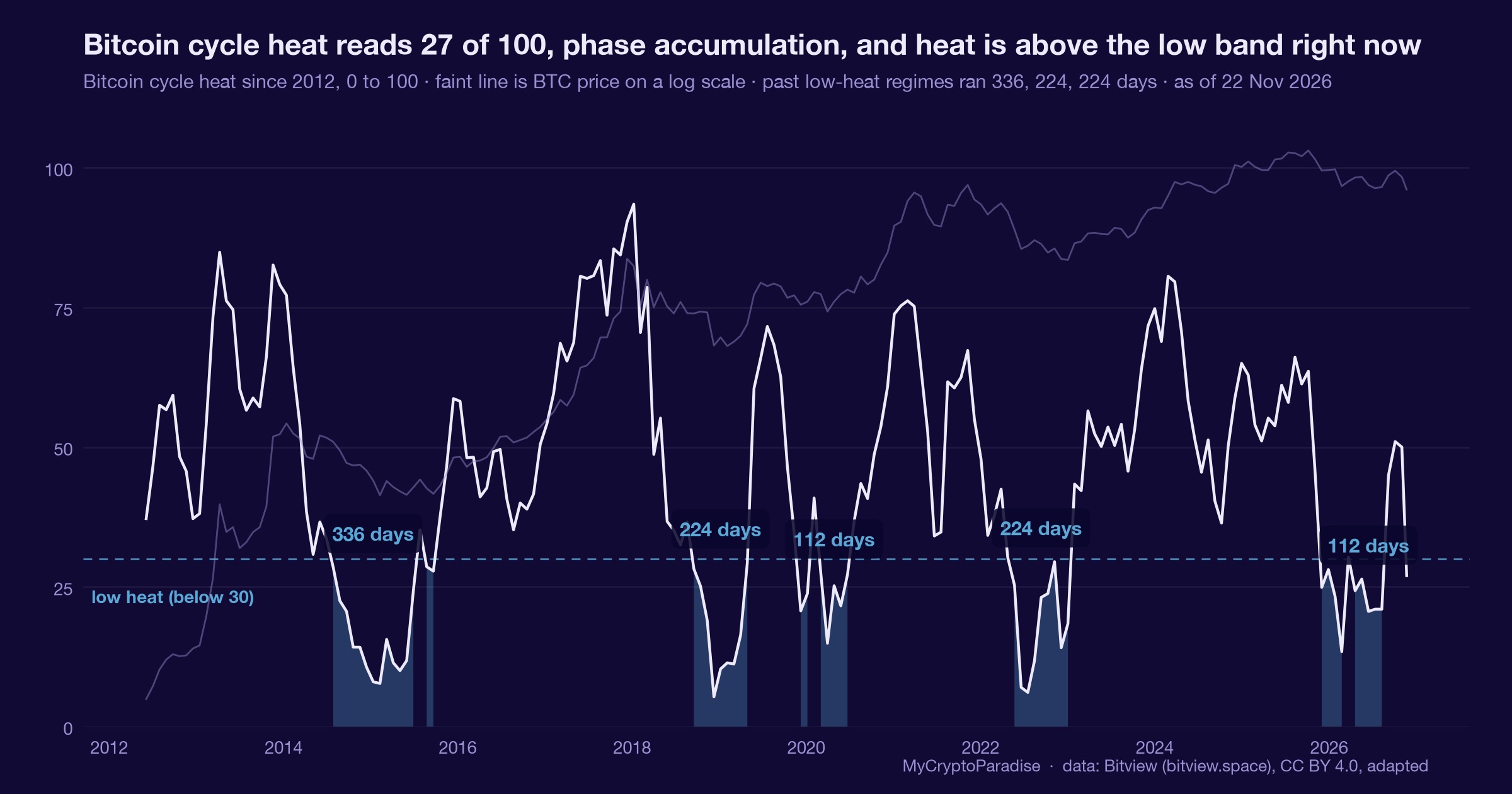
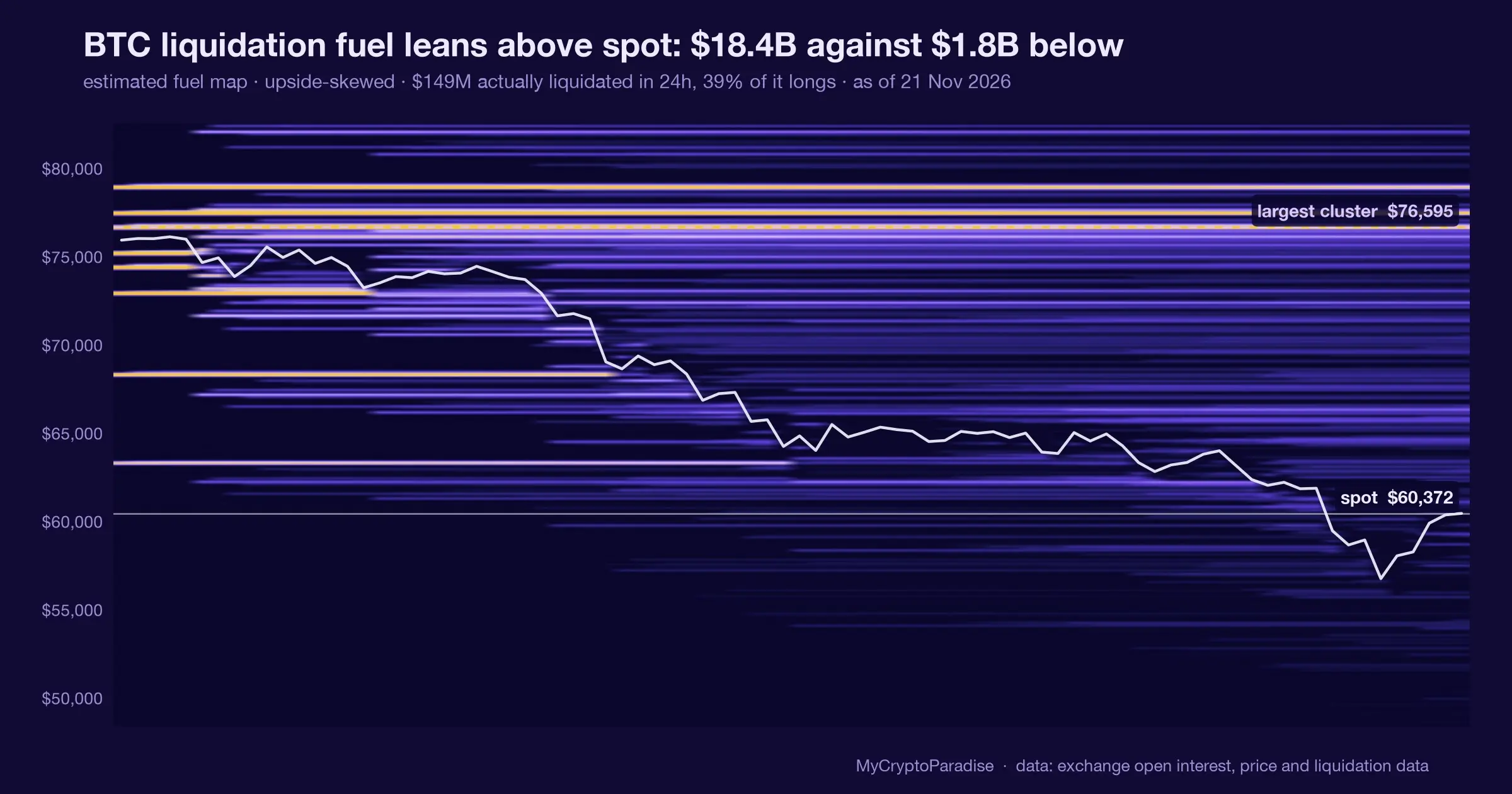
That read starts at the $62,000 zone. Whales have defended it twice with heavy, long-standing buy walls, absorbing the selling while retail capitulated into shorts. BTC near $60,537 as of 20:27 UTC sits just under that shelf, which is the tension that matters, not a frozen altcoin.
Here is the mechanism we care about. Retail chased the prior selloff into shorts as funding flipped neutral-to-negative. If enough of that short interest stacks above price, market makers have fuel to squeeze higher and liquidate it. This exploit changes none of that math.
So we frame any bounce as a relief move inside a bigger downtrend, not a reversal. The higher-degree structure stays bearish below $64,700, the heavy resistance node we need reclaimed with real volume before we talk trend change.
Until a clean five-wave push breaks $64,700, we still eye the $55,000 to $44,000 region as the eventual draw. For ACE, there is no edge to trade through the halt: no live price, no exit, no read. Our discipline here is to keep capital on the assets where liquidity is actually deciding the next move. Probabilities, never certainty.
The read behind this: we framed this story through our own market analysis, Bitcoin Traders Turn Bearish at $62K Support.
Track it live: our live crypto funding rates and the Crypto Fear and Greed Index both update in real time, so you can watch this shift for yourself.
Related coverage
For exact entries, targets, and stop losses with full risk management, that is what ParadiseFamilyVIP is for. New to reading these moves? Start with our crypto trading strategies guide.
ParadiseTeam is monitoring the market situation closely, and we are taking these developments into consideration while building our trading tactics inside ParadiseFamilyVIP.
Crypto trading involves substantial risk. Prices are volatile and you can lose money. This article is educational and is not financial advice. Past performance does not guarantee future results.
Do single token exploits like this still move BTC and ETH?
How 12 Paradisers are calling it
The first call is still open
Free account, no password. Members just sign in.











Join the discussion 1
when a protocol freezes everything but btc and eth keep sitting still thats the part i watch. one exploit and the whole chain goes quiet for a minute, how long before the bridge reopens is what i want to know