


Listen: the breakdown
Unconfirmed: This is an early, unverified report that has not been confirmed and may not be accurate. We are tracking it and will update or correct it as facts emerge.
Market briefing: A viral claim says an institution bought $1 billion of Bitcoin on the dip, but no source backs it. BTC was trading near $60,879, up 5.3% on the day, as of 11:25 UTC.
- An unverified post claims an institution bought $1 billion in Bitcoin, with no named buyer or flow data behind it.
- BTC traded near $60,879, up 5.3% on the day, yet slipped 0.58% in the last hour as the claim spread.
- A widely shared fear gauge reads 10 out of 100, its lowest since June, a gap that can precede a squeeze or a capitulation low.
Everyone is resharing the same $1 billion Bitcoin whale buy, yet nobody posting it can prove it happened. So what did the price actually do while the claim went viral?
A single claim is doing the rounds this morning. An institution supposedly bought one billion dollars of Bitcoin, and whales are said to be going all in on the dip. The post spread fast. The proof did not travel with it.
No named buyer sits behind the number. No wallet, no exchange print, no flow data. Just a headline that happened to land while Bitcoin was already green.
BTC was trading near $60,879, up 5.3% on the day, as of 11:25 UTC. That strength is real. The billion-dollar story bolted onto it is not confirmed.
Here is the detail most reposters skipped. Over the last hour, price actually slipped 0.58%. So the move people are crediting to a whale had already stalled while the claim went viral.
Sentiment adds the fuel. A widely shared fear gauge is reading 10 out of 100, its lowest since June. Extreme fear and a 5% up day rarely sit together for long.
That gap between mood and price is the real story. It usually breaks one of two ways: a fear-driven capitulation low, or a short, sharp relief squeeze. The fear number alone cannot tell you which.
We have watched this pattern before. A confident headline, a green candle, and a crowd deciding the two must be connected. Sometimes they are. Often the candle came first and the story arrived later to explain it.
Until a real source backs the billion-dollar figure, treat it as narrative, not evidence of a whale footprint.
An unproven number meeting extreme fear
The mechanism here is sentiment, not flow. A billion-dollar buy, if real, would move liquidity. An unverified claim moves something cheaper: attention.
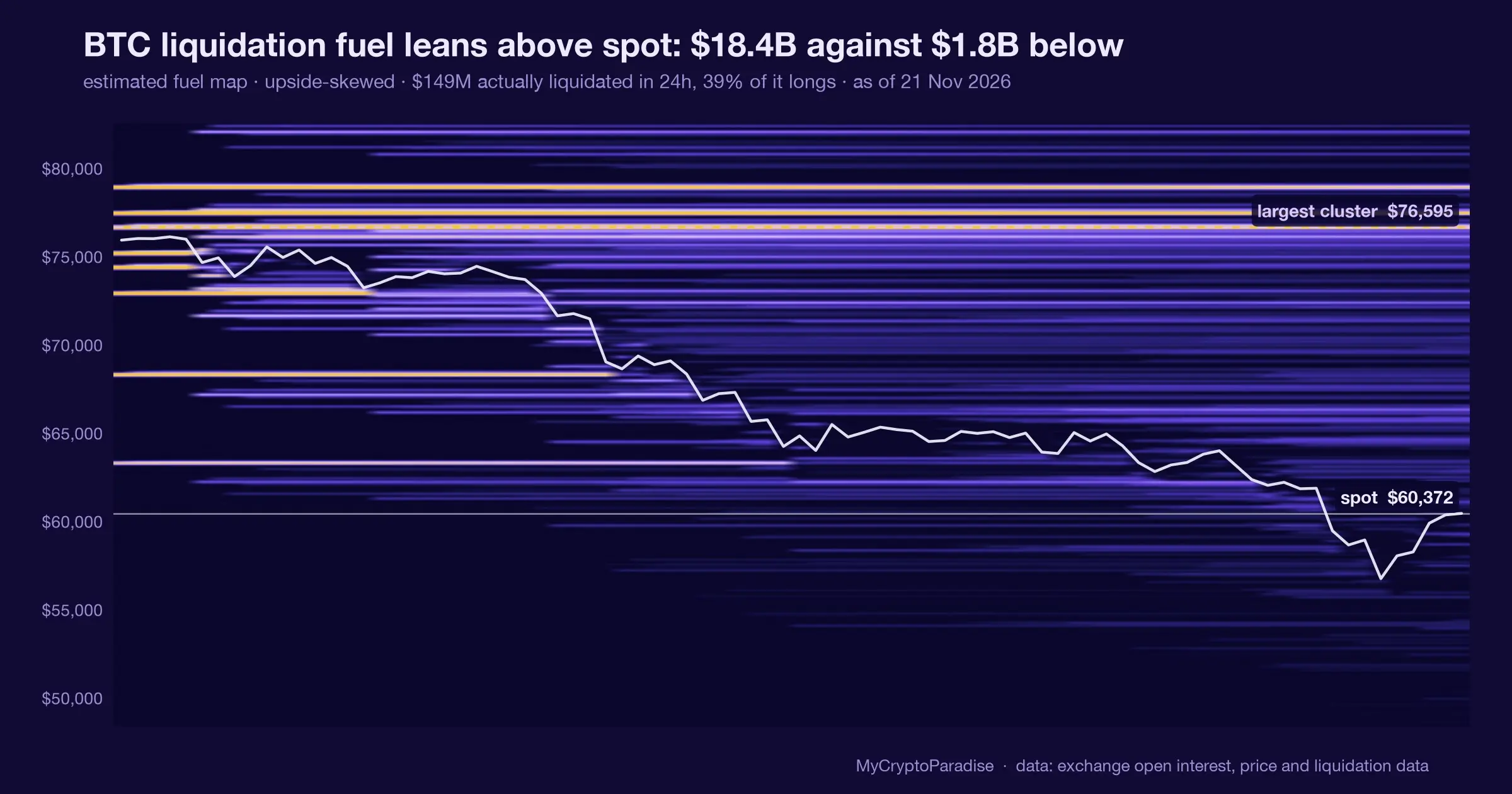
Extreme fear is the key macro input. When a fear gauge prints 10 out of 100, positioning is already stretched to the downside. Shorts are crowded. Longs are thin. That setup primes the market for a squeeze on any bullish headline, true or not.
So the chain runs like this. A viral whale story meets a fearful crowd. Short-covering kicks in. Price that was already up gets a second push, and the move looks like confirmation of the claim it never proved.
This is how narrative becomes liquidity. The headline does not need to be true to move money. It only needs enough fearful shorts caught on the wrong side.
But there is a limit. Real institutional accumulation leaves a trail: sustained bids, rising demand, flat or positive funding under a rising price. A relief squeeze leaves a different one: a fast spike, fading volume, and a stall.
Right now we have the fast part and, in the last hour, the stall. That is more consistent with a crowd chasing a story than with a billion dollars of patient demand.
None of this makes the up day fake. It makes the explanation unconfirmed. The price did what it did. The reason attached afterward is the part to hold loosely.
How trapped shorts could lift BTC, ETH and alts
Start with BTC, because every alt takes its cue from it here. A 5% day plus an extreme-fear reading is the exact combination that can trap shorts. If real demand is stepping in under the noise, those crowded shorts become fuel.
That is the bullish read, and it has logic. Bearish sentiment at its lowest since June, meeting a green tape, is the kind of mismatch where smart money quietly absorbs what fearful retail dumps. The whale claim may be unproven, but demand under extreme fear is a familiar accumulation signature.
ETH follows BTC's beta. If Bitcoin squeezes higher off trapped shorts, Ether tends to move harder, because its leverage crowd is lighter and quicker to chase. A BTC relief leg usually drags ETH up faster in percentage terms.
Alts sit at the end of the chain. They carry the most beta and the least independent support. On a BTC-led squeeze they can outrun both majors for a session, then give it back just as fast when the lead candle stalls.
The risk is the mirror image. If this was retail chasing a viral headline into fading volume, the squeeze is short. Alts that ran hardest unwind first. The same beta that lifts them leads them down.
So the structure is genuinely two-sided. But the weight of extreme fear meeting real strength leans the near-term tape toward the upside, not the downside.
The flow trail that would confirm real buying
Confirmation starts with a trail. A genuine billion-dollar buyer leaves sustained bids, not a single spike. Watch whether demand holds price up rather than letting it bleed back once the headline cools.
Funding is the tell. If price rises while funding stays flat or positive, spot demand is doing the work, which fits real accumulation. If price rises only as funding turns sharply negative, that is short-covering, and short-covering runs out.
The last-hour slip of 0.58% is the first warning. One red hour inside a green day is noise on its own. A second and a third, with volume fading, would say the crowd chased and the move is stalling.
Invalidation is simpler. If the up day gives back its gains and the fear reading stays pinned at extremes, the whale story was a headline, not a footprint. Price returning below where the claim went viral would settle it.
We also watch the crowd itself. Extreme fear can mark a low, but only when price stops making new ones. A fear gauge at 10 with price grinding lower is capitulation in progress, not a floor.
So the honest frame is this. The number is unverified, the strength is real, and the next sessions decide which one leads. Sustained bids and holding gains argue the dip buyers were real. A fading spike and returning fear argue the tape wrote its own story and moved on.
Extreme fear, trapped shorts, and the $62K line
The ParadiseTeam reads this through one lens: who is trapped. With BTC near $60,879 as of 11:25 UTC, price sits just under the $62,000 zone we have watched defended twice by large, long-standing buy walls. That is where this story earns its weight.
Extreme fear at 10 out of 100 tells us retail has been capitulating into shorts after the selldown. A viral whale headline into that positioning is exactly the mismatch that can squeeze. The fuel is the crowd, not the tweet.
So the near-term lean is a relief move, not proof of a reversal. Reclaiming $62,000 and then the $62,700 wall would say buyers are back in control. Above that, $64,700 is the line that decides everything: our heavy volume node and ribbon resistance.
We want an impulsive push through $64,700 on expanding volume before the structure flips bullish. Until then, this is strength inside a higher-degree downtrend, and strength can still meet sellers at resistance.
The invalidation sits lower. Losing momentum here and slipping back toward $55,000 would argue the whale story was noise and the downtrend intact.
Smart money defends $62K while retail chases headlines. Our job is to separate the absorption from the hype. The unverified billion-dollar buy does not move our levels. It changes who is positioned on the wrong side of them.
The read behind this: we framed this story through our own market analysis, Bitcoin Traders Turn Bearish at $62K Support.
Track it live: our Crypto Whale Alert and Tracker and the Crypto Fear and Greed Index both update in real time, so you can watch this shift for yourself.
Related coverage
For exact entries, targets, and stop losses with full risk management, that is what ParadiseFamilyVIP is for. New to reading these moves? Start with our crypto trading strategies guide.
ParadiseTeam is monitoring the market situation closely, and we are taking these developments into consideration while building our trading tactics inside ParadiseFamilyVIP.
Crypto trading involves substantial risk. Prices are volatile and you can lose money. This article is educational and is not financial advice. Past performance does not guarantee future results.
Does BTC reclaim $62K before it loses $55K?
Settles on BTC's first hourly close above $62,000 or below $55,000, at the latest Sun 29 Nov.
How 1 Paradiser is calling it
The first call is still open
Free account, no password. Members just sign in.
An education game, not trading advice.










Join the discussion
No comments yet. Members, share how you are reading this.