


Listen: the breakdown
Market briefing: A single ETH short got liquidated 13 times in nine days, losing $1.14M and handing the market $43.9M in forced buying. ETH sat near $2,368 and BTC held near $81,451 as the squeeze fed the move.
- Wallet 0xb15b shorted ETH and was liquidated 13 times in nine days
- 18,080 ETH worth $43.9M was force-closed for a $1.14M net loss
- Each liquidation added forced buying as ETH climbed roughly 3% on the day
One trader shorted ETH, got liquidated 13 times in nine days, and fed the market $43.9M in forced buying. So who really pays when a short squeeze runs?
Nine days ago, a new wallet appeared on chain. The address 0xb15b arrived with 1.25 million USDC and one clear intention: short ETH. What followed reads less like a strategy and more like a stress test of conviction.
Since opening, 0xb15b has been liquidated 13 times. In total, 18,080 ETH worth roughly $43.9 million has been force-closed out of this single account. The running loss sits near $1.14 million.
Thirteen liquidations in nine days is not bad luck. It is a position fighting the tape and losing every argument.
Each liquidation is more than a personal loss. It is a forced buy order. When a short gets liquidated, the exchange buys the asset back to close it, adding real demand into the book. One trader's pain became the market's bid.
ETH was trading near $2,368 as this played out, up about 3% on the day. The timing is not a coincidence. Repeated short liquidations feed directly into the kind of green candles that trap the next wave of bears.
This is the oldest tension in markets, dressed in fresh on-chain clothing. A persistent short against a resilient uptrend supplies the fuel for that trend to keep climbing. The king of liquidations did not break the market. He helped move it higher, one margin call at a time.
The hidden cost of fighting a trend
A short squeeze is a liquidity story first and a price story second. When leverage stacks on one side, it creates a pool of stops waiting to be hit. That pool becomes the market's next target.
Here the mechanism is clean. A trader kept selling ETH with borrowed size. Each time price rose, his margin thinned, and the exchange closed part of the position by buying ETH back. That buying is not optional. It is automatic, and it arrives fastest when price is already moving up.
Multiply that across 13 liquidations and $43.9 million in closed size. The result is a steady drip of forced demand into a rising market. It does not create a trend on its own. It accelerates one that already exists.
The broader point matters for everyone watching leverage. OI (open interest) tells you where the bets sit. CVD (cumulative volume delta) tells you who is actually hitting the bid or the offer. When heavy shorts stack into strength, they are lending the market a trampoline.
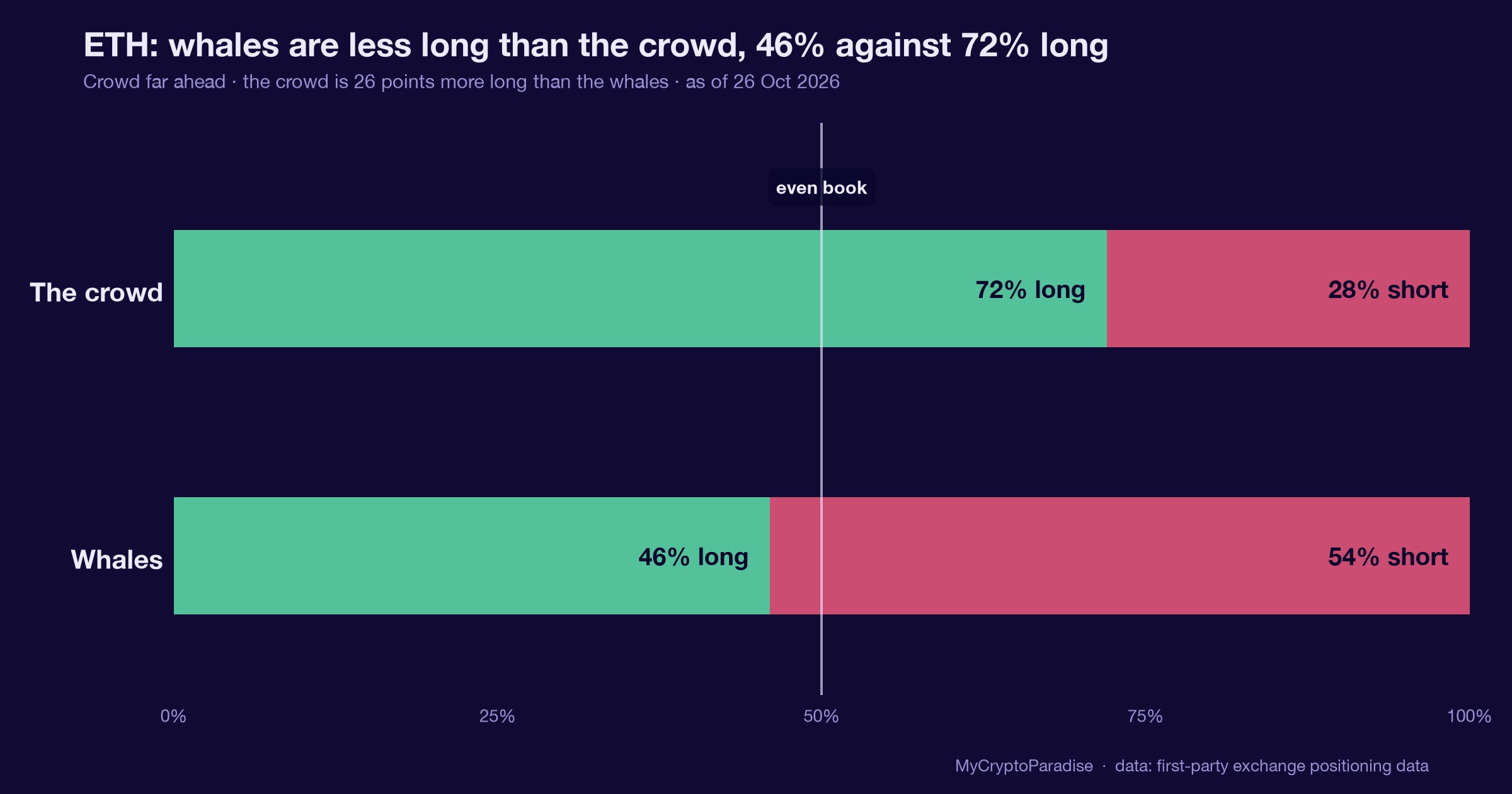
Retail often reads a shrinking account as proof the top is in. Smart money reads the same screen as free fuel. The difference is not intelligence. It is understanding where the stops live and who is forced to buy next.
Forced buying fed ETH's green candle
Start with the tape. ETH sat near $2,368 and up roughly 3% on the day as these liquidations stacked. BTC held firm near $81,451 as of 10:24 UTC, up about 2.5%. The strength was broad, not isolated.
Forced short covering behaves like a bid that never negotiates. It buys at market, regardless of level, which is exactly what thin order books reward. That is how one stubborn account can leave a visible footprint on ETH's intraday move.
BTC sets the risk tone, and right now that tone is constructive. When Bitcoin holds its ground, altcoin shorts become far more dangerous to run. ETH sits closest to BTC in the risk stack, so it felt the squeeze first and hardest.
From there the effect ripples outward. A firm ETH tends to lift large-cap alts, because traders rotate risk down the curve once the majors stabilize. Short books on those alts then face the same arithmetic 0xb15b just learned the hard way.
None of this guarantees continuation. Squeezes can exhaust once the crowded shorts are flushed. But while bears keep feeding the book, the path of least resistance stays upward. The market tends to punish the position that refuses to admit the trend, and it did so here with unusual consistency.
Signals that the squeeze is fading
The first thing to track is whether fresh shorts replace the ones just flushed. One trader liquidated 13 times is a story. A crowd repeating it is a trend.
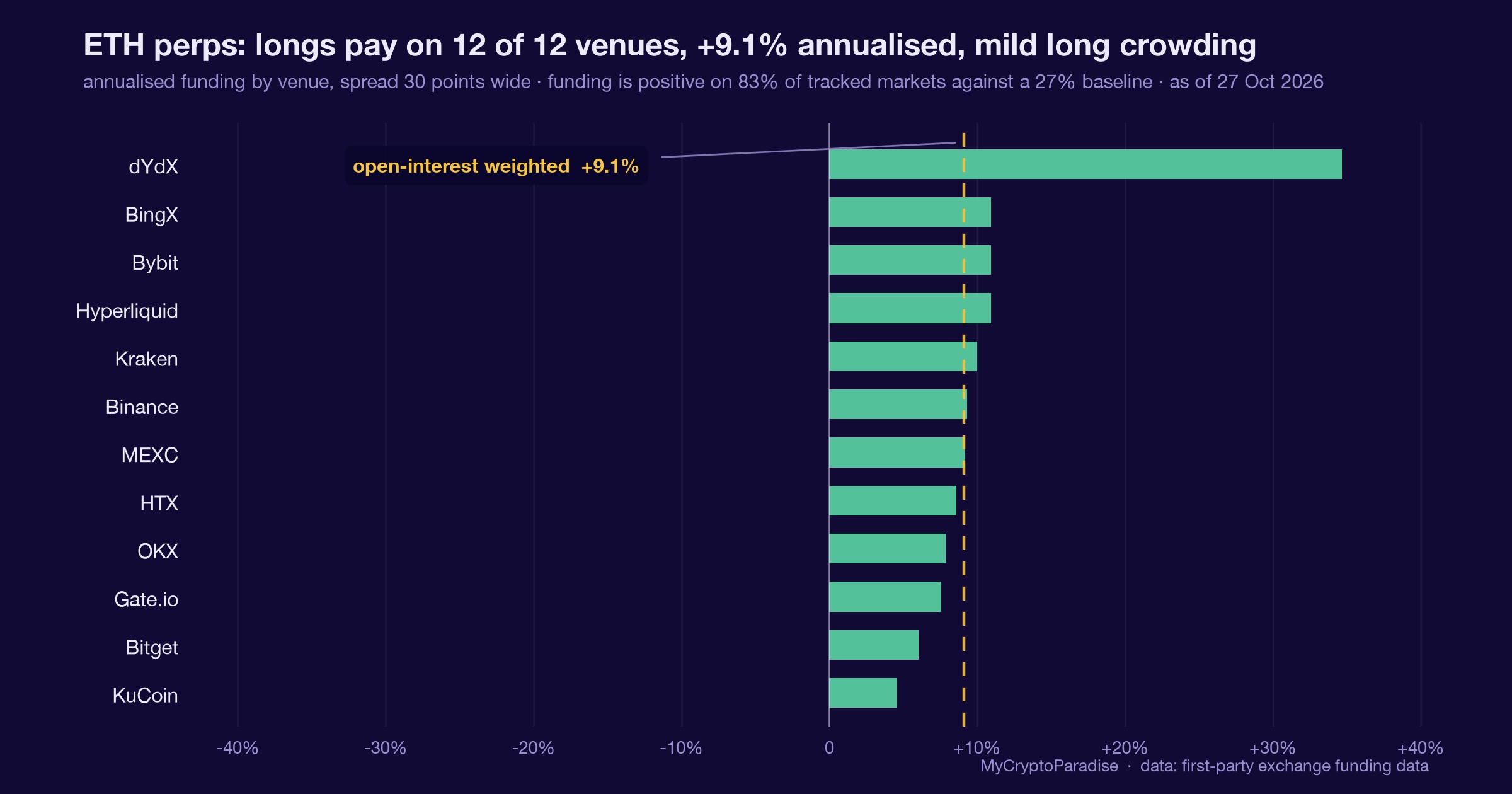
Watch funding rates on ETH. If funding stays positive and climbing, longs are paying to hold, and the squeeze fuel starts to thin. If funding cools while price holds, that hints real spot demand, not just forced buying, is doing the work.
OI is the next tell. Rising open interest into rising price with shorts getting hit confirms the squeeze is live. Falling OI alongside a stalling price suggests the fuel is spent and a pullback can follow.
Confirmation looks like ETH holding its gains on lower leverage, with spot buyers stepping in on dips. That would mean the move outlived the liquidation cascade.
Invalidation is simpler. If ETH gives back the day's advance and OI drops hard, the squeeze was the whole story, and little sits underneath it. A quick round trip toward where this started would say the fuel, not the fundamentals, did the lifting.
Also watch BTC. If Bitcoin loses its footing, altcoin shorts stop looking foolish fast. The entire short-squeeze dynamic depends on the majors staying firm. Lose that anchor, and the trapped side of the book changes overnight.
Liquidity left behind by a trapped short
The ParadiseTeam reads this liquidation story as a live example of a dynamic already in play across the majors. Crowded shorts are expensive to hold when smart money is quietly buying the dips.
On BTC, our lens still points toward a short-term push, with price near $81,451 as of 10:24 UTC. Resistance sits around $82,500, the intermediate liquidation cluster. Above that, the bigger magnet is near $89,000, where close to $11 billion in short liquidations wait. That is the same mechanic 0xb15b just demonstrated, only far larger.
Support holds the structure together. We watch $80,100, then $78,000 as the deeper line. A flush into $78,000 would likely squeeze crowded longs before any serious attempt at $90,000.
The ETH read rhymes with this story. Repeated short pain tells us the trapped side has been the bears, not the bulls. That favors the upside while it lasts.
But we stay honest about the higher timeframe. The weekly structure remains cautious, and strength can meet real selling into resistance. A short squeeze is a reason price moved, not a promise it keeps moving.
Our stance stays risk-first. Respect the momentum, define your SL (stop-loss) before entry, and remember that the trader who forgot that rule supplied this week's fuel.
The read behind this: we framed this story through our own market analysis, Can Bitcoin Recover to $90K From Here?
Track it live: our live crypto funding rates and the crypto liquidation heatmap both update in real time, so you can watch this shift for yourself.
Related coverage
For exact entries, targets, and stop losses with full risk management, that is what ParadiseFamilyVIP is for. New to reading these moves? Start with our crypto trading strategies guide.
ParadiseTeam is monitoring the market situation closely, and we are taking these developments into consideration while building our trading tactics inside ParadiseFamilyVIP.
Crypto trading involves substantial risk. Prices are volatile and you can lose money. This article is educational and is not financial advice. Past performance does not guarantee future results.
Does the ETH short squeeze have more fuel, or are the bears already flushed?
How 1 Paradiser is calling it
The first call is still open
Free account, no password. Members just sign in.
Follow this topic: Crypto liquidation news










Join the discussion
No comments yet. Members, share how you are reading this.