


Listen: the breakdown
Market briefing: Ether treasury firm BTCS has told the SEC its $54M Aave loan could face liquidation as ETH collateral weakens. BTC was trading near $58,382 as of 12:33 UTC, down 5% on the day.
- BTCS disclosed to the SEC that its $54M Aave loan faces liquidation risk as ETH slides.
- The firm cut $10M of debt in 10 days, a clear move into damage control.
- ETH traded near $1,656 after a 4.6% drop, squeezing leveraged treasury collateral.
A public company is now racing its own balance sheet. BTCS has warned the SEC that its $54M Aave loan could be liquidated as ETH slides. When treasury firms start deleveraging, who sells next?
BTCS, an Ether treasury firm, has told the SEC that its $54M loan on Aave faces liquidation risk. ETH price pressure has pushed the posted collateral under stress. That is a rare, concrete marker of how real ETH's drawdown has become for leveraged treasury players.
The firm is not waiting for a rescue. BTCS has cut its debt by $10M over just 10 days. That pace tells its own story. This is defensive deleveraging, not a show of confidence. A balance sheet moving that fast is a balance sheet that feels the heat.
The backdrop makes the move easier to read. ETH was trading near $1,656 after a 4.6% drop on the day. When the collateral behind a loan falls that hard, the liquidation line stops being a distant abstraction and starts feeling close.
DeFi lending is unsentimental by design. A loan on Aave liquidates automatically when collateral breaches its threshold. There is no workout meeting, no quiet extension, no sympathetic loan officer.
So the disclosure matters beyond one firm. BTCS is almost certainly not the only leveraged ETH holder doing this math right now. One company telling a regulator its loan could be liquidated is the kind of detail that usually points to broader strain across the leveraged side of the market, not a private accounting problem that stops at its own door.
How ETH's drop strains a treasury balance sheet
The mechanism here is simple and old. ETH falls, collateral posted against a DeFi loan loses value, and the position edges toward its liquidation line. BTCS posted ETH-linked collateral against $54M on Aave. As ETH slid near $1,656, that cushion thinned fast.
DeFi lending does not negotiate. A smart contract liquidates the moment collateral breaches its threshold. There is no phone call and no grace period.
That is why the firm acted. Cutting $10M of debt in 10 days buys headroom against the liquidation price. It is prudent risk management. It is also a public admission that the danger was real enough to disclose to a regulator rather than manage quietly.
This is where it ties back to the broader tape. BTCS is unlikely to be the only leveraged ETH holder feeling this squeeze right now. One disclosure is a single data point.
But it hints at something larger. Collateral stress tends to arrive across the leveraged cohort at once, because they all bought the same asset with borrowed money and now watch the same price fall. A treasury firm disclosing liquidation risk after a notable drawdown reads as a symptom of that shared pressure, not an isolated balance-sheet quirk. The leverage that looked clever near the highs becomes the problem on the way down, as it tends to every cycle.
Forced selling risk filters into ETH and alts
Forced deleveraging is a one-way flow. When a treasury firm trims debt against a DeFi loan, the mechanical path often runs through selling or hedging the underlying. That pressure lands on ETH first.
ETH is the collateral at the center of this story. Fresh supply from stressed holders meets a market already down 4.6% on the day. Thin bids get thinner when everyone tries to de-risk at once.
BTC sets the tone for the whole complex. It was trading near $58,382 as of 12:33 UTC, down 5% in 24 hours. When the majors bleed, ETH-collateral loans get squeezed harder, and the feedback loop tightens.
Alts sit at the far end of this chain. They carry the least liquidity and the most leverage per dollar invested. If ETH deleveraging spreads, alts usually fall fastest and recover last.
The smart-money read offers no comfort here. Nothing in the evidence shows a buyer stepping deliberately into this specific risk. BTCS itself is the marginal actor, and it is selling pressure, not a bid.
Bad news here stays bad news. Until a buyer of this dip in ETH-collateral risk actually shows up in the data, the honest base case is more supply, not less.
Collateral health and the next debt move
The debt line is the first thing to watch. Another chunk cut from the loan would confirm BTCS still sees its collateral as fragile. A pause in deleveraging would suggest the pressure has eased.
ETH's price does the real talking. A stabilization near current levels would relieve the collateral stress across leveraged holders. A fresh leg down would do the opposite and pull every liquidation line closer at once.
Contagion signals matter just as much. If other treasury firms or large DeFi positions start disclosing or quietly unwinding, that confirms the squeeze is systemic rather than single-firm. One name racing its balance sheet is a story. Several at once is a theme.
The invalidation is straightforward to define. A reclaim in ETH, rising spot demand, and a steadying of the loan would turn this into a story that peaked and faded. In that case the disclosure marks the moment of maximum fear, not the start of a cascade.
Until those appear, treat continued deleveraging as the working assumption. The firm has shown its hand by cutting debt first and explaining later.
One regulatory filing rarely ends a cycle. More often it opens a chapter, and the next few prints decide how long that chapter runs.
Where leveraged ETH risk sits versus support
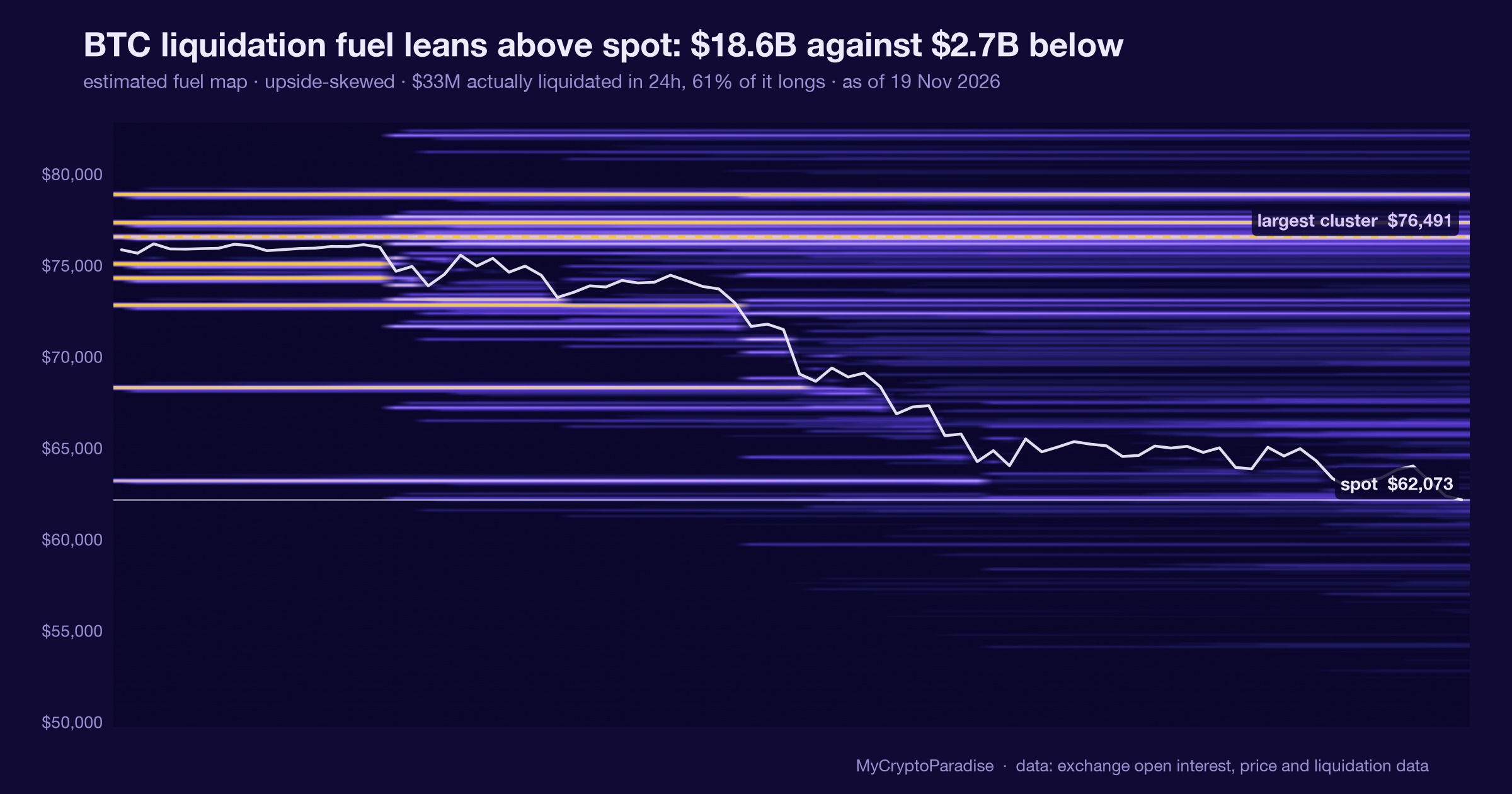
The ParadiseTeam reads this as collateral stress, not a bottom signal. BTC was trading near $58,382 as of 12:33 UTC. That already sits below the $62,000 demand zone we had flagged, where whales defended twice with large buy walls. Price slipping under that shelf changes the posture.
With $62,000 lost for now, our mapped downside of $55,000 to $44,000 moves back into focus. Forced ETH selling from leveraged treasuries feeds that same direction. It adds mechanical supply at the worst possible moment for bulls.
Smart money is not obviously accumulating this specific risk. BTCS cutting $10M in 10 days is defense, not conviction. Retail that chased the prior move now sits trapped on the wrong side of it.
Stops tell the rest. SL (stop-loss) clusters likely sit just below recent ETH lows, which is exactly where forced sellers aim. A reclaim of $62,000 with real volume would be the first hint the squeeze has run its course. Below $55,000, momentum clearly favors the sellers.
Our higher-degree bias stays bearish until a clean impulsive break above $64,700 appears. This news fits that frame rather than fighting it. Any bounce from here is a relief move to respect, not a reversal to chase, until the structure proves otherwise.
The read behind this: we framed this story through our own market analysis, Bitcoin Traders Turn Bearish at $62K Support.
Track it live: our live crypto funding rates and the Crypto Fear and Greed Index both update in real time, so you can watch this shift for yourself.
Related coverage
For exact entries, targets, and stop losses with full risk management, that is what ParadiseFamilyVIP is for. New to reading these moves? Start with our crypto trading strategies guide.
ParadiseTeam is monitoring the market situation closely, and we are taking these developments into consideration while building our trading tactics inside ParadiseFamilyVIP.
Crypto trading involves substantial risk. Prices are volatile and you can lose money. This article is educational and is not financial advice. Past performance does not guarantee future results.
Does BTCS's deleveraging ease the ETH pressure or feed more selling from here?
How 2 Paradisers are calling it
The first call is still open
Free account, no password. Members just sign in.
Follow this topic: Crypto liquidation news · Crypto regulation news










Join the discussion
No comments yet. Members, share how you are reading this.