

Listen: the breakdown
Developing story update (November 21, 2026, 13:03 UTC):
Lookonchain: Chainflip was hacked for $4.86M!
The stolen funds include 3.25M USDC, 520.22 ETH ($851K), and 758K USDT.
The hacker has already swapped all the stolen funds for 2,910 ETH ($4.76M) and deposited the ETH into #TornadoCash.
https://arkm.com/explorer/address/0x7d14a719072DA80076b4edcec3e3401209d21Eaf
https://arkm.com/explorer/address/0xfd24197eF8503dd5dd18F30C7B86A77910D3B080
Developing story: This story is still unfolding. We are tracking it and will update this article as more details are confirmed.
Market briefing: Chainflip froze every swap after a monitor flagged a possible vault exploit, with roughly 4.86 million dollars in ETH out before the doors shut. BTC was trading near $57,840, down 6.2% on the day, as the scare landed.
- Chainflip disabled deposits, withdrawals and quotes after a monitor flagged a potential vault exploit.
- Roughly $4.86M in ETH outflows left the vaults before the lockdown took hold.
- ETH's one-hour change was just -0.11%, so the broader tape barely noticed the freeze.
The Chainflip vault exploit scare froze every swap on the protocol, with about $4.86M in ETH gone before the lockdown. One monitor shut the whole thing down. Does your bridge have the same weak point?
Chainflip went dark on its own terms. A security monitor flagged a potential vault exploit, and the protocol halted all swaps rather than wait to find out how bad it was.
Deposits, withdrawals and quotes all went offline together. For a cross-chain swap protocol, that is the whole product. Nothing moves until someone flips it back on.
The number at the heart of it is modest by hack standards: roughly $4.86M in Ethereum outflows left the vaults before the freeze bit. Not a headline-grade drain. But it was enough to trip the alarm and shut the front door.
That is the part worth sitting with. A mid-cap protocol froze its entire operation over an outflow that, in a different week, would barely register. The caution is defensible. It also tells you how little margin these systems carry when a monitor starts blinking.
Structurally, this is a confidence event, not a market event. Chainflip depositors now wait on a status update they cannot control, while their funds sit behind a locked gate. The broader ETH tape, meanwhile, moved -0.11% on the hour. The asset did not flinch.
So we separate the two cleanly. ETH is down about 6.2% on the day inside a wider risk-off slide. This freeze is a local scare, running alongside that slide, not driving it. One protocol caught a fright. The market kept doing what it was already doing.
A $4.86M drain froze an entire protocol
The mechanism here is confidence, and confidence is the one input a protocol cannot hedge. When a monitor flags a possible vault exploit, the honest move is to freeze first and investigate second. Chainflip did exactly that.
The cost of that honesty is total. Deposits, withdrawals and quotes are the protocol. Turn them off and depositors are stuck watching a wall, unable to act on their own funds. That helplessness is the real damage, far more than the $4.86M itself.
For the wider market, the transmission is deliberately thin. ETH carries deep liquidity across dozens of large exchanges. An outflow this size is a rounding error against that depth. The one-hour move of -0.11% is the market telling you it agrees.
So the chain stops at the protocol's own perimeter. Exploit scare, then full halt, then roughly $4.86M out, then eroded trust among Chainflip users. It does not reach ETH's price in any measurable way.
What it does reach is a question every cross-chain trader should now ask. If a monitor alert can lock an entire platform over a sum this small, where is the single point of failure in the bridges and swap routers you use? That question outlasts this one incident, and it is the part that matters.
Local scare, deep ETH book absorbs it
Start with the obvious: this does not cascade into BTC. Bitcoin was trading near $57,840 as of 09:55 UTC, down 6.2% on the day, and that move belongs to broad leverage unwinding, not to one frozen swap protocol. The freeze and the sell-off share a calendar, nothing more.
ETH is the asset in the headline, yet ETH is the asset that shrugged. A $4.86M outflow against Ethereum's market depth is noise. The -0.11% hourly print confirms it. Spillover to broader ETH liquidity is minimal, because the size simply is not there to move it.
The real impact concentrates on Chainflip and its depositors. Their funds are locked, their exit is closed, and their confidence takes the hit. That is a protocol-level repricing of trust, not a token-level repricing of ETH.
Alts carry a secondary, softer effect. Traders who route through cross-chain swap infrastructure may pull liquidity toward larger exchanges while they reassess. Any protocol that competes in the same lane could see users ask harder questions about reserves and monitoring.
Bad news here stays bad news. There is no sign of dip-buying or quiet accumulation around the freeze, so we do not dress it up as a smart-money setup. It reads as a straightforward confidence knock on one protocol, happening to land on a day the whole tape was already red.
The restart, the trail, the bridge contagion
The first tell is the restart itself. A clean, documented resumption of deposits, withdrawals and quotes, with a clear account of what the monitor saw, would frame this as caution that worked. Trust rebuilds fastest when the freeze looks like discipline rather than damage control.
The opposite tell is silence that stretches. The longer swaps stay halted without a credible explanation, the more the $4.86M figure gets treated as a floor rather than a ceiling. Prolonged lockdown turns a scare into a story, and stories about frozen funds travel fast.
Watch the outflow trail next. If the roughly $4.86M proves to be the whole of it, the incident contains cleanly. If more leaves once analysts trace the vaults, the confidence hit widens and the honest read darkens.
Then watch the neighbours. The sharper risk is contagion of fear across other cross-chain bridges and swap routers. If users start pulling liquidity from peers on the same question of single points of failure, that matters more than this one protocol's balance.
For ETH as an asset, the bar for this event to matter is high and probably will not be cleared. It would take a far larger confirmed drain, or evidence of a shared exploit across multiple protocols, to register on the broader book. Absent that, the market keeps pricing macro, and treats Chainflip as its own contained problem.
What a frozen crosschain protocol means for liquidity
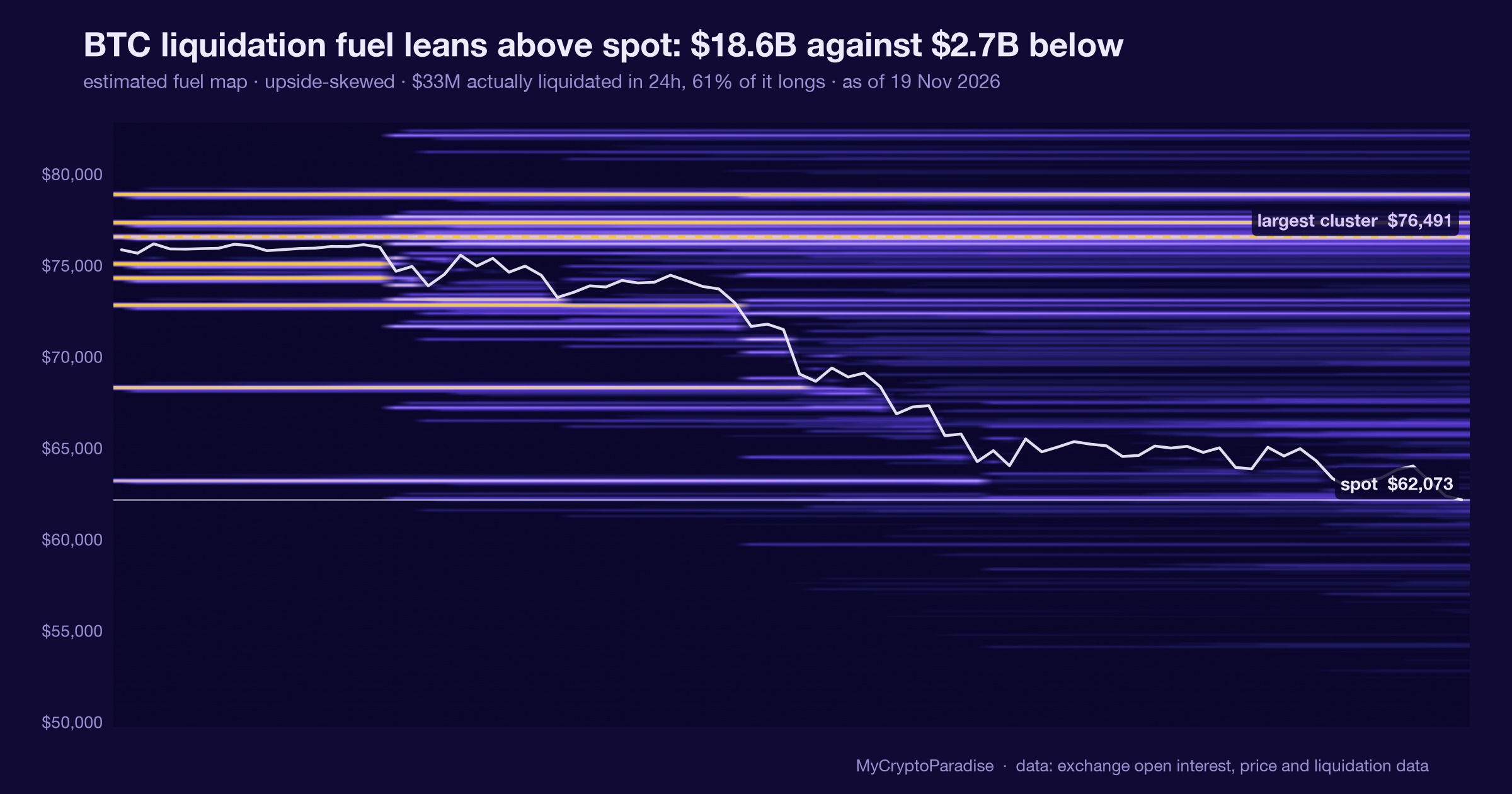
The ParadiseTeam keeps this one in its lane. BTC was trading near $57,840 as of 09:55 UTC, already beneath the $62,000 demand zone whales had defended twice. That break is the day's structural story. A $4.86M swap freeze is not.
With price under $62,000, the standing caution matters more than usual. Our higher-timeframe read stays bearish while BTC trades below the $64,700 resistance, and the old $55,000 to $44,000 exchange-of-hands zone sits in view below. This Chainflip scare changes none of those levels.
What it does change is a risk map for anyone holding funds on cross-chain infrastructure. The lesson is operational, not directional. One monitor alert locked an entire platform, so the stop that protects you is diversification of where your capital sits, not a price level.
Smart money is not accumulating anything around this freeze. There is no absorption to read, no buy wall defending Chainflip the way whales defended $62,000 on BTC. Retail here is not capitulating into a bottom; depositors are simply trapped behind a gate.
So we treat the two events separately and refuse to merge them. Macro caution governs BTC and ETH positioning. Protocol caution governs where you leave idle balances. Confirmation of the broader downtrend still waits on a five-wave impulsive break above $64,700, and this incident does nothing to bring that closer or push it away.
The read behind this: we framed this story through our own market analysis, Bitcoin Traders Turn Bearish at $62K Support.
Track it live: our Crypto Fear and Greed Index and the live crypto funding rates both update in real time, so you can watch this shift for yourself.
Related coverage
For exact entries, targets, and stop losses with full risk management, that is what ParadiseFamilyVIP is for. New to reading these moves? Start with our crypto trading strategies guide.
ParadiseTeam is monitoring the market situation closely, and we are taking these developments into consideration while building our trading tactics inside ParadiseFamilyVIP.
Crypto trading involves substantial risk. Prices are volatile and you can lose money. This article is educational and is not financial advice. Past performance does not guarantee future results.
Does the Chainflip freeze spread confidence damage to other crosschain bridges?
How 7 Paradisers are calling it
The first call is still open
Free account, no password. Members just sign in.











Join the discussion 2
A vault that freezes everything the moment it looks shaky is the detail I'd watch, not the headline. Plenty of people will already read this as a bargain. I check where the bottleneck sits before I trust any of it.
I'd want the gap between the first odd outflow and the halt before calling it a good save. That timing tells me more than the total that left the vault.