

In short
The Hash Ribbons gauge compares Bitcoin’s 30-day average hashrate against its 60-day average: when the short line falls below the long one, miners are powering down faster than difficulty adjusts, and the cross reads as miner stress. On 27 November 2026 our MCP Insights cycle panel put that ratio at 0.9947, its first inversion in weeks, with cycle heat at 18 of 100 and the regime flagged capitulation. Two weeks ago the same ribbon ran warm at the 73rd percentile and we wrote no miner capitulation; that line has now flipped, so we called this neutral, explicitly not a bottom. Valuation still sits in its value zone at the 5th percentile, with market value to realised value (MVRV) at 1.125, so holders are barely in profit. The whole panel carries a model-estimate flag, so we quote no historical frequency. This piece shows you how to read Hash Ribbons yourself, before you trust the label.
A ribbon inversion is only half a signal
Hash Ribbons track two moving averages of Bitcoin’s network hashrate: a short one run over thirty days, and a slower one run over sixty. When the short average sits above the slow one, the network is adding computing power and miners are comfortable.
When the short average falls below the slow one, miners are switching machines off faster than difficulty can adjust, and that downward cross is the inversion. It is only the first leg.
The pattern that has historically marked washouts needs a second move: the short average turning back up through the slow one, the recovery that says the weak miners are gone and the survivors are expanding again.
An inversion on its own is a question about miner health. Only the recovery answers it.
The panel splits on 27 November
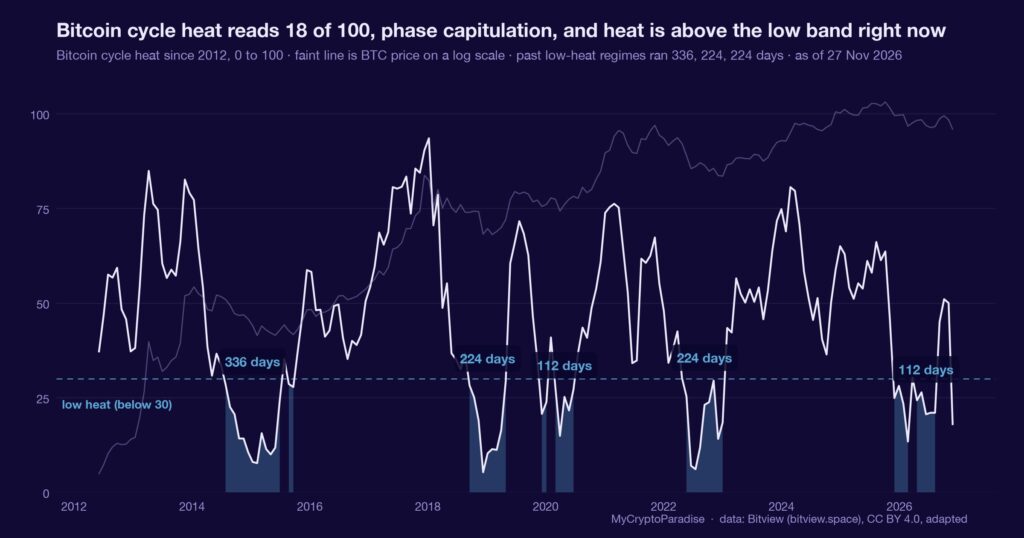
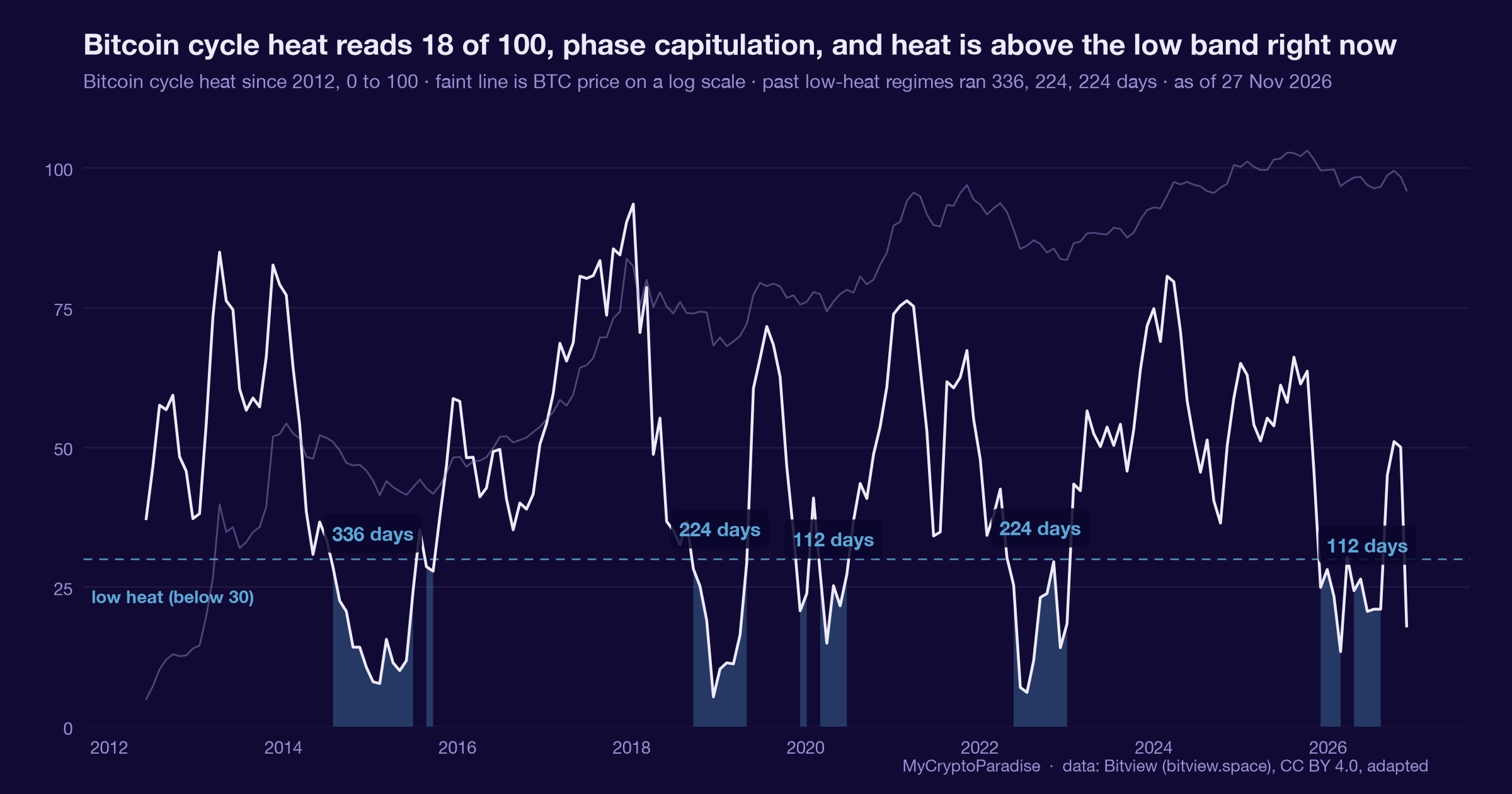
Our MCP Insights cycle panel on 27 November 2026 reads cold almost everywhere. Cycle heat sits at 18 of 100 with the regime flagged capitulation.
The Mayer Multiple, price over its 200-day average, reads 0.8317 against a 2.4 threshold, the 11th percentile. The 2-year moving-average multiplier reads 0.6733, the 7th percentile. The Puell Multiple, miner revenue over its yearly average, reads 0.7453, the 17th percentile.
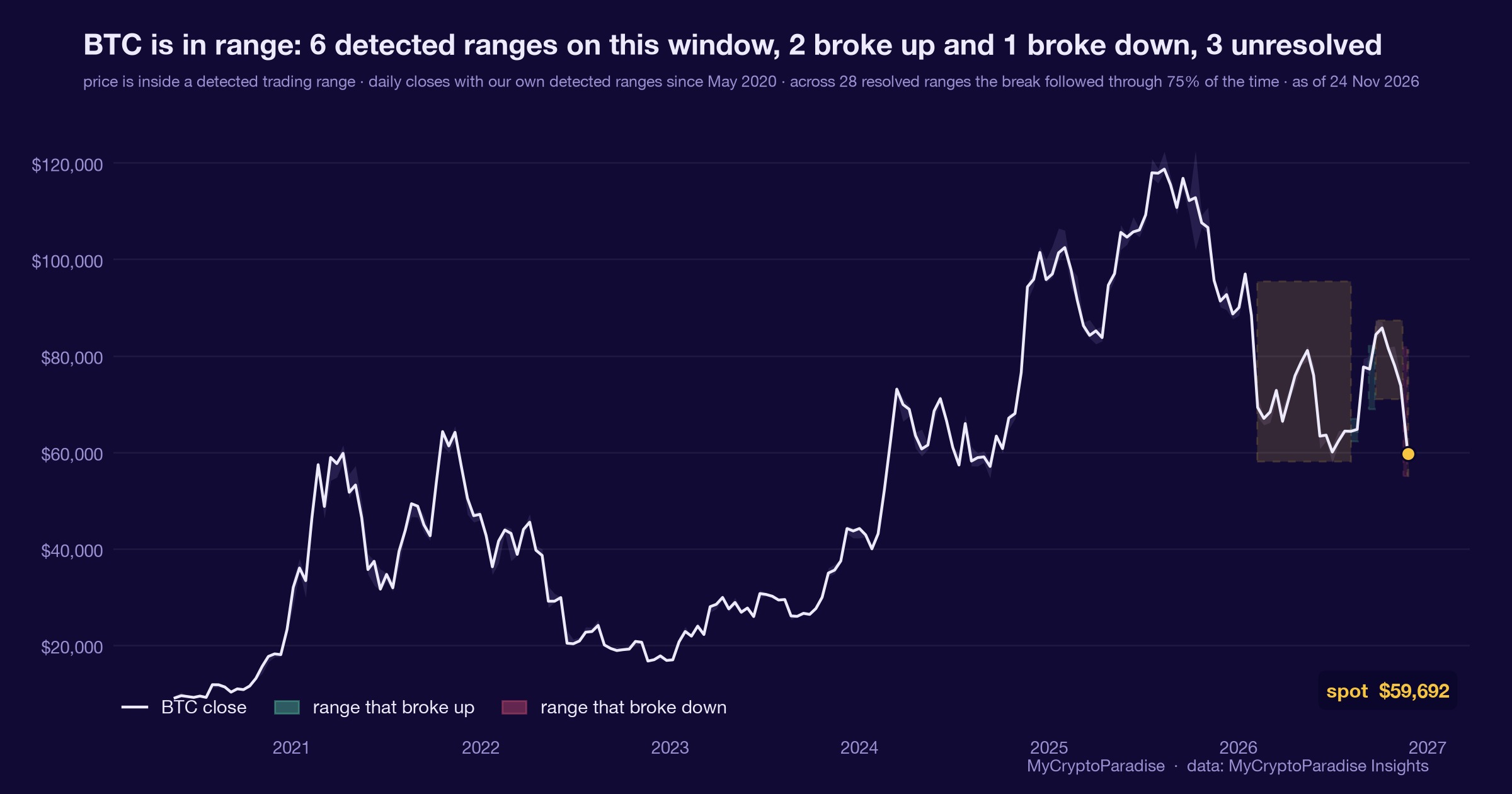
Valuation sits in its value zone at the 5th percentile, with market value to realised value (MVRV) at 1.125 and net unrealized profit and loss (NUPL) at 0.111, so holders are barely above water. Spot near $59,720 sits at 0.66 of our estimated production cost near $90,660.
The second half is the one line that moved: Hash Ribbons inverted, the 30-day hashrate average at 0.9947 of the 60-day, the ribbon at its 22nd percentile, all of it carrying a model-estimate flag.
A panel that is cheap on five lines and stressed on the sixth is not contradicting itself: it is telling you that miner pain and investor value can land on the same day.
Calling this a bottom skips the second leg
The obvious misread is to see cycle heat at its cold end, an inverted ribbon and a value-zone valuation, and call the bottom. That skips the half of the ribbon that matters.
The inversion is the stress; the recovery cross is the confirmation, and our 30-day miner-capitulation reading has not fired. Every past instance that turned into a durable low needed the hashrate to turn back up, and it has not.
There is no wired base rate for this regime, and the whole panel is a model estimate that has not cleared its calibration gate, so we quote no historical frequency: a number with no error bar is decoration, not evidence.
This is one input. It sits alongside funding, open interest and spot absorption, and on the cycle horizon it is the layer that just disagreed with the constructive read the others carried last week.
A cold, cheap panel earns attention. A half-complete ribbon does not earn conviction.
What is different here
The ParadiseTeam does not trade a Hash Ribbons inversion on the first cross. We treat the downward cross as a stress warning, wait for the recovery leg to confirm, and size the read against valuation and miner revenue rather than acting on a single line the day it flips below its sixty-day average.
What flipped since the 14 November read
Grade this against our own recent cycle reads, because that is the point of the stream. On 14 November our panel called the hashrate ribbon warm at the 73rd percentile and wrote, in plain words, no miner capitulation.
On 22 November cycle heat read 27 and the lean stayed constructive. Today the ribbon has inverted and cycle heat has fallen to 18: the long-horizon frame is intact, but the miner-health line that supported it has flipped, and that is a change we publish rather than bury.
The valuation grade eased from 24 to 22 and the top-risk grade from 47 to 42 over the same window, both still low. The full panel, all five components and the ribbon, updates daily on our Bitcoin cycle valuation page.
None of this is a forecast. It is a description of where the panel sits and which line moved. The deeper layers, funding, positioning and the rest of the cycle stack, live in PRO Paradiser; this one reading is a probability weight on a bias, never the bias itself.
Reading Hash Ribbons yourself, step by step
- Pull Bitcoin’s 30-day and 60-day hashrate moving averages: the ribbon is the fast line plotted against the slow one.
- Mark the inversion: when the 30-day average drops below the 60-day, the ratio falls under 1 and miners are stressed.
- Do not act on that cross alone; the pattern needs the recovery, the 30-day turning back up through the 60-day.
- Cross-check miner revenue through the Puell Multiple and compare spot against estimated production cost to confirm the stress is genuine.
- Set invalidation at the ratio reclaiming 1, and size the read against valuation rather than the ribbon by itself.
The step people skip is the recovery cross: an inversion only flags stress, while the historical bottom pattern needs the hashrate turning back up to confirm it.
Every number above is checkable against the live data. Start with the Crypto Fear and Greed Index, then cross-read the MCP Insights hub and the live crypto funding rates.
Act and invalidate
| Scenario | What confirms it | What kills it |
|---|---|---|
| Classic bottom completes | 30-day crosses back above 60-day | Hashrate keeps sliding lower |
| Value case holds | Heat stays cold, MVRV near 1 | Valuation above the 25th percentile |
| Miner stress spreads | Spot drifts under production cost | Ribbon and Puell both turn up |
Posture: The cold, cheap panel earns attention over the cycle horizon, but the half-complete ribbon earns patience, not conviction. This is accumulation-horizon context, not a near-term trade.
Frequently asked questions
What is a Hash Ribbons inversion?
It is the moment Bitcoin’s 30-day average hashrate falls below its 60-day average, meaning miners are powering down machines faster than the network adjusts difficulty. The cross flags miner stress; it becomes a bottom pattern only once the hashrate recovers back above the slower line.
Does cycle heat at 18 mark the bottom?
Not on its own. A reading of 18 of 100 places the regime at its cold, capitulation end, which is constructive context over a cycle horizon, but a single cold gauge is a probability weight, not a timing tool, and our miner-capitulation confirmation has not yet fired.
Why quote no historical frequency this time?
Two reasons. No calibrated base rate is wired for this cycle regime, and the entire panel carries a model-estimate flag that has not cleared its calibration gate. We do not dress a model estimate as a measured frequency, so we describe the readings and leave the rate unquoted.
What does MVRV at 1.125 indicate?
Market value to realised value compares price against the aggregate cost basis of all coins. At 1.125 the market is worth just above what holders paid, so the average coin is barely in profit. That thin cushion means little trapped selling sits overhead on the cycle horizon.
What would change this neutral read?
Three things. The ribbon reclaiming 1 as the 30-day hashrate crosses back above the 60-day tilts it constructive. Valuation climbing above the 25th percentile out of its value zone removes the cheap case. Spot sliding further under production cost would deepen the near-term miner stress.
Crypto trading involves substantial risk and is not suitable for everyone. Nothing here is financial advice; it is education only. Never risk more than you can afford to lose.
The private Extras feed, where the Hash Ribbons inversion, cycle-heat regime and valuation zone update daily with their invalidation levels attached, is part of PRO Paradiser, the intelligence layer behind the ParadiseFamilyVIP strategies.











Join the discussion
No comments yet. Members, share how you are reading this.