


Listen: the breakdown
Market briefing: A disclosed security incident cost about 1 ETH, roughly $2,000, from a bridge fee wallet, with user funds untouched. BTC was near $79,948 as of 12:58 UTC and barely noticed.
- Alexandre Dreyfus disclosed a security incident with no user funds or wallets affected
- Total loss stated at around 1 ETH, roughly $2,000, from a bridge fee wallet
- The gap between the scary framing and the tiny figure is the real story for traders
A security incident sounds like a crisis until you read the number. One ETH, about $2,000, from a fee wallet. So why disclose a loss this small at all?
Alexandre Dreyfus went public with a statement that reads far heavier than it lands. A security incident, he called it. Then he gave the number.
The total loss was around 1 ETH, roughly $2,000, taken from a bridge fee wallet. User funds and wallets were not affected. He was direct on that point, and the figure he reported is small enough to vanish inside most projects' petty cash.
That gap is the entire story. The word "incident" carries the weight of a systemic exploit. The reality is an operational wallet that leaked the price of a used car.
We treat the disclosed facts as facts: no user funds hit, loss stated at about $2,000, source a bridge fee wallet. What we read around those facts is ours.
And the read is simple. This looks like a project moving fast to own the narrative around a small, platform-specific loss before anyone else frames it. Getting ahead of a story is good operational hygiene. It is also the kind of thing you only bother doing when the headline risk exceeds the dollar risk.
One honest caveat matters here. The ~$2,000 bridge-fee-wallet figure is self-reported. We have seen no independent on-chain or third-party confirmation of the size. The number is probably exactly what it says. But the "security incident" label may be doing more work than the amount warrants, and traders should hold both thoughts at once.
The gap between the word and the number
Language moves markets faster than losses do, and this disclosure is a clean example. "Security incident" is a phrase that makes risk desks flinch. Attach it to $2,000 and the flinch has nowhere to go.
That matters because late October has primed everyone to scrutinize security headlines. A broader wave of disclosed breaches and audits across tech and crypto has made the market jumpy. Nothing ties that backdrop to this specific wallet, but the mood frames how the words land.
So the transmission mechanism here is perception, not plumbing. A $2,000 operational loss does not drain liquidity, stress a treasury, or threaten solvency. It does not change any token's supply or demand in a way a chart would register.
What it can do is seed doubt. In a nervous tape, vague security language invites readers to imagine worse than the facts. That imagined worse is what occasionally prices in, briefly, before the number corrects it.
The discipline is to separate the trigger from the size. The trigger is a scary noun. The size is a rounding error.
For macro, this is a non-event. There is no single confirmed same-day catalyst driving crypto today, so reading any broad move off this disclosure would be an interpretive stretch we are not willing to make. We flag it honestly: this is a small story wearing a large word.
Why ETH liquidity shrugs off two thousand dollars
Follow the money and the chain goes nowhere. A bridge fee wallet loses about 1 ETH. There is no mechanism by which that drains order books or forces liquidations.
ETH itself barely registered the day. Spot traded near $2,319.42, down about 0.72% over 24 hours and essentially flat on the hour at roughly 0.05% lower. That is noise, not a reaction.
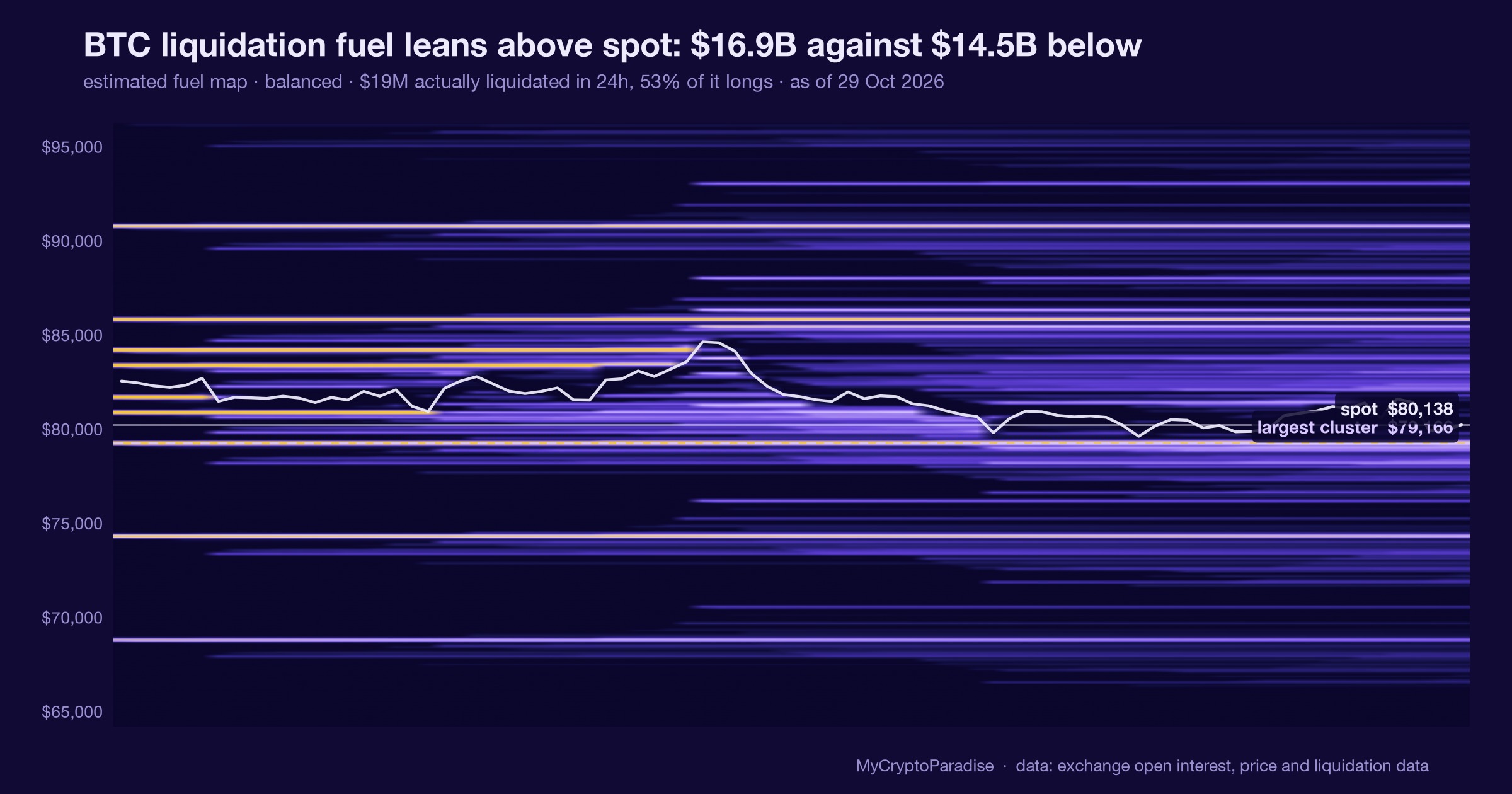
BTC told the same quiet story. It was near $79,948 as of 12:58 UTC, down about 0.9% on the day. A real exploit touching user funds would show up as a fear bid into stables and a visible wobble in open interest, which is the total value of outstanding derivatives contracts. We see none of that here.
So the liquidity cascade is effectively a flat line. BTC did not lead a flight to safety. ETH did not bleed on contagion fear. Alts, which usually amplify any genuine security scare, showed no incident-specific spillover at all.
That absence is itself the signal. When a "security incident" produces zero measurable liquidity response across BTC, ETH and alts, the market has already priced the truth: the dollar figure is trivial.
The only risk to this calm is informational. If the self-reported $2,000 proves too generous, the number could reprice. Until independent verification appears, we treat the market's non-reaction as the most honest vote on this story so far.
The on-chain confirmation this disclosure still lacks
The next move that matters is verification, not price. The $2,000 bridge-fee-wallet figure is self-reported, and nothing in the evidence independently confirms it on-chain or via a third party.
Confirmation looks like silence that holds. If no larger loss surfaces, no user reports contradict the statement, and on-chain flows match a roughly 1 ETH leak, then the story stays exactly as small as it reads. In that case the market's non-reaction was correct, and there is nothing further to trade.
Invalidation looks different. Watch for a follow-up disclosure that revises the number upward, outflows larger than described, or user wallets quietly affected after the "not affected" line. Any of those would turn a $2,000 footnote into a genuine trust problem.
The tell to track is behaviour around the project's own tokens and bridges. A clean incident sees deposits and withdrawals normalize fast. A papered-over one sees quiet, persistent outflows while the public statement stays reassuring.
Broader crypto needs no special watch here. BTC and ETH liquidity never flinched, so there is no cascade to monitor off this event.
For now, treat the disclosure as a reputational data point, not a market one. The honest posture is patience: let independent confirmation arrive before upgrading or downgrading how seriously to take the word "incident" attached to such a small sum.
What a fee-wallet loss really means for positioning
The ParadiseTeam frames this as a reputational event, not a liquidity one. A $2,000 loss from a fee wallet changes nothing about how any major asset is positioned. There is no accumulation or distribution footprint tied specifically to this disclosure.
BTC was trading near $79,948 as of 12:58 UTC, down about 0.9% on the day. That price is set by macro flows and derivatives positioning, not by a bridge fee wallet. We would not adjust any BTC or ETH view off this headline.
Our standing caution is simpler and worth repeating. In a jumpy late-October tape, scary words arrive daily, and most of them are smaller than they sound. The edge is refusing to be moved by language when the number is trivial.
Smart money ignores this entirely. The people who move size react to verifiable losses, not to adjectives. Retail is the audience a "security incident" post is really written for, and the lack of any price reaction suggests even retail read the figure and moved on. So the positioning takeaway is discipline, not action. We are not inventing support or resistance off a $2,000 story, because the market lens gives none for this event, and forcing levels onto a non-event is exactly how traders talk themselves into noise.
Keep risk sized to real catalysts. This is not one. File it, verify it, and let the actual drivers set your levels.
The read behind this: we framed this story through our own market analysis, MCP Tokens: Play Free, Unlock Selected MCP AI Indicators on TradingView.
Track it live: our crypto liquidation heatmap and the Crypto Fear and Greed Index both update in real time, so you can watch this shift for yourself.
Related coverage
For exact entries, targets, and stop losses with full risk management, that is what ParadiseFamilyVIP is for. New to reading these moves? Start with our crypto trading strategies guide.
ParadiseTeam is monitoring the market situation closely, and we are taking these developments into consideration while building our trading tactics inside ParadiseFamilyVIP.
Crypto trading involves substantial risk. Prices are volatile and you can lose money. This article is educational and is not financial advice. Past performance does not guarantee future results.
Does a $2,000 fee-wallet loss deserve the label security incident?
How 1 Paradiser is calling it
The first call is still open
Free account, no password. Members just sign in.








Join the discussion
No comments yet. Members, share how you are reading this.