


Listen: the breakdown
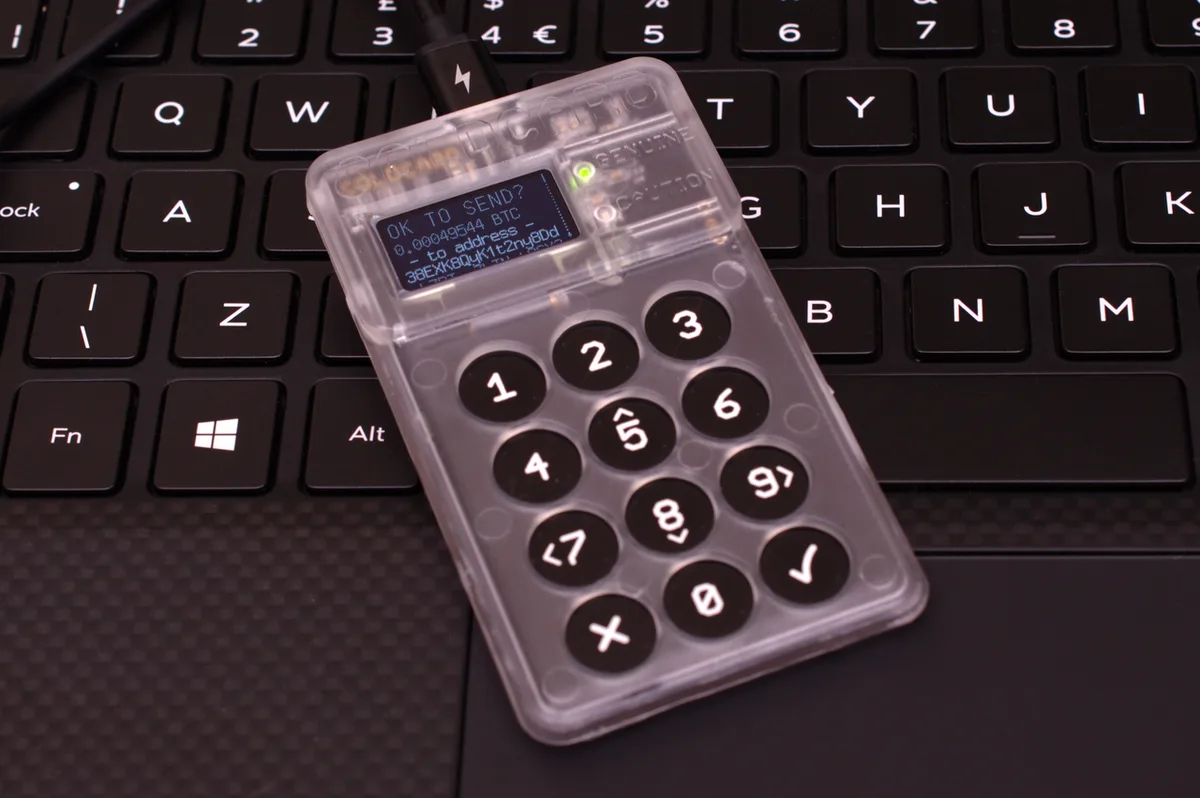
Market briefing: A Coldcard hardware wallet exploit drained more than 1,158 BTC, roughly $75 million, and Binance founder CZ reminded holders that nothing is 100% safe. Bitcoin barely flinched, trading near $62,808 as of 00:50 UTC while the market weighs whether self-custody fear turns into selling.
- A Coldcard exploit drained over 1,158 BTC, valued near $75.1 million, in roughly 41 minutes.
- CZ warned that even hardware wallets can carry bugs and urged holders to split funds across wallets.
- BTC held near $62,808 and BNB traded at $573.91, so far no broad market cascade from the Coldcard hack.
A $70 million Coldcard exploit and CZ's blunt warning have retail rattled about self-custody. But is this a reason to panic sell, or the exact fear smart money waits for?
A Coldcard hardware wallet exploit has drained a serious sum of Bitcoin, and the founder of Binance has weighed in with an uncomfortable truth. Changpeng Zhao, better known as CZ, reminded crypto users that nothing is 100% safe. Even hardware wallets, he said, can carry bugs. His advice was simple: diversify, and split your funds across multiple wallets.
The numbers behind the exploit are the real story. Early reports pointed to a loss near $38 million. That figure later climbed to roughly $70 million as the picture cleared. Our reading of the drained totals puts it at more than 1,158.66 BTC, valued at approximately $75.1 million.
Speed made it worse. One account describes 1,082 BTC leaving in a single 41 minute window, tied to a firmware flaw in the Coldcard Mk3. The whole event unfolded in roughly 40 to 41 minutes. In a market that loves to say your keys are your coins, that is a sobering reminder that firmware is code, and code has bugs.
What changed here is not Bitcoin's structure. What changed is confidence. Hardware wallets are the tool retail trusts most, and CZ just told everyone that trust has limits. That psychological shift matters more than the dollar figure, because fear moves faster than any exploit. Bitcoin itself barely moved, trading near $62,808 as of 00:50 UTC.
Why a wallet bug shakes self-custody faith
This event matters because it strikes at the emotional core of crypto, not the balance sheet. Self-custody is the promise that you, and only you, control your coins. A firmware exploit that empties wallets in 41 minutes attacks that promise directly. When the loudest voice in the industry then confirms that hardware wallets can have bugs, the message lands hard with everyday holders.
The macro transmission runs through sentiment, not liquidity. A $75 million loss is tiny against Bitcoin's total market. It will not move rates, flows, or the broader risk appetite that drives this cycle. What it can move is behavior. Frightened holders sometimes move coins to exchanges, and coins on exchanges are coins that can be sold.
That is the real chain to watch. Exploit fear leads to self-custody doubt, which leads to hesitation or panic among retail. If enough holders decide safety means selling into cash, that pressure shows up as spot supply. It is a slow, sentiment-driven drip rather than a sharp shock.
But here is the honest part. There is no confirmed causal line from this exploit to a market decline. This is an interpretation, our read, not a proven catalyst. History suggests isolated security incidents rarely bend the trend. They test conviction, they do not usually break it. The market has survived far larger breaches without changing course.
How exploit fear filters into BTC and alts
Start with the tape, because the tape is calm. Bitcoin traded near $62,808, down only 0.2% on the day, as of 00:50 UTC. BNB sat at $573.91, off 2.0% over 24 hours and nearly flat on the hour. For a headline screaming $70 million and panic, the price reaction is remarkably quiet.
That silence is the signal. If a $75 million Coldcard drain and a warning from CZ cannot dent BTC, then the selling pressure from fear is not yet real. Smart money reads that calm as strength. Retail reads the headline; professionals read the reaction to the headline.
Down the risk curve, the story is thin. ETH and larger alts show no exploit-driven cascade so far. BNB's mild dip fits normal noise, not a self-custody panic. Without a sharp BTC break, alts have no fuel to gap lower on this specific news.
The mechanism to respect is liquidity around support. Bitcoin hovers just above the $62,500 zone we treat as critical. That is exactly where nervous stops cluster. A fear-driven flush toward that level would trigger those stops, and stop cascades are where forced sellers hand cheap coins to patient buyers.
So the impact is conditional. No level breaks, and this fades into the archive of hacks nobody remembers by month's end. A high-volume break below $62,500, and the exploit narrative suddenly gets blamed for a move it did not truly cause.
The Coldcard hack signals to confirm or fade
The single most important line is $62,500. We treat it as the invalidation for the current bullish structure. As long as Bitcoin holds above it, this exploit stays a headline, not a trend-changer. A clean, high-volume break below flips the risk and gives the fear narrative real teeth.
Watch volume closely, because volume separates a real move from noise. A dip toward the $61,000 to $59,000 region on thin, panicky volume looks like retail flinching. The same dip absorbed with rising buy-side volume looks like accumulation. Same price, opposite meaning.
Exchange inflows are the second tell. If frightened holders start moving coins onto exchanges after CZ's warning, that is potential supply arriving. A quiet chain, with coins staying in cold storage despite the scare, says conviction is intact and the exploit changed sentiment more than behavior.
On the upside, confirmation looks like Bitcoin defending support and pressing back toward the trendline breakout we have been tracking. Reclaiming momentum after bad news is a classic strength signal. Weakness that shrugs off is bullish; weakness that spreads is not.
Finally, watch whether this stays contained. So far it is one wallet product, one firmware flaw, one isolated drain. If no second exploit or broader exchange scare follows, the market will file it away fast. The theatre of panic rarely survives a boring second day.
What the exploit means at the $62,500 line
The ParadiseTeam reads this exploit as a conviction test, not a structural break. Our broader view has the market in a cautiously bullish phase, with smart money reaccumulating Bitcoin around $61,000 while eyeing a final push toward the $79,000 target before a meaningful reversal. This Coldcard news does not change that map. It just adds noise near the edges of it.
The key level stays $62,500. With BTC near $62,808 as of 00:50 UTC, price sits right on the line that separates our bullish thesis from invalidation. That proximity is what makes this event tactically interesting. Retail fear plus a level that already matters is a combustible mix.
Here is the smart-money angle. If exploit panic pushes price into the $61,000 to $59,000 zone, that aligns with where we expect professionals to reaccumulate, not distribute. Fearful sellers near support are exactly the counterparty patient buyers want. The exploit becomes the emotional trigger that hands coins to the wrong crowd at the wrong time.
The risk is honest and specific. A high-volume break below $62,500 invalidates the near-term bullish read, and at that point we respect the downside rather than argue with it. Manage exposure with a defined stop-loss (SL) and a sensible risk-to-reward (R:R); do not let a $75 million headline lure you into oversized bets. Probabilities, not certainty, guide every call here.
Track it live: our Crypto Fear and Greed Index and the crypto liquidation heatmap both update in real time, so you can watch this shift for yourself.
Related coverage
For exact entries, targets, and stop losses with full risk management, that is what ParadiseFamilyVIP is for. New to reading these moves? Start with our crypto trading strategies guide.
ParadiseTeam is monitoring the market situation closely, and we are taking these developments into consideration while building our trading tactics inside ParadiseFamilyVIP.
Crypto trading involves substantial risk. Prices are volatile and you can lose money. This article is educational and is not financial advice. Past performance does not guarantee future results.
After the Coldcard exploit, where does BTC go from here?
This is how the Paradisers are calling it. Tap your call.
No calls on this one yet. Tap yours to be the first.
Free account, no password. Members just sign in.









Join the discussion
No comments yet. Members, share how you are reading this.