

Listen: the breakdown
Developing story: This story is still unfolding. We are tracking it and will update this article as more details are confirmed.
Market briefing: The Coldcard hack losses have now passed $100 million and may reach $130 million, with Canadian holders bearing a quarter of the damage. Bitcoin barely flinched, trading near $63,952, up 0.8 percent on the day.
- Coldcard hack losses have surpassed $100 million and could reach $130 million.
- Bitcoin holders in Canada are bearing 25 percent of the losses.
- BTC shrugged the news off, holding near $63,952, up 0.8 percent.
The Coldcard hack losses have topped $100 million, yet Bitcoin barely moved. So who is really rattled here, and who is quietly waiting to buy the fear?
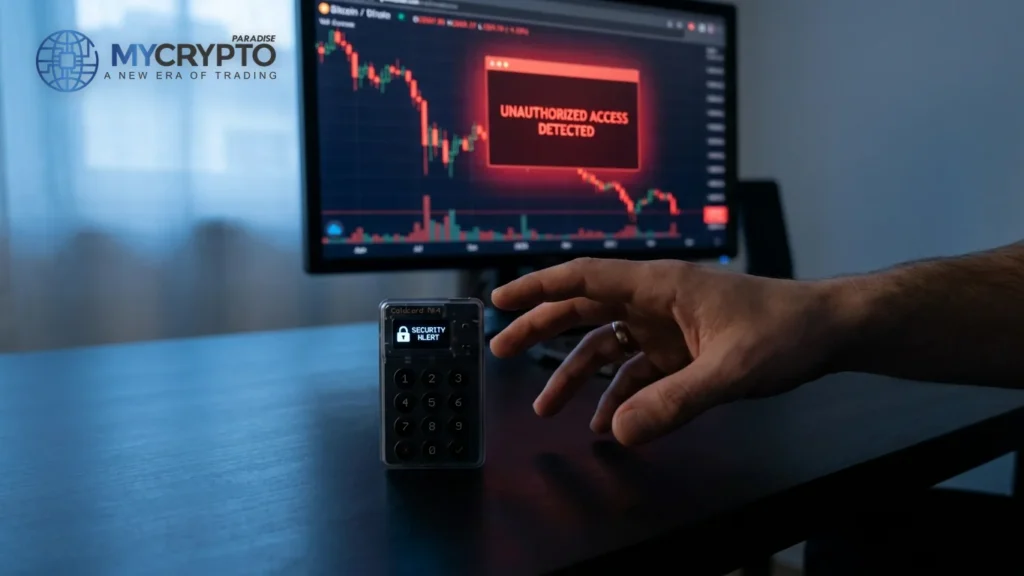
The Coldcard hack losses have crossed a grim threshold. Total damage has now surpassed $100 million, and the figure could climb toward $130 million as attacks continue. Bitcoin holders in Canada are absorbing a full quarter of that pain.
That 25 percent concentration is the detail that stings. It means the losses are not spread thinly across the globe. A specific pool of holders, using a specific hardware wallet, took the brunt.
What matters structurally is where the failure sits. This was not an exchange collapse or a protocol exploit. It struck self-custody, the exact setup crypto keeps promising is the safe one. A cold wallet, it turns out, stays cold only until someone finds the crack.
And yet the price tape barely registered any of it. Bitcoin was trading near $63,952 as of the latest read, up 0.8 percent over 24 hours and down a trivial 0.2 percent on the hour. A hundred-million-dollar loss event, and the chart yawned.
That gap between the headline and the candle is the real story. When bad news lands and the market refuses to panic, something is being absorbed rather than dumped. The fear is real for the victims. The forced selling, so far, is not showing up in a broad flush. That absence tells us more than the loss figure does about who currently holds the wheel.
Why a hardware wallet breach spreads fear
A self-custody hack transmits differently than an exchange failure. There is no company to sue, no support desk to call, no insurance backstop. The loss is final and personal, which is precisely why it corrodes confidence quietly rather than loudly.
The transmission runs through trust, not liquidity. Every holder who kept coins on a hardware device now asks the same question. If that setup can be breached for $100 million, is mine safe? That doubt does not trigger an instant sell. It seeds hesitation, and hesitation is what thins out fresh buying.
The Canadian concentration sharpens the effect. A quarter of the damage sitting in one region suggests a shared point of failure, not random bad luck. Regional holders feel the exposure directly, and word travels fast inside a tight community.
Here is the macro link. Adoption depends on people believing they can hold crypto safely without a middleman. A visible self-custody breach chips at that belief. It does not crash the market, but it raises the psychological cost of holding, and that matters at the margin.
So the news reinforces caution rather than igniting a crash. It joins the general unease already present in the tape. New longs think twice. Sidelined capital stays sidelined a little longer. None of that is dramatic on its own, but it quietly tilts the near-term backdrop toward the cautious side, which is exactly where fresh downside pressure tends to come from.
How the hack pressures Bitcoin liquidity
Start with the driver and follow it down the chain. The Coldcard hack losses feed caution, caution thins new demand, and thinner demand removes a layer of support beneath price. That is the mechanism, and it is subtle rather than violent.
On Bitcoin itself, the immediate effect is small. BTC held near $63,952 while the loss figure grew, proof that no mass liquidation is underway. But the absence of a bounce is telling. Bad news is being digested, not bought aggressively.
The more likely path is drift, not collapse. With buyers hesitant and no strong bid stepping in, price can slide toward the lower liquidity pockets. Our read points at the $61,000 to $59,000 area as the zone that pulls this tape.
Ethereum tends to amplify whatever BTC does here. If Bitcoin leaks toward that support band, ETH usually leaks faster, because a self-custody scare makes holders defensive across every asset they personally secure. Confidence is the shared input.
Alts sit at the far end of the whip. They rely on borrowed liquidity that dries up first when fear rises. In a slow bleed like this, alts do not crash on the news itself. They simply stop attracting the marginal buyer, and open interest, the total value of outstanding leveraged positions, quietly rolls over. That is how a contained hack still shapes the whole board without ever printing a panic wick.
Signals that separate contained from spreading
The first thing to watch is the loss figure itself. If it stalls near the current $100 million-plus range, the event stays contained and the market moves on. If it pushes toward the $130 million ceiling with fresh attacks, the fear story gets a second wind.
Next, watch how Bitcoin behaves around $63,000 and below. A slow, orderly drift toward $61,000 confirms the cautious read. It shows sellers are patient and buyers are waiting, exactly the texture that precedes accumulation rather than capitulation.
Invalidation looks different. A sharp reclaim back above recent highs on rising volume would say the hack was fully shrugged off and demand is returning. In that case the cautious lean is wrong, and the tape wants higher.
The danger signal is a break of the $59,000 floor on heavy volume with expanding open interest to the downside. That would mean the fear stopped being contained. It would suggest forced selling, not just hesitation, and the accumulation thesis would need to be parked.
Also track the tone inside the affected community. If the narrative shifts from this specific device to hardware wallets in general, the psychological damage widens. That is when a niche breach becomes a market-wide confidence question. Watch cumulative volume delta, the running tally of buy versus sell pressure. Flat or rising CVD into a dip signals absorption. Falling CVD warns the bleed is real.
What the hack means near support
The ParadiseTeam frames this event through the accumulation lens, not the panic one. The hack is genuine and painful, but the price refused to break. With BTC near $63,952, the market is telling us the loss is being absorbed, not liquidated into.
That behaviour fits a familiar pattern. Bad news arrives, retail braces for a crash, and the crash does not come. Instead price grinds lower in slow steps. The ParadiseTeam reads that grind as pressure building toward the $61,000 to $59,000 band, the zone we have flagged as a strategic accumulation area.
Here is who is doing what to whom. Nervous holders sell into hesitation and thin bids. Patient capital does not chase; it waits for that lower band where liquidity pools and stops rest. The hack simply supplies the fear that helps push price there.
The ParadiseTeam is honest about the caveat. There is no single confirmed catalyst forcing this move, so the dip toward support is an interpretation, not a promise. Probabilities, not certainty.
What would confirm the read is an orderly slide into $61,000 to $59,000 with buying absorption showing up on the tape. What would invalidate it is a clean break of $59,000 on heavy volume, which flips the story from accumulation to distribution. Until then, the ParadiseTeam treats this as fear being manufactured near support, the kind of backdrop that tends to reward patience over reaction.
Track it live: our Crypto Fear and Greed Index and the crypto liquidation heatmap both update in real time, so you can watch this shift for yourself.
Related coverage
For exact entries, targets, and stop losses with full risk management, that is what ParadiseFamilyVIP is for. New to reading these moves? Start with our crypto trading strategies guide.
ParadiseTeam is monitoring the market situation closely, and we are taking these developments into consideration while building our trading tactics inside ParadiseFamilyVIP.
Crypto trading involves substantial risk. Prices are volatile and you can lose money. This article is educational and is not financial advice. Past performance does not guarantee future results.
Where does BTC go next after the Coldcard hack news?
This is how the Paradisers are calling it. Tap your call.
No calls on this one yet. Tap yours to be the first.
Free account, no password. Members just sign in.










Join the discussion
No comments yet. Members, share how you are reading this.