

In short
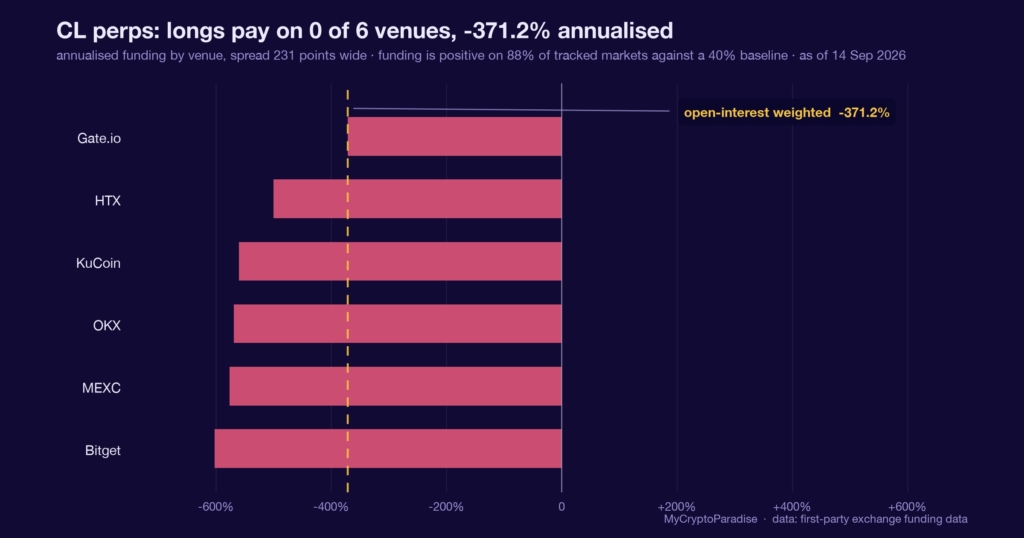
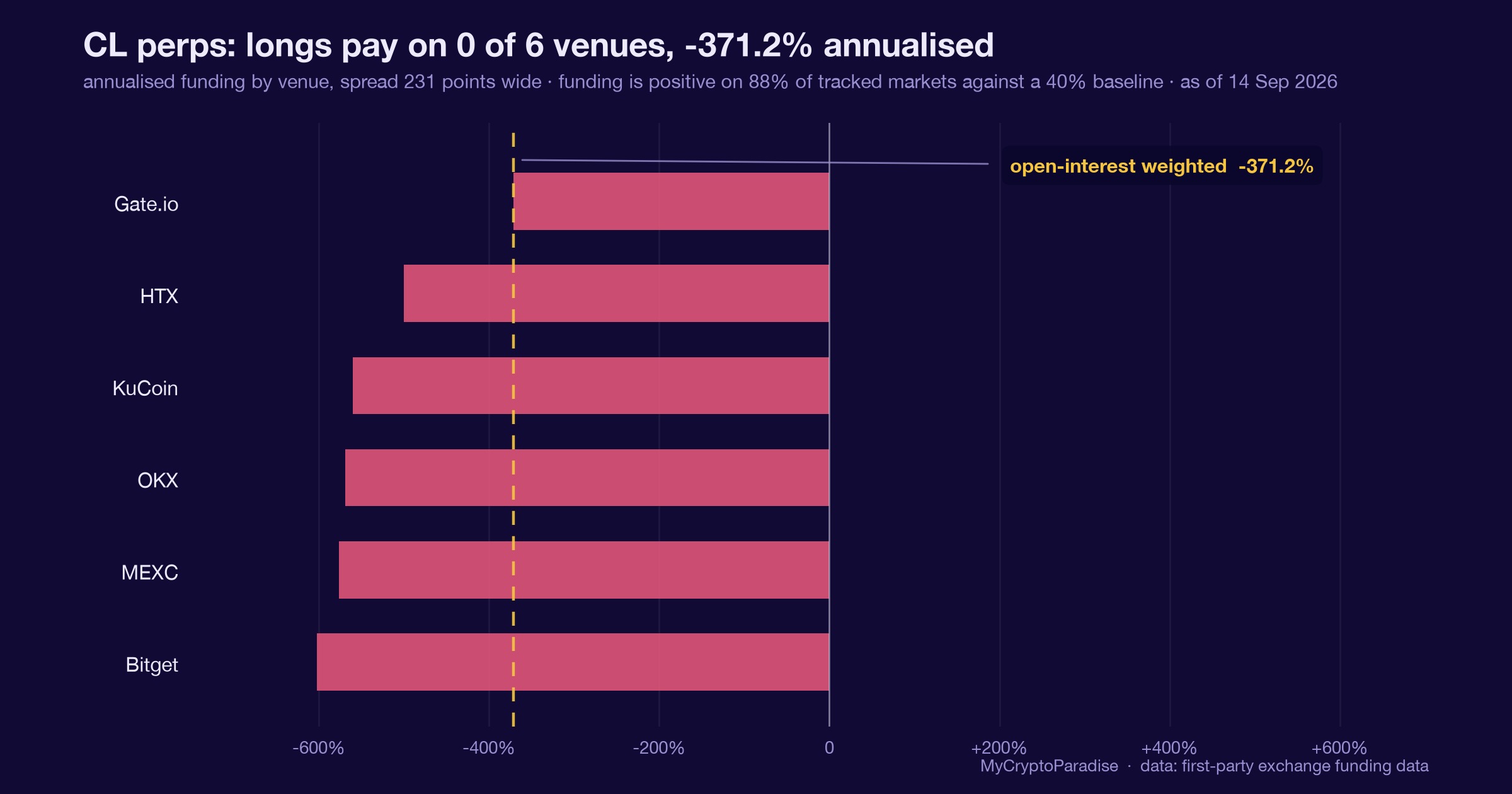
A perpetual funding rate is the periodic fee that longs and shorts pay each other to keep a perpetual future tethered to spot, and when it turns negative the shorts are the ones paying. Our MCP Insights funding data on 14 September 2026 put CL at minus 385 percent APR, its annual percentage rate, the most stretched short-paid funding anywhere in our exchange grid. We read that as a constructive lean: crowded shorts are fuel, not a verdict, and we explicitly refused to call it a reversal or a trade. It stops being the higher-probability reading if funding normalises while price keeps making lower lows, which would mean the shorts were right. No base rates are wired for funding extremes, so we quote no historical frequency and grade this one live in the weekly ledger. This piece shows you how to read a funding extreme yourself, and where it lies to you.
Funding is a fee, not a forecast
A perpetual future has no expiry date, so an exchange needs a way to keep its price tethered to the underlying spot market. That mechanism is the funding rate: a small fee exchanged directly between the two sides of every open contract, settled every few hours.
The direction of that fee follows the crowd. When leverage piles onto the long side, longs pay shorts to hold their positions. When shorts crowd in, the flow reverses and shorts pay longs instead.
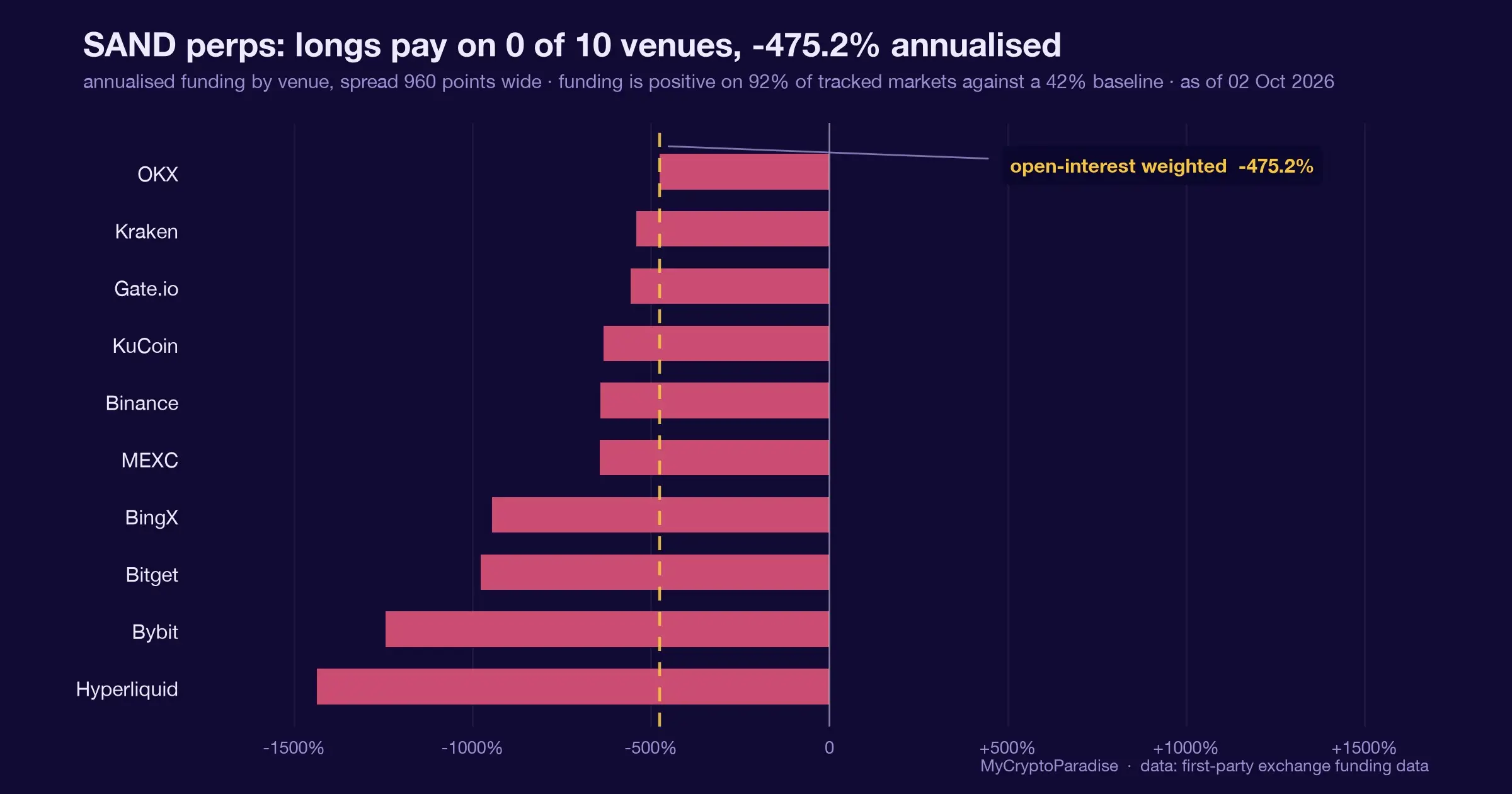
The sign of the rate tells you which side is paying; the size tells you how badly they want to stay. Funding is therefore a gauge of crowding, never of direction, and confusing the two is the classic error with this number.
CL shorts are paying to be short
Our MCP Insights funding data on 14 September 2026 flagged CL as the single most negative funding print anywhere in the market, at minus 385 percent APR, its annual percentage rate. In plain terms, shorts on CL are paying an annualised 385 percent to keep their positions open.
That headline number is a rate, not a bill anyone settles in full. Funding is charged in small slices every few hours, so minus 385 percent is only what a full year at today’s pace would total. No extreme survives a year, so the real cost is smaller, though still steep.
What the print captures is intensity, not error. A minus 385 percent reading does not say the shorts are wrong; it says one side of the trade has run out of patience, and impatience on this scale is expensive.
What is different here
The ParadiseTeam does not read a funding extreme as a cue to fade or to chase. We treat it as a measure of crowd stress, then look to open interest and price structure to decide whether that stress is about to resolve or simply persist.
The obvious misreading is squeeze now
The reflex on a funding extreme this deep is to assume a short squeeze is about to fire. Crowded shorts do supply the fuel: if price ticks up, underwater shorts must buy back, that buying lifts price, and the move forces still more shorts to cover. The loop is real and can be violent.
It is not a schedule, though. Funding can stay stretched for days while price grinds sideways, quietly bleeding the crowded side through the fee rather than through any dramatic reversal.
Extreme funding raises the probability of a squeeze; it does not set its clock. A loaded setup and a triggered one are different things, and only the second is tradeable.
One reading among several, and its blind spot
This is one input, and on its own the narrowest of the ones we watch. It sits alongside open interest (OI), spot absorption and the price structure itself. Funding can tell you the crowd is stretched short; it cannot tell you whether that crowd is early or simply wrong.
No base rates are wired for funding extremes in our data yet, so we quote no historical hit rate and refuse to manufacture one. A handful of remembered analogs would be an anecdote with a spreadsheet, not a sample, and we do not even have that catalogued.
A funding extreme is a probability weight on a bias, not the bias itself. It sizes a lean that has to come from somewhere else, which is exactly why the other layers exist.
What we do with it today
With price direction unconfirmed, the honest posture is constructive but unhurried. The crowded short side is real upside fuel, and that is enough to lean, not enough to act.
We mark the level that kills the read before anything else: fresh lower lows while the fee drifts back toward zero would show the shorts were right all along. Until price confirms, the highest-probability action for most remains no trade.
A lean you can invalidate in one line is worth more than a conviction you cannot.
Reading a funding extreme yourself, step by step
- Open a live funding rate table and sort by the most negative annualised rate to find where shorts are paying hardest.
- Confirm the sign: a negative funding rate means shorts pay longs, so the crowd on that coin is leaning short.
- Check whether open interest is rising or falling, since a stretched fee on rising interest is a fresher, heavier crowd.
- Overlay price structure, and ask whether recent lows are holding or breaking while the funding fee stays extreme.
- Set the level that would prove the read wrong before you act, not after, and size only to that risk.
Most people stop at the sign and declare a squeeze. The step they skip is open interest: a stretched fee on falling interest is a crowd already leaving, not arriving.
Every number above is checkable against the live data. Start with the live crypto funding rates, then cross-read the MCP Insights hub and the Crypto Fear and Greed Index.
Act and invalidate
| Scenario | What confirms it | What kills it |
|---|---|---|
| Short squeeze ignites | Price reclaims recent highs on rising volume | Funding normalises with price flat |
| Slow bleed, no squeeze | Fee stays extreme, price grinds sideways | A sharp move breaks the range |
| Shorts were right | Lower lows while funding stays negative | Funding flips positive as price bounces |
Posture: Constructive but unhurried. The crowded short side is genuine upside fuel, yet fuel is not ignition, so this weights a bias rather than opening a trade, and the read dies if price makes fresh lows while the fee bleeds back to normal.
Frequently asked questions
What does negative funding actually mean?
Negative funding means the short side of a perpetual future is paying the long side a periodic fee. It signals that leverage is crowded short on that coin. The deeper the negative rate, the more it costs those shorts to keep waiting.
Is minus 385 percent APR a real cost?
It is a rate, not a lump sum. Funding is charged in small slices every few hours, and the minus 385 percent figure is what one year at that pace would total. No extreme lasts a year, so the real cost is far smaller, though still punishing.
Does extreme funding guarantee a short squeeze?
No. Crowded shorts are the fuel for a squeeze, but fuel needs a spark. Funding can stay stretched for days while price drifts sideways and the crowd bleeds through the fee. The setup raises the probability of a squeeze; it never sets the timing.
How do I tell if shorts are early or wrong?
You cannot from funding alone, which is its blind spot. Pair it with open interest and price structure: rising interest with holding lows suggests trapped shorts, while new lows on stable funding suggest the shorts are simply correct so far.
Should I trade a funding extreme on its own?
No single reading is a trade. A funding extreme sizes a bias you already hold from price and flow; it does not create one. The highest-probability action for most is no trade until price confirms which way the crowd stress resolves.
Crypto trading involves substantial risk and is not suitable for everyone. Nothing here is financial advice; it is education only. Never risk more than you can afford to lose.
The private Extras feed, where the funding-extremes ranking, open-interest shifts and the crowd-stress read update intraday with their invalidation levels, is part of PRO Paradiser, the intelligence layer behind the ParadiseFamilyVIP strategies.




Join the discussion 1
The funding rate extreme does not always translate directly into a squeeze. I have seen instances where the market remains range-bound despite such readings, often influenced by the Tokyo open.