

Listen: the breakdown
Market briefing: CFTC Chair Michael Selig says onchain platforms like Hyperliquid must register or partner with a licensed exchange to serve US users, citing the Backpack model. BTC sat near $62,086, down 1.8% on the day.
- CFTC Chair Selig says onchain platforms like Hyperliquid must register or partner with a licensed exchange.
- He named the Backpack model as the reference path for US compliance.
- BTC and ETH show no clean reaction, each down under 2% on the day.
The CFTC just drew a line for onchain perp platforms like Hyperliquid: register or partner with a licensed exchange. Does this force a real DeFi compliance wave, or fade as talk?
CFTC Chair Michael Selig drew a clear line this week. Onchain platforms like Hyperliquid must register as exchanges or partner with a licensed one to serve US users. The message was direct, and it named names.
Selig pointed to the Backpack model as the reference structure. That gives these platforms a template, not just a warning. It is a register-or-partner path, not an outright ban.
For years, onchain perpetual platforms lived in a grey zone. They offered leverage without the paperwork a US exchange carries. That let them scale fast and cheap, but it left them exposed the day a regulator decided to look closer.
Now the chair has looked.
This matters because it targets one specific corner of crypto. Not BTC spot. Not ETH spot. The derivatives rails where DeFi built its deepest liquidity. The distinction is the whole story.
Regulators have promised clarity before. The market has learned to wait for enforcement, not for press lines. So the open question is whether this becomes rules or stays rhetoric. Still, a chair naming Hyperliquid directly is not nothing. It signals where attention sits, and it hands compliant exchanges a competitive edge they lacked last month.
The majors barely flinched. BTC traded near $62,086, down 1.8% on the day, and actually ticked up on the hour. ETH slipped a similar amount. Neither move reads as a reaction to this headline, which is exactly the point.
The compliance line being drawn around DeFi perps
The real mechanism here is market access, not price. The CFTC controls who can legally offer derivatives to US users. By naming a register-or-partner path, it decides which platforms keep that door open.
Onchain perp platforms grew by skipping this step. They matched buyers and sellers with code, not a licensed order book. That is cheaper to run, but it leaves no regulatory cover once a chair starts naming names.
The Backpack model now gives a compliant blueprint. Either register yourself, or route through someone who already has. Both routes cost money.
Compliance is never free. Legal teams, capital requirements and reporting all eat into the thin margins these platforms run on. Friction is a tax on liquidity.
The transmission is straightforward from there. Higher compliance risk discourages some US flow. Thinner US participation can widen spreads and soften depth on the affected platforms. That is a genuine headwind for the DeFi derivatives corner specifically.
The majors sit outside the blast radius for now. This is a rules story about perp rails, not a catalyst for BTC or ETH spot. Traders should hold those two ideas apart, because the market clearly is.
Where the friction lands on perp liquidity
Read this story in the direction it points: a mild headwind for onchain derivatives, not the majors. The first-order effect is restricted US access and higher friction. That is bearish for the platforms named, at the margin.
BTC barely registered the news. Price sat near $62,086, down 1.8% on the day, and ticked up slightly on the hour. If this headline mattered to BTC, the tape would show it. It does not.
ETH tells the same story. It slipped around 1.7% on the day, broadly in line with BTC, with no isolated reaction to the CFTC line. The two majors are moving on their own weather.
The clearer pressure sits one layer down, on DeFi derivatives tokens and the platforms that live on perp volume. If compliance costs rise and US users thin out, those platforms feel it first. OI (open interest) on the affected platforms is the honest gauge.
Altcoins tied to onchain derivatives carry the most direct exposure. A real compliance wave would pull liquidity toward registered exchanges and away from the grey-zone players. That reshuffles flow within the sector rather than draining the whole market.
So the cascade is narrow by design. Regulatory friction on perp rails, limited read-through to BTC and ETH, and a sector rotation risk for DeFi derivatives names. Nothing here argues for a broad market move.
Enforcement or another unpoliced jawboning headline
The open question is simple: enforcement or another headline. A chair's statement sets intent. It does not move money until rules bite.
Confirmation would be concrete action. Watch for a formal CFTC rulemaking, a registration filing from a named platform, or a visible partnership struck on the Backpack template. Any of those turns talk into structure.
Watch OI and volumes on the affected platforms too. A sustained drop in US-linked activity would show the market pricing real friction. Stable flows would suggest traders are shrugging this off.
Invalidation of the bearish read is equally clear. If weeks pass with no filing, no rulemaking and no enforcement, this fades into the long list of regulatory lines drawn and never policed. The market has seen that film before.
Backpack-style partnerships are the tell to track. If more platforms announce that path, the compliance wave is real and the sector is already adapting. Silence means the status quo holds.
For BTC and ETH, the thing to watch is whether this stays contained. So far it has, cleanly. A clear separation between DeFi perp regulation and majors keeps the read narrow and the risk sector-specific.
The honest frame: this is a credible regulatory signal with an uncertain enforcement timeline. We treat intent and action as two different things until the filings appear.
Reading a DeFi rule through the majors
The ParadiseTeam reads this as a sector story, not a majors catalyst. Our standing map for BTC does not shift on a DeFi perp rule. The levels that matter were set before this headline landed.
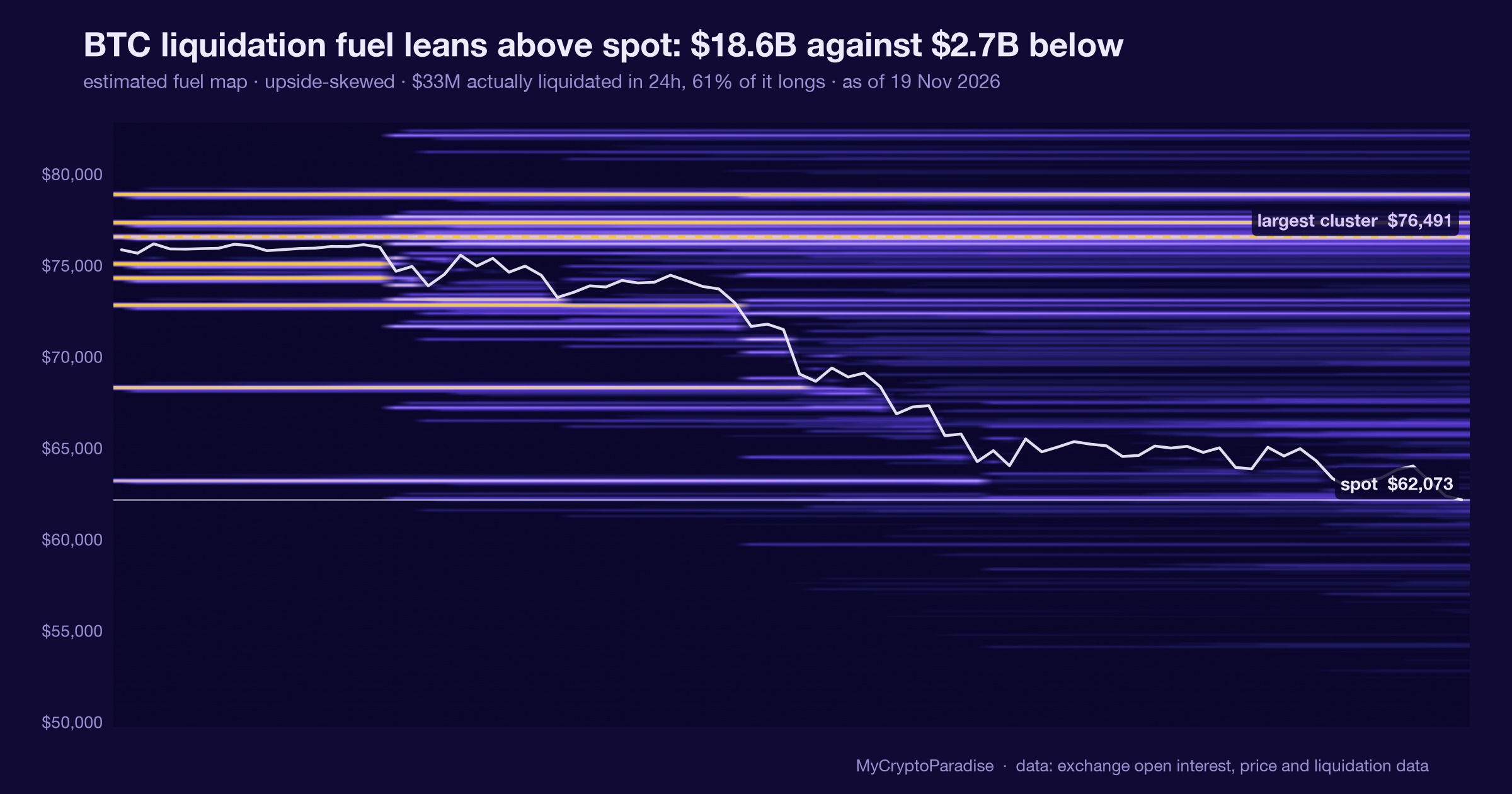
BTC was trading near $62,086 as of the latest read, just under the $64,000 support we watch. That zone, near the 0.786 Fib retracement, is where a bullish hammer formed earlier. Reclaiming and holding $64,000 keeps the short-term recovery alive.
Below, $61,000 is a re-accumulation shelf, and $58,000 marks the prior low. Lose $58,000 and the weekly bias opens the door toward the $44,000 macro target. None of that is driven by the CFTC comment; it was already on the map.
Here is the edge. This headline is the kind of scary-sounding news retail reacts to and smart money positions around. But the facts show no clean reaction in the majors, so we see no accumulation or distribution signal in this move. It reads as background noise, not a trigger.
For anyone trading the DeFi derivatives names directly, the register-or-partner line is a real risk input. Size smaller and keep your SL (stop-loss) tight, because regulatory headlines gap prices fast.
Our base case stays cautious on the weekly. We want proof of real smart-money re-accumulation, not a retail-driven bounce, before trusting any push higher. A tight R:R (risk-to-reward) beats conviction here.
The read behind this: we framed this story through our own market analysis, Why Did Bitcoin Crash After the Binance Hack?
Track it live: our live crypto funding rates tracks this in real time, so you can watch it play out for yourself.
Related coverage
For exact entries, targets, and stop losses with full risk management, that is what ParadiseFamilyVIP is for. New to reading these moves? Start with our crypto trading strategies guide.
ParadiseTeam is monitoring the market situation closely, and we are taking these developments into consideration while building our trading tactics inside ParadiseFamilyVIP.
Crypto trading involves substantial risk. Prices are volatile and you can lose money. This article is educational and is not financial advice. Past performance does not guarantee future results.
Does the CFTC line force a real DeFi compliance wave or fade as talk?
How 2 Paradisers are calling it
The first call is still open
Free account, no password. Members just sign in.
Follow this topic: Crypto regulation news











Join the discussion
No comments yet. Members, share how you are reading this.