


Listen: the breakdown
Market briefing: The SEC says eight entities ran fake crypto trading platforms and took over $37 million from U.S. investors. It is a scam cleanup, not a market event: BTC sat near $61,995 and ETH near $1,759, both modestly softer on the day for reasons of their own.
- SEC says eight entities used fake crypto trading platforms to steal over $37 million from U.S. investors.
- No real exchange, protocol, or liquidity pool was touched; this removes bad actors, not market depth.
- BTC near $61,995 and ETH near $1,759 drifted lower on unrelated factors, not this enforcement release.
Source: U.S. SEC
The SEC says eight entities ran fake crypto trading platforms and lifted more than $37 million from retail. Does a scam sweep like this actually move BTC and ETH?
The SEC confirmed that eight entities used fake crypto trading platforms to steal more than $37 million from U.S. investors. These were not exchanges anyone reading this would recognise. They were counterfeit storefronts built to look like the real thing, dressed in the vocabulary of trading to harvest deposits that never touched a real market.
The mechanism is old. Victims see a slick interface, a fabricated balance that climbs, and a withdrawal button that quietly stops working. The money was gone the moment it arrived.
So the headline sounds heavy, and the dollar figure is real. But read what it actually describes. No functioning crypto exchange was hacked. No protocol was drained. No custodian failed. The SEC removed a pocket of fraud that existed alongside the market, not inside it.
That distinction matters for traders more than the $37 million does. A fraud ring stealing deposits never provided BTC or ETH liquidity in the first place. Its removal changes nothing about order books, funding, or flows on the exchanges where price is actually set.
Meanwhile the tape did its own thing. BTC was trading near $61,995, down about 1.4 percent on the day, while ETH sat near $1,759, off roughly 0.85 percent. Those are ordinary moves. We see no evidence connecting them to this release, and we will not pretend one exists.
The honest framing is simple. This is a scam-prevention story the market already assumed was true. It confirms a known risk rather than introducing a new one.
Why a scam sweep is not a catalyst
The transmission chain here is short, and that is the whole point. A genuine catalyst reaches crypto prices through macro conditions, then liquidity, then BTC, ETH, and alts in sequence. This enforcement action never enters that chain.
Start at the macro layer. An SEC case against counterfeit platforms does not change interest rates, dollar liquidity, or institutional risk appetite. It adjusts nothing about the environment that sets the cost of holding risk.
Now the liquidity layer, where real moves are born. The stolen $37 million sat inside fake infrastructure. It was never depth on a real book, never collateral behind real leverage, never a flow that any trading screen could see. Returning it, or charging the people who took it, withdraws no liquidity from the markets that price BTC and ETH.
That leaves one effect that is real but soft: narrative. Every fraud headline reinforces the retail belief that crypto is a minefield. It feeds the fear that keeps nervous money on the sidelines and quick to sell scary headlines.
And that is where the asymmetry lives. The same crowd that funds these scams is the crowd that reliably buys euphoria and sells fear. The SEC closing one trap does not fix that behaviour; it just documents another instance of it.
For us, the takeaway is disciplined rather than dramatic. Separate fraud against investors from stress inside the market. They look similar in a headline and behave nothing alike in a book.
How real BTC and ETH books absorbed this
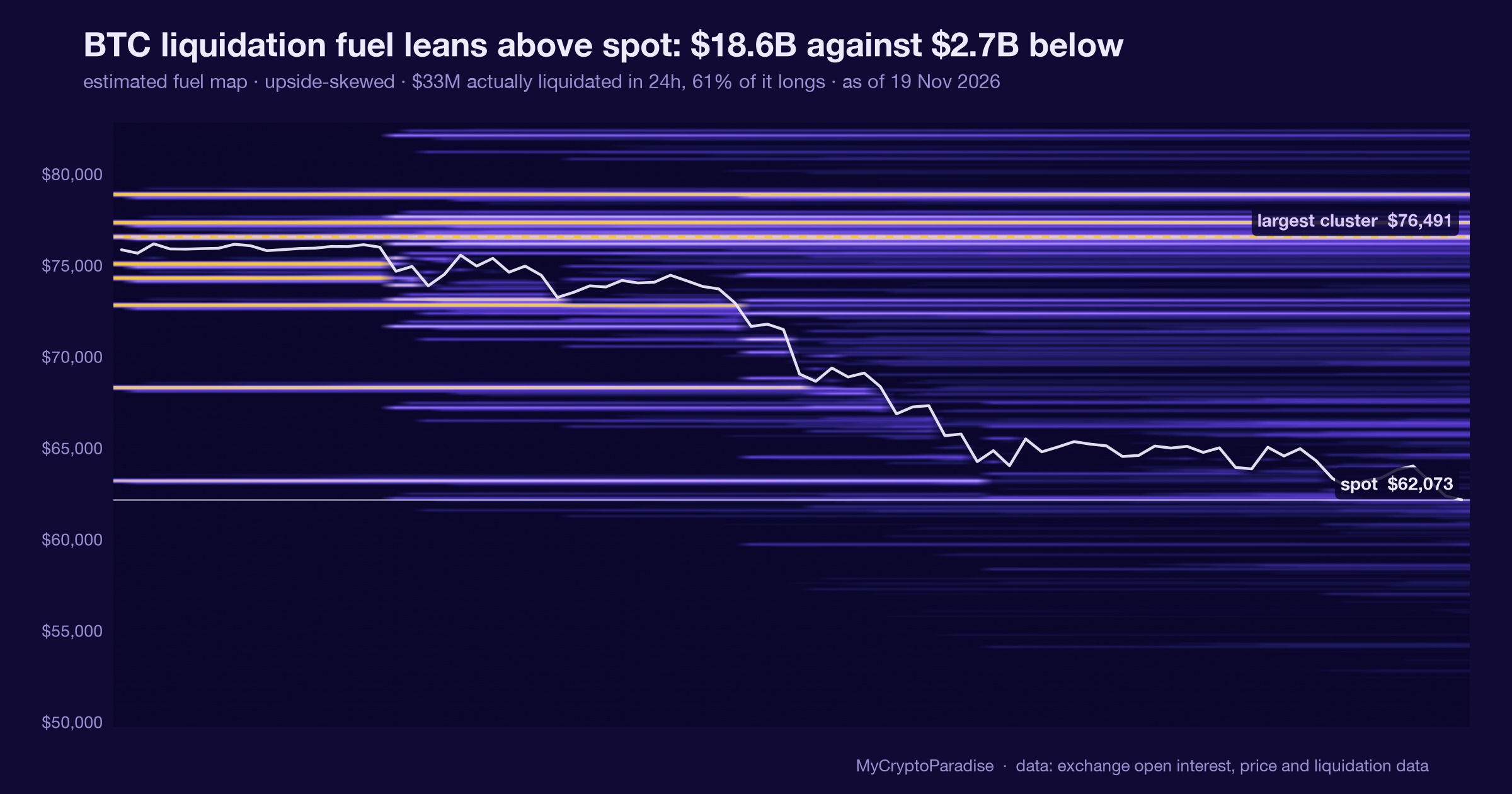
Follow the cascade and it fizzles out fast, which is exactly what we would expect. Start with BTC, the market's anchor. It was trading near $61,995 as of the figures in hand, softer by about 1.4 percent over 24 hours. That is well inside a normal day's range and shows no spike, no liquidation wick, no signature of forced selling tied to news.
ETH tells the same story. Near $1,759 and down roughly 0.85 percent, it actually held up slightly better than BTC on the day. If a fraud release were pushing fear into real markets, the higher-beta asset would usually lead the drop. It did not.
Alts, the final link in the chain, had no fresh reason to move either. They take their cue from BTC and ETH liquidity, and neither majors flinched in a way that would ripple outward. So the liquidity effect of this story rounds to zero. There is no cascade to trace because nothing left the system. The capital these entities stole was gone long before the charges landed.
We treat the 24 hour softness as its own event with its own, unrelated drivers. Tying it to this release would be a tidy narrative and a false one.
The cleaner read is that the market simply ignored a story that did not concern it. Price was busy with structure, positioning, and the wider tape, none of which care about a shuttered fake platform.
What would turn fraud news into a flow story
The thing to watch is not this case; it is whether anything like it ever touches real infrastructure. That is the line between a scam headline and a market event, and it is worth knowing in advance where it sits.
Confirmation that this stays a non-event is already here. No real exchange reported stress. No custodian halted withdrawals. No stablecoin wobbled. As long as that holds, the correct response to this story is to note it and move on.
Invalidation would look very different. If enforcement ever named a functioning exchange, a live protocol, or a custodian that actually holds client crypto, the chain we described would suddenly connect. Deposits could freeze, collateral could be questioned, and liquidity could genuinely leave. That is when fraud news becomes a flow story.
There is a second, slower thing to track: the aggregate drip of fear. One case changes little. A steady run of fraud headlines can thicken the retail belief that crypto is unsafe, keeping sidelined money sidelined for longer.
That matters at turning points. Markets need fresh buyers to sustain rallies, and a frightened crowd is a reluctant one. Persistent fear tends to delay the handoff from smart money back to the broader public.
So keep the filter simple. Ask whether a given headline touches the plumbing of a real market or merely the wallets of retail victims. The first can move price; the second, like this one, mostly moves the mood.
Why this release does not shift the structure
The ParadiseTeam treats this as background, not input. Our standing map of BTC did not move because a fraud ring did; the levels that matter were set by real smart money, not by a counterfeit platform. That map still runs through $64,000, the 0.786 retracement where a bullish hammer formed and buyers last showed real intent. With BTC near $61,995, price sits just under that line, in the $61,000 re-accumulation band we have flagged. This enforcement news changes nothing about who is positioned there or where their stops sit.
Below, the structure is unchanged too. The $58,000 prior low remains the pivot that decides whether this holds as support or opens the path toward the deeper $44,000 flush we still carry as a base case. None of those levels care about $37 million in stolen retail deposits.
Here is the connection worth making. Stories like this one feed the exact retail fear that provides exit liquidity near highs and panic sellers near lows. Smart money does not fund fake platforms; it waits for the crowd those platforms frighten. So our read is positioning discipline, not a reaction. We stay weighted toward patience, watching whether the hammer at $64,000 earns follow-through on real volume or fades on retail-only buying.
The verdict on this release is neutral, and we will not dress it as more. A scam sweep is housekeeping. Price structure, not press releases, still decides the next leg.
The read behind this: we framed this story through our own market analysis, Why Did Bitcoin Crash After the Binance Hack?
Track it live: our Crypto Fear and Greed Index and the live crypto funding rates both update in real time, so you can watch this shift for yourself.
Related coverage
For exact entries, targets, and stop losses with full risk management, that is what ParadiseFamilyVIP is for. New to reading these moves? Start with our crypto trading strategies guide.
ParadiseTeam is monitoring the market situation closely, and we are taking these developments into consideration while building our trading tactics inside ParadiseFamilyVIP.
Crypto trading involves substantial risk. Prices are volatile and you can lose money. This article is educational and is not financial advice. Past performance does not guarantee future results.
Do steady fraud headlines keep retail sidelined long enough to delay the next leg up?
How 1 Paradiser is calling it
The first call is still open
Free account, no password. Members just sign in.
Follow this topic: Crypto regulation news










Join the discussion
No comments yet. Members, share how you are reading this.