


Listen: the breakdown
Market briefing: Bybit has sued North Korea over the $1.5 billion Lazarus hack and won an order freezing assets, recovering only a sliver so far. BTC sat near $65,170, up 0.6% on the day, essentially unmoved.
- Bybit sued North Korea and won a court order freezing hack-linked assets.
- It has recovered $48.4 million and frozen $30.5 million of the $1.5 billion taken.
- BTC held near $65,170, up 0.6%, treating the news as a footnote.
The Bybit hack lawsuit just won an asset freeze against North Korea, yet BTC barely twitched near $65,170. So is this recovery a real catalyst, or a distraction?
Bybit has taken North Korea to court over the $1.5 billion stolen from it in February 2025, and it won an order freezing the assets it could trace. The Lazarus Group carried out the theft, one of the largest in the industry's history. This is the exchange trying to claw value back through the legal system rather than through code.
The recovered numbers are honest about the odds. Bybit says it has recovered $48.4 million and frozen a further $30.5 million. Together that is roughly $79 million, or about five percent of what walked out the door.
Suing a nation-state that has no intention of appearing in court is less about the verdict and more about the freeze order itself. A judgment gives Bybit a legal lever to seize funds wherever they surface across the ecosystem. That is the real prize here, not a courtroom apology.
Structurally, this matters for exchange trust more than for price. It signals that stolen funds can be chased, tagged, and locked, which raises the cost of laundering for state-linked attackers. Custodians and market makers watch these outcomes closely.
But let us be clear about scale. Seventy-nine million dollars recovered is meaningful for Bybit's balance sheet and reputation. Against total crypto market capitalization, it is a rounding error. The market read the headline, shrugged, and kept trading its own technical map.
Why a partial recovery moves trust not price
The transmission from this news to macro liquidity is thin, and it is worth saying so plainly. A hack recovery changes sentiment inside one exchange and, at the margin, across the security narrative. It does not add or remove dollars from broad market liquidity. So the usual chain from driver to macro to liquidity to BTC mostly stops at the first link.
Where it does matter is confidence in custody. Every large theft chips at the assumption that funds held on exchanges are safe. When an exchange proves it can trace, freeze, and legally pursue stolen assets, it rebuilds a little of that assumption. Institutions weighing counterparty risk notice this.
There is also a deterrence angle. State-linked attackers rely on laundering speed and on the belief that recovered funds are unrecoverable. Freeze orders slow that machine and raise the friction. Over years, not days, that shifts the risk calculus for the whole sector.
The honest read is that this is a slow-burn trust story, not a liquidity event. It supports the long-term case for the asset class surviving its own worst actors. It does nothing for this week's funding rates or order books. Traders looking here for a macro catalyst are looking in the wrong place, and the flat tape agrees.
How the market shrugged off the hack news
Price told the story before analysis did. BTC traded near $65,170, up just 0.6 percent over 24 hours and barely 0.1 percent over the last hour. ETH sat near $1,925, up 0.3 percent. Neither moved on the freeze order, which is exactly what a footnote should do.
Start with BTC. A recovery of roughly $79 million cannot cascade into liquidity because it never touches broad market flow. There is no forced buying, no forced selling, no unlock, no inflow. The largest asset simply kept grinding inside its existing range.
ETH followed BTC's indifference rather than reacting on its own. When the leader does not move on a story, the second layer rarely invents a reaction. Correlation held, and ETH's small gain was market beta, not a response to the lawsuit.
Alts were quieter still. With no liquidity impulse from the top, the risk curve had nothing to amplify. Capital rotation runs on catalysts that change flows, and this one changes reputations instead.
So the real market driver today was internal structure, not external news. Funding, positioning, and key levels did the steering. The hack recovery was background noise on a chart that is trading its own map, and the candles never pretended otherwise.
What actually decides Bitcoin's next move
Since the lawsuit is not the catalyst, watch what is: the level map and the crowd. The single most important line near term is $65,500. A clean reclaim and hold there opens the door to continuation, while repeated rejection keeps sellers in control of the immediate range.
On the downside, the $64,700 to $64,300 zone is the low-timeframe support that bulls need to defend. Lose it decisively and the next real shelf is the $62,500 defense area. Holding that band keeps the interim structure intact.
Higher up, $69,000 is the level to respect for anyone thinking about a fade. Price arriving there stretched, with crowded longs and positive funding, is the classic setting for a squeeze that traps late buyers. That is a where-to-be-careful zone, not a promise.
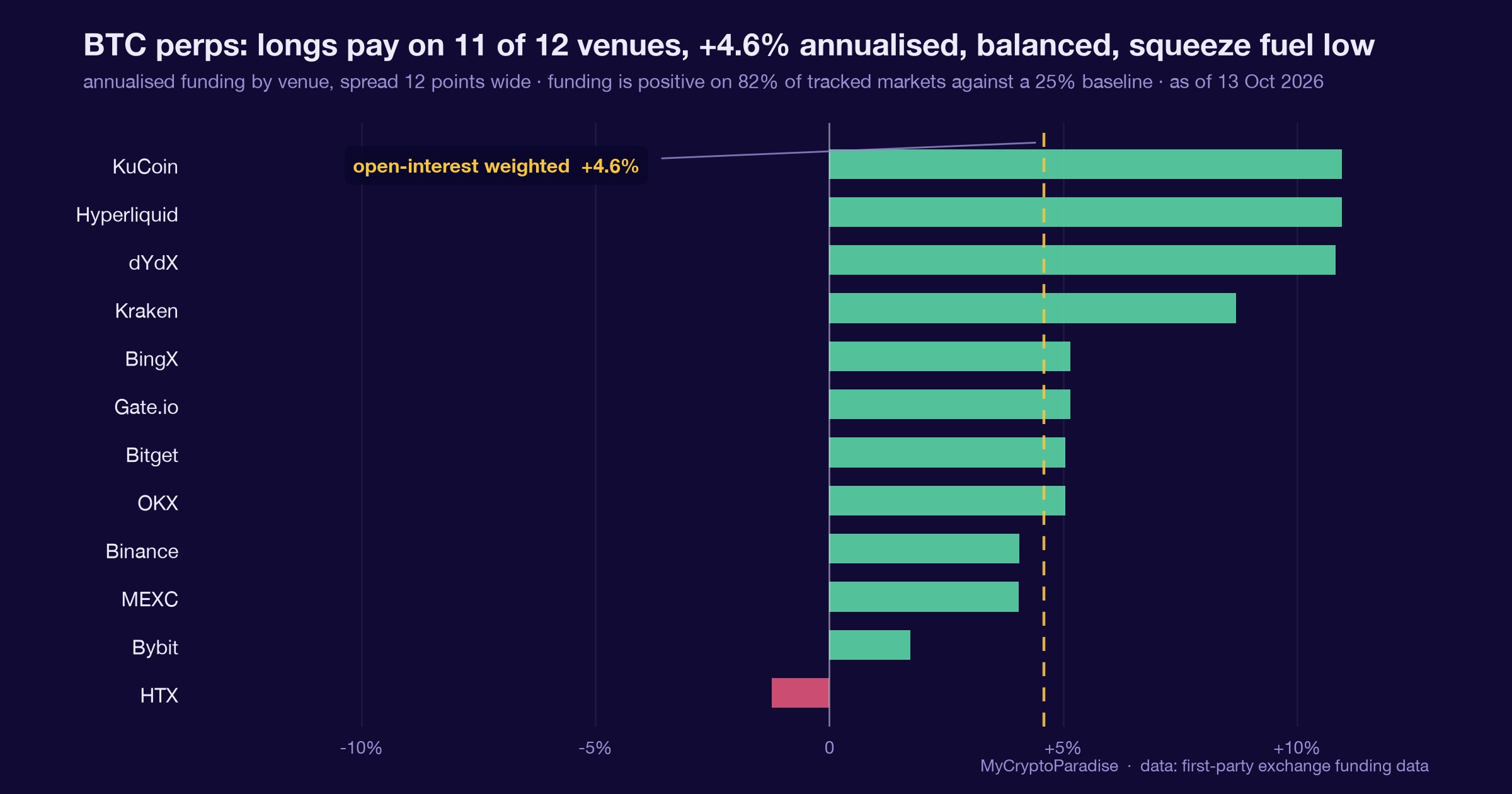
The crowding signals matter more than any headline right now. Funding rates are turning positive and long-squeeze probability is ticking up, which means longs are getting popular. Popular positioning is fragile positioning.
Invalidation of the constructive read is simple: a firm break of $62,500 with follow-through changes the near-term tone. Confirmation is a $65,500 reclaim that holds on a retest. Everything else, including recovered hack funds, is context, not signal. Trade the levels, not the news cycle.
Reading this hack recovery through smart money
The ParadiseTeam view is direct: the Bybit hack lawsuit is a reputational win, not a trading input. With BTC near $65,170, the story does not shift a single level on our map. Smart money treats it as noise and stays focused on structure and positioning.
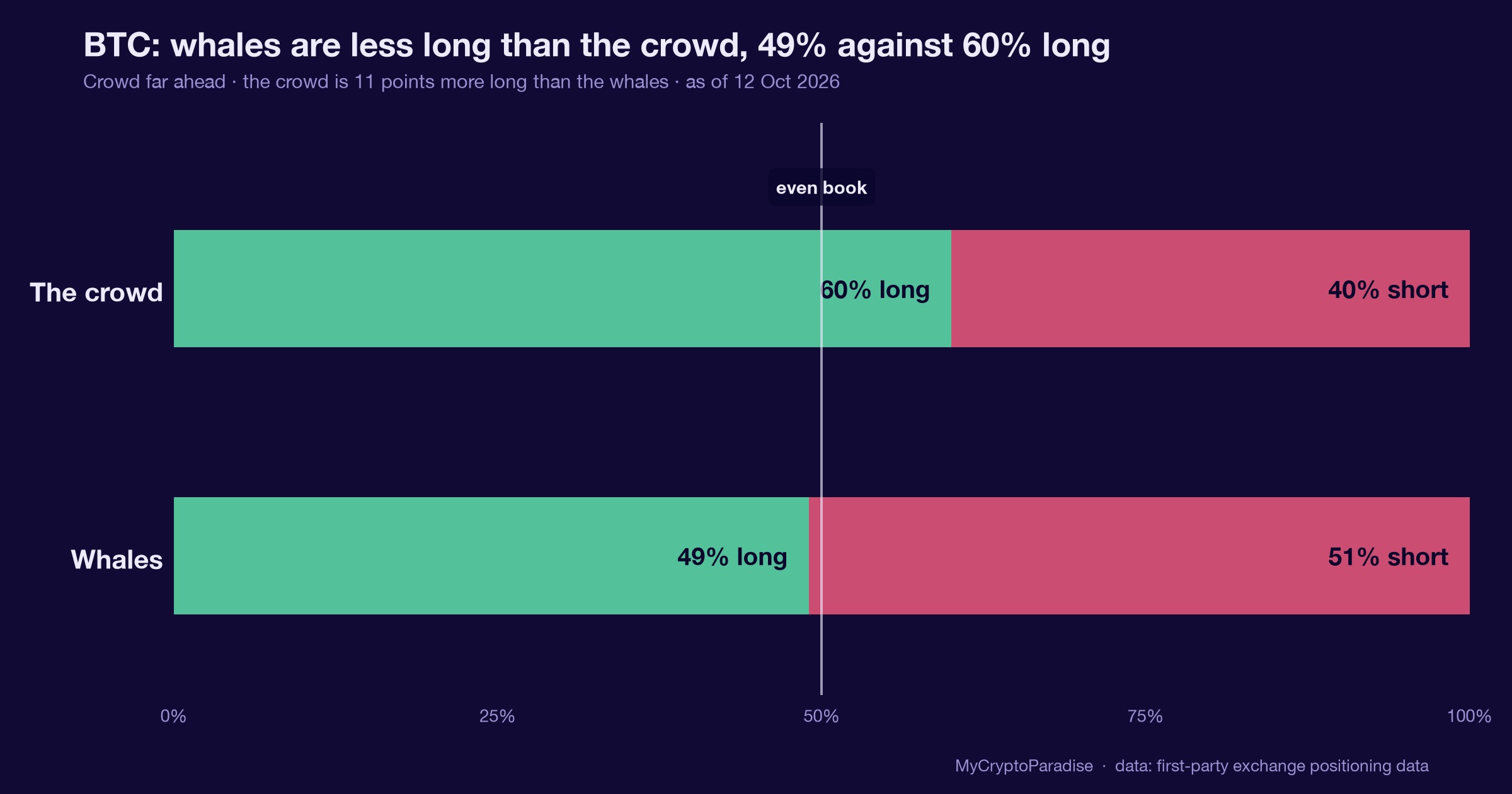
Here is what actually guides the read. The team has been accumulating on dips, with prior reaccumulation around $61,000, while retail crowds into longs as funding turns positive. That imbalance, not a courtroom win, is where the next move is built.
The pivot remains $65,500, the level that separates long continuation from more chop. A reclaim that holds supports a push toward the $68,000 to $69,000 area. That upper zone is where we get cautious, because a stretched fifth wave into crowded longs is prime distribution territory.
On the medium-timeframe view, the weekly map still carries a path toward a deeper $44,000 flush where smart money expects to reaccumulate. That is the level where poorly managed longs tend to capitulate. Professionals plan for that black swan rather than assume it away.
So the ParadiseTeam read on this specific event is to file it and move on. It does not change who is trapped or where stops sit. Defend $64,700 to $64,300, respect $69,000 as a caution zone, and let positioning, not headlines, tell you when the crowd is offside.
Track it live: our live crypto funding rates and the crypto liquidation heatmap both update in real time, so you can watch this shift for yourself.
Related coverage
For exact entries, targets, and stop losses with full risk management, that is what ParadiseFamilyVIP is for. New to reading these moves? Start with our crypto trading strategies guide.
ParadiseTeam is monitoring the market situation closely, and we are taking these developments into consideration while building our trading tactics inside ParadiseFamilyVIP.
Crypto trading involves substantial risk. Prices are volatile and you can lose money. This article is educational and is not financial advice. Past performance does not guarantee future results.
Where does BTC go next from the mid-65Ks?
This is how the Paradisers are calling it. Tap your call.
No calls on this one yet. Tap yours to be the first.
Free account, no password. Members just sign in.






Join the discussion
No comments yet. Members, share how you are reading this.