

Listen: the breakdown
Market briefing: A new Aave governance thread argues its per-asset liquidation model undercounts correlated co-liquidation risk by 301 times, landing as caps rise and a Kraken-parent stake arrives. BTC was near $75,141 as of the update.
- Aave forum thread argues the per-asset model undercounts co-liquidation risk by 301x
- Risk Stewards move to lift the USDC borrow cap and the USDe supply cap on Core
- Kraken parent Payward takes a stake as liquidations run hot market-wide
A fresh Aave co-liquidation risk thread says the protocol's own math understates correlated blowups by 301x, right as caps rise and institutions arrive. Latent fuse or noise?
A new Aave governance thread lands with an uncomfortable headline number. It argues the protocol's liquidation engine understates correlated co-liquidation risk by 301 times. The claim is technical, but the implication is not. If multiple linked collateral assets unwind together, the model may wave them through as safe.
Here is the mechanism. Aave V3 scores liquidation risk per asset. Each collateral gets its own maximum loan-to-value and its own liquidation threshold, set independently. The health factor treats those positions as separate boxes. The thread's point is that in a sharp, correlated drawdown, the boxes fall together, and the math never saw it coming.
Timing is the story's edge. Aave's Risk Stewards are moving to raise the USDC borrow cap on Core from 2.6 billion toward 2.75 billion, and the USDe supply cap from 550 million toward 750 million. More cap means more leverage surface, arriving as a researcher questions the gauge measuring it.
The backdrop is busy too. Since April 2025 the Aave DAO has spent roughly 42 million dollars buying back AAVE, acquiring over 205,000 tokens, about 1.28 percent of the 16 million supply by February 2026. That buyback budget was trimmed in March on softer fee income. Separately, Payward, Kraken's parent, took a stake in AAVE.
So institutional money arrives while the risk engine gets questioned. The protocol is not on fire. It is being asked, politely, whether its smoke detector works.
Why a per-asset model can miss correlated blowups
The transmission runs through one word: correlation. Aave scores each collateral asset on its own. That is tidy in calm markets, where assets drift apart. It is dangerous in a crash, where everything falls at once and the separate risk boxes collapse into one.
The 301x figure is the thread's estimate of that gap. We treat it as the researcher's claim, not settled fact. But the direction is the part traders should sit with. A model that assumes independence will almost always underprice a day when nothing is independent.
This matters more because the leverage surface is growing. Raising the USDC borrow cap and the USDe supply cap lets more capital sit on the same rails. Bigger caps are a bet on confidence. They work beautifully until the one correlated shock the model discounts actually arrives.
Layer in the institutional read. A Kraken-affiliated stake gives a well-connected group exposure without taking the protocol over. That is a vote of confidence in the franchise, and franchises price risk through models exactly like this one.
So the stakes are structural, not sentimental. If the critique is right, a single correlated drawdown could trigger liquidation cascades larger than the health-factor math expects. The flaw only shows up under stress, which is the worst possible time to discover it. For now it is a question in a forum, not a loss on a balance sheet.
Why this stays a DeFi credibility question for now
On its own facts, this does not move BTC. There is no confirmed link between the forum post and any price action. It reads as a credibility question for Aave's risk engine, not a catalyst, so we score it neutral for crypto.
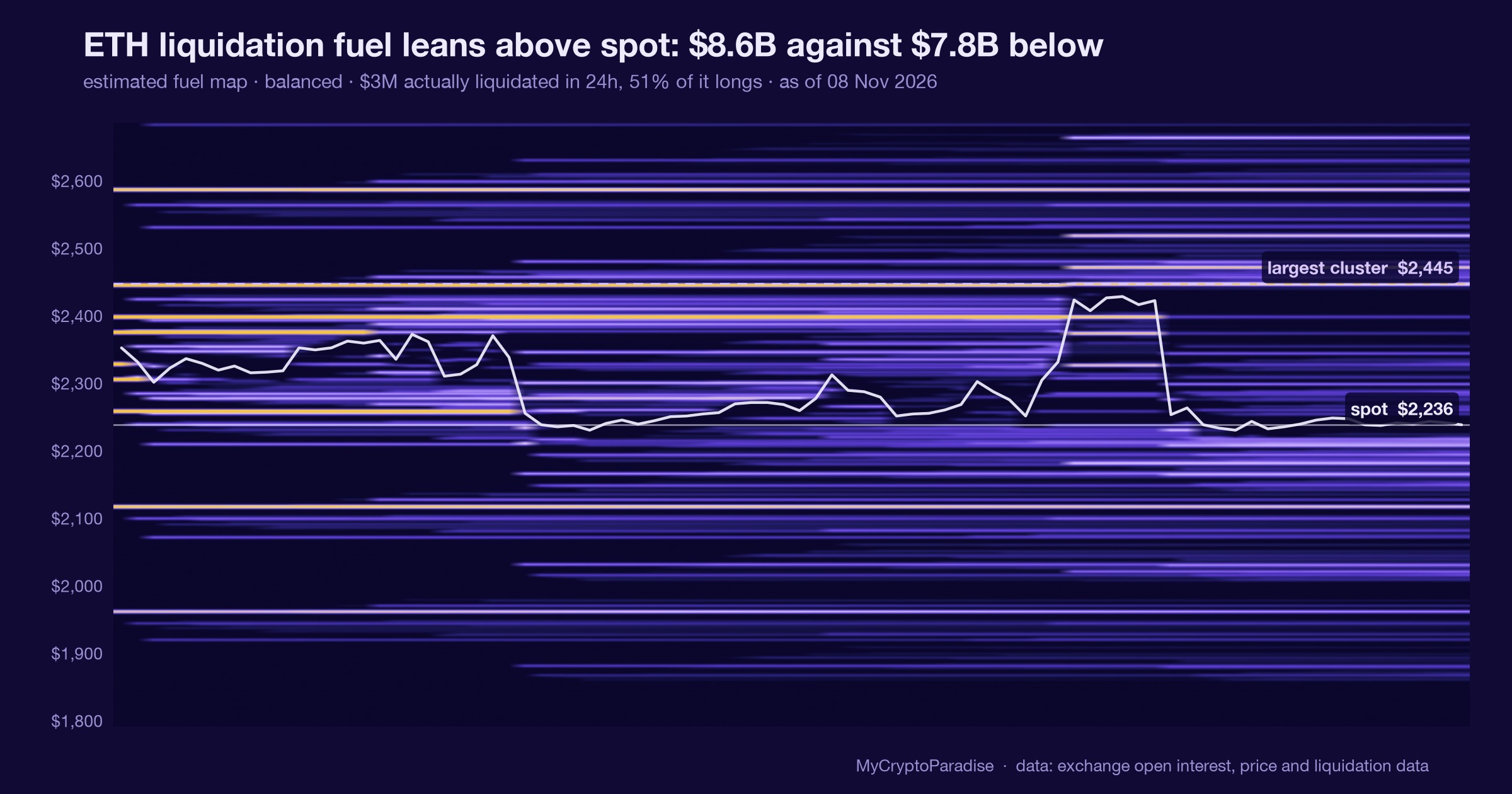
The liquidation pressure in the market is real, but it is broader than Aave. Over a recent four-hour window, ETH liquidations outran BTC, roughly 358 million dollars against 233 million. ETH was down about 4.1 percent on the day while BTC held firmer. That pattern points to general deleveraging, not an Aave-specific break.
Work down the risk ladder. BTC and ETH feel this only as background noise. AAVE and other DeFi-linked alts carry the governance and credibility weight, because the question is about their plumbing. If confidence in the risk model wobbles, it is these tokens that wear it first.
The cap increases cut both ways for sentiment. More room for USDC and USDe signals growth and demand. It also means a larger stack of leveraged positions resting on the exact model now under scrutiny.
The honest read is that this is a latent structural flag, not confirmed positioning by anyone. We see no clean sign of distribution or accumulation around the disclosure itself. It sits in the system as unpriced risk, waiting for a correlated move sharp enough to test whether the health-factor math holds.
The correlated drawdown that would test the math
The confirmation this story needs is a sharp, correlated drop. That is the only real test of the thread's claim. Independent dips will not stress the model the way a broad, synchronized flush would. Watch for a day when BTC, ETH and major collateral fall together.
Liquidation flow is the tell. The gathered data flags that a BTC move below 72,535 dollars could drive cumulative long liquidations toward 598 million on major exchanges. A cascade like that, hitting correlated collateral at once, is precisely the scenario the per-asset model is accused of underpricing.
Invalidation of the worry is quieter. If caps keep rising, leverage keeps building, and markets chop without a correlated shock, the flaw simply stays theoretical. A model can be wrong for a long time before the market ever collects on it.
Governance is the second thing to track. Watch whether the thread gains traction, whether Risk Stewards adjust parameters in response, or whether the cap increases proceed unchanged. The DAO's reaction tells you how seriously insiders take the 301x number.
Keep the buyback in view as a sentiment gauge. The budget was trimmed in March on weaker fees. Renewed spending would signal confidence; continued restraint signals caution. None of this is a price trigger today. It is a map of where the pressure would show first if the next correlated drawdown arrives before the model is fixed.
What the risk flag means for DeFi positioning
The ParadiseTeam reads this as a structural flag, not a trade trigger. BTC was trading near 75,141 dollars as of the update, just under the 76,000 support we treat as the line in the sand. This Aave thread changes nothing about that level directly. It adds to the list of things that break worse if 76,000 fails.
Our standing map still rules the price action. Below sits the 70,000 to 71,000 liquidation pocket; above sits the 81,700 to 82,500 cluster where shorts are stacked. Whales have been quietly buying this dip and absorbing sell pressure, which keeps a short-squeeze toward 82,000 on the table before any deeper leg.
Here is where the two stories meet. The brief flags that a BTC loss of 72,535 could unleash around 598 million in long liquidations. A flush like that is exactly the correlated event this thread warns Aave's model underprices. So the DeFi risk is dormant now and most dangerous on the same break we already watch for.
Practical posture: treat AAVE and DeFi-linked alts as higher-beta to any correlated deleveraging, not as a fresh short on this news alone. The honest truth is that this story points at a fuse, not a flame.
We stay risk-first. Strength into 82,000 can still meet selling, and our dominant daily bias stays heavy toward lower levels until 76,000 is reclaimed and held.
The read behind this: we framed this story through our own market analysis, Bitcoin Squeeze to $82K or Crash to $44K?
Track it live: our live crypto funding rates and the Crypto Fear and Greed Index both update in real time, so you can watch this shift for yourself.
Related coverage
For exact entries, targets, and stop losses with full risk management, that is what ParadiseFamilyVIP is for. New to reading these moves? Start with our crypto trading strategies guide.
ParadiseTeam is monitoring the market situation closely, and we are taking these developments into consideration while building our trading tactics inside ParadiseFamilyVIP.
Crypto trading involves substantial risk. Prices are volatile and you can lose money. This article is educational and is not financial advice. Past performance does not guarantee future results.
Does the next correlated BTC and ETH drop expose Aave's co-liquidation gap?
How 2 Paradisers are calling it
The first call is still open
Free account, no password. Members just sign in.
Follow this topic: Crypto liquidation news







Join the discussion 1
lol the 301x number is the part that gets me, cause in my old shop we had a saying that a tolerance you never measured is the one that bites you.... aave's caps going up with everything tied together feels like that. buddy from the shop saw it too late in '21 and i still think about that.