

In short
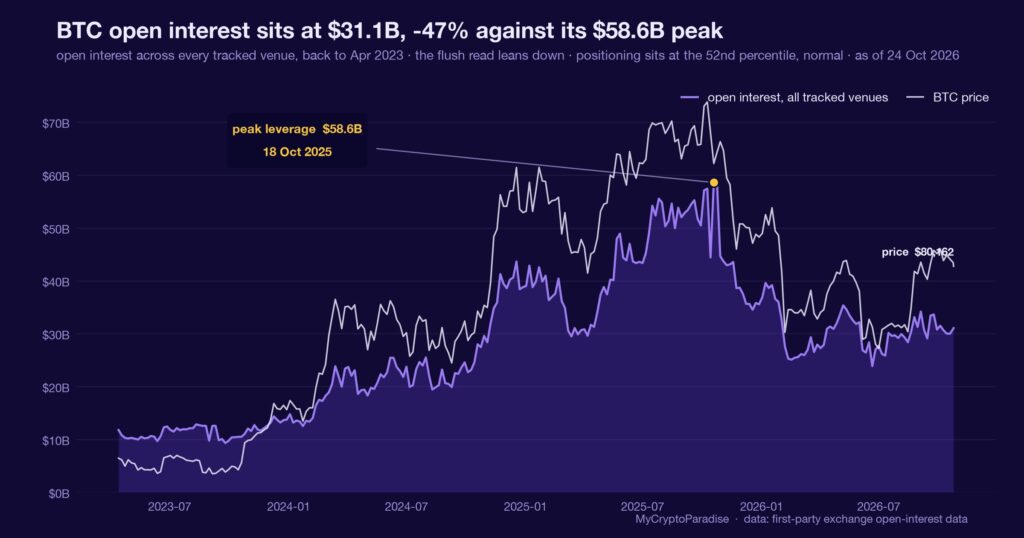
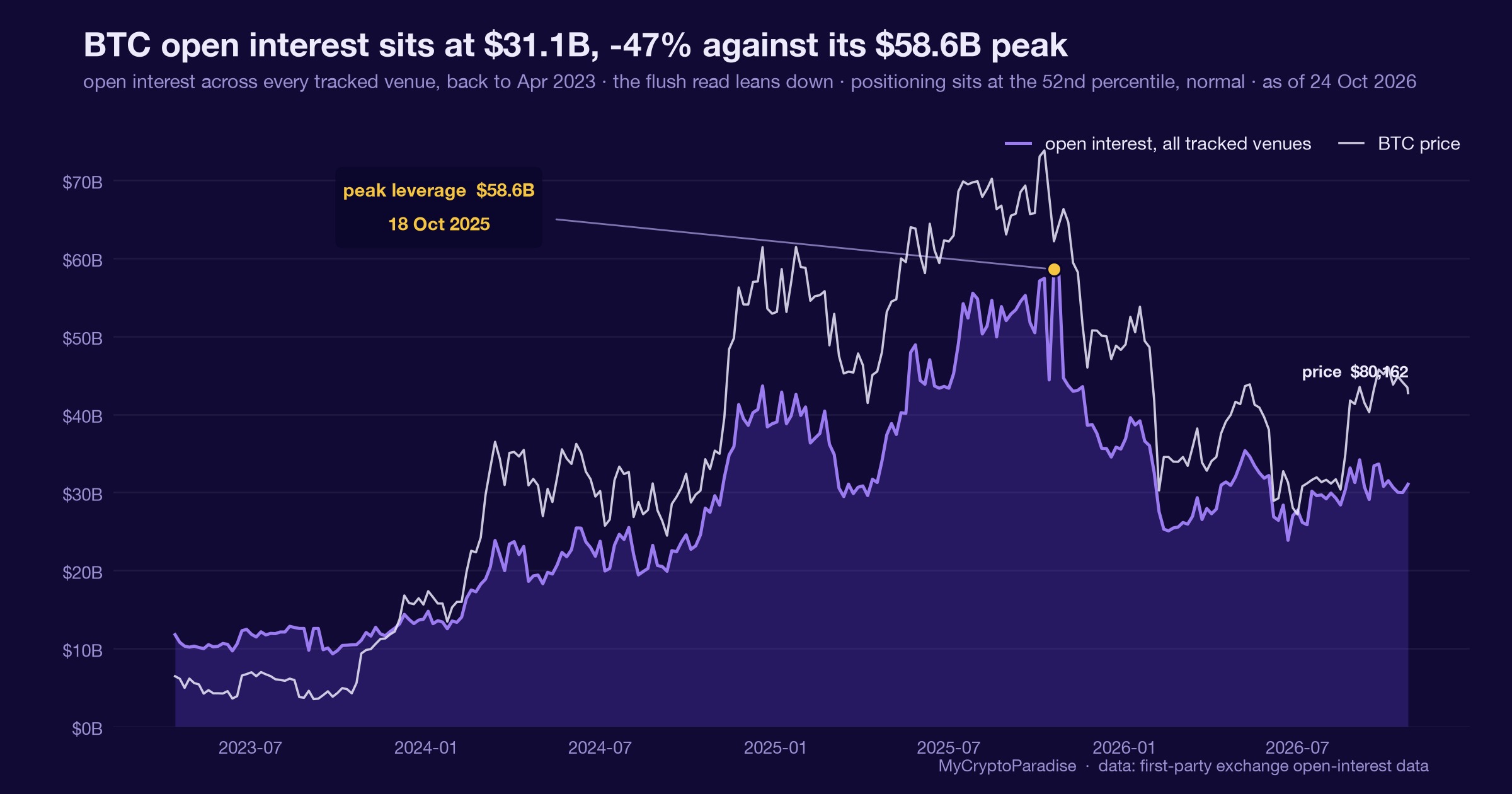
Open interest (OI) is the total value of derivatives contracts left open, and a rising OI means traders are adding positions rather than closing them. On 24 October 2026 the Insider feed logged roughly $41.6 billion combined across Bitcoin, Ethereum and Solana; our own recon reads higher, near $31.0 billion on Bitcoin alone, so we flag it as a model estimate and not a calibrated print. The series that is live, not estimated, is funding: Bitcoin longs pay shorts about 6.3 percent annualized, Ethereum about 6.8 percent, and breadth is split, 47 percent of tracked pairs positive. We call this constructive, explicitly not crowded: risk appetite is returning without the froth that precedes a flush. No calibrated base rate is wired for OI-expansion regimes, so we quote no historical frequency. This piece shows you how to read open interest against funding yourself.
Key facts
- BTC spot at the reading
- $80,162
- BTC open interest
- $31.05B
- Where that sits in its own history
- the 52nd percentile, normal
- Long share of the build
- 67%
- What would prove this read wrong
- BTC funding accelerating well past the current 6.3 percent annualized into genuinely crowded territory, or open interest climbing while price stalls, which would load the fuel for a long flush.
- Reading taken
- 24 October 2026
- Source
- Our MCP Insights tools, from first-party exchange data
What open interest actually measures
Open interest (OI) is the total value of derivatives contracts that remain open, neither closed nor settled. When it rises, more money is committing to positions than is leaving them.
The number is direction-agnostic. A new long and the new short on the other side of the same contract both add the same open interest, so a rising figure tells you that conviction is building without telling you whose.
This is the trap in the headline. Open interest measures how much is at stake, never which way it points: a gauge of commitment is not a gauge of direction.
The reading on 24 October 2026
The Insider feed logged roughly $41.6 billion of combined open interest across Bitcoin, Ethereum and Solana: $23.4 billion on Bitcoin, about 56 percent of the total, $15.5 billion on Ethereum and $2.7 billion on Solana.
Our own recon reads higher, and we flag it honestly as a model estimate rather than a calibrated print: near $31.0 billion on Bitcoin and $18.1 billion on Ethereum, with spot around $80,160 and $2,342 respectively.
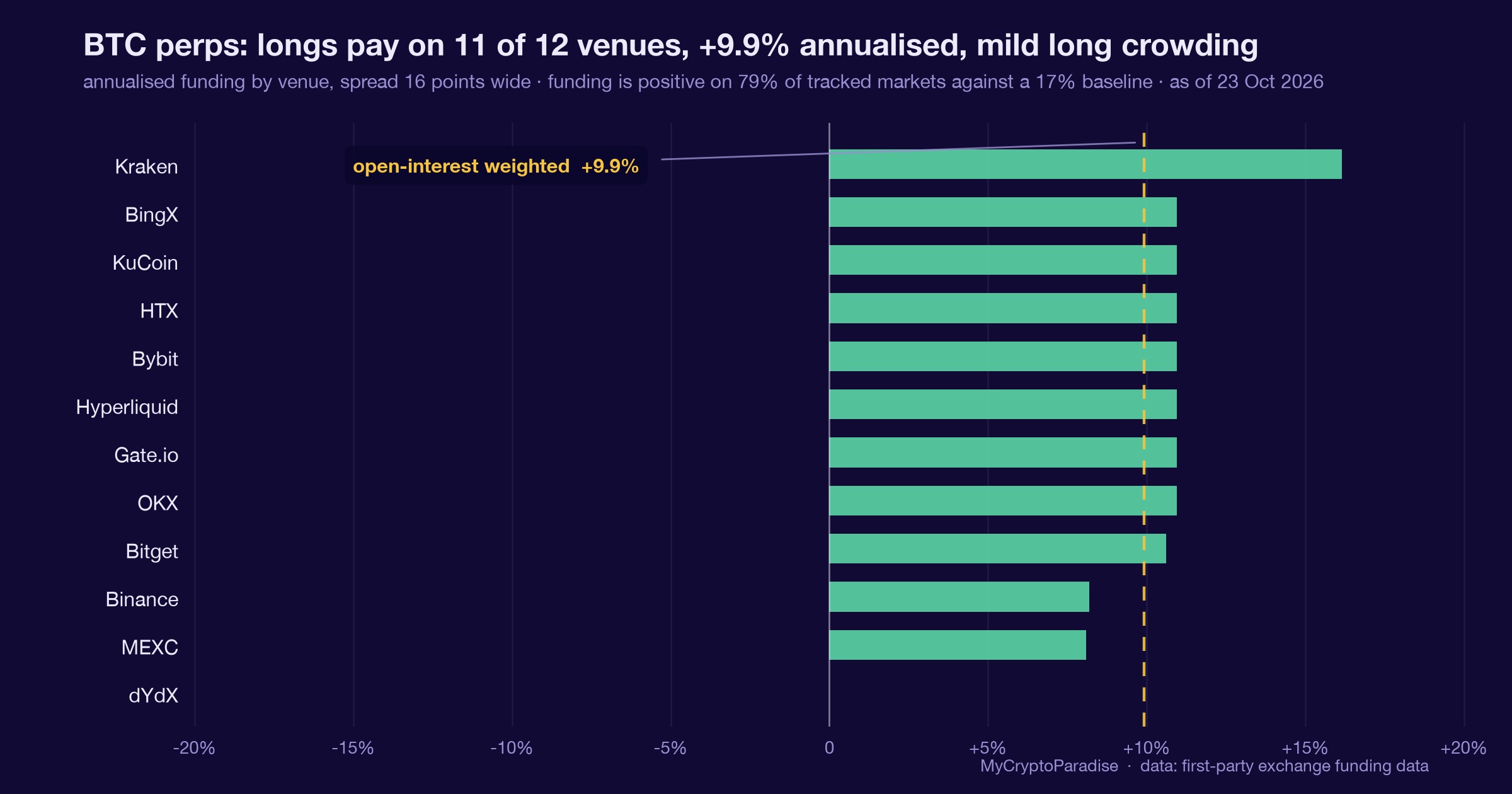
The series that is live rather than estimated is funding. Per our MCP Insights funding data, Bitcoin longs pay shorts about 6.3 percent annualized, Ethereum about 6.8 percent, and breadth is split: 47 percent of tracked pairs positive, a median of minus 0.61 percent, and Bitcoin basis at minus 0.05 percent.
The feed and our recon disagree on the size. They agree on the shape: more is open than a month ago, and the cost of holding it is still cheap.
Rising open interest is not confirmation
The common misread is to treat a rising OI as proof that a trend is real. It is not. Open interest expands just as fast while a crowd piles into the wrong side.
What separates a healthy build from a fragile one is the funding rate, the periodic payment between longs and shorts. Mild funding means the new positions are not yet paying dearly to exist; expensive funding means they are.
Today the payment is mild. A build that costs almost nothing to hold is early risk appetite, and early is the opposite of crowded.
What is different here
The ParadiseTeam does not read a rising open-interest number as a verdict. We pair it with the live funding regime, because the same expansion is healthy when funding is mild and fragile when it is crowded, and only the second series tells those two apart.
What the funding regime says the build is not
Both majors lean mildly long, Bitcoin at about 6.3 percent annualized, Ethereum near 6.8 percent. That is a lean, not a crowd: the froth that precedes a flush shows up as double-digit or triple-digit funding, and it is absent here.
Breadth matters more than the majors. With 47 percent of pairs positive and the median funding slightly negative, the broad tape is balanced to faintly short, not stampeding in one direction.
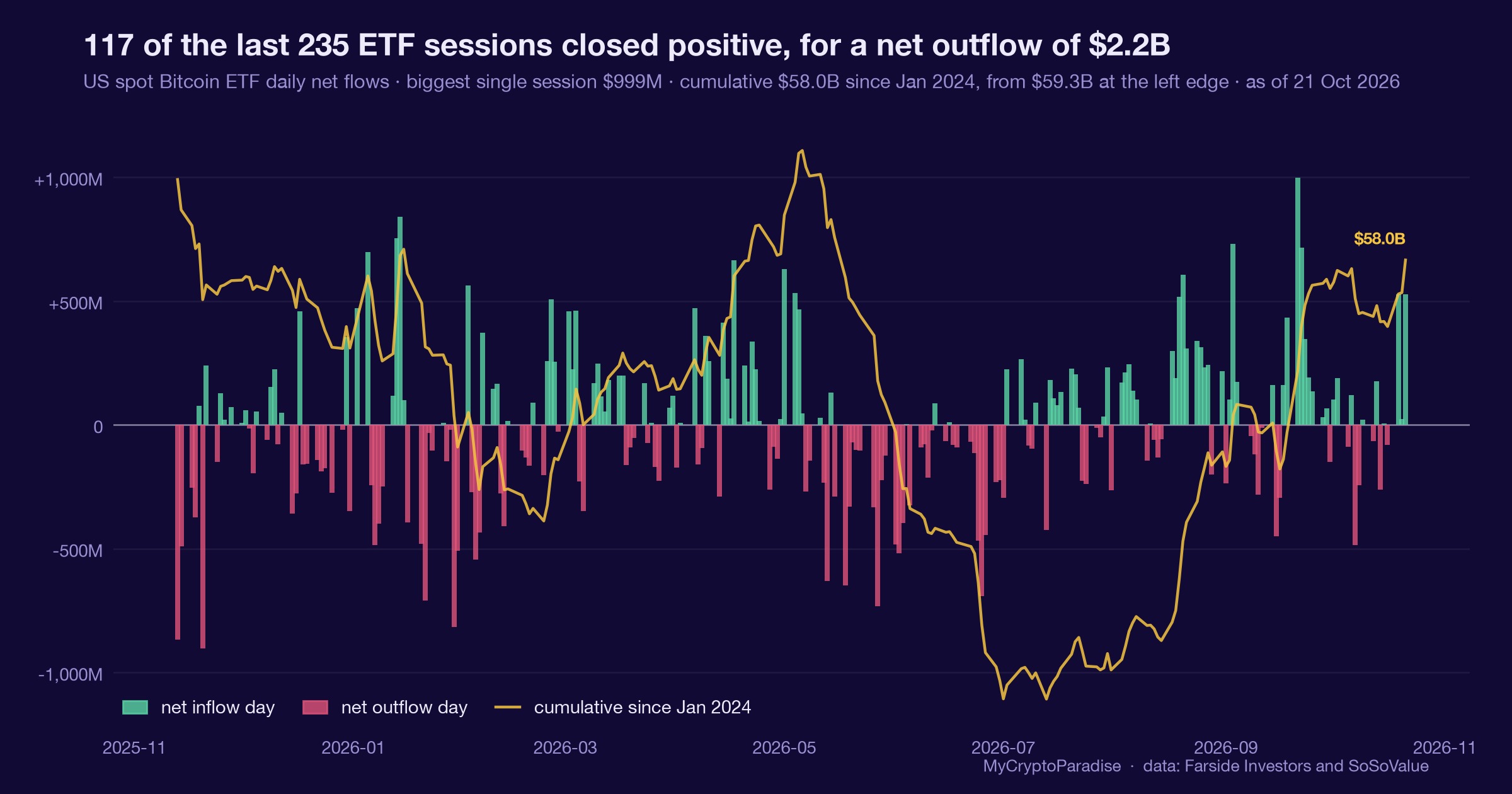
This is one input. It sits beside spot volume, order-flow absorption and the breadth read, and the rest of those layers live in PRO Paradiser.
A rebuild without crowding is the healthiest kind, and the least dramatic. It rarely makes a headline, which is exactly why it is worth reading.
Where the rebuild turns into fuel
The build becomes dangerous in one specific way: when open interest keeps climbing while price refuses to advance. That combination means leverage is stacking into a wall, and stacked leverage is liquidation fuel.
Funding is the tripwire. If the mild 6.3 percent accelerates into genuine crowding, the new longs become the cheapest coins for the market to hunt, and a spot stall is all it takes to start a cascade.
Leverage that no one is paying much to hold is quiet. Leverage that everyone is paying heavily to hold is loud, and loud is when it gets taken.
Reading open interest against funding yourself, step by step
- Pull aggregated open interest for BTC and ETH and note whether the dollar total is rising or falling week over week.
- Check the live funding rate beside it: positive means longs pay shorts, negative means shorts pay longs.
- Read the magnitude, not just the sign: a mild 6 percent annualized is early risk appetite, not crowding.
- Scan breadth across pairs, not only the majors, because a split tape says the leverage is not yet one-sided.
- Watch for open interest climbing while price stalls: that silent build is how liquidation fuel loads before a flush.
Most people skip breadth and read only the Bitcoin funding number: a single mild print hides whether the whole tape is leaning the same way or splitting.
Every number above is checkable against the live data. Start with the aggregated open interest, then cross-read the live crypto funding rates and the MCP Insights hub.
Act and invalidate
| Scenario | What confirms it | What kills it |
|---|---|---|
| Healthy rebuild continues | Funding stays mild, spot volumes rise | Funding spikes into crowding |
| Hollow OI, flush risk | Open interest rises, price stalls | Spot demand confirms the bid |
| Range, no edge | Breadth stays split | Majors and breadth align one way |
Posture: Constructive while funding stays mild and breadth split: this is a lean worth one line of risk, not a position. Treat accelerating funding as the tripwire.
Frequently asked questions
What does rising open interest tell you?
Rising open interest means traders are opening more derivatives contracts than they are closing, so money is committing to positions. It signals building conviction, but not its direction: both the new long and the matching new short add the same open interest.
Is high open interest bullish or bearish?
Neither on its own. Open interest measures how much leverage is in the market, not which way it leans. To read the side you pair it with funding: positive funding says longs dominate, negative says shorts, and the magnitude says how crowded.
Why does funding matter for open interest?
Funding is the periodic payment between longs and shorts, and it prices the crowd. A large and rising open interest with mild funding is early risk appetite; the same open interest with expensive funding is a crowded trade that can be flushed.
What counts as a mild funding rate?
There is no fixed line, but single-digit annualized funding, like the 6.3 percent on Bitcoin on 24 October 2026, is mild: positions cost little to hold. Double-digit or triple-digit annualized funding is where crowding and flush risk usually begin.
Can open interest predict a liquidation flush?
Not by itself, but it flags the setup. When open interest climbs while price stalls and funding grows expensive, leverage is stacking into a wall. That is the fuel a flush needs, though the trigger and timing remain unknowable in advance.
Crypto trading involves substantial risk and is not suitable for everyone. Nothing here is financial advice; it is education only. Never risk more than you can afford to lose.
The private Extras feed, where the open-interest rebuild, the live funding regime and the breadth split update intraday with invalidation levels attached, is part of PRO Paradiser, the intelligence layer behind the ParadiseFamilyVIP strategies.









Join the discussion
No comments yet. Members, share how you are reading this.