

Listen: the breakdown
Developing story update (October 14, 2026, 10:34 UTC):
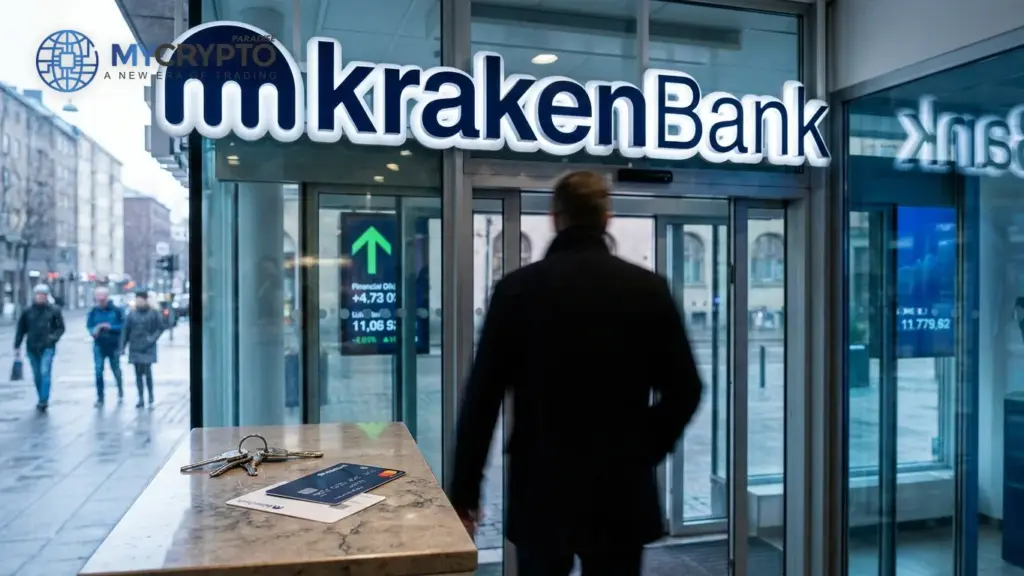
Kraken Owner Payward to Buy Lithuania's Saldo Bank in EU Push. Co-CEO Arjun Sethi says customers want cash, crypto, tokenized stocks and credit in one place, starting with lending and cards.
Developing story update (October 14, 2026, 10:23 UTC):
Kraken Owner Payward to Buy Lithuania's Saldo Bank in EU Push
Market briefing: Kraken's parent Payward is buying Saldo Bank, an EU-regulated Lithuanian lender, to add lending and card issuance. BTC sat near $83,216 and barely moved, treating this as a long-horizon story, not a catalyst.
- Payward, Kraken's parent, plans to acquire EU-regulated Saldo Bank in Lithuania, with a close expected in 2027.
- The deal targets traditional banking services, specifically lending and card issuance, layered onto the exchange.
- In the same stretch, Payward secured full Dubai VARA approval, pointing to a multi-jurisdiction bank-rail strategy.
The Kraken bank acquisition sees its parent Payward buying an EU-regulated lender in Lithuania. So is the exchange-to-bank roadmap finally arriving in real time?
Kraken's parent company, Payward, is acquiring Saldo Bank, an EU-regulated lender based in Lithuania. The stated purpose is plain: to build traditional banking services, specifically lending and card issuance, directly into the Kraken orbit. This is a structural move, not a trading one. The deal is expected to close in 2027, which tells you how to read it. A 2027 closing date is a corporate milestone, not a catalyst for this week's tape.
The Kraken bank acquisition does not sit in isolation. In the same stretch, Payward secured full approval from Dubai's Virtual Assets Regulatory Authority, clearing it to operate as a regulated virtual asset service provider ahead of a UAE launch. So within days, the group has layered an EU bank charter ambition on top of a fresh Dubai license. That is two continents, two regulatory frameworks, one direction of travel. The company is assembling licensed financial-services rails around the exchange rather than running purely as a trading platform.
The backdrop helps. Payward reported adjusted revenue of $508M in its most recent quarter, up 17% year on year, with growth broadening beyond crypto spot trading. A business that already earns outside spot is a more natural buyer of a bank than one that does not.
One small wrinkle is worth noting for accuracy. One account referred to the target as 'Soldo Bank' rather than 'Saldo Bank', a naming discrepancy across reports. We flag it rather than paper over it, because precision matters more than a clean sentence.
Building a licensed bank rail around the exchange
The transmission mechanism here is regulatory, not monetary. An exchange that owns a bank can offer lending and card issuance under a recognised charter, which deepens the integration between crypto trading and ordinary finance. That matters structurally because it changes what an exchange is. For years the model was simple: match buyers and sellers, hold custody, charge fees. Owning bank-grade infrastructure turns the exchange into something closer to a financial institution, with its own regulated balance-sheet activities.
Europe is the chosen stage for a reason. An EU bank charter carries passporting potential and a credibility that a crypto license alone does not. Pair that with the Dubai VARA approval, and the shape becomes clear: regulated rails in multiple jurisdictions, not a single market bet.
There is a broader pattern at work. Major exchanges increasingly want to acquire regulated banking plumbing rather than operate purely as trading platforms. Each such deal incrementally reinforces the legitimacy narrative that institutions use to justify allocation.
We will be honest about the limits. This reinforces a narrative; it does not move a flow. There is no new buyer of BTC created here, no supply removed, no liquidity injected. The legitimacy story is real and slow, and slow stories rarely show up on a daily candle.
So the significance is cumulative. One deal is a headline. A decade of deals is an industry quietly changing what it is allowed to do, which is the part worth tracking for the long game.
A flat tape meets a structural story
Start with the tape, because it tells the truth. BTC was trading near $83,216, down roughly 0.4% on the day, as of the figures in front of us. ETH sat near $2,497, down about 0.5%. Neither flinched.
That non-reaction is the signal. When a corporate headline lands and the two largest assets do not move, the market is telling you it has not priced this as a near-term driver, and it is right not to.
Follow the usual chain and it breaks early. The driver is a bank acquisition, the macro effect is slow legitimacy, and there is simply no liquidity effect to pass down. With no new flow, there is nothing to cascade into BTC, then ETH, then alts. So the honest read is that the liquidity cascade does not fire here. This is not a story that forces stops, drains or adds leverage, or reprices a level.
For exchange-token or Kraken-adjacent exposure, the long-term case is incrementally sounder; a diversified, bank-backed parent is a more durable counterparty. But durability is not a price catalyst, and markets pay for catalysts, not for soundness.
The quiet absence of retail and social chatter confirms the point. Nobody is positioning around a 2027 close. There is no crowd to trap and no crowd being trapped. That leaves the verdict neutral by construction. The event is real, forward-dated, and strategically meaningful, yet it carries no discernible flow implication for crypto over the days-to-weeks horizon that this tape actually trades.
The 2027 clock and the license milestones
The confirmations on this story are regulatory, not technical. Watch for the deal to clear its approvals and actually close toward 2027, because a planned acquisition and a completed one are different animals.
The first real milestone is the live product. Lending and card issuance moving from press release to shipped service would turn the ambition into revenue, and that is where the narrative earns its keep.
Watch the follow-through across jurisdictions too. If Payward pairs the EU charter with its Dubai VARA license to roll out services in both regions, the multi-continent rail thesis confirms itself in public.
The invalidation path is just as instructive. Regulatory friction, a renegotiated price, or a quiet shelving of the deal before 2027 would tell you the bank-rail roadmap is harder than the announcement suggests. Plans slip; that is the base rate, not a surprise.
For the broader sector, the thing to watch is replication. One exchange buying one bank is an event. Several exchanges buying banks is a trend, and trends are what eventually reprice an industry's multiple.
On the actual tape, there is little to watch tied to this specific news, and we will not pretend otherwise. BTC and ETH will trade on liquidity, positioning, and larger macro, not on a Lithuanian bank charter dated years out. So the discipline is to file this correctly. Track it as a structural adoption story with clear future checkpoints, and resist the temptation to attach it to any short-term move it did not cause.
Placing the news against a low-leverage support
The ParadiseTeam files this as context, not a catalyst. It changes nothing about the levels that actually matter on Bitcoin right now, and pretending otherwise would be noise dressed as insight.
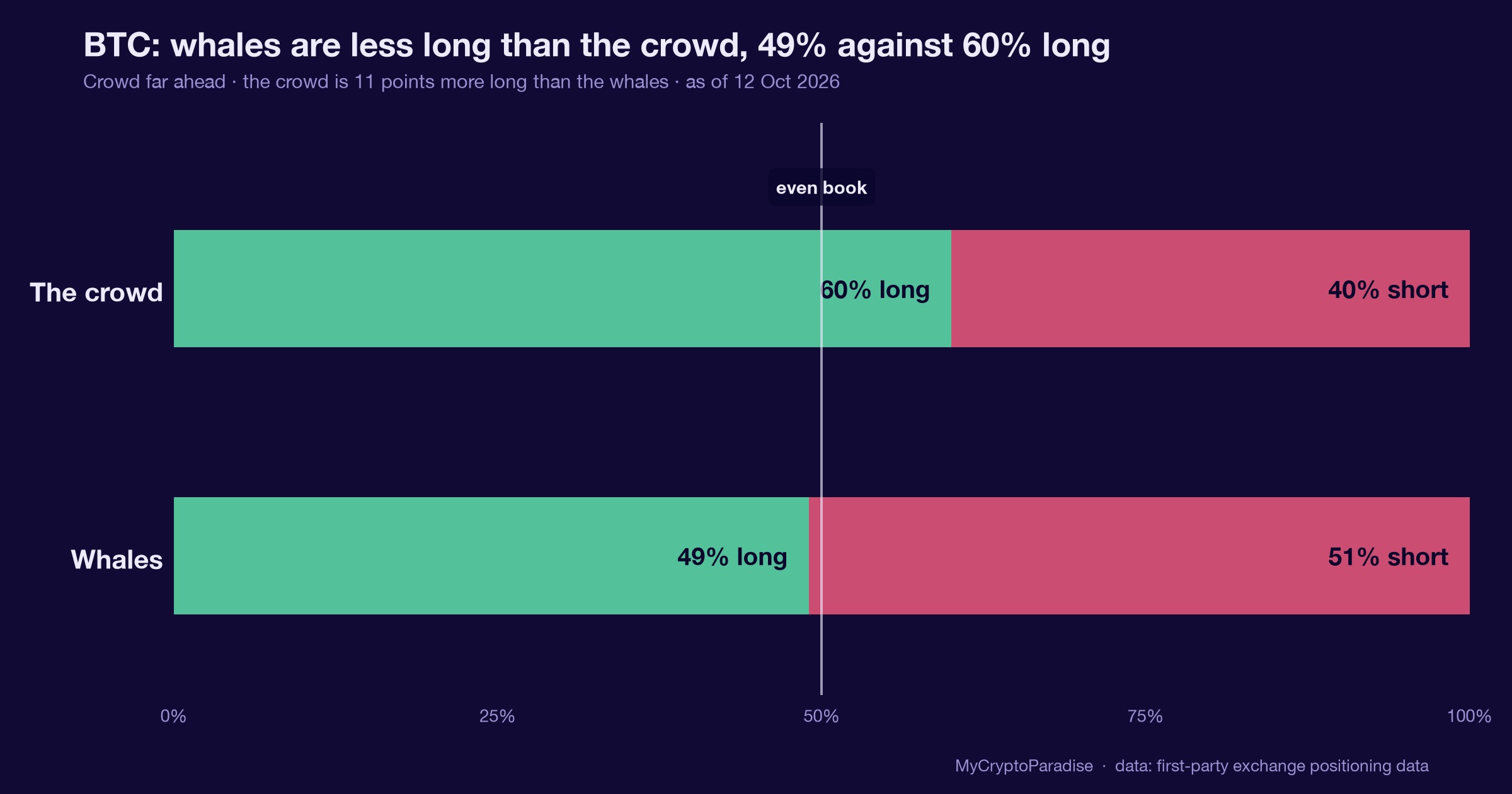
Against our current lens, BTC near $83,216 sits just above the defended $82,000 support, with $82,300 acting as a whale entry and support zone and $81,000 marking the lower boundary. A bank acquisition dated 2027 does not touch any of those lines.
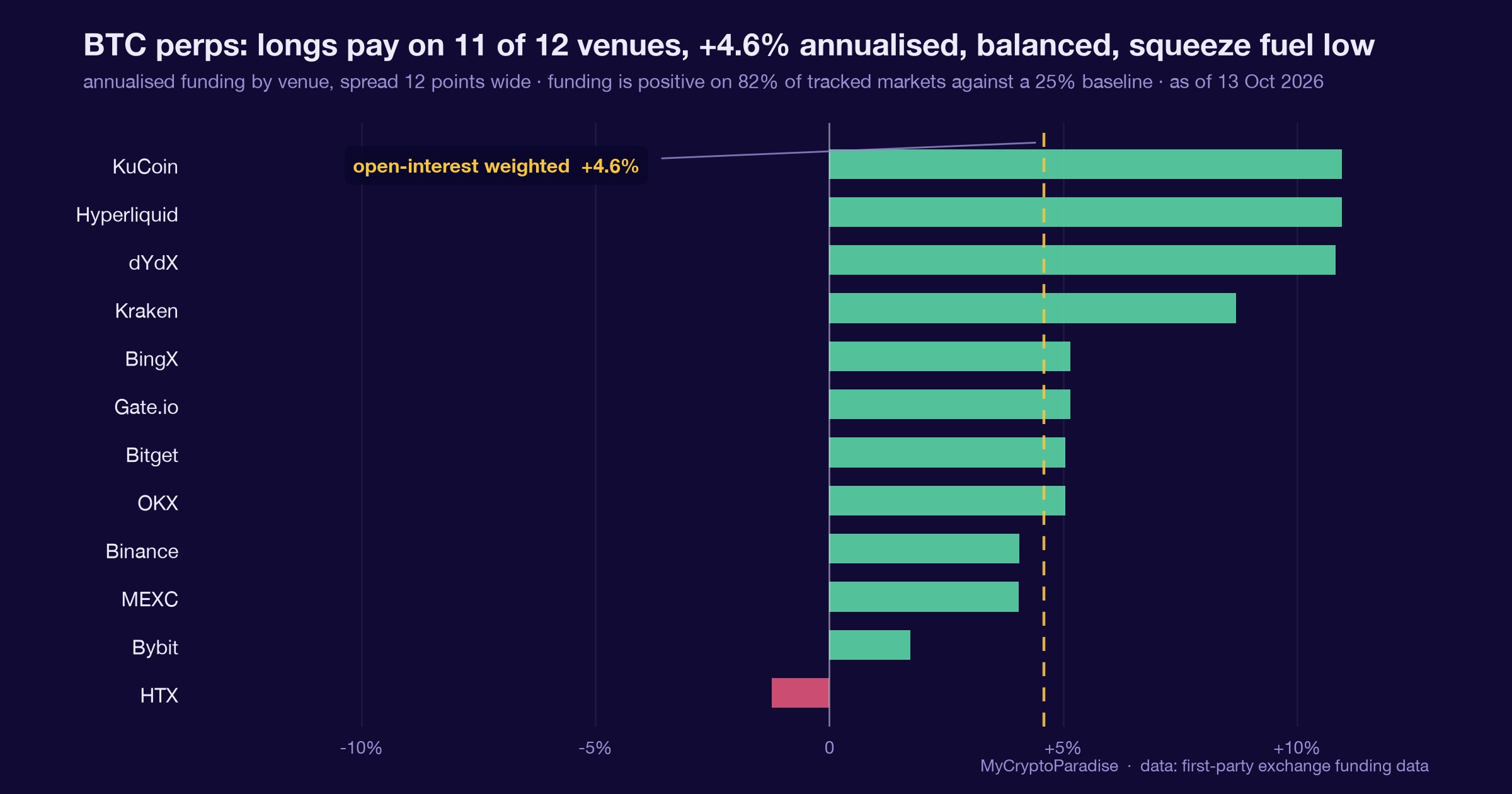
What we do find constructive is the surrounding structure, and it exists independent of this headline. Open interest sits near an all-time low and funding rates are at a 90-day baseline, which historically marks a low-leverage, uncrowded tape. That is the kind of backdrop where whale accumulation can work without a frothy crowd fighting it.
So our standing read stays short-term constructive while $82,000 holds, with eyes on $84,000 as the prior high and $84,500 as a nearer upside marker. The real test remains higher, around $90,000, where we see a meaningful probability of rejection.
Here is the caution, and it is a general one, not drawn from this story. Strength into a major resistance like $90,000 is exactly where good news tends to meet selling. We would respect that level far more than any legitimacy narrative.
Bottom line from the ParadiseTeam: trade the structure, not the press release. This deal strengthens the long-term adoption case; it does not give you an edge on the next move, and we will not manufacture one.
The read behind this: we framed this story through our own market analysis, Bitcoin at $82K: Can Bulls Defend It?
Track it live: our live crypto funding rates and the crypto liquidation heatmap both update in real time, so you can watch this shift for yourself.
Related coverage
For exact entries, targets, and stop losses with full risk management, that is what ParadiseFamilyVIP is for. New to reading these moves? Start with our crypto trading strategies guide.
ParadiseTeam is monitoring the market situation closely, and we are taking these developments into consideration while building our trading tactics inside ParadiseFamilyVIP.
Crypto trading involves substantial risk. Prices are volatile and you can lose money. This article is educational and is not financial advice. Past performance does not guarantee future results.
Will exchange-owned banks become normal across the industry by 2027?
This is how 4 Paradisers are calling it. Tap your call.
No calls on this one yet. Tap yours to be the first.
Free account, no password. Members just sign in.






Join the discussion
No comments yet. Members, share how you are reading this.