

In short
Stablecoin exchange reserves are the dry powder behind spot buying: when they drain, incoming demand thins, and when they refill, buyers have fuel again. Our MCP Insights Coinbase premium data on 9 September 2026 reads a thin +0.01 percent premium that still sits in the 89th percentile of its own 90-day range, tilted to what we grade as institutional absorption. The on-chain feed we track reports Binance stablecoin reserves recovering, with the 90-day market-cap change improving from -17 percent to -1.6 percent and roughly $1.6 billion added over the month. We called this a constructive lean, explicitly not a confirmed liquidity return. Our earlier bearish stablecoin-flow read is now being tested by that refill. This piece shows you how to read stablecoin reserves and the premium yourself, and the level that would settle it.
Stablecoin reserves are stored demand
A stablecoin parked on an exchange is a buy order that has not happened yet. It is dollars staged next to the order book, waiting for a decision. When those balances swell, the fuel for spot bids is sitting there; when they drain off the venue, incoming demand has to come from somewhere thinner.
The Coinbase premium works alongside it as a tell for who is doing the buying. It measures whether US spot pays up relative to offshore, and a persistent bid there reads as patient accumulation rather than leveraged chasing.
Reserves say how much dry powder is staged; the premium says who is spending it. A vacuum that refills without a premium is retail catching a bounce; a refill led by the premium is something steadier.
Fuel in the tank and a hand on the throttle are not the same reading, and a demand recovery needs both.
The premium is buying what spot will not
Our MCP Insights premium data on 9 September 2026 puts BTC at roughly $77,900, with a Coinbase premium of just +0.01 percent. Thin on its face, that reading still sits in the 89th percentile of its own 90-day range, with a z-score of 0.87 and a tilt we grade as institutional absorption.
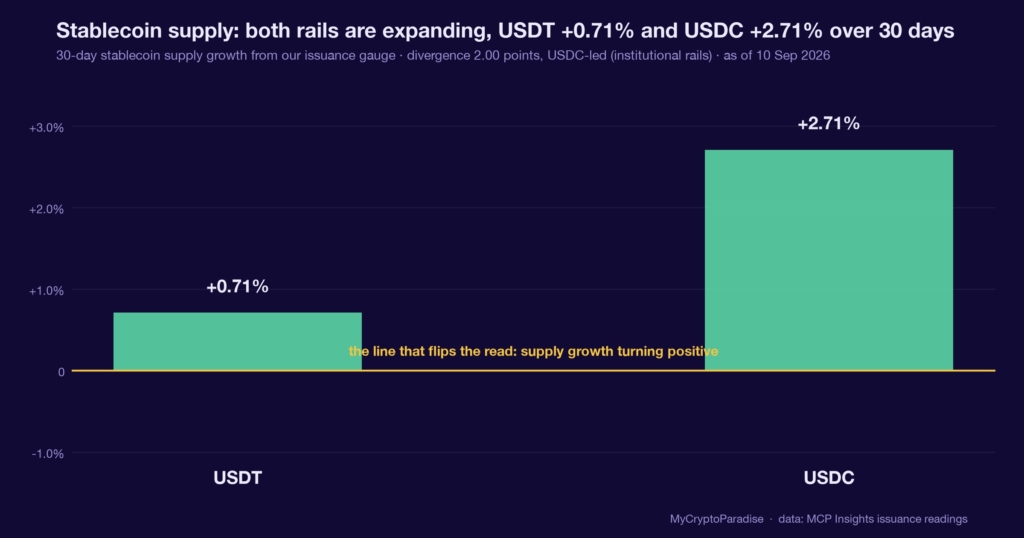
The issuance split points the same way. USDC supply has grown 2.71 percent over 30 days against 0.71 percent for USDT, a 2 percentage-point spread that our data reads as USDC-led, the institutional rails. The Korean leg is bid too, with a Kimchi premium of 1.66 percent.
The reserve side is where our confidence drops, because those figures come from the on-chain feed we re-narrate rather than our own series. That feed reports Binance stablecoin reserves down nearly $7 billion from a $50 billion-plus peak.
Even so, the 90-day stablecoin market-cap change has recovered from -17 percent to -1.6 percent, with about $1.6 billion added in a month. The feed also cites a daily relative strength index (RSI) of 67 and a 45 percent rebound off the low.
The premium and issuance are ours and they lean one way; the reserve recovery is borrowed and still shallow, so we weight them accordingly.
What is different here
The ParadiseTeam does not read a reserve refill as a buy button. We separate the borrowed number from our own: the reserve figures are re-narrated from an on-chain feed, while the premium and the issuance split are measured on our grid, so the two carry different weight in the call.
A refill is not a return
The easy misread is to treat any green print in reserves as the all-clear. A 90-day change of -1.6 percent is still negative: the demand vacuum is shallower, not filled, and a single positive month does not undo the drain since October.
Spot demand confirms the caution. The cumulative volume delta (CVD), which tracks whether market buys or sells dominate over time, is still neutral on its 90-day average, so the futures bid is doing the lifting while spot sits on its hands.
This is one input. It sits alongside funding, open interest and spot absorption, and today it is the reading that has stopped getting worse rather than the one that has turned decisively good.
A gauge that has stopped falling is telling you something real, but it is not yet telling you the thing buyers want to hear.
What the premium earns you the right to say
Here is the part we state plainly, because the data does. The premium sitting in the 89th percentile while spot volume stays flat is not noise: it is someone paying up on US venues to accumulate into weakness, and the USDC-led issuance says who tends to do that.
Base rates for stablecoin-reserve regimes are not wired into our data yet, so we claim no historical frequency for how these refills resolve.
What we can claim is the live shape. Three of our own gauges, the premium, the issuance split and the reserve month-change, now point the same direction, and a month ago they did not.
Our earlier bearish stablecoin-flow read was right about the drain and is now being tested by the turn. Grading our own call honestly, the direction we leaned has weakened, and we say so.
An accumulation tell that shows up before price does is worth stating with a straight back, provided you also name the level that would prove it wrong.
The level that settles the argument
For all the improvement, the read stays a lean until price does the confirming.
The feed frames a clean daily close above the $80,000 level as the trigger for liquidity to return; our own gauges would want the reserve month-change to keep climbing and the premium to hold its accumulation percentile as that happens.
You can watch both without taking our word for it. Our Coinbase premium gauge shows the percentile and tilt updating live, and the MCP Insights hub carries the issuance split and the reserve trend beside it.
The invalidation is just as concrete. A fresh reserve drawdown that drags the 90-day change back toward its lows, with the premium falling out of its upper range, says the vacuum is reopening and the lean is wrong.
A constructive read that names its own kill switch is a position you can hold with your eyes open, which is the only kind worth holding.
Reading stablecoin reserves yourself, step by step
- Start with the 90-day change in exchange stablecoin reserves, not the raw balance, so seasonal noise does not fool you.
- Check whether the change is merely less negative or actually positive; a shallower drain is progress, not arrival.
- Read the Coinbase premium beside it, watching the percentile and tilt rather than the tiny raw number.
- Compare USDC and USDT 30-day issuance; a USDC-led spread points to institutional rails rather than retail demand.
- Set your invalidation on a renewed reserve drawdown and a premium that slips out of its upper range.
The step people skip is the percentile. A +0.01 percent premium looks like nothing until you see it sitting in the 89th percentile of its own range.
Every number above is checkable against the live data. Start with the MCP Insights hub, then cross-read the Crypto Fear and Greed Index and the live crypto funding rates.
Act and invalidate
| Scenario | What confirms it | What kills it |
|---|---|---|
| Liquidity genuinely returns | Daily close above $80,000, reserves keep climbing | Reserve month-change rolls back negative |
| Accumulation stalls | Premium holds but price stays capped | Premium drops out of upper percentile |
| Vacuum reopens | Reserves drain, spot bids vanish | Reserves stabilise, CVD turns positive |
Posture: Constructive but unconfirmed: this favours patience over chasing and treats the lean as one probability weight, not a level to act on. No entries, no targets.
Frequently asked questions
What are stablecoin exchange reserves?
They are the stablecoins parked on an exchange, effectively dollars staged next to the order book. High reserves mean plenty of dry powder for spot buying; falling reserves mean incoming demand has to come from thinner sources. It is a measure of stored intent.
Does a reserve recovery mean Bitcoin will rise?
No. A less-negative 90-day change shows the drain slowing, not demand surging. On 9 September the change was still -1.6 percent, which is shallower than -17 percent but not yet positive fuel. It raises the odds of a turn without promising one.
Why watch the Coinbase premium here?
Because it separates who is buying from how much. A premium in the 89th percentile while spot volume stays flat reads as patient US accumulation rather than a leveraged chase, which is a steadier signal than a bounce funded entirely by futures.
What is cumulative volume delta telling us?
Cumulative volume delta (CVD) tracks whether aggressive buys or sells dominate over time. Its 90-day average is still neutral, meaning spot demand has not confirmed the futures-led bounce. That neutrality is the main reason we call this constructive rather than confirmed.
What would prove this read wrong?
A renewed reserve drawdown that drags the 90-day change back toward its lows, paired with the Coinbase premium slipping out of its upper percentile. That combination would say the demand vacuum is reopening and the accumulation tell has failed.
Crypto trading involves substantial risk and is not suitable for everyone. Nothing here is financial advice; it is education only. Never risk more than you can afford to lose.
The private Extras feed, where the reserve trend, the Coinbase premium tilt and the USDC-led issuance split update intraday with invalidation levels, is part of PRO Paradiser, the intelligence layer behind the ParadiseFamilyVIP strategies.












Join the discussion 2
good to see those stablecoin reserves ticking up... for me, its always been about the liquidity when you really need it, more than the charts.
Remember buying sats with stablecoins back in 2021 and my dad asking if I was buying “funny money with funny money” again. A good reminder to only ever measure in sats.