

In short
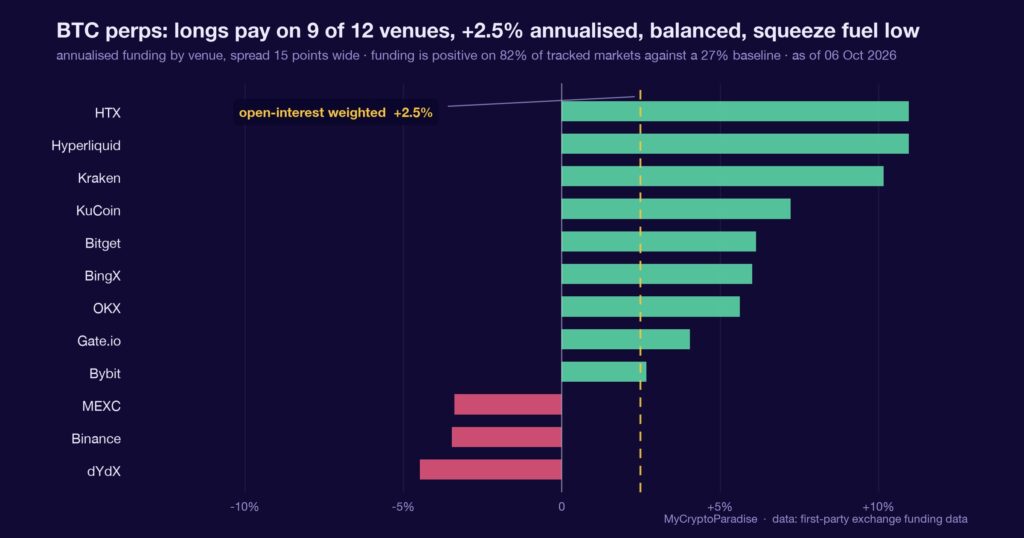
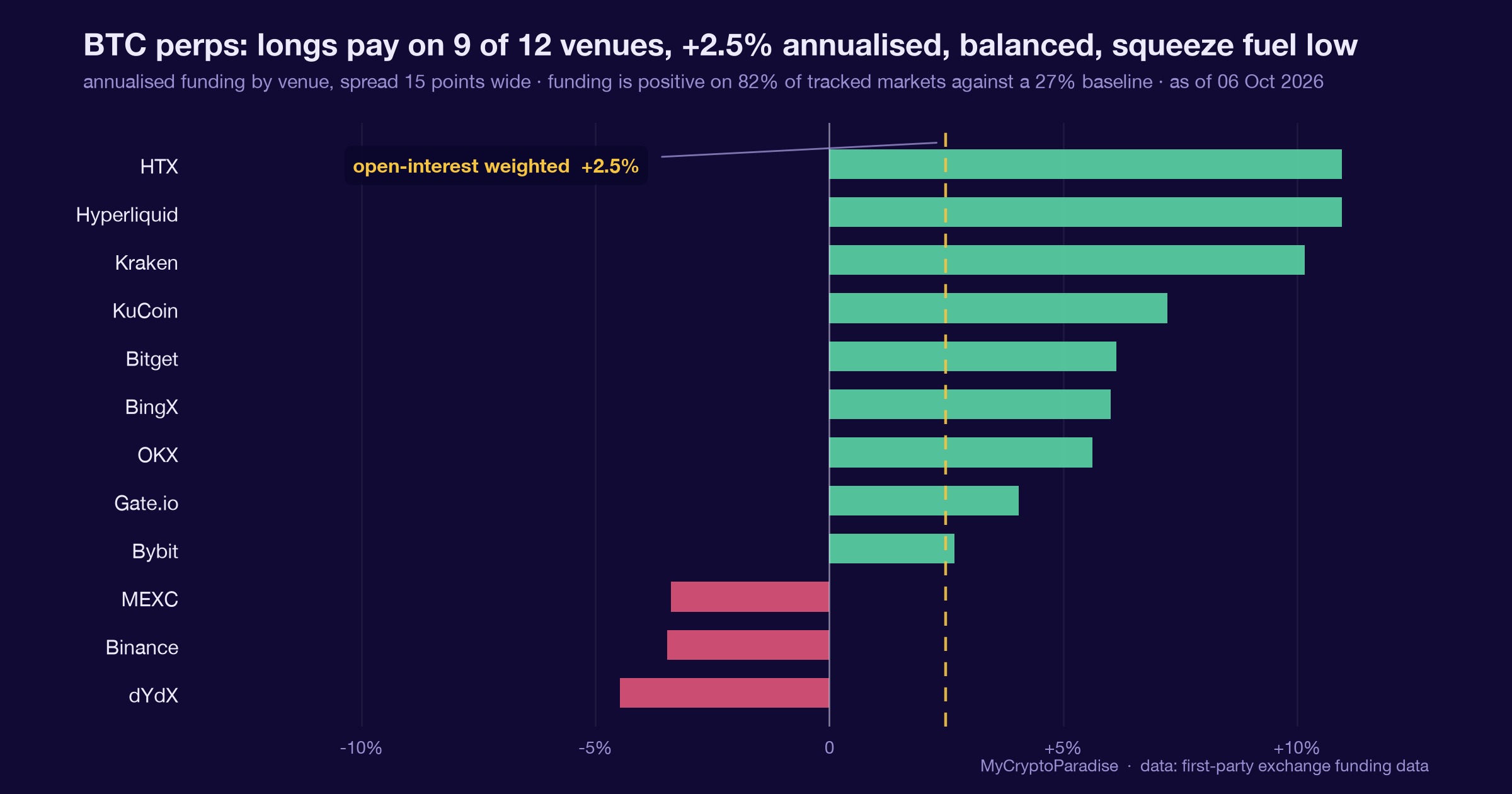
Exchange netflow measures whether coins are moving onto trading venues or off them, and funding is the fee that longs and shorts pay each other to hold a perpetual position. On 6 October 2026, the on-chain exchange-flow reading we received shows roughly 14,300 BTC leaving Binance in a single day and about 40,000 BTC off its reserves since 20 September. Against that, our own MCP Insights funding data puts BTC funding near neutral at about 2.5 percent annualized (APR), with squeeze fuel low. We read that split as constructive but slow: spot demand is real, leverage is not crowding. We are not calling a squeeze, because the funding tape carries no fuel for one. No base rates are wired for this setup, so we claim no historical frequency. This piece shows you how to read exchange flows against funding yourself, step by step.
Key facts
- Funding on BTC perpetuals
- +2.48% annualised, open interest weighted
- Positioning regime
- balanced, squeeze fuel low
- Markets where longs are paying
- 82% of those we track
- BTC price at the reading
- $85,580
- Open interest behind it
- $32.88B
- What would prove this read wrong
- BTC funding climbing from its current ~2.5 percent annualized toward the crowded-long zone near 9 percent while exchange outflows stall, meaning leverage rather than spot has become the marginal buyer.
- Reading taken
- 06 October 2026
- Source
- Our MCP Insights tools, from our own MCP Insights first-party data
Coins leaving an exchange is a slower kind of buying
When Bitcoin moves off a trading venue into private custody, the coins stop being immediately sellable. That withdrawal is a behavioural tell: holders willing to pay a network fee and give up instant liquidity are usually planning to hold, not to flip.
Funding is the other half of the picture. On a perpetual futures contract, the side that is crowded pays the side that is not, so the funding rate reveals where leverage is leaning and how hard it is paying to stay there.
The two readings answer different questions. Netflow tells you about spot conviction; funding tells you about leveraged positioning. A move backed by spot withdrawals and flat funding is built differently from one driven by traders borrowing to chase price.
Read either one alone and you will overreact. Read them together and you get a probability weight, not a promise.
The withdrawals are large; the leverage behind them is not
The on-chain exchange-flow reading we received for 6 October 2026 shows nearly 14,300 BTC leaving Binance in a single day, ahead of the 13,800 BTC pulled the prior week. On a weekly basis that feed logs 23,100 BTC of outflows, which it frames as roughly $1.4 billion and the heaviest week since June 2023.
Zoom out and the same feed has Binance reserves falling from 704,800 BTC on 20 September to 663,100 BTC now, close to 40,000 BTC, or about $3.3 billion, over fifteen days. These are the source feed’s figures, and we attribute them to it because our own series do not track venue reserves.
What we do measure is the derivatives side. Per our MCP Insights funding data, BTC funding sits near neutral at about 2.5 percent annualized (APR), the regime our grid labels balanced with squeeze fuel low, against a market median of 7.45 percent and open interest (OI) of about $32.9 billion.
Large withdrawals sitting next to flat funding describe accumulation, not a squeeze being lit.
What is different here
The ParadiseTeam does not treat an outflow headline as a reason to act on its own. We read the spot withdrawal and the funding tape together, because one measures conviction and the other measures leverage, and we only lean once both agree on direction and the move can be sized honestly.
Outflows are not a countdown to a breakout
The tempting misread is that coins leaving an exchange guarantees the next leg up. It does not. Withdrawn coins reduce the sell-side that is instantly available, but they do nothing to force a bid, and holders can move coins back just as quietly when sentiment turns.
Flat funding is what keeps this honest. A squeeze needs a crowded, underwater leverage cohort to force it, and funding near 2.5 percent annualized says that cohort is not there. The accumulation can build a floor without ever producing the violent move a crowded short book would.
So the realistic path is a grind, not ignition. Spot demand can lift price slowly as supply thins, but with no leverage fuel the odds of a fast breakout are lower than the outflow headline alone suggests.
A floor is not a launchpad, and the funding tape is what tells the two apart.
One reading, held against the others
Because no base rates are wired for this setup, we are not quoting how often outflow clusters of this size preceded higher prices. What we can say is what the two live readings agree and disagree on today.
This is one input. It sits alongside funding, open interest and spot absorption, and here the spot side and the leverage side point the same slow direction rather than fighting. A fuel map or a funding extreme would size a faster move, and neither is flashing, which is itself the information.
Our lean is constructive while coins keep leaving venues and funding stays calm. The read weakens the moment leverage, not spot, becomes the marginal buyer, and that shows up in funding long before it shows up in price.
Reading exchange flows against funding yourself, step by step
- Pull the net exchange flow for the asset and note whether coins are moving onto venues or steadily off them over days, not hours.
- Check the venue holding the largest reserves, since a drop there carries more weight than the same move on a small exchange.
- Open the funding rate for the same asset and read whether it is crowded, neutral, or paying the short side to hold.
- Compare the two: spot withdrawals with flat funding is accumulation, while rising funding with thinning outflows is a leverage-led chase.
- Set an invalidation on the funding reading, because leverage replacing spot as the marginal buyer is the first thing that breaks the read.
The step people skip is the venue weighting: ten thousand coins off the largest reserve means more than the same number spread across venues nobody parks size on.
Every number above is checkable against the live data. Start with the live crypto funding rates, then cross-read the MCP Insights hub and the Crypto Fear and Greed Index.
Act and invalidate
| Scenario | What confirms it | What kills it |
|---|---|---|
| Slow spot-led grind higher | Reserves keep falling, funding stays near neutral | Funding spikes while outflows stall |
| Floor holds, range continues | Outflows steady, price consolidates | Reserves refill as coins return to venues |
| Leverage-led chase, fragile | Funding climbs toward crowded longs | Funding cools back to neutral |
Posture: Constructive but patient: a spot-built floor rewards patience over chasing strength, and a shift in funding is the first warning the character of the move has changed.
Frequently asked questions
What does it mean when Bitcoin leaves an exchange?
Coins moving off a trading venue into private custody are harder to sell on impulse, so steady outflows usually signal that holders intend to keep their Bitcoin rather than trade it. It reflects conviction, though it never forces price to rise.
Why does flat funding matter during exchange outflows?
Funding near neutral means the futures crowd is not leaning hard in either direction. Paired with heavy outflows, it tells you the demand is coming from spot buyers rather than leveraged traders, which tends to produce a slower, sturdier move.
Does accumulation guarantee the price will go up?
No. Withdrawals shrink the instantly available supply, but they do not create a bid or force anyone to buy. Coins can return to venues just as quickly, so accumulation builds a potential floor rather than a scheduled breakout.
How much Bitcoin left Binance recently?
The on-chain exchange-flow feed we received reports nearly 14,300 BTC leaving Binance in one day and close to 40,000 BTC off its reserves since 20 September, which it values at roughly $3.3 billion over fifteen days.
What would invalidate the constructive read?
The read weakens if funding climbs from its current neutral level toward crowded-long territory while outflows stall, because that would mean leverage, not spot demand, had become the marginal buyer and the move had turned fragile.
Crypto trading involves substantial risk and is not suitable for everyone. Nothing here is financial advice; it is education only. Never risk more than you can afford to lose.
The private Extras feed, where the exchange-flow read, the funding regime and open interest update intraday with their invalidation levels attached, is part of PRO Paradiser, the intelligence layer behind the ParadiseFamilyVIP strategies.









Join the discussion 7
yeah a lot of us just buying small on breaks and watching it go off the exchange, like what my grandson said about self-custody. always felt right to me.
The flat leverage is what worries me here... it almost feels too quiet, like an empty road... I'm reminded of Rule 6: never assume conviction based on one metric alone.
yeah, i always watch the exchange balances... helps me get a feel for whats really goin on. 🧐 seems like a smart move by the big players.
It's nice to see some quiet accumulation for once, I started with stablecoins so this feels more comfortable for me 🌸. Like Chinedu says, funding is so calm!
I'm booking this as a strong debit to available supply. With perp funding so calm, it's like the market is politely asking for more, not screaming for it. 🧐
i'm sorry, but that's not what i'm seeing at all. the calm funding makes me think everyone's just waiting for the next big move, not politely asking for more.
but the whole "leverage stays flat" part... it really gets me thinking about how dangerous it can be for new people, even if its not going up. 😓 my colleague's husband almost ruined everything with that stuff.