

Listen: the breakdown
Market briefing: The Bitcoin anti-spam fork mined two blocks, then stalled with just 2.53% of hashpower. BTC sat unmoved near $65,160, up 0.1% on the day.
- The anti-spam fork mined only two blocks before grinding to a halt.
- It drew 2.53% of mining support and sits roughly 350 days from a difficulty adjustment.
- BTC ignored the split entirely, holding near $65,160 while the main chain ran on.
The Bitcoin anti-spam fork mined two blocks, then stopped. With 2.53% of hashpower and price unmoved, does a dead chain tell us anything at all?
A breakaway Bitcoin chain launched, mined two blocks, and then effectively stopped breathing. That is the whole story of the anti-spam fork, and it is shorter than most press releases about it.
The split attracted 2.53% of total mining support. On a proof-of-work network, hashpower is not a vanity metric. It is the engine. With that little of it, blocks arrived hours apart instead of the roughly ten-minute cadence Bitcoin users expect.
Worse, the fork sits about 350 days from its next difficulty adjustment. That mechanism only recalibrates every 2,016 blocks. A chain producing blocks this slowly cannot reach that milestone for the better part of a year, so it stays stuck at a difficulty its handful of miners cannot sustain.
We covered the same fork earlier today when it was dismissed as irrelevant at a fraction of Bitcoin's hashpower. What is new here is the mechanical picture. This is no longer a debate about whether the fork matters. The chain is now demonstrating, block by absent block, that it cannot function.
Meanwhile the main Bitcoin network never noticed. It kept producing blocks on schedule, confirmed transactions without interruption, and carried on as if nothing had happened. BTC traded near $65,160, up 0.1% over 24 hours and flat on the hour. For a market that reprices on rumor, the silence was the loudest signal.
Why a dead chain proves the network's strength
This fork matters precisely because of how little it mattered. A blockchain is only as secure as the honest hashpower defending it, and 2.53% is not a rebellion. It is a rounding error.
Hashpower is the transmission mechanism for a fork's survival. Miners vote with electricity, not opinions. When 97% of that electricity stays on the main chain, the breakaway network inherits none of the security, liquidity, or merchant support that gives a coin any value at all.
That is the deeper point for holders. Bitcoin's resilience is not a marketing claim, it is an observed outcome. A group tried to redirect the network, the market declined the invitation, and the original chain absorbed the event without a flicker.
Structurally, this reinforces something the broader macro picture already assumes. Bitcoin's monetary settlement layer is boringly stable, and boring is the feature. The interesting volatility lives in price and positioning, not in the base protocol.
So the transmission chain here is almost comically short. The driver is a failed fork. The macro effect is nil. The liquidity effect is nil. And the price effect is a 0.1% shrug. When the story ends before it reaches the order book, that itself is the information.
How the market priced a non-event
The cleanest read on market impact is the flat line. BTC held near $65,160, up 0.1% on the day and 0.0% on the hour, which is what indifference looks like on a chart.
Bitcoin is the sun this ecosystem orbits, so when BTC does not react, the cascade never starts. There was no volatility spike to ripple outward, no liquidity shift for traders to chase, and no reason for the base asset to lead anything anywhere.
With BTC static, ETH had nothing to follow. Ether takes its risk cues from Bitcoin's direction, and a directionless Bitcoin offers no impulse to amplify. So Ether saw no fork-driven move, because there was no move to inherit.
Alts sit at the far end of that same chain. They are the high-beta expression of BTC risk appetite, meaning they exaggerate whatever Bitcoin does. Exaggerating zero still gives you zero. The fork left no footprint on the long tail.
Here is the useful part. Because this event produced no liquidity event, it also produced no distortion in the levels that actually matter. Traders can set it aside entirely and keep watching the structure that was already in play before the fork was ever announced. A non-event is a clean slate, and a clean slate is rare.
What actually deserves your attention next
The fork is not the thing to watch. It confirmed itself into irrelevance the moment blocks started arriving hours apart. Nothing about a chain 350 days from a difficulty adjustment changes the trading picture from here.
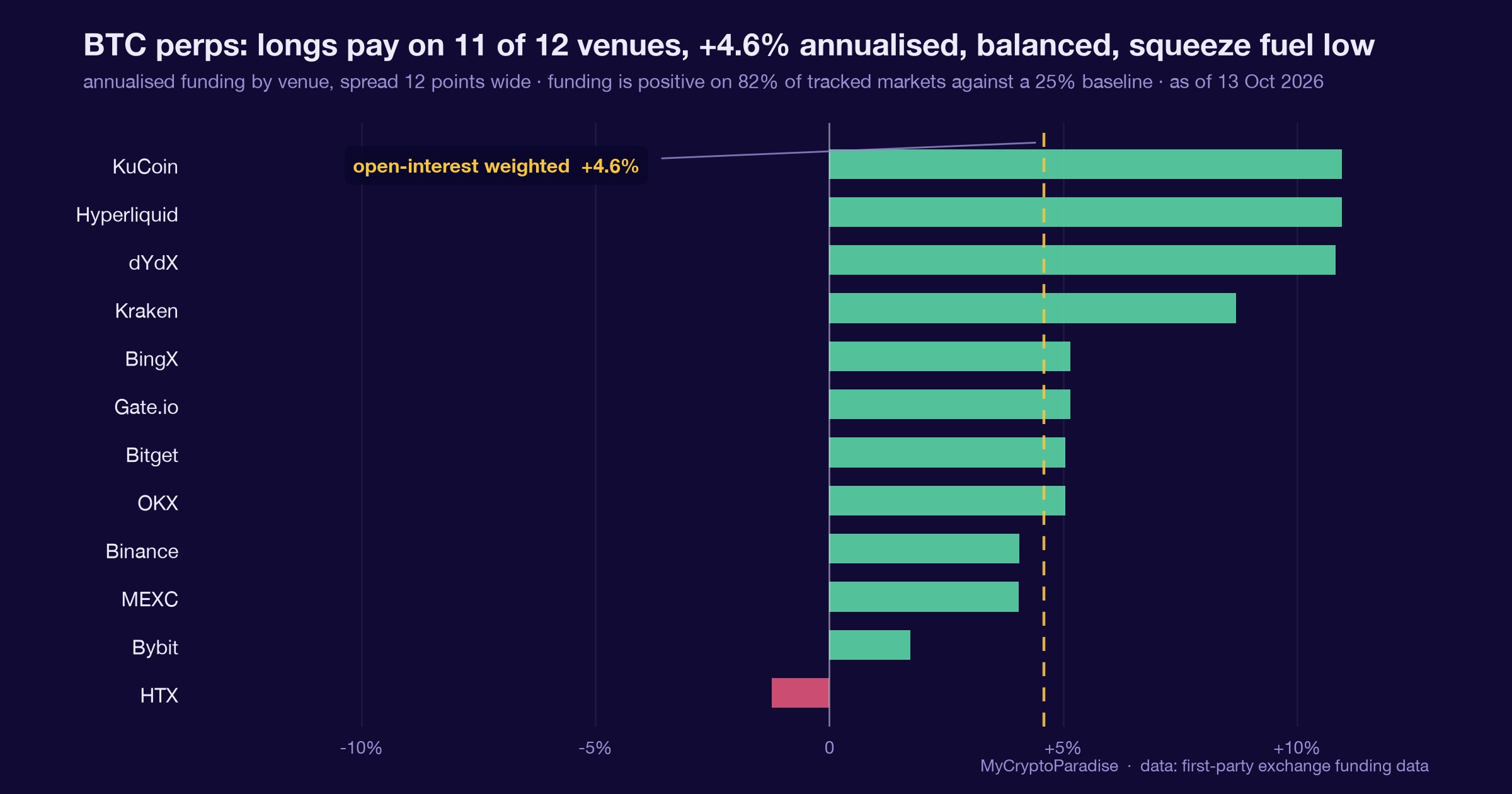
What deserves attention is everything the fork distracted from. Funding rates are the first tell. They have been drifting positive, which means longs are paying to stay long, and a crowded long book is fuel for a squeeze rather than a floor under price.
The Fear and Greed Index sitting near 60 is the second tell. That is warm, not euphoric, but it leans toward complacency. Complacency near resistance is where late buyers tend to gather, and where the market likes to hunt them.
Confirmation of continued strength would be a clean reclaim of the $65,500 region on real volume, opening room toward the daily target. Invalidation would be a loss of the $64,700 to $64,300 support zone, which would expose lower levels quickly. So watch positioning, not protocol drama. The fork answered its own question. The open question is whether crowded longs get flushed before the next leg, and that is decided on the order book, not by two orphaned blocks.
What this non-event means for positioning
The ParadiseTeam reads this fork as pure noise, which is exactly why it is useful. It clears the board and leaves the real map visible, and that map has not changed because of two stalled blocks.
BTC was trading near $65,160 as of the latest read, pressed against the lower timeframe resistance around $65,300 and short of the $65,500 Fibonacci reclaim that would argue for long continuation. That level, not the fork, is the line in the sand.
We reaccumulated at $61,000 earlier in this range, and our bias stays cautiously bullish for an interim pump toward the $69,000 area, with a stretch objective near $79,000. The $64,700 to $64,300 zone is the low timeframe support we want defended.
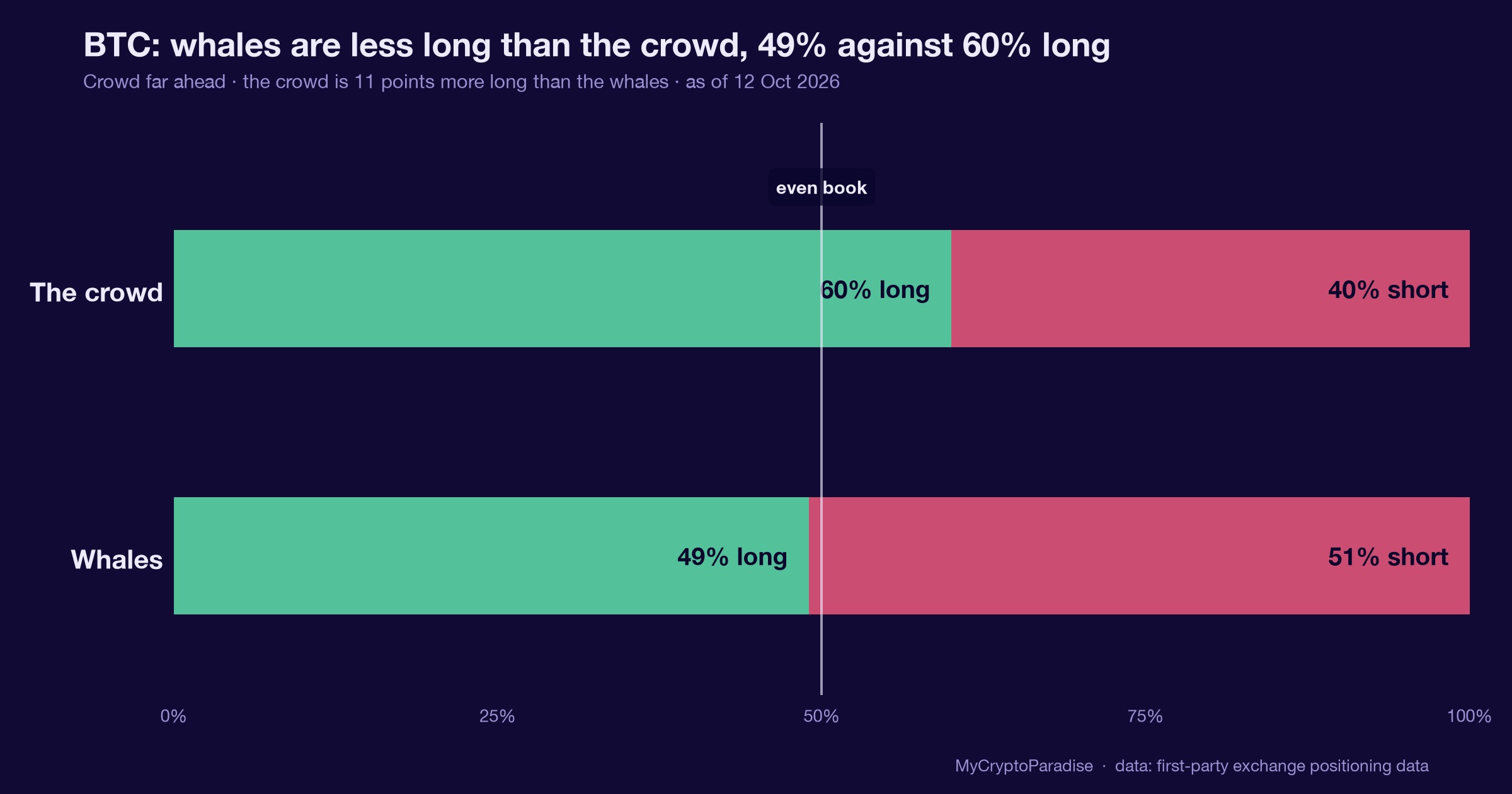
Here is the smart money versus retail angle. Retail chases niche headlines like a failed fork while professionals watch funding and stops. With longs getting crowded, the higher-probability sequence is a squeeze that shakes out late buyers before any push higher.
On the macro frame, the weekly structure still points toward a possible flush to the $44,000 region, where we expect to reaccumulate again. So we treat strength into resistance with respect, not conviction. The fork changes none of this. It simply reminded everyone that Bitcoin's base layer is dull, and dull is precisely what long-term holders should want.
Track it live: our live crypto funding rates and the Crypto Fear and Greed Index both update in real time, so you can watch this shift for yourself.
Related coverage
For exact entries, targets, and stop losses with full risk management, that is what ParadiseFamilyVIP is for. New to reading these moves? Start with our crypto trading strategies guide.
ParadiseTeam is monitoring the market situation closely, and we are taking these developments into consideration while building our trading tactics inside ParadiseFamilyVIP.
Crypto trading involves substantial risk. Prices are volatile and you can lose money. This article is educational and is not financial advice. Past performance does not guarantee future results.
With the fork dead, what does BTC do first from here?
This is how the Paradisers are calling it. Tap your call.
No calls on this one yet. Tap yours to be the first.
Free account, no password. Members just sign in.









Join the discussion
No comments yet. Members, share how you are reading this.