


Listen: the breakdown
Developing story update (September 03, 2026, 23:24 UTC):
A new data exposure incident has emerged, involving Pocket Bitcoin, a Swiss non-custodial Bitcoin service. This breach affected 291 customers, exposing compliance records that link real identities to public Bitcoin addresses and on-chain activity.
While no funds were moved and private keys remained untouched, this incident highlights ongoing privacy risks within the crypto ecosystem, particularly for services handling identity verification.
This adds to the broader picture of August’s security landscape, reinforcing the need for vigilance beyond just direct fund compromises, as data integrity remains a critical concern for market participants.
What to watch now: Watch for further details on the scope of data exposures and their potential impact on user privacy and regulatory scrutiny.
Developing story update (September 03, 2026, 23:03 UTC):
Our sources confirm MetaMask issued same-day notifications to affected users regarding the August 2026 data exposure. This prompt communication is a positive step in managing user concerns following the incident.
New data indicates August 2026 crypto losses may have reached approximately $162 million across 27 major incidents, a higher figure than the previously reported $136 million across 50 incidents. This suggests the scale of individual exploits might be larger than initially understood, even if the total number of incidents is lower by this measure.
Bitcoin, after logging strong monthly gains in August, has recently edged lower. Traders should note this shift in short-term price action, as it could signal a period of consolidation or further downward pressure following the earlier rally.
What to watch now: Monitor for further clarification on the total August loss figures and Bitcoin's short-term price trend for signs of continued consolidation or deeper retracement.
Developing story update (September 03, 2026, 22:42 UTC):
Our latest check reveals more granular detail on the types of security incidents contributing to August 2026’s $136 million in crypto losses. Confirmed attack vectors included DeFi protocol exploits, bridge attacks, and phishing campaigns.
This clarifies the nature of the 50 security incidents reported for the month, reinforcing the diverse and persistent threat landscape. Traders should note the continued prevalence of these specific attack methods, which underscore the ongoing need for vigilance across various crypto sectors.
What to watch now: Monitor for further details on specific vulnerabilities exploited in DeFi protocols, bridges, and phishing campaigns.
Developing story update (September 03, 2026, 21:38 UTC):
Further details regarding the August MetaMask data breach confirm that Trezor’s 90-day data retention policy helped limit potential exposure. MetaMask also acted swiftly, flagging the incident to affected users on the same day it was discovered, reinforcing that customer funds and wallets remained secure.
Our sources indicate that August’s security incidents were diverse, encompassing not only DeFi protocol exploits and bridge attacks but also targeted phishing campaigns against individual wallet holders. This broader scope of attack vectors underscores the persistent and varied risks in the crypto ecosystem.
What to watch now: Traders should monitor how these diverse attack vectors evolve and if proactive measures by platforms like MetaMask become standard practice.
Developing story update (September 03, 2026, 21:17 UTC):
Our sources now indicate an additional estimate for August 2026 crypto security losses, placing the total at $162 million across 27 major incidents. This figure adds to the previously reported $136 million across 50 incidents, suggesting a broader range of financial impact for the month.
While the core finding remains that no record hardware wallet raid was confirmed and MetaMask funds were not compromised, the emergence of a higher total loss estimate underscores persistent vulnerabilities. Traders should note the varied reporting on incident frequency and total value lost, indicating a complex risk landscape.
This fragmented picture of security incidents, even without a single catastrophic event, reinforces the smart money perspective of underlying market fragility. Continue to monitor for further consolidation of these loss figures and any shifts in attack vectors, as these can influence broader market sentiment and strategic positioning.
What to watch now: Watch for any further revised estimates on August's total losses and the ongoing frequency of smaller, high-impact DeFi exploits.
Developing story update (September 03, 2026, 20:55 UTC):
Our sources confirm MetaMask notified affected users about the August data breach on the same day it occurred. This swift communication regarding the exposure of personal data, including names and contact information for approximately 12,000 customers, demonstrates a proactive incident response.
Crucially, this update reinforces our original finding that no MetaMask wallets, funds, or firmware were compromised in the incident. While personal data was exposed, the security of user crypto assets remained intact.
Traders should continue to exercise caution against potential phishing attempts targeting the exposed personal information, even as the broader August crypto loss figures remain consistent at approximately $136 million across 50 incidents.
What to watch now: Monitor for any follow-up phishing campaigns targeting the exposed MetaMask user data.
Developing story update (September 03, 2026, 20:34 UTC):
Our sources now indicate August 2026 crypto security losses reached a precise $136.3 million, slightly refining the previously reported $136 million figure. This total was spread across 50 incidents, confirming the high frequency of exploits during the month.
Crucially, the majority of these crypto losses were concentrated in the final days of August. This late-month surge suggests a period of heightened vulnerability or targeted activity towards the close of the reporting period.
What to watch now: Monitor for any follow-on reports detailing specific incidents from late August and their potential impact on market sentiment.
Developing story update (September 03, 2026, 20:13 UTC):
An update on crypto security concerns reveals a data exposure incident impacting nearly 12,000 MetaMask customers, with personal information including names, addresses, and emails compromised. While MetaMask confirmed that user wallets, funds, and firmware remained untouched, this incident highlights persistent data privacy risks within the ecosystem.
Separately, new data indicates August crypto security losses totaled approximately $162.0 million across 27 major incidents, an increase from previously reported figures. This revised total, alongside the ongoing Tectonic exploit contributing $75 million, underscores the continued financial impact of various vulnerabilities.
What to watch now: Monitor for further details on data breach impacts and any new reporting on total monthly crypto losses.
Market briefing: August saw over $136 million in crypto security losses across 50 incidents, a 67% increase in hacks. This data points to ongoing systemic vulnerabilities, despite BTC trading near $81,506.
- August crypto security losses reached $136 million across 50 separate incidents.
- Crypto hacks increased by 67% in August, with a $75 million Tectonic borrowing event leading.
- These widespread losses challenge market confidence, reinforcing underlying systemic risk for traders.
While prior reports speculated about a record hardware wallet raid, new data reveals a broader and more concerning trend. August crypto security incidents racked up $136 million in losses across 50 events, marking a 67% increase in hacks. Does this persistent vulnerability undermine broader market confidence?
The widely reported 'record hardware wallet raid' that supposedly drained 1,816 Bitcoin (BTC) from thousands of addresses was not corroborated by our latest data. Instead, August witnessed a more distributed, yet equally impactful, wave of crypto security breaches. This period recorded approximately $136 million in total losses spread across 50 separate incidents.
This marks a significant increase in exploit activity, with crypto hacks rising by 67% over the month. The largest single contributor to these August losses was a $75 million borrowing event involving the Tectonic protocol. Approximately $6 million from this specific incident was subsequently moved to the Ethereum blockchain.
These ongoing vulnerabilities paint a clearer picture of the market's underlying security challenges. They contrast sharply with the often-optimistic narratives surrounding crypto adoption and institutional integration. The cumulative effect of these losses highlights systemic risks rather than isolated, large-scale events.
Further reinforcing the theme of unexpected losses, a specialist team attempting to recover funds from a purported $1 billion Ether (ETH) wallet in Georgia found only $10. Such findings, while distinct from hacks, add another layer of uncertainty to the perceived value and security of substantial crypto holdings.
Cumulative losses fuel market caution
The consistent drumbeat of security breaches, totaling $136 million in August, directly impacts broader market sentiment. Each incident, whether a large DeFi exploit or a smaller protocol hack, chips away at investor confidence. This creates a risk-off environment where capital becomes more hesitant to flow into the ecosystem.
Such a landscape makes institutional engagement significantly more challenging. Financial institutions, already navigating complex regulatory environments, are highly sensitive to security risks and the potential for reputational damage. Persistent exploits can easily deter new institutional inflows, slowing the market's maturation.
From a macro perspective, these vulnerabilities contribute to a narrative of cautious optimism, if not outright skepticism. While Bitcoin trades near $81,506, the underlying fragility presented by these security concerns can easily cap upward momentum. It provides a fundamental justification for smart money to de-risk or distribute assets strategically.
Retail traders, often focused on price action and short-term gains, may overlook these systemic security issues. However, the cumulative effect of these losses is a powerful, albeit often invisible, force shaping long-term market structure. It creates headwinds that require more than just bullish news cycles to overcome.
Liquidity shifts amid systemic insecurity
The ongoing pattern of security losses directly impacts market liquidity by altering the behavior of both smart money and retail participants. Heightened risk perception tends to reduce fresh capital inflows, particularly from larger institutional players who prioritize security and robust infrastructure. This can lead to shallower order books and increased volatility as liquidity dries up.
For Bitcoin, this environment means sustained bearish pressure, making it harder to hold key support levels or break through significant resistance. Smart money often uses such negative news cycles, even if distributed across many incidents, as cover for distribution. They offload positions into any retail buying enthusiasm, exacerbating downside moves.
Ethereum and altcoins typically experience an amplified effect. As the broader market becomes more risk-averse, capital often flows out of higher-beta assets first. This can lead to sharper declines in ETH and various altcoins, especially those with smaller market caps or less mature security audits. The $6 million moved to Ethereum from the Tectonic event highlights the interlinked nature of these exploits.
Ultimately, these cumulative losses create a market structure where downside flushes become more probable. Stop-loss (SL) orders from retail traders become prime targets for market makers. This dynamic traps less experienced participants in unfavorable positions, while smart money accumulates at lower prices or profits from short positions.
Confirming market direction from here
To confirm a continued bearish outlook, traders should monitor Bitcoin's reaction to key support levels. A sustained break below immediate demand zones, accompanied by increasing trading volume and negative cumulative volume delta (CVD), would signal conviction in downside momentum. Any weak bounces that quickly reject resistance would also reinforce the current narrative.
Conversely, signs of invalidation would involve a swift and decisive reclaim of significant price levels, possibly on higher timeframes. This would need to be coupled with a noticeable shift in market sentiment, perhaps driven by genuine institutional accumulation or a prolonged period without major security incidents. However, given the August data, such a shift seems less likely in the immediate term.
Watch for any significant changes in Open Interest (OI) across major crypto exchanges. A rapid deleveraging event, either from long liquidations or short squeezes, could temporarily disrupt the trend. However, the underlying systemic risk from continued hacks would likely reassert itself, pushing prices back towards the prevailing direction.
Finally, the market will likely interpret any further security breaches or significant fund recovery failures as confirmation of fragility. These events, even if smaller in scale, add to the cumulative bearish pressure. They reinforce the incentive for smart money to continue distributing assets and for retail to capitulate.
Reading August losses through smart money
The ParadiseTeam views these August security losses as a critical data point reinforcing the current bearish market structure. While Bitcoin trades around $81,506, the cumulative $136 million in exploits provides a strong narrative for smart money distribution. This is not about a single, dramatic raid, but a persistent erosion of trust and security.
Smart money recognizes that retail often ignores the systemic fragility highlighted by these numerous incidents. Instead, less experienced traders tend to focus on short-term price movements or narratives of adoption, making them susceptible to buying into rallies that lack fundamental support. This creates ideal conditions for distribution from larger holders.
Our analysis, aligning with Simon's bearish outlook, suggests that market makers are incentivized to push prices lower. The goal is to trigger retail stop-loss (SL) orders and induce capitulation, allowing for re-accumulation at more favorable levels. The $44,000 target remains a key level to watch for potential downside exhaustion.
Traders should be cautious of any perceived strength in the market that isn't backed by genuine, high-volume accumulation at significant demand zones. Instead, look for evidence of distribution at resistance. This means paying close attention to order flow and the behavior of large entities, as they leverage these ongoing security concerns to their advantage.
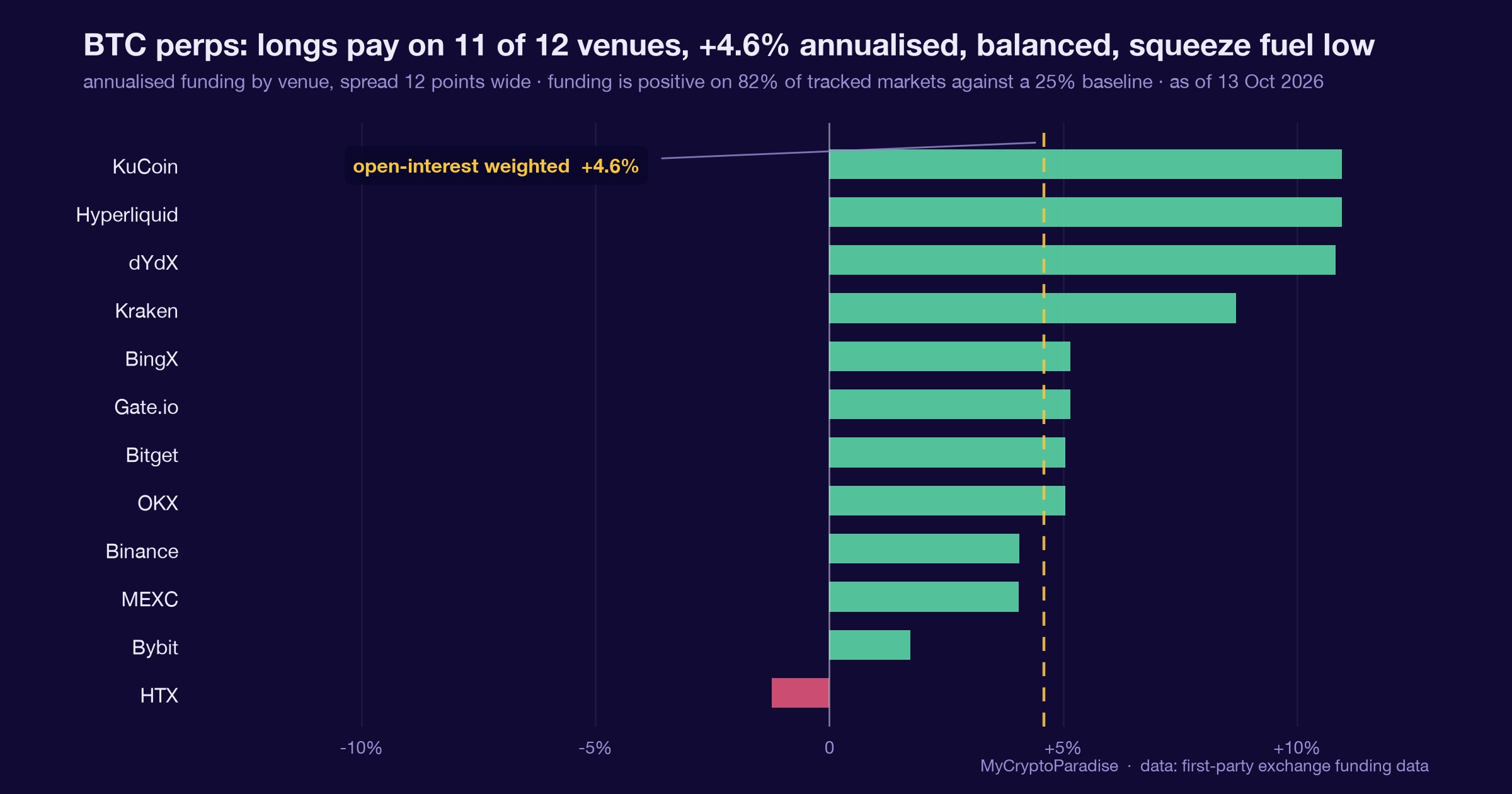
Track it live: our live crypto funding rates and the Crypto Fear and Greed Index both update in real time, so you can watch this shift for yourself.
Related coverage
For exact entries, targets, and stop losses with full risk management, that is what ParadiseFamilyVIP is for. New to reading these moves? Start with our crypto trading strategies guide.
ParadiseTeam is monitoring the market situation closely, and we are taking these developments into consideration while building our trading tactics inside ParadiseFamilyVIP.
Crypto trading involves substantial risk. Prices are volatile and you can lose money. This article is educational and is not financial advice. Past performance does not guarantee future results.
Will ongoing security losses push Bitcoin towards $44,000 this quarter?
This is how 39 Paradisers are calling it. Tap your call.
No calls on this one yet. Tap yours to be the first.
Free account, no password. Members just sign in.










Join the discussion 4
The question is not the amount, but the process for assessing the individual impact. Does the stop protect from this systemic fragility?
Oh wow, that's a lot of money gone... 😱 It makes me wonder if there’s a pattern with these smaller projects, as Samuel mentioned? What do you all look for to avoid getting caught in one of those rug pulls?
hmm, 50 incidents for $136m in one month is a debit entry nobody wants. i always make sure my stop loss covers at least half of any reported exploit for the asset. 😅
i always check for these security reports... especially for the smaller coins I'm holding between semesters. it's a constant concern... 😥