

Listen: the breakdown
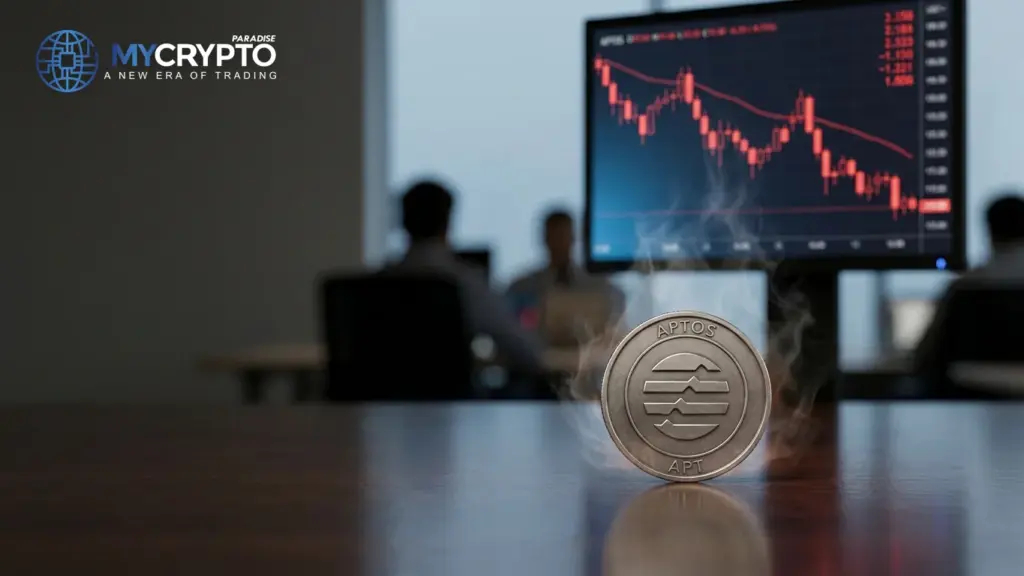
Market briefing: Aptos just made its tokenomics overhaul live: every gas fee burned, staking rewards halved, supply capped at 2.1 billion APT. Yet APT slipped near $0.77 while BTC traded around $80,927, down 0.9 percent on the day.
- Aptos now burns every gas fee, with fees set 10x higher, and hard-caps supply at 2.1 billion APT.
- Staking rewards were halved from 5.19 percent to 2.6 percent, cooling fresh token issuance.
- The tokenomics are structurally deflationary, yet APT dipped 1.42 percent in a soft market.
Aptos just flipped on deflationary tokenomics, burning every gas fee and capping supply at 2.1B APT. So why did the price slide instead of jump?
Aptos quietly turned a February proposal into live network rules. Onchain governance approved the package, and the changes are now in force. The headline is simple: scarcity just got engineered into the protocol.
Three pieces matter. Gas fees are now set 10x higher, and every one of them is burned. Staking rewards were halved from 5.19 percent to 2.6 percent. Supply is hard-capped at 2.1 billion APT. Each change points the same way, toward less issuance and more destruction of tokens over time.
This is the Aptos tokenomics story most traders underweight. Burning fees removes tokens permanently. A hard cap kills the open-ended inflation question. Lower staking rewards slow the drip of new coins into the market. Together they rewrite the supply curve.
And yet APT traded near $0.7686, down 1.42 percent over 24 hours. A fundamentally tighter token met a softer price. The market, it seems, was not waiting by the mint to applaud.
Context helps. Aptos is a layer 1 chain building Web3 infrastructure, and it carries an unusual lineage: it began inside Facebook as the Libra, later Diem, project before the team broke away. That history gives it credibility and baggage in equal measure. The current move is about economics, not pedigree, and the economics clearly tightened.
Why engineered scarcity reshapes the APT supply curve
The mechanism here is supply, not hype. When a chain burns every gas fee, each transaction quietly retires tokens. More network use means more burning. That links real activity to real scarcity, which is the kind of loop long-term holders prize.
The hard cap at 2.1 billion APT does something subtler. It removes a question mark. Investors no longer price in open-ended dilution, because the ceiling is now fixed in code. Uncertainty about future supply is itself a discount, and that discount just shrank.
Halving staking rewards from 5.19 percent to 2.6 percent slows new issuance. Fewer fresh tokens reach sellers each day. Lower emissions reduce the structural selling pressure that quietly caps many layer 1 tokens.
So why the muted price? Two honest readings compete. The first is timing: the proposal dates to February, so markets had months to absorb it, and the live switch confirmed what was already expected. The second is macro: with BTC near $80,927 and down on the day, project fundamentals get drowned out by broad risk-off tape.
This is our analysis, not a confirmed cause. The deflationary design is fact. The weak reaction is fact. The bridge between them, a classic sell the confirmation in a soft market, is our read. Scarcity rarely reprices in a single candle. It compounds quietly, which is exactly why short-term traders routinely ignore it.
How tighter APT supply filters through a soft tape
On its own facts, this story leans bullish for APT over the near to medium term. Deflationary tokenomics are a slow tailwind, not a one-day catalyst. The hard cap and fee burn work in the background, every block, regardless of the daily candle.
The immediate tape tells the honest part. APT fell 1.42 percent even as its supply mechanics improved. That gap between good news and a red price is the signature of a sell the confirmation moment layered on top of general market weakness.
Start with the top of the stack. BTC traded near $80,927, down 0.9 percent, and ETH sat around $2,384, also down 0.9 percent. When the majors soften, liquidity drains from the long tail first. Alts like APT feel that gravity before any project-specific story can push back.
That sequence matters for positioning. Smart money tends to accumulate improving fundamentals into weakness, because panic from retail provides the cheaper fills. Retail tends to do the reverse, selling a token precisely as its supply tightens.
So the near-term pressure and the long-term setup point different ways. The daily move is macro-driven and bearish. The structural change is scarcity-driven and bullish. Over days to weeks, as the burn accumulates and issuance slows, the deflationary mechanics carry more weight. That is why we read the story itself as a bullish supply shift, even with a red print on the screen today.
What confirms the scarcity bid versus a fakeout
Watch network activity first. The fee burn only bites if usage holds up. Rising transaction counts mean more tokens destroyed, which validates the deflationary thesis. Falling activity would hollow it out, turning a clever design into a quiet one.
Second, watch how APT behaves against BTC, not just in dollars. An alt that holds its BTC ratio while the majors wobble is quietly being accumulated. One that keeps bleeding against BTC is still being distributed, scarcity story or not.
Third, the macro backdrop sets the ceiling. With BTC near $80,927 and under pressure, alts stay on a short leash. A BTC bounce would give APT room to express its fundamentals. A deeper BTC flush would overwhelm any project-level tailwind, at least temporarily.
Confirmation, for us, looks like APT basing and reclaiming ground on steady or rising volume while the burn keeps compounding. That is the market accepting the tighter supply rather than shrugging at it.
Invalidation is simpler. If activity fades and price keeps grinding lower on heavy volume, the deflationary design becomes a footnote. Good tokenomics cannot save a chain nobody uses.
The honest trap to avoid is confusing a structural change with an instant one. Scarcity is a compounding force, not a trigger. Treating a slow tailwind like a fast catalyst is how traders buy a confirmation and then sell the first dip in frustration.
Reading engineered APT scarcity through smart money
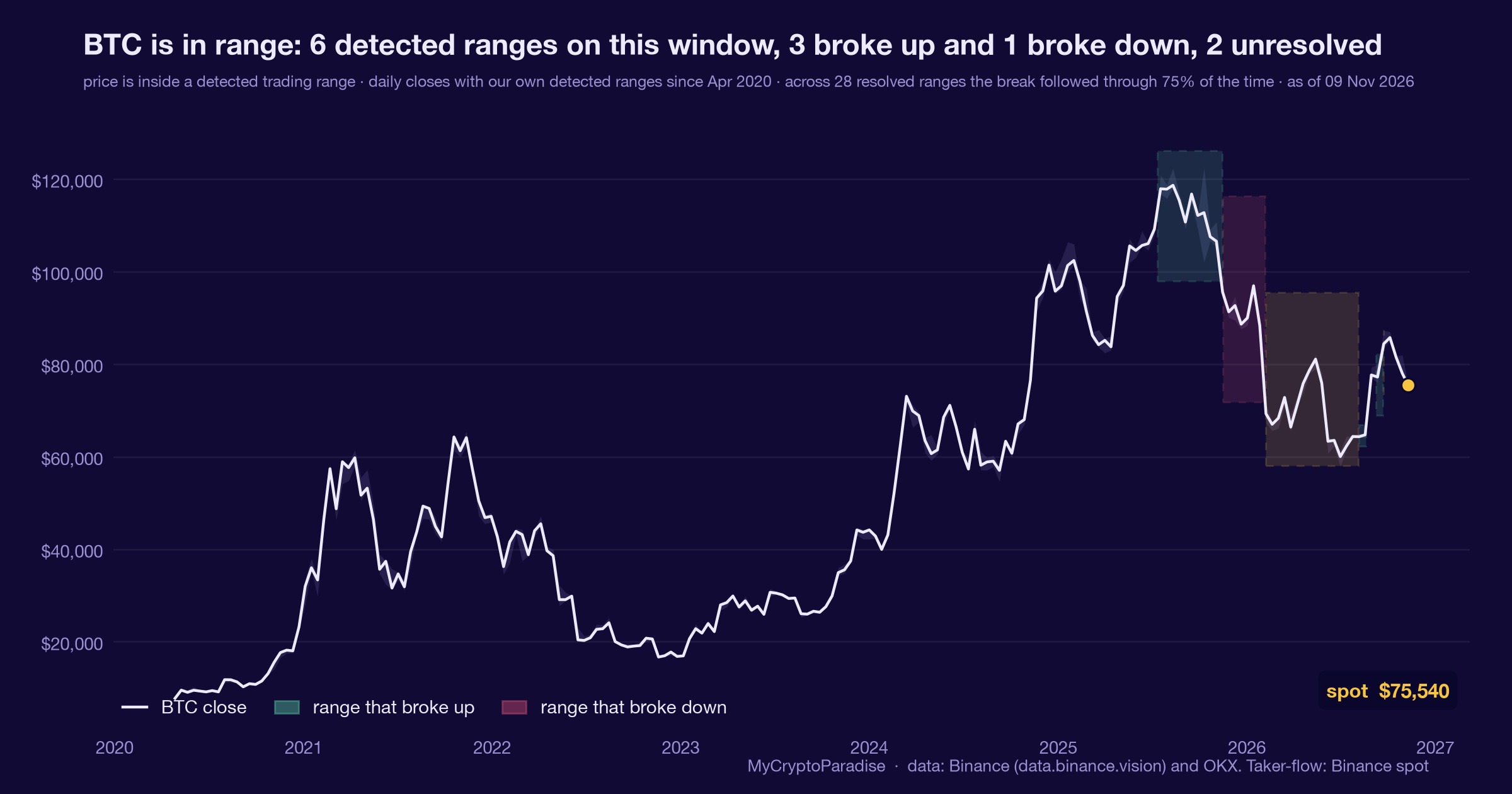
The ParadiseTeam frames this through the current tape, not the press release. BTC was trading near $80,927 as of the latest read, sitting right on the $80,000 to $81,000 support zone we track as a 0.618 retracement. That zone, not APT itself, is the switch for alt risk appetite.
Here is the link. While retail is fearful and shorting into that support, we see whales absorbing supply rather than panicking. Roughly 56 percent of smart money was buying against 44 percent selling in the past day. Improving tokenomics landing into that fear is the kind of setup where patient capital quietly builds, using retail's exit liquidity as the fill.
That said, our standing read stays risk-first. On higher timeframes the structure is still vulnerable, and losing $79,000 would open a far deeper path toward the $44,000 region. If BTC breaks that support, no alt's scarcity story survives the undertow, Aptos included.
So the balance is this. The deflationary mechanics give APT a genuine long-term tailwind. The macro structure gives it a near-term headwind while BTC defends $80,000 to $81,000.
For positioning, the ParadiseTeam watches BTC holding that support as the green light for alt strength to matter at all. Strength in APT into broad weakness can still meet selling, so we treat the scarcity bid as a slow accumulation thesis, not a reason to chase a token lower against a soft Bitcoin.
The read behind this: we framed this story through our own market analysis, Can Bitcoin Still Make a Higher High?
Track it live: our live crypto funding rates and the Crypto Fear and Greed Index both update in real time, so you can watch this shift for yourself.
Related coverage
For exact entries, targets, and stop losses with full risk management, that is what ParadiseFamilyVIP is for. New to reading these moves? Start with our crypto trading strategies guide.
ParadiseTeam is monitoring the market situation closely, and we are taking these developments into consideration while building our trading tactics inside ParadiseFamilyVIP.
Crypto trading involves substantial risk. Prices are volatile and you can lose money. This article is educational and is not financial advice. Past performance does not guarantee future results.
Can engineered scarcity lift APT while BTC fights to hold support?
How 45 Paradisers are calling it
The first call is still open
Free account, no password. Members just sign in.








Join the discussion 42
I always log gas fee burn rates versus network usage. That's the only real metric for supply pressure, not just the cap.
katya, i think supply pressure needs looking at the actual transactions 📈, not just theoretical models 🤷♀️. burn rate vs usage is the real deal for me 🔥.
It's why I prefer volume metrics over the burn rate hype. If the throughput isn't there, a cap means nothing for real price action.
So, with the halved staking rewards... did they also reduce the unlock schedule for early investors to match... or is that still the same?
Oh, that's a really good question, Derek. I wonder also about the new token minting schedule if that stays the same?
hahaha and *this* is why i started tracking unlock schedules more closely! 🤦♂️ learned that the hard way in 2021 🫠🚀
wonder if the halved staking rewards were priced in already... or if the overall liquidity drain is just too much to fight, even with the burns 🤔.
yeah that feels like the real question, right? but also, what about the volume for future burns then?! kinda need that to tick up 🤷
so did the halving also apply to that initial 130m unlock for insiders or just staking rewards
Yeah, I'm wondering about that 130M unlock too. Plus, what about the effect on overall network adoption if the gas fees are just gone... 🧐
Halving staking rewards and burning gas fees feels a bit like closing the stable door after the horse has bolted, honestly. Four-hour noise is not a signal. 🤷♀️
Exactly! And without a clear use case beyond staking, burning fees just thins out the value for everyone, not just the large holders. 📉
If the supply cap is the main thesis, why is there no mention of the current float and actual distribution from early investors?? That's where the real asymmetric pressure sits. 📉
youre right isabella, a fixed supply means little if the initial distribution is too top-heavy. its all about the sats.
isabella, the burn helps balance, but the initial distribution is only one part of the picture. volume and actual usage matter more for pressure IMO 🔥📈.
for me, the morning sessions in Tokyo were the only clear direction. after 11:00 JST it became too noisy.
Half staking rewards… 📉 I get it, but it makes me wanna cut my trade size on APT even more now 🤔. Too much risk for the small moves. 🙅♀️
oh, that's why my small stablecoin trades felt so… expensive lately?! 😅 i knew staking rewards were cut, but the gas fees burning too really adds up.
Yeah, fees eat you alive on small buys... especially when you're turning it over fast.
Yuki, it’s funny how those small things add up, isn't it?! A weekend wobble in my parking money taught me nothing is boring by default, only boring by design. Keep observing! 🧐
yeah, that cap on supply only helps so much… like trying to patch a corroding pipe with a sticker… the underlying pressure is still there. 🚢
the burn mechanism seems a bit of a red herring here its usually the net issuance or basis widening that really drives things, hard to say this is the primary cause of slippage
I think the burn mechanism *is* a big part of the slippage, Tobias. If the other variables were so dominant, you'd see it everywhere else too, no? 🤔
i'm reminded of how i initially misunderstood token burn mechanics, expecting an immediate price floor rather than a long-term supply adjustment. the thesis here is what matters.
The burn mechanism is usually just one component. Token unlock schedules have a more immediate impact on available supply, which is often overlooked.
yes, the *thesis* is key, and the market often requires a few quarterly reports to properly price in a supply-side adjustment.
I was wondering if that was why my small trades felt off lately, it's good to understand the details now. Sorry if this is a silly question.
yeah thats often overlooked, the effective cost can jump quite a bit when spreads widen on lower liquidity. its not just the quoted fee.
gas fee burns, while a positive, rarely translate to immediate price action in my experience. the market often looks at broader liquidity.
marco, its not just gas fees, the overall available float matters more than the burn. liquidity decides.
Yeah, that's what I was thinking meself re the de-risking Sandra 🤔. Teh burn is nice but it's like putting a plaster on a broken leg sometimes 🤕. Still, I'm always checking those tokenomics! 📈👀
look this burning mechanism is only half the picture, if the yield remains unsustainible we'll see exactly the same outcome as before its just another exit liquidity play.
Totally, Mei Lin! 🙏 And if the project itself isn't building more utility for the token... then what's even the point, right? 🤔
half the picture" implies the burn is even partially effective. It's not the yield that's unsustainable, it's the token emission schedule vs. burn rate, which is why Sandra's point matters.
Exactly. The market doesn't care about mechanisms, only what the cash flow says.
The burn mechanism does not sufficiently de-risk the initial token distribution model. That is where the real risk lies.
Oh, so the burning doesn't change much for the initial token holders? I was wondering about how that affects long-term stability with the cap.
this was helpful, always good to re-check the checklist for my entry and exit protocols before i even consider looking at new tokens. 🧐
All that burning might look good on paper, but if the initial distribution ledger doesn't balance out, you're still carrying a net liability. My wife would say it's like buying a new outfit when the old one just needs a good wash. 😂🤔
chinedu, thats the problem with all these distribution models. high float from founders and early investors just keeps the selling pressure high, regardless of burn.
haha for real! a lot of projects forget that early distribution is the whole pie, right? 🤦♂️ makes those 1m scalps feel like a gamble.
You're right Chinedu. The initial distribution is key - especially considering the early investor unlock schedules and how they might impact circulating supply.