

Listen: the breakdown
Developing story update (October 24, 2026, 14:00 UTC):
Common Knowledge Base Association (CKBA): If elliptic-curve cryptography were broken, wouldn't the banks fall too? It's the most common reply whenever quantum risk to crypto comes up: if crypto is in trouble, so is everything else in our digital world.
Dragonfly's answers it in "Against Cryptographic Doomerism": banks can recover, and so can TLS, the encryption behind every secure website. Blockchains can't. If anyone could compute anyone else's keys, "that's no longer a currency, that's a graffiti wall."
Here's why
A bank maintains its own ledger
If its cryptography fails, it can revoke keys, reissue cards, re-verify customers and reverse fraudulent transfers, because its records tie every balance to a named customer. On a blockchain, the ledger belongs to everyone, and whoever holds the key controls the coins.
Someone is in charge of the fix
When eight eMudhra certificate keys turned out to be trivially weak this month, Chrome blocked the affected certificates the same evening they were reported. Browser makers can push emergency blocklists to every user. A blockchain has no central authority to do the same.
Nobody phones you
Your bank may call to check a suspicious transfer before it goes through. Nobody calls before Satoshi's coins move. The lack of gatekeepers is what makes crypto permissionless, and it's also what makes a stolen key final.
Exposed keys stay exposed
A public key revealed on-chain can't be hidden again. Whatever it still guards stays a target until its owner moves the funds somewhere safer.
Recovery is possible, but it's the nuclear option. Ethereum hard-forked to reverse the DAO hack in 2016, when the network was barely a year old, and even then it split in two.
Rolling back Ethereum today, with a whole web of DeFi protocols, stablecoins and tokenized assets depending on it, would be a different proposition entirely. So the answer is preparation. As Haseeb puts it, "The opposite of doomerism is a decisive plan of action."
On CKB, the protocol side of that plan already exists. An audited post-quantum lock is live on mainnet, and any holder can move to it with an ordinary transaction.
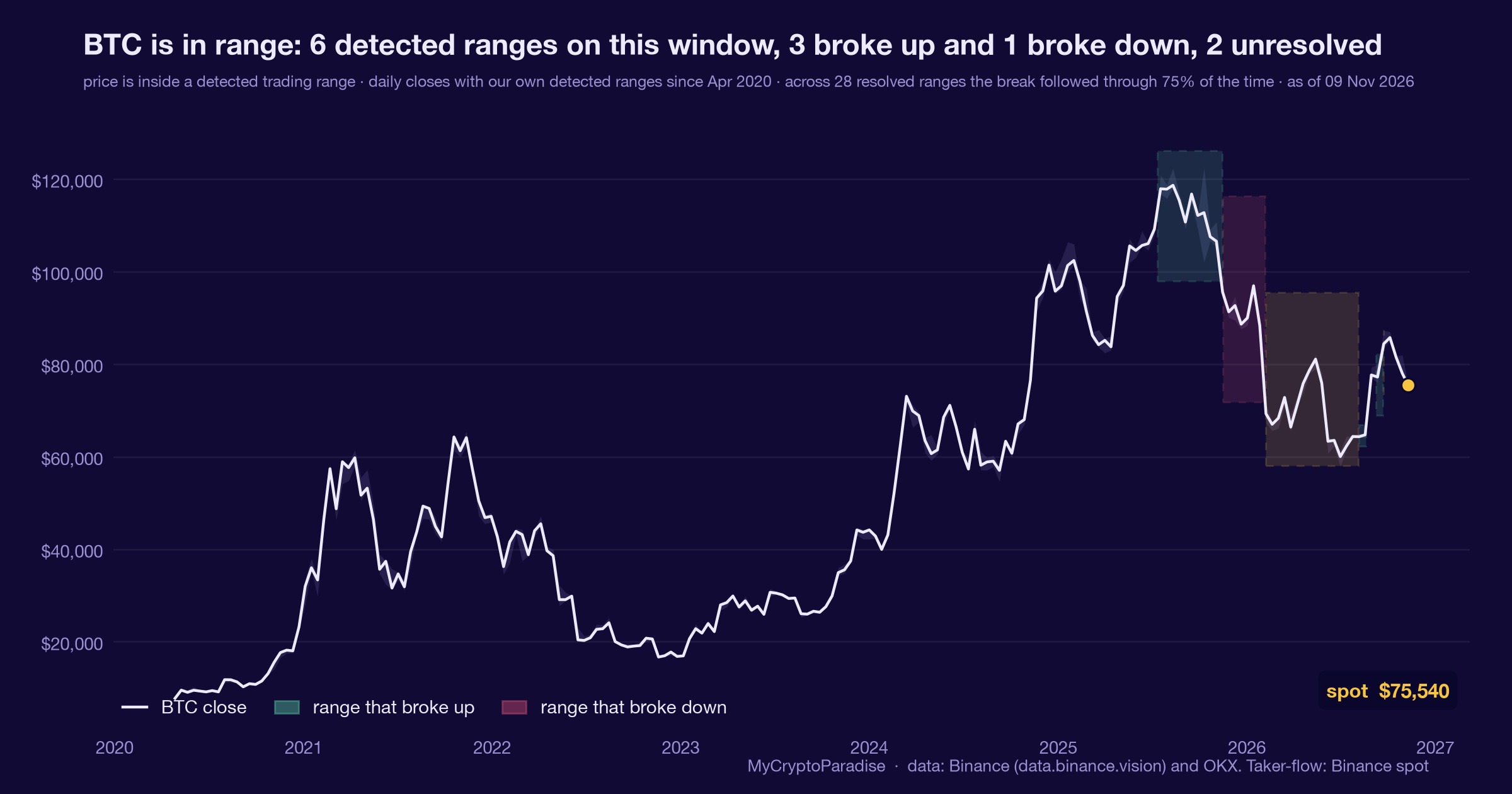
Market briefing: Crypto's quantum Q-Day is back in the conversation, the unannounced day encryption could break. No date, no warning. BTC sits near $80,795, down about 1% on the day, and markets are barely reacting.
- Q-Day is the unannounced day quantum computers could break deployed crypto encryption.
- It is a long-term, theoretical risk, not a same-day market catalyst.
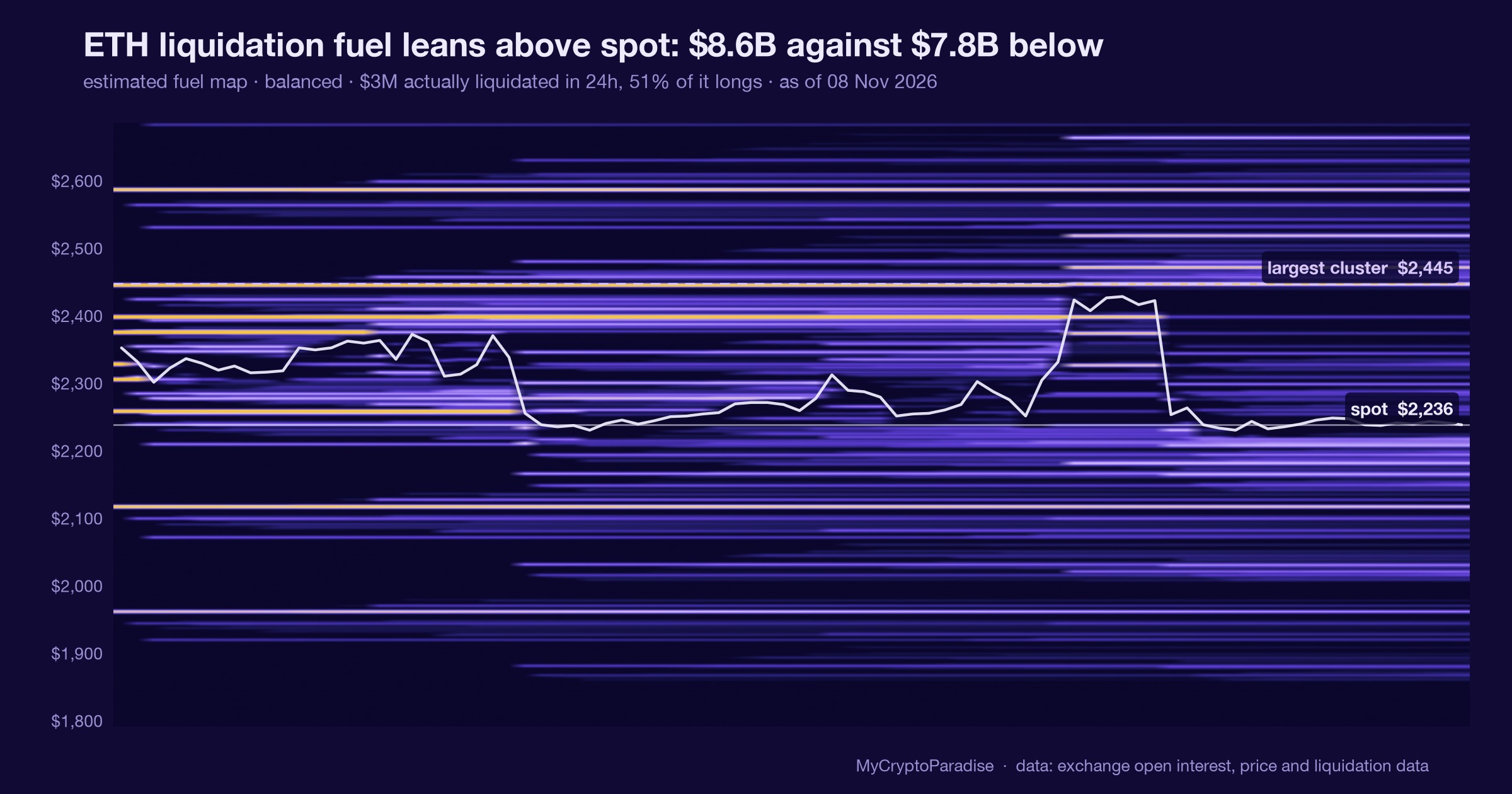
- BTC traded near $80,795 and ETH near $2,377, both down roughly 1% on the day.
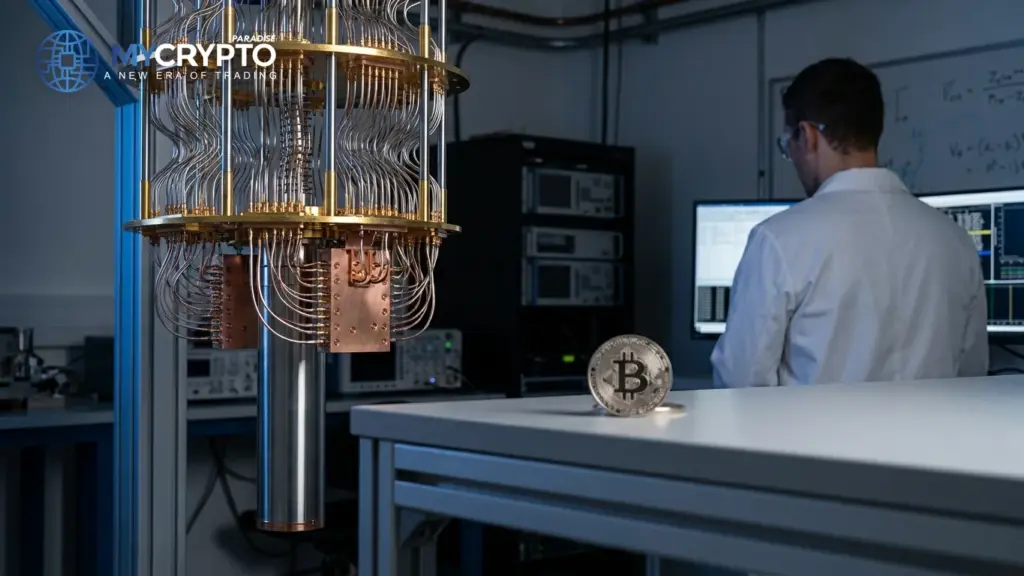
A post-quantum project just reminded crypto that Q-Day arrives with no countdown and no warning. So how do you prepare for a quantum threat that refuses to tell you when?
A post-quantum chain project pushed an old fear back in front of traders. It framed Q-Day as something no one gets to circle on a calendar. Y2K had a date. Quantum breakage does not.
The warning leans on a cryptography lead at a research group. The idea is simple and uncomfortable. Q-Day is the moment an adversary can quietly break encryption that is already live. No countdown, no press release, just a capability held by someone with every reason to stay silent.
That is exactly what makes it hard to prepare for. A dated threat lets you plan backward from the deadline.
An undated one is different. It asks you to spend money now against a risk you cannot watch approaching. The underlying math rests on a problem first attacked by an algorithm from 1994. For three decades that threat has stayed firmly theoretical.
The industry has spent those decades agreeing the risk is serious. It has spent considerably less time acting like it.
Markets treated the reminder as exactly that. BTC traded near $80,795, down about 1% on the day. ETH sat near $2,377, off a similar amount. No urgency, no rush for the exits.
Why a quantum threat hits crypto's foundation
Q-Day matters because the threat sits at the base of the stack, not the top. It does not target a price, a product, or a single chain. It targets the signatures and keys that make ownership mean anything in crypto.
That makes it a tail risk, not a liquidity event. There is no rate decision here, no fund flow, no supply unlock. The transmission runs through confidence, slowly, rather than through order books today.
A theoretical future does not move collateral around. A demonstrated capability would.
The honest framing is that nothing changed structurally this week. The story is a reminder, not a catalyst. Our read is interpretive, because the brief shows no single confirmed event forcing the minor dips in BTC and ETH.
Preparation is the real subject of a quantum Q-Day. Migrating cryptography is slow, coordinated, and expensive. An unannounced deadline removes the one thing that usually forces that kind of work, a date. So the weight of Q-Day is long-term and strategic. It belongs in how projects plan their defenses, not in how you size a position this week.
How little the Q-Day reminder moved prices
The immediate market impact of this reminder is close to nothing, and that is the point. BTC drifted near $80,795, down roughly 1%. The move is small, routine, and hard to pin on a quantum headline.
Trace the usual chain and it runs dry fast. Driver, a theoretical security threat. Macro effect, none today. Liquidity effect, none we can see. BTC, ETH, and alts all slipped slightly, most likely for reasons unrelated to Q-Day.
ETH near $2,377 told the same story, off about 1%. Alts followed the majors without any extra fear premium. If traders genuinely priced an existential break, you would not see a quiet 1% drift.
Panic leaves fingerprints. This left none.
There is no sign of smart money accumulating or distributing on this specific story. The flows we track are responding to structure and macro, not to a quantum reminder. Social sentiment sat mixed, which is roughly what indifference looks like.
So we read the event as neutral for price over days to weeks. It shifts the long-term risk conversation. It does not shift the near-term liquidity picture.
Signs the quantum risk turns real
Watch for the moment theory turns concrete, because that is what would change the read. A credible demonstration of breaking deployed encryption would reprice risk fast. Until then, Q-Day stays a slow-burning concern.
Migration timelines are the real signal. If major protocols publish and fund post-quantum upgrades, that confirms the threat is being taken seriously. Quiet governance posts matter more here than price candles.
On the chart, separate noise from story. The current dips in BTC and ETH carry no quantum signature. Treat them as ordinary tape unless a hard catalyst attaches.
Invalidation is simple. Any sharp, security-driven selloff would tell us the market finally woke to the risk.
Confirmation that nothing has changed is just as useful. Mixed sentiment, minor moves, and no flow shift all say the same thing. The crowd has filed Q-Day under later. So the practical watch list stays narrow. Demonstrations, migration announcements, and any genuine volatility that ties back to security rather than macro.
What Q-Day changes for current positioning
The ParadiseTeam treats Q-Day as context, not a trigger. It changes none of the levels that actually matter right now. With BTC near $80,795, the structure in play is the same one we carried into this week.
That structure sits on the $80,000 to $81,000 support band, the 0.618 retracement. $79,000 is the line underneath it. Hold those and the short-term bid stays intact. Lose $79,000 as support and the higher-timeframe caution gets louder.
Overhead, $85,300 and $90,000 are the levels we respect. Our standing bias is patient here. Strength into that resistance can still meet sellers, especially while the broader map points lower.
On this story specifically, the smart-money read is boring, and that is informative. Whales are absorbing retail selling at support for reasons that have nothing to do with quantum computing. A small majority of tracked smart money has been buying over the past day.
Q-Day does not sit in that decision. It sits in the ten-year one. So anchor to the levels, not the headline. The ParadiseTeam files this under long-term risk to monitor, while the near-term map stays the $79,000 to $90,000 range.
The read behind this: we framed this story through our own market analysis, Can Bitcoin Still Make a Higher High?
Track it live: our Crypto Fear and Greed Index and the live crypto funding rates both update in real time, so you can watch this shift for yourself.
Related coverage
For exact entries, targets, and stop losses with full risk management, that is what ParadiseFamilyVIP is for. New to reading these moves? Start with our crypto trading strategies guide.
ParadiseTeam is monitoring the market situation closely, and we are taking these developments into consideration while building our trading tactics inside ParadiseFamilyVIP.
Crypto trading involves substantial risk. Prices are volatile and you can lose money. This article is educational and is not financial advice. Past performance does not guarantee future results.
When does quantum risk start moving crypto prices?
How 18 Paradisers are calling it
The first call is still open
Free account, no password. Members just sign in.






Join the discussion 7
quantum security is like when i first looked at correspondent banking SWIFT messages always thinking how long they took to settle cross-border
That's an interesting parallel, Mei Lin. It makes me wonder if the concern about "how long" also applies to how much resources a quantum attack might take, not just the time.
I appreciate the long-term perspective here; it reinforces my practice of revisiting the whitepaper periodically, especially when new tech like this emerges.
100% Priya! 💯 Re-reading those whitepapers always reminds me to check for recent audits too, especially with new tech. 👀 Good for discipline! 🧘♂️
I dunno, the part where they say markets barely moved feels a little… dismissive? 🤔 Like, did they check all the small caps too? 🧐 I always notice little wiggles even on Q-Day. ⬆️⬇️
quantum security threads like these always make me think of the early days, with all those "secured" smart contract projects that turned out to be anything but. a healthy dose of paranoia is good! 🤔
Yeah, like those 'totally audited' contracts that still had exit doors for devs 🤦♂️. Makes you wonder about the supply chain for the hardware too, eh? 🤔🔌