

In short
The spot premium measures whether US-dollar spot buyers or offshore stablecoin buyers are setting the Ethereum price. On 26 October 2026 that gap sat at minus 0.019 percent, and across 13 graded sessions since 8 October our data shows US venues led the price in zero of them. An initial coin offering (ICO) holder sold 7,000 ETH for $16.8 million that day, and the feed framed a 774,000 percent gain as the headline. No calibrated base rate is wired here, so we quote no historical frequency. We read the sale as one distribution print on a tape already leaning that way: our 24-hour whale net flow was minus $30.84 million. We called it cautious, and we refused to call a top from one wallet’s exit. This piece shows you how to read the spot premium yourself.
Key facts
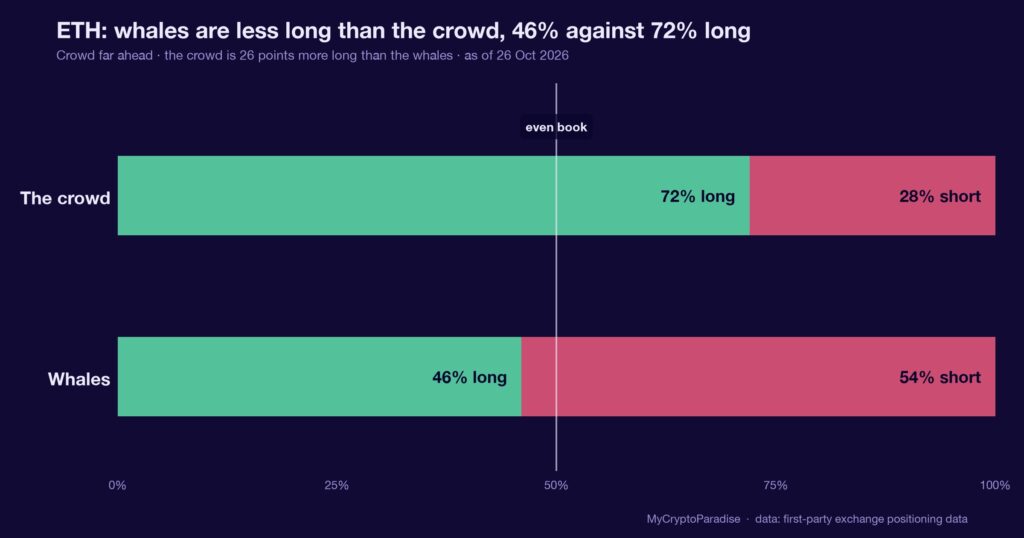
- Whale long share on ETH
- 46%
- Crowd long share on ETH
- 72%
- Crowd minus whales, long share
- +26 points
- Positioning read
- Crowd far ahead
- What would prove this read wrong
- A single US-led spot-premium session ending the three-session offshore run, or our 24-hour whale net flow flipping back to net buying.
- Reading taken
- 26 October 2026
- Source
- Our MCP Insights tools, from our own MCP Insights first-party data
One wallet’s exit is a cash event, not a verdict
A single large sale moves one wallet’s balance. It does not, on its own, tell you where price goes next, because direction is set by whether other buyers step in to absorb that supply or step back and let it fall.
The tape that absorbs a sale is readable. The spot premium measures it directly: it compares the price on US-dollar venues against the price on offshore stablecoin venues, and the sign of that gap says which side of the world is paying up to own the coin right now.
A holder realizing a gain tells you about that holder. The bids waiting underneath tell you about the market, and only one of those two is tradable.
The 26 October tape was already distributing
Per our MCP Insights spot-premium data, Ethereum traded at $2,302.22 on US-dollar spot against $2,306.49 offshore on 26 October 2026, a premium of minus 0.019 percent. Across 13 graded sessions since 8 October, US venues led the price in zero of them, and the current offshore run stands at three sessions.
Our own whale radar logged a 24-hour Ethereum net flow of minus $30.84 million: $4.03 million bought against $34.87 million sold across four orders, lean distribution. The largest single order was a $13.4 million sell on a perpetual, timed at 02:57 UTC.
Positioning backs the lean. The crowd sits 72 percent long against whales at 46 percent, a 26-point gap that has run on the crowd’s side for 35 days, while funding pays longs 8.45 percent annualized.
Four readings, one direction. That is not proof, but it is a tape that was selling before the ICO wallet ever pressed the button.
The 774,000 percent gain tells you nothing tradable
The feed led with a 774,000 percent gain, and the number is real: 100,000 ETH bought near $0.31 in the initial coin offering, a sliver sold eight years later. It is also irrelevant to direction.
This was not forced selling. No margin call, no liquidation, no redemption pressure: a long-term holder chose to realize 7 percent of a position, which is the most ordinary thing a wallet that size can do.
Forced flow sets a floor or a ceiling because someone must transact at any price. Chosen flow does not, because the seller can wait. The size of a gain measures patience, not conviction about tomorrow.
A percentage that large is a headline. The bids that met it are the only part of the story a trader can use.
What is different here
The ParadiseTeam does not repeat a feed’s headline before checking our own tape. Where the source saw a 774,000 percent gain, we read the spot premium, the whale radar and positioning, and only called the lean once all three pointed the same way, with an invalidation attached.
One layer that agrees with the rest today
On its own the spot premium says little: a minus 0.019 percent gap is thin, and one soft session is noise. Stacked against the whale tape and positioning, it stops being noise and becomes a theme.
This is one input. It sits alongside our whale-flow radar, crowd-versus-whale positioning and funding, and today all four lean the same way, which is exactly when a single reading earns the right to raise its weight.
The honest caveat is the sample. No calibrated base rate is wired for this event, so we attach no historical frequency: the zero-of-13 session count is a description of this month, not a probability about the next move.
Four gauges pointing one way is a lean, not a level. It is worth one line of risk and one line that cancels it.
Reading the spot premium yourself, step by step
- Open the spot premium gauge and read the current gap between US-dollar spot and offshore stablecoin spot for the coin.
- Check the session record: count how many of the recent graded sessions the US venue actually led the price.
- Cross the premium against the 24-hour whale net flow, so demand and supply are read on the same clock.
- Add positioning: compare the crowd long share against the whale long share, and note how long the gap has run.
- Write the invalidation before acting: the single session or flow flip that would cancel the lean you just built.
Most readers check the premium and stop. The step they skip is the session record: one soft print is noise, but zero US-led sessions in 13 is a regime.
Every number above is checkable against the live data. Start with the MCP Insights hub, then cross-read the Crypto Fear and Greed Index and the live crypto funding rates.
Act and invalidate
| Scenario | What confirms it | What kills it |
|---|---|---|
| US demand stays absent | Offshore keeps leading sessions | A US-led session prints |
| Whales keep distributing | 24h net flow stays negative | Net flow flips to buying |
| Crowd stays over-long | 72 percent long holds above whales | Gap closes toward whale share |
Posture: Cautious and patient while US demand is absent and the whale tape is distributing. The highest-probability stance for most is a smaller book, not a new position, until a US-led session or a flow flip clears the lean.
Frequently asked questions
Does a 774,000 percent gain predict a market top?
No. The gain describes one holder’s patience since the initial coin offering, not the market’s direction. A sale becomes meaningful only through the tape that absorbs it, which on 26 October 2026 was already leaning toward distribution on our own radar.
What does the ETH spot premium actually measure?
It compares Ethereum’s price on US-dollar spot venues against offshore stablecoin venues. A negative premium means US buyers are paying less, so offshore flow is setting the price. On 26 October it read minus 0.019 percent.
Why avoid quoting a historical hit rate here?
Our calibrated base-rate lake is not wired for this event class yet. Quoting a frequency we cannot measure would be decoration, not evidence. The zero-of-13 session count describes this month only, and we present it as exactly that.
Was this whale forced to sell the 7,000 ETH?
No. There was no liquidation, margin call or redemption behind it. A long-term holder chose to realize about 7 percent of a position bought near $0.31. Chosen flow sets no floor or ceiling, because the seller can simply wait.
What would flip this cautious read to constructive?
A single US-led session ending the three-session offshore run, or our 24-hour whale net flow turning positive while the crowd-versus-whale gap closes. Any one of those would tell us demand is stepping back in to absorb supply.
Crypto trading involves substantial risk and is not suitable for everyone. Nothing here is financial advice; it is education only. Never risk more than you can afford to lose.
The private Extras feed, where the spot premium, whale-flow tape and crowd positioning reads update intraday with their invalidation levels attached, is part of PRO Paradiser, the intelligence layer behind the ParadiseFamilyVIP strategies.








Join the discussion 2
So teh whales just dump when we're asleep eh? 😴 Always teh same craic! 🙄 What's teh average USD spot premium looking like now?? 📉
always the way it seems, but a slow monthy buy always wins out. 💸 It certainly got me back on track after covid. 🤷♂️