

In short
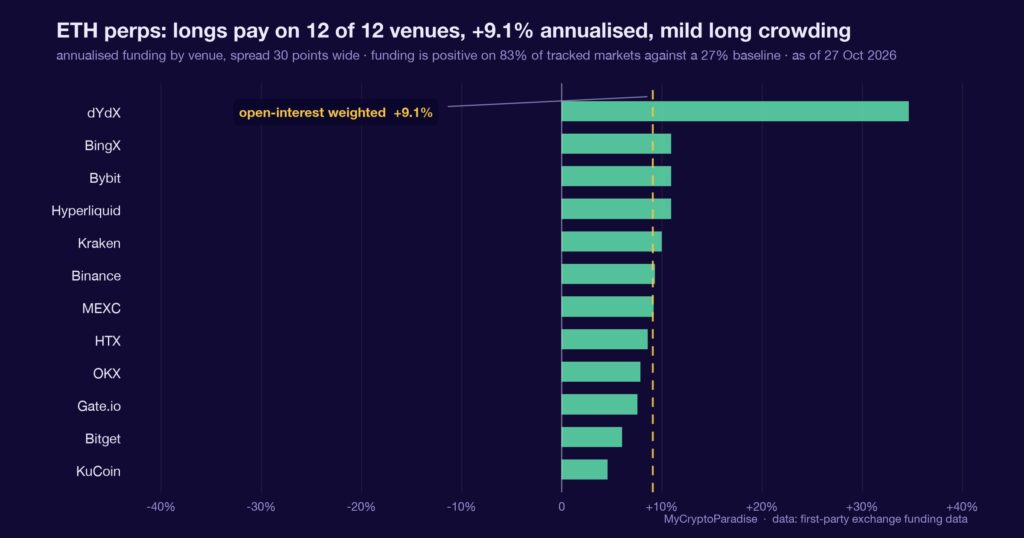
Funding is the fee perpetual-futures traders pay each other to hold a position: when it is positive, longs pay shorts, and the longer you stay long the more that carry costs you. On 27 October 2026, the on-chain feed flagged a single wallet holding a 30,282 ETH long on Hyperliquid, about $71.17 million in notional with $6.54 million in unrealized gain. Per our MCP Insights funding data, ETH funding sits at 9.11 percent annualized, which our tape labels mild long crowding, and 83 percent of tracked markets fund positive. We read that as the crowd already leaning long and paying for it; we did not call it a squeeze setup, and we quote no historical frequency because no calibrated base rate is wired for this event. One wallet does not move that tape. This piece shows you how to read funding carry yourself, so a headline position becomes a number you can check.
Key facts
- Funding on ETH perpetuals
- +9.11% annualised, open interest weighted
- Positioning regime
- mild long crowding
- Markets where longs are paying
- 83% of those we track
- ETH price at the reading
- $2,343
- Open interest behind it
- $17.71B
- What would prove this read wrong
- ETH funding accelerating well past 9.11 percent annualized into a genuinely stretched regime, or funding flipping negative so shorts begin paying longs: either would end the mild-long-crowding read.
- Reading taken
- 27 October 2026
- Source
- Our MCP Insights tools, from our own MCP Insights first-party data
Positive funding is a cost, not a verdict
A perpetual futures contract has no expiry, so an exchange uses a recurring funding payment to tether its price to spot. When more traders want to be long than short, longs pay shorts a periodic fee, and that fee grows with the imbalance.
That fee is carry. It is the rent on conviction: you can be right about direction and still bleed a few percent a year to hold the position while you wait for it to work.
So funding does not tell you where price goes. It tells you how crowded one side already is, and who is paying to stay there.
The whale long sits on the crowded side
On 27 October 2026, the on-chain feed reported a single wallet, the one investigators tie to last year’s roughly $40 million UXLINK theft, running a 30,282 ETH long on Hyperliquid. The feed marks it near $71.17 million, with $6.54 million in unrealized gain against an average entry of $2,134.45.
The wallet is not reckless. It consolidated about 11.55 million USDC (a dollar-pegged stablecoin) from several sources, began trading ETH in early August, and the feed counts five of its six trades as profitable.
Now set that against the tape. Per our MCP Insights funding data, ETH funding sits at 9.11 percent annualized, a touch above BTC at 9.06 percent, and our grid labels both mild long crowding. Breadth is wide: 83 percent of tracked markets fund positive, at a median 8.59 percent annualized.
The wallet is long. So is most of the market. It is paying the same carry as every other long, famous entry price or not.
What is different here
The ParadiseTeam does not read a whale wallet as a buy-the-same-thing tell. We price the carry it pays and set it against the whole funding tape, so a visible position becomes a measured cost and a crowding read, not a screenshot to follow blindly into the same trade.
A famous entry price proves nothing here
The temptation is to treat a profitable whale as a tell: this wallet is up $6.54 million and long, so follow it. That reasoning fails twice over.
First, the carry runs the other way. At 9.11 percent annualized, holding 30,282 ETH long costs real money every funding interval, and the unrealized gain is a snapshot that funding quietly erodes while the position sits open.
Second, one wallet is one data point in a 2,227-market universe. Its direction is already the crowd’s direction, so it adds conviction to a side that is not short of it.
A position you can see on a block explorer is a story. The funding it pays is the only part of it that sizes anyone’s risk.
Mild crowding is a lean, not a squeeze
So where does that leave the read. Funding is positive and broad, but mild: 9.11 percent annualized is crowding, not euphoria, and far from the tape’s extremes, where XMR longs pay about 39 percent annualized and QNT shorts pay about 32 percent.
That matters for direction. A mildly crowded long side has little fresh short fuel to squeeze upward, and it leaves longs, this wallet included, exposed if price slips and the crowd unwinds together.
Funding is one input. It sits alongside open interest, spot absorption and the liquidation map, and today it simply says the long side is positioned and paying, not stretched to breaking.
The probability shifted toward a crowded, patient long side; it did not resolve. Mild crowding is a lean worth one line of risk, not a level.
What we cannot claim, and why that matters
Be clear about the gap. No calibrated base rate is wired for funding-crowding regimes in our lake yet, so we quote no historical frequency on how such setups have resolved. A number with no error bar is decoration, not evidence.
What we can say is measured and present-tense: the long side is crowded at 9.11 percent annualized, broadly, and a single celebrated wallet is sitting on it like everyone else. That is an observation about where positioning is, not a forecast of where price goes.
The honest edge here is small and precise. We can tell you the crowd is long and paying; we cannot yet tell you how often that has paid off, so we size it as a lean and nothing more.
Reading funding carry yourself, step by step
- Open our live funding rates tool and find ETH, then read whether the rate is positive (longs pay) or negative (shorts pay).
- Convert the number to annualized percent so a tiny interval fee becomes a yearly carry cost you can actually weigh.
- Check breadth: see how many tracked markets fund positive, because one hot coin and a hot whole market mean different things.
- Compare the coin against the tape’s extremes, so you know whether its crowding is mild or genuinely stretched.
- Hold it next to open interest and price, because funding alone names the crowd, not where price goes next.
Most people read the raw funding number and stop. Annualizing it is the step they skip, and it is the one that turns a trivial-looking fee into a real carry cost.
Every number above is checkable against the live data. Start with the live crypto funding rates, then cross-read the MCP Insights hub and the Crypto Fear and Greed Index.
Act and invalidate
| Scenario | What confirms it | What kills it |
|---|---|---|
| Crowded long holds | Funding stays mild near 9% annualized | Funding spikes toward the tape’s extremes |
| Long side unwinds | Price slips, longs cut together | Funding flips negative, shorts pay |
| Whale exits quietly | On-chain feed shows the long closing | Position grows, carry keeps accruing |
Posture: Carry favors patience over chasing a crowded long. The highest-probability stance here is defensive and small: let the funding tape, not a famous wallet, size the risk, and stand aside if breadth tips toward euphoria.
Frequently asked questions
What is a crypto funding rate?
It is a periodic fee that perpetual-futures traders pay each other to keep the contract tied to spot. When it is positive, long holders pay short holders; when negative, shorts pay longs. The size reflects how lopsided positioning has become.
Does a whale long mean ETH goes up?
No. One wallet is a single data point in a universe of more than two thousand markets, and its direction already matches the crowd’s. Funding, not a visible position, tells you how crowded that side is and what it costs to stay.
What does mild long crowding mean?
It is our label for positive funding that leans long without stretching to an extreme. On 27 October 2026, ETH funding read 9.11 percent annualized, well below the tape’s hottest names. It describes a crowd that is positioned but not yet forced.
How does funding erode an unrealized gain?
A long position with positive funding pays a fee every interval, regardless of price. That cost accrues against the holder continuously, so a snapshot gain of $6.54 million shrinks a little each funding window unless price keeps climbing faster than the carry drains it.
Why does funding breadth matter?
Breadth tells you whether crowding is isolated or market-wide. With 83 percent of tracked markets funding positive on 27 October 2026, the long lean is broad rather than one hot coin, which makes a synchronized unwind a bigger risk than an isolated squeeze.
Crypto trading involves substantial risk and is not suitable for everyone. Nothing here is financial advice; it is education only. Never risk more than you can afford to lose.
The private Extras feed, where the ETH funding read, market-wide breadth and the carry on crowded longs update intraday, is part of PRO Paradiser, the intelligence layer behind the ParadiseFamilyVIP strategies.






Join the discussion
No comments yet. Members, share how you are reading this.