

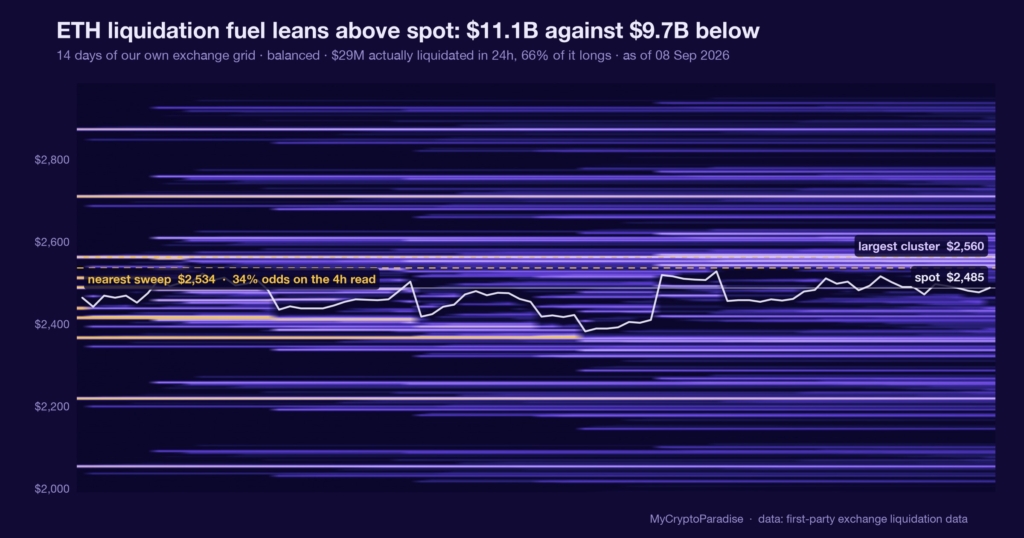
In short
A liquidation level is the price at which an exchange force-closes a leveraged position to protect the lender: cross it, and the position is sold into the market whether the trader consents or not. On 6 September 2026, our on-chain whale-flow feed flagged a single account opening a 111 million dollar Ether long with a stated liquidation price of 2,176 dollars. We called this neutral, and explicitly not a signal: one account’s stop is a headline, not a map of where the crowd sits. We could not verify either figure against our own first-party liquidation data, so we attribute them to the feed and carry them as unconfirmed. Two days on, nothing in our own data has invalidated that caution. This piece shows you how to read a single liquidation level yourself, and why one position is an anecdote rather than evidence.
Key facts
- ETH spot at the reading
- $2,485
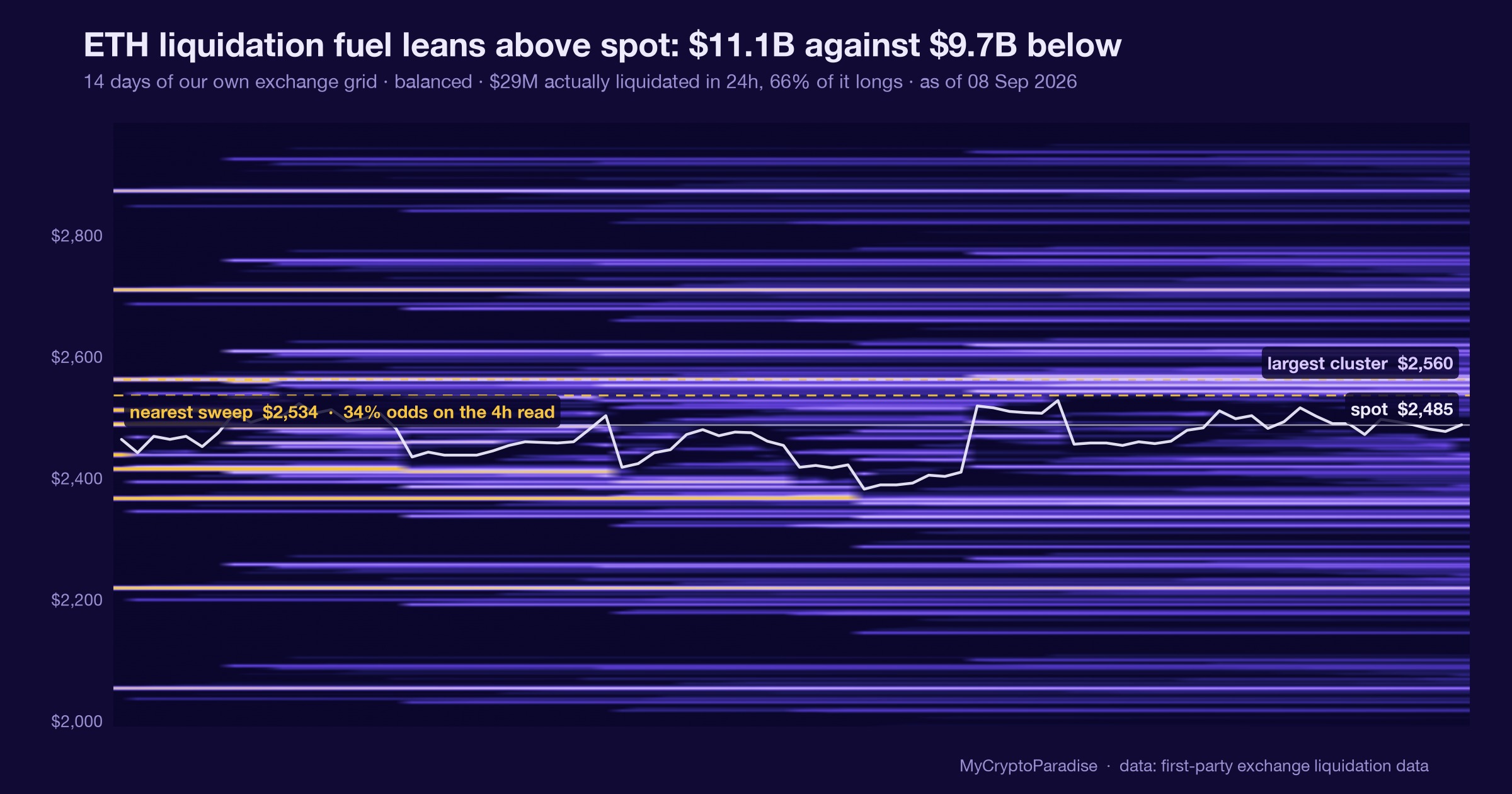
- Estimated ETH liquidation fuel above spot
- $11.12B
- Estimated ETH liquidation fuel below spot
- $9.72B
- Fuel balance
- balanced, +7 points toward the heavier side
- What would prove this read wrong
- A measurable imbalance in aggregate liquidation clusters across venues that clearly favours one side, replacing a single account’s stop with a market-wide asymmetry worth sizing risk against.
- Reading taken
- 08 September 2026
- Source
- Our MCP Insights tools, from first-party exchange data
What a liquidation level actually is
A liquidation level is not a target and not a prediction. It is the price at which the exchange, not the trader, closes a leveraged position because the margin backing it has run out.
The mechanism is mechanical and public. Every venue publishes the maintenance margin it requires, so any leveraged position carries a price at which it is force-sold, and that price is knowable the moment the position opens.
A stop the market can see is a stop the market can aim at. That is the entire reason these levels matter, and it has nothing to do with whether the trader is right.
What the feed actually reported
On 6 September 2026 our on-chain whale-flow feed flagged one account opening a 111 million dollar Ether long, with a stated liquidation price of 2,176 dollars. Per our MCP Insights liquidation data, which draws on first-party exchange data and is marked estimated, we could not independently confirm either figure.
So we hold them as reported, not verified. When a number cannot be checked against our own series, it is attributed to the feed and carried as unconfirmed, because a figure you cannot audit is a claim, not a measurement.
For scale on what we can measure: our MCP Insights squeeze grid carried 687 live grade rows across coins and timeframes on the same reading, none of which turned on this one position.
One account is one account. A feed that reports a single whale is telling you what one trader did, not what the market decided.
What is different here
The ParadiseTeam does not turn a single whale headline into a bias. Where a feed shows one account, we ask where the aggregate liquidation fuel sits across venues, and we mark any figure we cannot verify against our own first-party data as unconfirmed rather than repeating it as fact.
Who has an incentive to hunt a known stop
A visible liquidation level is a magnet, and the reason is structural rather than conspiratorial. Forced selling at a known price is predictable liquidity, and predictable liquidity attracts traders who want to be on the other side of it.
This is not one villain pushing price. It is many participants independently noticing the same undefended stop and positioning for the moment it gives way, which is why clusters, not single accounts, are what move markets.
The incentive to test a stop scales with its size and its visibility. A lone 111 million dollar level is visible but isolated: a dense cluster is where the pressure actually concentrates.
Why one whale is not a signal
The obvious misreading is to treat a large long as a directional vote: someone with 111 million dollars is bullish, therefore be bullish. That inverts how leverage works.
A leveraged long is a borrowed position with a built-in seller. If price falls toward its liquidation level, that same account becomes forced supply, and the size that looked like conviction becomes fuel for the move against it.
This is one input, and a thin one. It sits alongside funding, open interest and aggregate liquidation clusters, and on its own it ranks below all of them.
Size is not the same as information. A big position tells you someone is committed, not that they are correct, and the two are priced very differently.
What has and has not happened since
Two days on, as of 8 September 2026, nothing in our own data has invalidated the caution. The single position is not something we track by account, so we grade the read, not the trade.
The honest scorecard is short because the sample is one. We refused to call a direction from it, and refusing was the correct call: there is no distribution here to reason from, only an anecdote with a dollar sign.
A read that admits it has a sample of one is more useful than a read that pretends one position is a trend. The first sizes your risk at zero: the second invents a bias you did not earn.
Reading a single liquidation level yourself, step by step
- Find the position size and its stated liquidation price, and note whether the figure comes from a feed you can independently verify.
- Locate that liquidation price relative to current spot, so you know how far price must travel before the stop becomes forced supply.
- Ignore the direction of the single position and ask instead where the aggregate liquidation clusters sit on both sides of price.
- Compare the two pockets by size, because the larger resting cluster is the one the market has more incentive to test.
- Set the level that would invalidate your read before you act, and size the whole thing as one input among several.
The step people skip is the second one: a liquidation price means nothing until you measure its distance from spot, because a stop far away is not fuel yet.
Every number above is checkable against the live data. Start with the crypto liquidation heatmap, then cross-read the MCP Insights hub and the Crypto Fear and Greed Index.
Act and invalidate
| Scenario | What confirms it | What kills it |
|---|---|---|
| Whale long holds | Spot stays well above the stop | Price drifts toward 2,176 |
| Position becomes fuel | Price falls toward the stop | Fresh margin lifts the level |
| One position, no signal | Aggregate clusters stay balanced | A real cluster imbalance forms |
Posture: No-trade on this event alone: a single account’s stop is not a reason to add or reduce risk. Wait for an aggregate liquidation imbalance you can measure across venues before it changes your sizing.
Frequently asked questions
What does a liquidation price mean?
It is the price at which an exchange force-closes a leveraged position because its margin is exhausted. The trader does not choose it: the venue does, based on the leverage used and the maintenance margin the exchange requires to keep the position open.
Does a large whale long predict price?
No. A large long shows one account is committed to a direction, not that the direction is correct. Because it is leveraged, that same position becomes forced selling if price falls toward its liquidation level, so size can cut against the trader.
Why did you not verify the figures?
The 111 million dollar size and the 2,176 dollar stop came from an on-chain feed we could not check against our own first-party liquidation data. We report unverified numbers as unconfirmed rather than restating them as measured fact.
Is one whale position a trading signal?
On its own, no. It is a single data point with no distribution behind it, so there is nothing to reason from statistically. It ranks below funding, open interest and aggregate liquidation clusters, which measure the whole market rather than one account.
What would make this read matter more?
A measurable imbalance in aggregate liquidation clusters across venues, rather than one account’s stop. If the resting fuel on one side clearly outweighed the other, that asymmetry would be worth a line of risk, with its own invalidation level attached.
Crypto trading involves substantial risk and is not suitable for everyone. Nothing here is financial advice; it is education only. Never risk more than you can afford to lose.
The private Extras feed, where the liquidation-level read, aggregate fuel map and squeeze grid update intraday with their invalidation levels attached, is part of PRO Paradiser, the intelligence layer behind the ParadiseFamilyVIP strategies.







Join the discussion 1
aye a single liquidation level alright, usually the one that takes your account to zero 📉 after the bookies 🎰 get ya on margin calls 🤦♂️. its a hard lesson to learn that one.