

Listen: the breakdown
Developing story: This story is still unfolding. We are tracking it and will update this article as more details are confirmed.
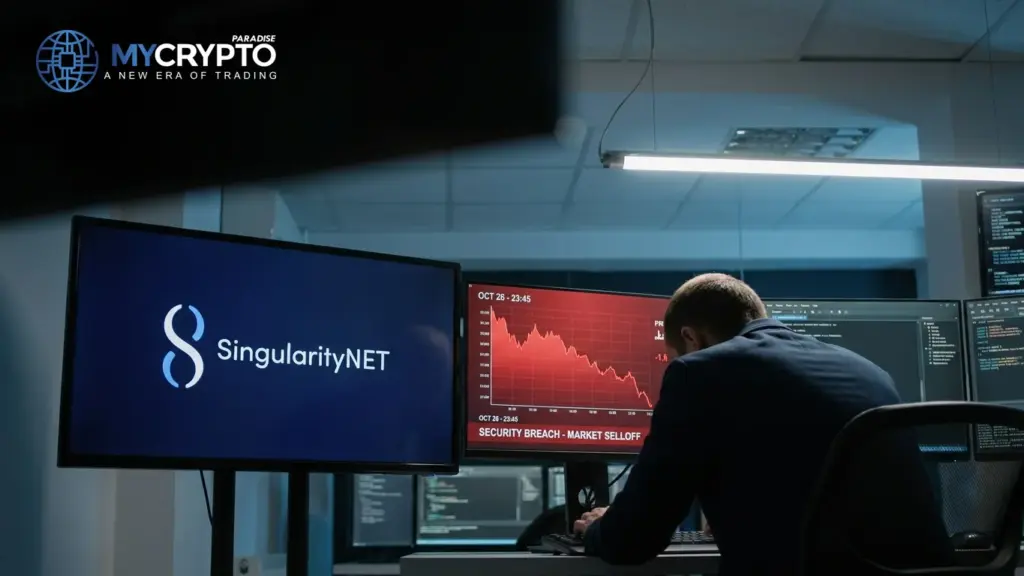
Market briefing: A SingularityNET bridge exploit minted about $16.77 million in AGIX and WMTx on September 20, with roughly $2.2 million already cashed out. Bitcoin traded near $81,341, up 1.2%, largely unmoved by the alt-level wound.
- An attacker exploited the SingularityNET bridge to illicitly mint 260 million AGIX and 53.83 million WMTx, worth about $16.77 million on paper.
- Roughly $2.2 million is already cashed out, and the same attacker is linked to earlier Fetch.ai and NuNet exploits.
- BTC held near $81,341 and ETH near $2,661.88, largely unmoved, keeping the damage local to the alts.
A SingularityNET bridge exploit minted $16.77 million in tokens from nothing, tied to a repeat attacker. But does a project-level breach change anything for the broader market right now?
An attacker turned a flaw in the SingularityNET bridge into a printing press on September 20, 2026. The contract let them mint tokens that no one bought or earned. It produced 260 million AGIX on Ethereum. It also spawned 53.83 million WMTx in the same run.
On paper, the illicit bag swelled to roughly $16.77 million. Around $2.2 million has already been cashed out into real liquidity. The rest sits as a threat hanging over both tokens.
This was not a lone contract failing in isolation. The same attacker is tied to earlier exploits at Fetch.ai and NuNet. The pattern points to a compromised operations key cluster across a shared ecosystem, not one unlucky bridge.
Fetch.ai says the exploit is now contained. An investigation into the root cause is underway. That is the honest state of it: the bleeding is stopped, the diagnosis is not finished.
For traders, the structural lesson matters more than the dollar figure. Bridges hold outsized permissions and thin defenses. When one key cluster falls, every token it can mint becomes suspect. Minting value from nothing is normally a central bank's privilege, not an anonymous address's, and markets price that difference quickly.
Bridge contracts remain the softest target
The driver here is trust in a bridge, and trust just broke. A bridge that can mint tokens is a bridge that can dilute holders without warning. That single fact reprices risk across every project sharing the same infrastructure.
The transmission runs through perception, not just price. Retail sees a $16.77 million headline and files it as someone else's problem. Smart money sees a systemic key compromise and files it as confirmation. Confirmation of what? That the altcoin layer stays fragile while the macro picture stays unresolved.
This is where our read separates from the noise. Our lens shows spot-heavy capital largely distributed and now parked in USDT. It is waiting for a genuine capitulation before absorbing supply again. An exploit like this does not trigger that flush. It simply adds one more reason to stay defensive.
So the exploit changes little about the macro clock. It changes plenty about how much you trust a bridge.
Meanwhile retail keeps chasing short-term strength, with sentiment near extreme highs. That gap, cautious capital sidelined while eager capital buys, is the real story sitting under this hack. The breach does not create the fragility. It exposes what was already there.
Fresh supply meets a stalling market
The direct hit lands on AGIX and WMTx first. A minter holding freshly created supply has one goal: convert paper into stablecoins before the market adjusts. With about $2.2 million already sold, that pressure is live, not theoretical.
WMTx carries the sharper dilution risk. 53.83 million new tokens is real supply overhang against existing holders. AGIX faces the same math at 260 million minted. Thin order books rarely absorb that cleanly.
The second ring is broader altcoin sentiment. Bridge exploits feed a familiar fear: if their infrastructure broke, whose is next? That question alone can drain bids from small caps, regardless of any single project's health.
Bitcoin and Ethereum sit largely outside the blast radius.
BTC traded near $81,341, up about 1.2% on the day. ETH held around $2,661.88, up roughly 3%. Neither move traces to this exploit. Both reflect the same retail-driven strength our lens already flagged, not a reaction to AGIX or WMTx. The cascade, in short, stays local. It bruises two tokens and dents alt confidence, while the majors keep dancing to a different tune.
Contagion signals versus contained damage
The first thing to watch is scope. Fetch.ai calls the exploit contained, but a compromised key cluster is only as contained as its last unaudited permission. Confirmation of a clean, isolated fix would cap the damage. Evidence of further mints would not.
Watch the cash-out pace on-chain. If the attacker keeps converting the remaining paper bag toward stablecoins, AGIX and WMTx face continued supply pressure. A stalled wallet suggests frozen or watched funds instead.
For the broad market, the levels that matter are not on AGIX. They are on BTC. Our lens marks $82,000 to $84,000 as daily resistance. A decisive reclaim with follow-through would tell us retail strength has real legs.
So far, that follow-through is missing.
The deeper signal is capitulation. Our read waits for Net Unrealized Profit and Loss to drop below zero before calling a macro bottom. This exploit does not move that needle. It is a project-level wound, not a market-level flush. Reading it as broad contagion would be the trap. The honest frame: watch bridge headlines for systemic spread, but keep your macro eyes on Bitcoin's resistance, not on one bridge's wreckage.
Reading alt fragility while Bitcoin stalls
The ParadiseTeam frames this exploit as noise against a bearish macro backdrop, not a new driver. Bitcoin was trading near $81,341 as of the latest read, pressing the $82,000 to $84,000 daily resistance our lens tracks. That zone has not been reclaimed with conviction.
Here is who is doing what to whom. Retail is greedy, with sentiment near extreme highs, buying short-term strength into resistance. Smart money, by our read, sits in USDT, waiting for a deeper flush. A bridge exploit feeding alt fear fits that patient, defensive stance perfectly.
The cumulative volume delta, CVD, showed less spot distribution on the last low, a small bullish tell. But price pressing resistance without momentum leans the other way. Bullish action into resistance often marks distribution, not breakout.
For altcoin exposure, the message is caution. This is where capital preservation beats reach. Sizing matters more than conviction when bridges are minting phantom supply. A tight risk-to-reward, R:R, and a clear stop-loss, SL, protect against exactly this kind of surprise dilution.
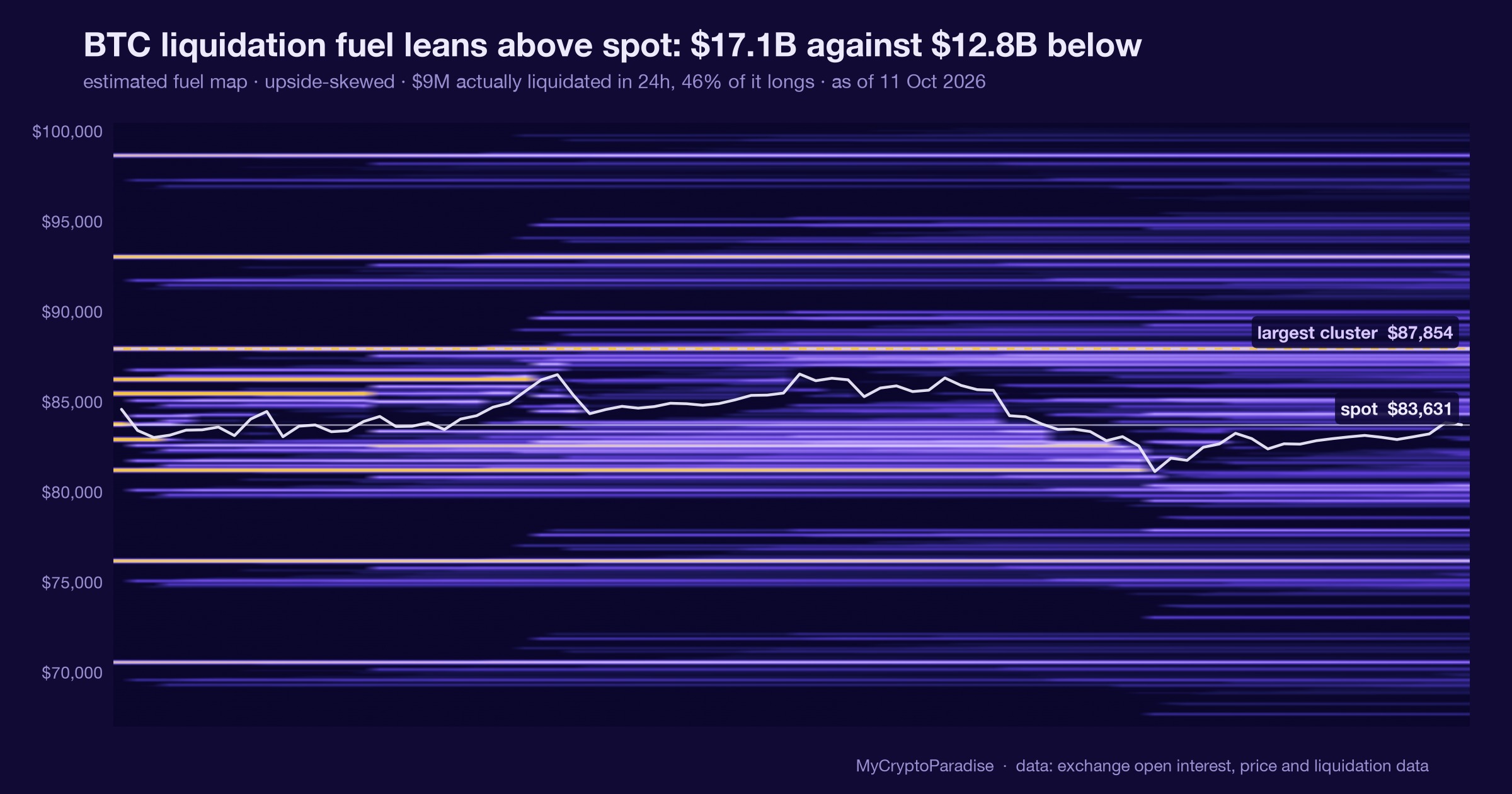
The $83,400 liquidation cluster remains the near-term magnet. Below it, $75,000 is the defended support. Our macro eyes stay on capitulation, not on the next headline.
The read behind this: we framed this story through our own market analysis, Can Bitcoin Break Resistance This Time?
Track it live: our Crypto Fear and Greed Index and the crypto liquidation heatmap both update in real time, so you can watch this shift for yourself.
Related coverage
For exact entries, targets, and stop losses with full risk management, that is what ParadiseFamilyVIP is for. New to reading these moves? Start with our crypto trading strategies guide.
ParadiseTeam is monitoring the market situation closely, and we are taking these developments into consideration while building our trading tactics inside ParadiseFamilyVIP.
Crypto trading involves substantial risk. Prices are volatile and you can lose money. This article is educational and is not financial advice. Past performance does not guarantee future results.
After this exploit, where do AGIX and WMTx go from here?
This is how 21 Paradisers are calling it. Tap your call.
No calls on this one yet. Tap yours to be the first.
Free account, no password. Members just sign in.











Join the discussion 19
These events reinforce the importance of understanding a project's architecture, especially its inter-chain mechanisms, before any capital allocation.
Another exploit, man... 🤦♂️ Makes you extra careful 'bout moving stuff around, even if it's just from my exchange to my wallet ya know? My wife just rolls her eyes when I spend extra time double-checking... 😒
Another bridge hack, jeez. you guys think this means more attention on layer 2s maybe?! starting to feel like that's the only way 🫠
not the only way benny its about self-custody its always about that.
another bridge. article mentions "altcoin risk" but this is really about network security, which is foundational. not some niche altcoin problem.
Altcoin risk?? Bram, this is about basic security, not some excuse to blame the assets 🤦♀️. My money was frozen because of 'bank risk,' so let's be real about foundational issues here 🔥.
The article itself mentioned altcoin risk. Your bank comparison does not hold up. This exploit shows that bridges between different chains introduce critical new vectors for attack. That is a fundamental network security problem.
My bank comparison holds up perfectly, Bram 🤔. Banks freeze funds over 'risk' all the time 🙅♀️. Bridges failing are just another type of operational risk, same as what banks do. Basic security, thats all 👆.
Banks do not introduce new attack vectors when they process a payment. Bridges are fundamentally different; they increase the attack surface. This is a technical vulnerability, not a operational risk.
i always double check which network im on for small transfers like this, even when its just for a commission payment 😅 a bit scary to see this happen to a bigger bridge!
Exactly! Even for a small tip, I'm always checking. What's the downside of these new cross-chain platforms for bigger sums? 😬
another bridge problem, but for a "minting" exploit to yield a specific $16.77M - how do they even quantify that so fast?! feels like a pre-planned exit.
Watching these bridge issues always reminds me that even the most complex systems can have a single weak point... like a small valve in a big engine.
I always trace the token flow after exploits like this to see where the liquidity drain happens. It helps with future risk assessments.
yeah, same, Sofia! seeing where it goes into other pools is key too. always interesting to see the chain of events 🕵️♂️
This is a difficult type of event. I remember the early days, hoping these systems would be robust. The focus on L2s is understandable, but bridge security still needs to be paramount.
yes, these exploits always highlight how critical auditing for these systems is.
it's always liquidity that matters in these moments.. not how many tokens got minted but where the exits are.
Another bridge issue 😬 - all this talk of layer 2s feels a bit like closing the stable door after the horse has bolted for some of these projects, doesn't it? 🤷♂️🤔