

In short
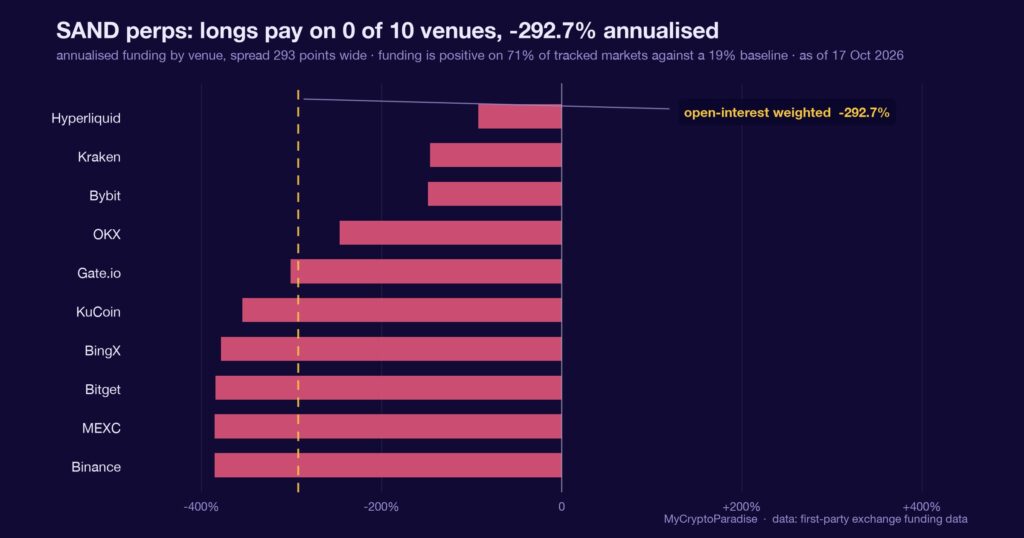
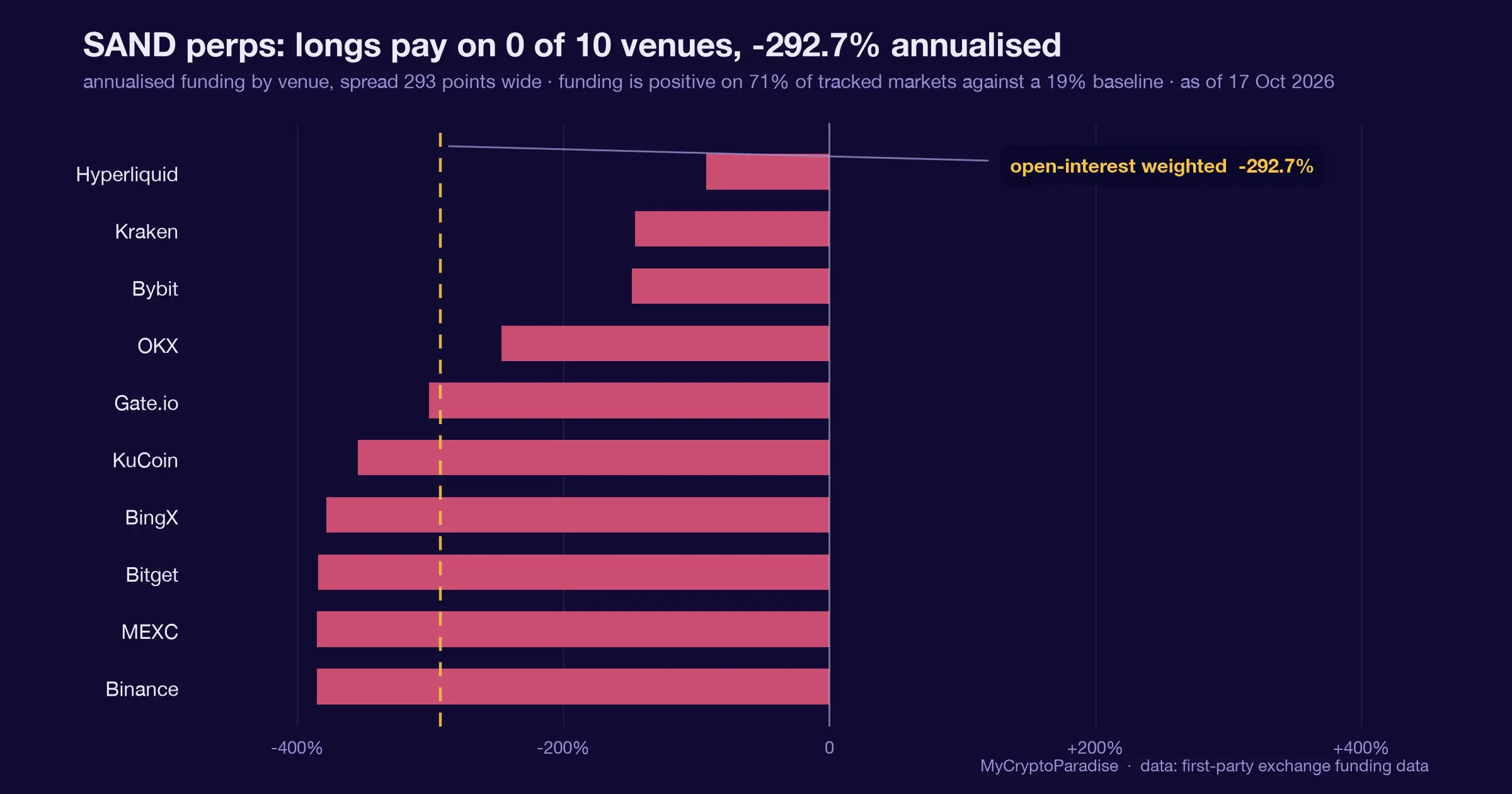
Funding is the recurring payment that keeps a perpetual futures price tied to spot: when it turns deeply negative, shorts are paying longs to hold their positions. On 17 October 2026, our MCP Insights funding reading put SAND at minus 292.7 percent annualized (APR), the most short-paid rate on the tape. That is squeeze fuel, but the direction matters more than the level: two weeks ago, on 2 October, we read the same name at minus 477 percent, so the extreme is cooling. We call this neutral, explicitly not a squeeze trade: a single low-cap name paying heavy funding is one input, not a setup. Around it, funding is positive on 71 percent of tracked markets at a 4.02 percent median, so the crowd leans the other way. This piece shows you how to read a funding extreme yourself, and why a draining one is less of a trap than a loaded one.
Negative funding is shorts paying to stay short
A perpetual futures contract never expires, so an exchange needs a tether to keep its price near spot. That tether is the funding rate: a small payment exchanged between longs and shorts every few hours, set by how far the perpetual trades from the underlying.
When funding is positive, longs pay shorts, and the crowd is leaning long. When it turns negative, shorts pay longs, and the lean has flipped: traders are paying a toll to stay short. A deeply negative rate means that toll has become expensive.
That expense is why extreme negative funding gets called squeeze fuel. A short paying heavily to hold has a reason to cover if price turns against it, and crowded shorts covering at once is how a squeeze feeds itself.
The fuel is the crowd, not the price. A gauge that measures who is paying tells you where the pressure sits, never when it releases.
The extreme is real, and it is cooling
On 17 October 2026, our MCP Insights funding reading put SAND at minus 292.7 percent annualized (APR), the single most short-paid rate across the 2,114 markets we track. Shorts are paying longs a steep toll to stay in the trade.
The level matters less than its path. On 2 October we read the same name at minus 477 percent APR, so over two weeks the extreme has compressed by roughly 184 percentage points. The squeeze fuel is draining, not accumulating.
The rest of the tape leans the opposite way. Per our MCP Insights funding data, the rate is positive on 71 percent of tracked markets at a 4.02 percent median, with Bitcoin at 7.25 percent and Ether at 9.61 percent annualized, both in mild long crowding. The most long-paid name, M, sits at 18.81 percent.
SAND is the lone short-paid extreme on an otherwise mildly long tape. A reading sitting at its extreme tells you less than the same reading on its way back from one.
Heavy short funding is not an entry by itself
The obvious misreading is mechanical: shorts are trapped, so price squeezes up, so this is the entry. Extreme funding has produced plenty of squeezes, and it has also sat extreme for days while price drifted nowhere, because a toll tells you who is uncomfortable, not when they are forced to act.
This is one input. It sits alongside market breadth, open interest (OI) and the squeeze gauge, and today it is the reading that disagrees with all of them: SAND leans short while 71 percent of the market leans long.
A single low-cap name is also thin enough that one position can distort its funding, which is exactly why we weight it as a lean and never as a level.
A funding extreme is a probability weight on a bias, not the bias itself. On its own it sizes risk; it does not pick a direction.
What is different here
The ParadiseTeam does not read a funding extreme as a trade on its own. We track the level, its direction over time and the market breadth around it together, so a lone cooling outlier is weighted as a fading lean rather than a squeeze waiting to happen.
What a draining extreme actually changes
Two weeks ago the same funding extreme was deeper, at minus 477 percent APR, and the honest read then was constructive: that much short crowding is fuel. The fuel has since bled off by roughly 184 percentage points without a violent squeeze, which is itself the update.
A draining extreme is a less loaded trap than a building one. Shorts paying less to stay in are either being proven right or quietly covering in an orderly way, and neither produces the disorderly cover that a squeeze needs. The setup that looked primed on 2 October is simply less primed now.
The probability shifted; it did not resolve. A fading extreme is still an extreme, and it still deserves exactly one line of risk, no more.
Reading a funding extreme yourself, step by step
- Open the live funding rates tool and sort the whole market by annualized rate, most negative first, to find the real extremes.
- Check whether the top name is a major coin or a thin low-cap, because one position can distort funding on a small market.
- Compare today’s reading to the same name a week or two ago, since the direction of the extreme matters more than the level.
- Scan the breadth number: if most markets lean the opposite way, your extreme is a lone outlier, not a market-wide regime.
- Set the invalidation before you act, naming the funding level that would say the crowd is re-crowding rather than unwinding.
Most people skip the second step and treat every funding extreme alike. A stretched rate on a thin alt carries far less signal than the same rate on a major coin.
Every number above is checkable against the live data. Start with the live crypto funding rates, then cross-read the MCP Insights hub and the Crypto Fear and Greed Index.
Act and invalidate
| Scenario | What confirms it | What kills it |
|---|---|---|
| Fuel keeps draining | Funding rises toward the market median | A sharp drop back below minus 400 percent |
| Orderly short unwind | Price stable as funding normalizes | A violent gap up on heavy liquidations |
| Extreme reloads | Funding re-stretches past minus 400 percent | Breadth flips and the whole tape turns short |
Posture: No trade is the highest-probability stance here. A single fading funding extreme on a low-cap name sizes risk at most; it does not open one, and position-takers should wait for breadth to agree.
Frequently asked questions
What does negative funding on SAND mean?
It means short sellers are paying long holders to keep their positions open on SAND perpetual futures. A deeply negative rate, like the minus 292.7 percent annualized we read on 17 October, signals a crowded and expensive short side rather than a healthy one.
Is extreme short funding a reason to go long?
Not on its own. Heavy short funding marks squeeze fuel, but fuel is not ignition, and an extreme can sit for days while price drifts. It is one input that sizes risk; it never decides a direction by itself.
Why does a cooling funding rate matter?
Because the direction of an extreme carries more information than its level. SAND cooled from minus 477 percent on 2 October to minus 292.7 percent now, which means the squeeze fuel is draining and the trap is less loaded than it was.
How is SAND different from the rest of the market?
SAND is a lone outlier. Our funding reading shows 71 percent of tracked markets positive at a 4.02 percent median, with Bitcoin and Ether both mildly long-crowded. SAND is the only name paying shorts this steeply right now.
What would invalidate the draining read?
Funding snapping back below roughly minus 400 percent annualized would say shorts are re-crowding and the fuel is reloading rather than bleeding off. A broad flip to negative funding across the market would change the picture entirely.
Crypto trading involves substantial risk and is not suitable for everyone. Nothing here is financial advice; it is education only. Never risk more than you can afford to lose.
The private Extras feed, where the funding extremes, market breadth and squeeze gauge update intraday with their invalidation levels attached, is part of PRO Paradiser, the intelligence layer behind the ParadiseFamilyVIP strategies.







Join the discussion
No comments yet. Members, share how you are reading this.